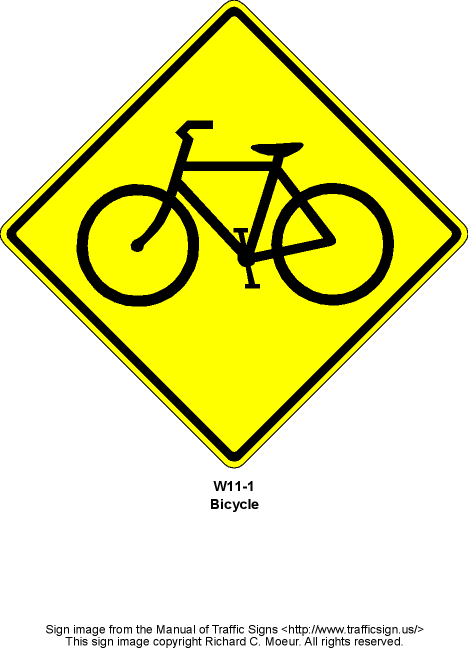
“This anti-bike hysteria must stop”
Clover Moore, the Lord Mayor of Sydney, has some tough words for her city’s anti-bike-lane extremists:
The anti-bike argument is strange when you consider the social and economic benefits. Before we started building the network, we asked AECOM, a Fortune 500 company, to do an economic analysis (PDF) to see if there was benefit in providing bike lanes. It showed huge benefits – delivering at least $506m in net economic benefits over 30 years, roughly equivalent to a $4 return on every dollar spent. Now, compare that to the $2 return delivered by Sydney motorways.
Thousands of people on bikes are thousands who aren’t in their cars or in public transport adding to congestion. There will always be cars traveling to and from the city centre but if tackling our growing congestion problem is not taken seriously, Sydney will be left behind.
In London, the biggest ever census of bike use in the city found that bikes now account for 24% of all road traffic in central London during the morning peak, and on key routes bikes even outnumber all other vehicles.
In May, New York started a bike-hire scheme. Within three days more than 20,000 people had registered and by August, more than two million trips had been made using the scheme.
The NSW government has set an ambitious target of doubling local and district trips by bike by 2016 and the City’s work to build a network of safe, separated cycleways will be essential if they want to meet that target. We expect the hysterical anti-bike ranting to continue for a while longer but as we’ve seen this week, they will increasingly become lone voices drowned out by tens of thousands of happy riders. You can’t stop progress.
Mike Bloomberg has done an admirable job in beating back the tabloid hysteria over bicycles. (His masterful performance at the Citi Bike launch press conference in May comes to mind.) The real question is whether our next mayor can continue to move the city forward while staring down the people who would rather see New York left behind, to use Moore’s words, when it comes to the economic, social, and health benefits of safer streets.
What on Earth!
What would visitors from another planet think if they suddenly visited Earth? They might think that cars were the dominant species. That’s the premise of this 1966 animated short film by Les Drew and Kaj Pindal. From the National Film Board of Canada:
This animated short proposes what many earthlings have long feared – that the automobile has inherited the planet. When life on Earth is portrayed as one long, unending conga-line of cars, a crew of extra-terrestrial visitors understandably assume they are the dominant race. While humans, on the other hand, are merely parasites.
The film was nominated for an Academy Award for Best Animated Short Film. As hard as it is to imagine in today’s media climate, “What on Earth!” was broadcast on ABC here in the U.S. in 1971 as part of a children’s television show produced by Chuck Jones of Bugs Bunny fame.
Hat tip: Gil Meslin.
Against the Grain
Think all salmoning is a product of scofflaw cyclists with little regard for the law? Elly Blue would like you to think again.
Another problem that salmoning can diagnose is bad infrastructure, missing links in the bike network. When you see someone riding the wrong way on a bike, the chances are good that they have chosen this as a crummy alternative to an even crummier series of major roads and horrifying intersections.
I hear about this all the time from people who are deeply embedded in the bike community, who know the laws better than they know their kids’ schedules, who ride dozens of miles every week on city streets doing everything by the book—except maybe there’s one street next to their kids’ daycare they don’t feel safe riding on, so they ride against traffic on a one-way side street to get around it.
Unfortunately in many places, even in some areas of the emerging bicycle cities of the US, people who ride bikes are presented with a series of bad choices—two possible routes, both unsafe. Is it so wrong, when faced with only bad choices, that many of us choose the slightly less stressful route, even if it happens to not be legal?
Pop Quiz
Which victim can expect to see the person responsible for their injuries punished under the law?
This one:

Or this one:

In a civil society this would be a trick question. But this is New York, so everybody already knows the answer.
Quote of the (Primary) Day
Via Alex Pareene in Salon.com:
“People in New York are obviously incredibly receptive to his message, and to his biography. Changing some positions and messages to better reflect the electorate is what politicians are supposed to do in democracies. And de Blasio is not simply offering empty rhetoric: He has made very real proposals, to raise taxes, reform the NYPD, and more. He unveiled a real pedestrian (and bike) safety plan. That’s a concrete plan to address a serious issue. Two hundred and seventy-four people — including 148 pedestrians and 18 bicyclists — were killed by cars in 2012. Thompson’s transportation plan, by the way, is mostly about tolls and parking.“
Work on Fourth Avenue Moving Along

Work on the Fourth Avenue safety improvements are moving along, with crews out at multiple intersections changing the lane markings and enhancing pedestrian islands with thermoplastic and other treatments today. I took these pictures on my way to vote this morning.

Above, a worker lays down a sand treatment at the intersection of Fourth Avenue and Dean Street. Left turns will be banned here, which will make things safer for the many pedestrians crossing Dean on the east side of Fourth and provide a 15-foot refuge for anyone who can’t easily make it across the avenue in time.
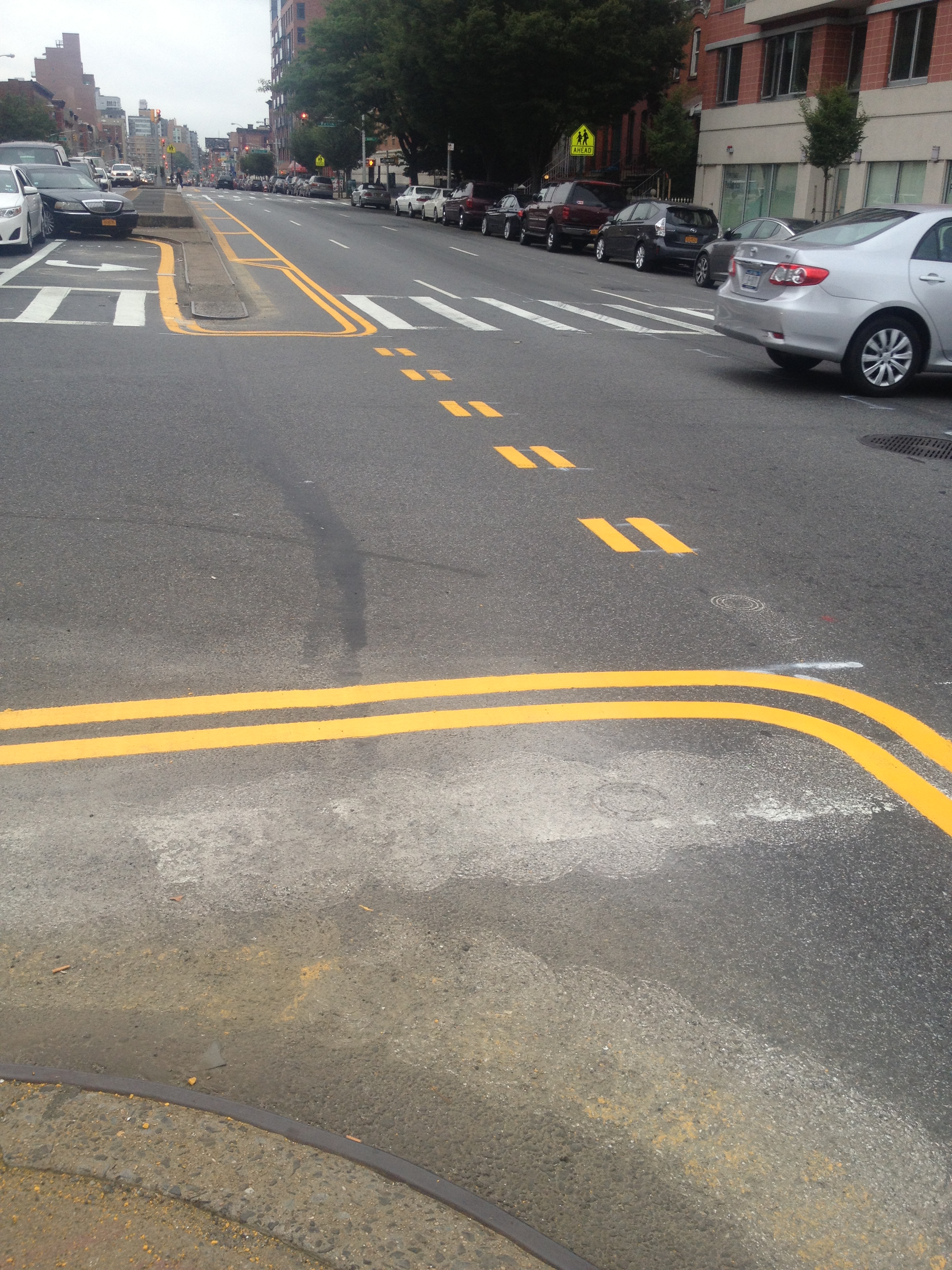
Above, the middle of Warren Street and Fourth Avenue. The yellow stripes in the lower part of the picture will be filled in with a sand treatment to widen the median. Across the way, what used to be a very narrow strip of barely raised concrete is now a wider space for pedestrians. With the median extended out into the intersection by about another foot, here’s hoping drivers will take the left turn from Fourth onto Warren at lower speeds.
More pictures to come as work progresses, but many thanks to the advocates, community board members, neighborhood residents, and elected officials who made this happen.
Enough is Enough
Quick thoughts…
Today’s carnage in Midtown is sickening, but all too predictable. (The fact that the cab driver responsible probably won’t be charged, and that no one is surprised about it, is all the more disgusting.)
If ever there was an incident that encompasses the very things we pedestrians and cyclists experience from aggressive motorists every day, this is it. While there are conflicting reports from various sources, witnesses described a driver who…
- …cut off a cyclist in the bike lane, with or without looking to see if anyone was there, even though it shouldn’t be surprising to find bike messengers or delivery cyclists in Midtown.
- …couldn’t be bothered to wait one second to let the cyclist — who had the legal right of way — proceed straight.
- …violated the crosswalk even though it was full of pedestrians with the walk signal.
- …thought that the proper response to this temporary inconvenience was intense anger, honking, and yelling.
- …believed that being delayed by one second gave him the right to floor it to make up for “lost” time.
And here’s the most important part:
- …did it all with what by now can only be described as the tacit approval of the NYPD, whose failure to enforce even basic laws regarding yielding to other human beings results in this carnage.
When Sharing isn’t Caring
Bike Delaware has asked its state department of transportation to discontinue the use of “Share the Road” signs.
As a traffic control device, motorists and cyclists interpret [Share the Road] in different, and sometimes diametrically opposed, ways. Many motorists see it as an admonition to cyclists not to ride in the center of a travel lane. Many cyclists see it as a message to motorists that, if they are riding in the center of a travel lane for one reason or another, that faster-moving motorists should cautiously and patiently maneuver around them.As a marketing campaign, the phrase’s ambiguity also invites conflicting interpretationss.
Many motorists believe that “sharing” means giving up part of something they believe is rightfully theirs while cyclists tend to think of sharing as referring to a commonly owned asset that belongs to them just as much as it does to motorists. This confusion causes motorists and cyclists to trade pointless and time-wasting accusations back and forth.
As an alternative, Bike Delaware urges DDOT to use either a basic bicycle silhouette sign or the “May Use Full Lane” sign.
“There aren’t any.”
Bicycle Habitat’s Charlie McCorkel, who knows a thing or two about bicycle advocacy, calls out the mayoral candidates for one of their common complaints:
I have been very active in the community regarding bike lanes and bike share. The DOT and neighborhoods collaborated in Community Board meetings, and I cannot picture a longer and more vetted process. Where valid concerns were raised, I saw plans change. It was tedious but purposeful; each street alteration was always vetted through the Community Boards. If you hear one of the candidates raise the spectre of public review of already installed bike lanes, ask them to name one which was installed without Community Board support and approval. There aren’t any.
Promises, Promises
Nicole Gelinas, writing in City and State last week, asked if the 2013 campaign was turning out to be the “Complete-Streets Election.” While the mayoral candidates still tend to dance around the subject of bike lanes–when not trashing them outright– the candidates in my backyard aren’t shy about how important safe streets are this election season.
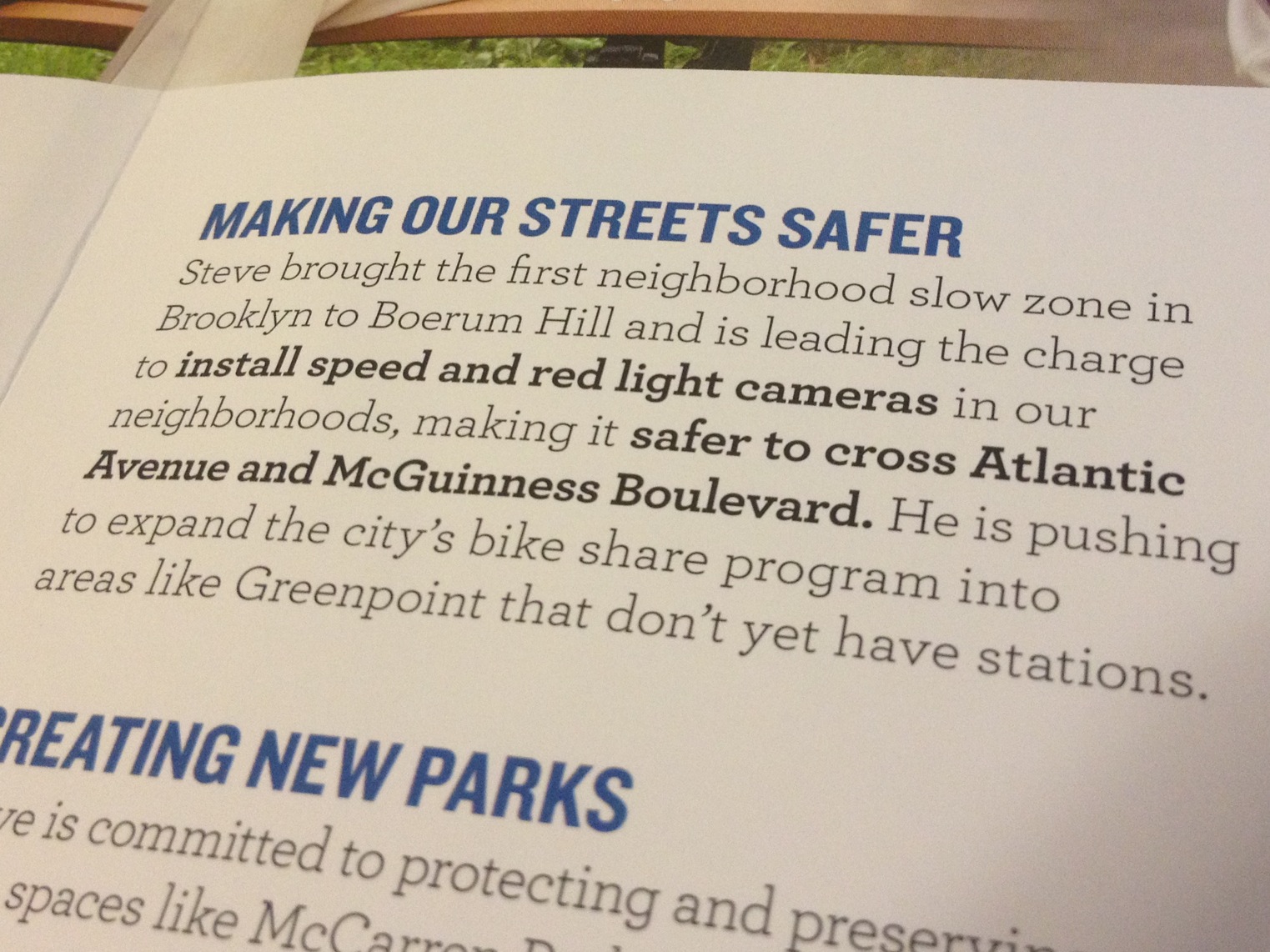
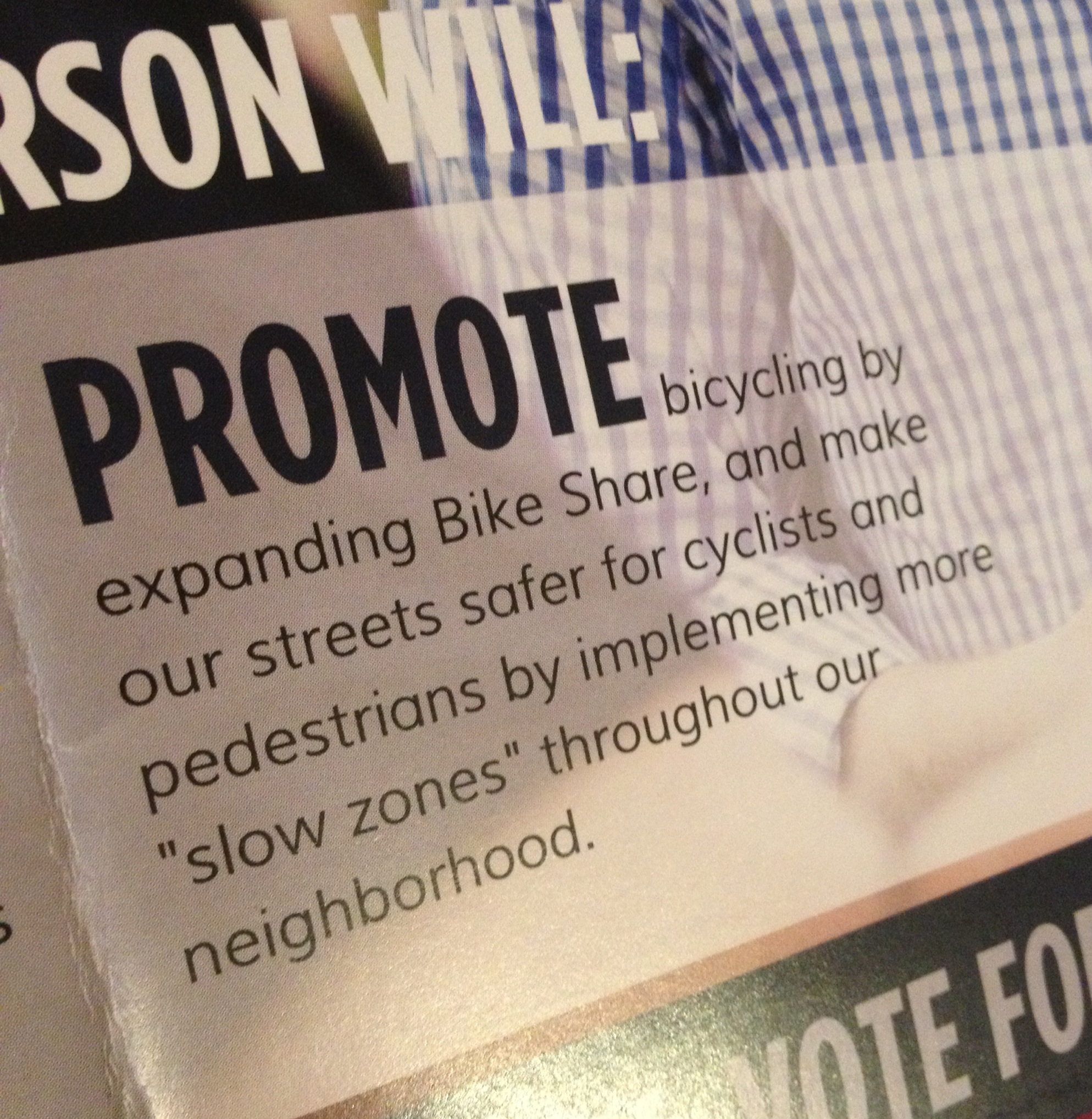
In City Council District 33, incumbent Stephen Levin and challenger Stephen Pierson recently sent out mailings in support of their campaigns, and better streets for cyclists and pedestrians are a big part of each. (Full disclosure: StreetsPAC, on which I serve as a board member, recently endorsed Levin in this race.)
Here’s the relevant part of Levin’s mailing:
Pierson’s mailing also features some livable streets promises:
In 2011, bike lanes were considered the “third rail of New York City politics.” Today, as TA’s Noah Budnick told Gelinas, “No serious candidates is going to run against these things.”
 Brooklyn Spoke