King of the World
Here’s Dutch singer/songwriter Theun Supheer (who performs as Anthony’s Putsch) with a song and video that’s bound to put a smile on your face.
As the first commenter beneath the video on YouTube says, “I wish my childhood was like this. Being shuttled in a car sucks.”
Reader beware
The editors of New York Times have invited readers to participate in a “dialogue” with reader Gary Taustine, who believes that Amsterdam’s so-called bicycle parking problems “portends my worst fears for New York City if Mayor Michael R. Bloomberg’s crusade to promote cycling at any cost is not scaled back by his successor.”
So can anyone who writes a response expect an open and honest dialogue with a man who uses Amsterdam as a cautionary tale? Don’t count on it.
Here’s a letter by Mr. Taustine from News’ “Voice of the People” section, which reads a bit like the first draft of the letter he sent the Times.
Manhattan:Mayor Bloomberg’s bicycle crusade has snarled traffic, made signage more confusing, crosswalks more perilous, parking more scarce and sidewalks more congested — all for a tiny demographic using a vehicle whose practicality wanes in the winter months and on rainy days.
Adding insult to injury, most cyclists treat the lanes and traffic lights as mere suggestions — blowing through reds, snaking in between traffic and even taking to the curb when they wish.
In an effort to retroactively justify his desolate lanes, Bloomberg has introduced the Citi Bike bike share program. That means thousands of inexperienced riders on unfamiliar, poorly maneuverable bikes flooding our streets in the coming months.
It’s a recipe for disaster. In the end, bicycles have the same right to the streets as cars — but have no more right to segregated lanes than scooters or motorcycles. If bikers to want ride in traffic, they should be licensed, insured and made to wear helmets. Gary Taustine
Here’s another letter in which Taustine holds Denis Hamill up as the voice of reason:
Manhattan: Thank you, Denis Hamill, for enumerating a few of the many reasons that Mayor Bloomberg’s bike lanes must go. Pro-bike Voicers have been writing in with ridiculous claims that the lanes keep pedestrians safe and cut down on pollution. Get over yourselves. Bicycling does not make you part of the solution to climate change. Bike lanes slow down traffic, which spews more toxic crud into the air, and they have turned every crossing into a life-and-death game of Frogger for pedestrians. Nobody is trying to deny cyclists a right to share the streets, as they always have, but segregation is not sharing. In an already congested city, narrowing the streets for a few bicycles cannot be justified. My vote for mayor will go to the candidate who vows to wipe every trace of Bloomberg’s legacy out of my city, starting with those infernal bike lanes. Gary Taustine
The beauty of Mr. Taustine’s poorly reasoned screeds is not so much their bike-related hysteria, but that they expose one of the biggest reasons behind New York’s bikelash: an irrational hatred of Mayor Bloomberg.
Manhattan: Mayor Bloomberg is banning large soda containers because sugary drinks are unhealthy and Styrofoam containers because they’re not biodegradable. If we’re going to ban things that make us sick and are impossible to get rid of, can’t we start with Bloomberg himself? Gary Taustine
So did the Times know what it was getting when it enlisted Taustine to hold a “dialogue with readers?” You bet it did. Here’s Taustine exhibiting Rabinowitzian levels of paranoia in a letter to the Times about our collective totalitarian future:
Mayor Michael R. Bloomberg’s effort to promote healthier lifestyles is commendable, but the government has no right whatsoever to go beyond promotion to enforcement. You can’t reduce obesity with smaller cups any more than you can reduce gun violence with smaller bullets.
This proposal sets a very bad, very dangerous precedent. Freedom is rarely taken away in supersize amounts; more typically it is slowly siphoned off drop by drop so people don’t even notice until they’ve lost it entirely.
Mayor Bloomberg has spent his 11 years in office stripping away our freedoms one drop at a time. Minorities are stopped and frisked, Muslims are watched, protesters are silenced, and smokers are taxed and harassed beyond reason.
In their apathy, New Yorkers have given the mayor an inch and he has already taken a mile. If we permit him to regulate portion control without a fight, then we don’t deserve the few freedoms we have left.
GARY TAUSTINE
New York, June 1, 2012
When you’re living in a smoke-free, bicycle-powered totalitarian nightmare and get arrested for possession of a medicine dropper’s worth of Mountain Dew, don’t say Gary Taustine didn’t warn you. So come on, Times editors. Get this man his own web series!
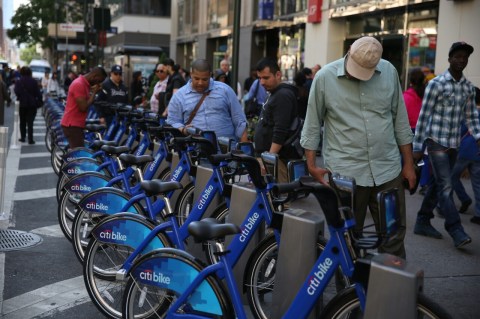
Image via People Looking at Citi Bike
With the launch of New York’s Citi Bike and Chicago’s Divvy Bikes, James Hamblin of The Atlantic declares 2013 “The Summer Bicycles Took Control.”
Some select passages:
The bottom line is that one contentious month since the launch of New York’s program — with riders as bad as they’ll ever be, and the blue paint without any sun-fading to tone down the gaudiness — the actual majority of New Yorkers love the bikes. Numbers released yesterday from Quinnipiac University showed overwhelming approval.
If we made it through this first harried month and most people still don’t hate the bikes, it’s not likely they’re going to start hating them once they’re woven into the city’s cultural identity. When London launched its bike-share program, which is probably the closest one to New York’s, there were similarly vocal Hyde Park detractors. But years later, it’s still alive.
No transport system is perfect, but bike-sharing is promising, and among the best we have. Look forward to more stories from the grand New York experiment, to inform, amuse, and challenge the rest of the country. Young, wild, free: the SoulCycle of the people. On this eve of the 100th Tour de France, we finally celebrate the bicyclization of urban America.
“Instead they threw him in jail.”
This story is somewhat buried at the end of this excellent Bike Snob post, and it shows further proof that the recent NYPD ticket blitz against cyclists has very little to do with safety.
…I recently received an email from a reader who got thrown in jail for riding on the sidewalk. Here are the highlights:
Since my husband Lin and I came home from the hospital with our twin boys, Otis and Max, I’ve tried to sneak out for 20 minutes daily for a bike ride in Prospect Park to get a little exercise and clear my sleep-deprived head. It’s been easy to do, especially with Lin’s parents visiting.
The Prospect Park traffic circle is pretty much a clusterfuck, and evidently the reader did what many people do, which is roll on the sidewalk for a bit in order to get to the park loop. Unfortunately, he also did something I did a zillion times when I lived near Prospect Park, which was duck in for a few laps without carrying ID.
Obviously you’re not supposed to walk on the sidewalk, and while sometimes there’s a good excuse, other times I think if you get ticketed for it then tough shit, them’s the breaks. This, however, is ridiculous:
Without delay, she told me to put my hands behind my back and *handcuffed* me – not the plastic, protest-y kind of handcuffs, but big metal numbers. And then she put me in the car. (Thankfully a local business owner, alarmed at what he’d seen, offered to store my bike until my return, saving me an extra hassle.) While the one who cuffed me was outside on the phone, undoubtedly deciding whether to screw with me or not, I mentioned to the partner that I had two newborns and home and maybe they could verify my identity through the computer, as was readily possible.
No, instead they threw him in jail.
In what world does detaining someone for riding on the sidewalk at a dangerous traffic circle make anyone safer?
Last week, in the midst of what seemed like a fairly large crackdown on cyclists, friend and fellow StreetsPAC board member Sebastian Delmont tweeted a picture of police officers ticketing people for riding on the sidewalk on Clarkson Street, just off of West Street.
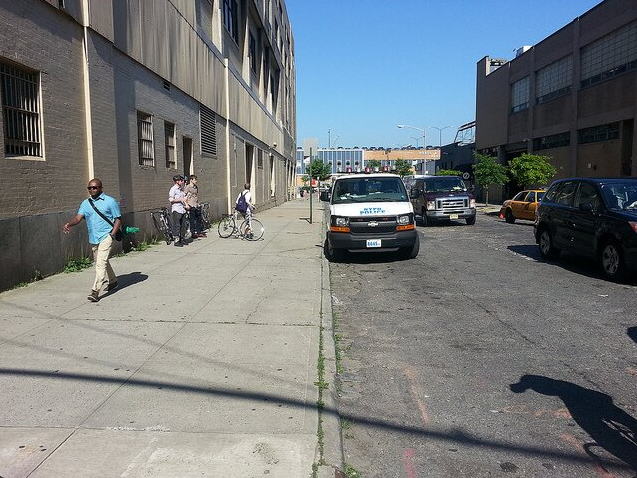
Clarkson Street is a major exit off of the West Side Greenway for cyclists heading to points east. It’s also a place where one will find a lot of cyclists riding on the sidewalk, for reasons I’ll outline below. The question I have is this: is conducting a ticket sting at this location an effective use of limited NYPD resources? As is evident in the picture above, there are no businesses that face the street. Pedestrian traffic is very light to the point of not even existing at some hours. Does ticketing cyclists in this location do anything to enhance public safety?
Now, I know some people may read this and think that I’m making excuses. After all, the law’s the law. Ride on the sidewalk and get caught? Tough, right? Plus, some people may believe that by focusing efforts on places where it’s easy to catch cyclists, the NYPD can influence behavior and encourage cyclists to observe the law in locations where pedestrian safety is a genuine concern, such as the crowded sidewalks of Soho or Midtown. Ticket a person for riding on the sidewalk here, and he’ll think twice before doing it anywhere.
But that line of reasoning relies on a tabloid-fueled idea that cyclists are either willfully flouting the law simply because it’s easy to do on a bicycle or because they’re ignorant of how the law applies to them. Indeed, one of the explanations I’ve heard for this recent crackdown is that with all the new cyclists out there thanks to Citi Bike, it’s important to make sure everyone is aware of and follows the rules of the road.
But on Clarkson Street, as at other locations where the NYPD choses the convenience of easy ticketing over the targeted and challenging effort of ensuring safety, I believe cyclists are making a highly rational choice that no amount of enforcement will ever change. That’s because the invitation to ride on the sidewalk is built in to the very design–or lack of design, if you will–of this particular street. Not only that, but people who ride on the sidewalk here are no more or less likely to ride on the sidewalk in other locations, making this NYPD effort rather useless. (More on that later.)
So what is it about the design of this street that encourages cyclists to violate the letter of the law, knowingly or not? Let’s start on the greenway.
Cyclists looking for a place to turn east off of the greenway can find signs like this one, directing them to Clarkson Street:
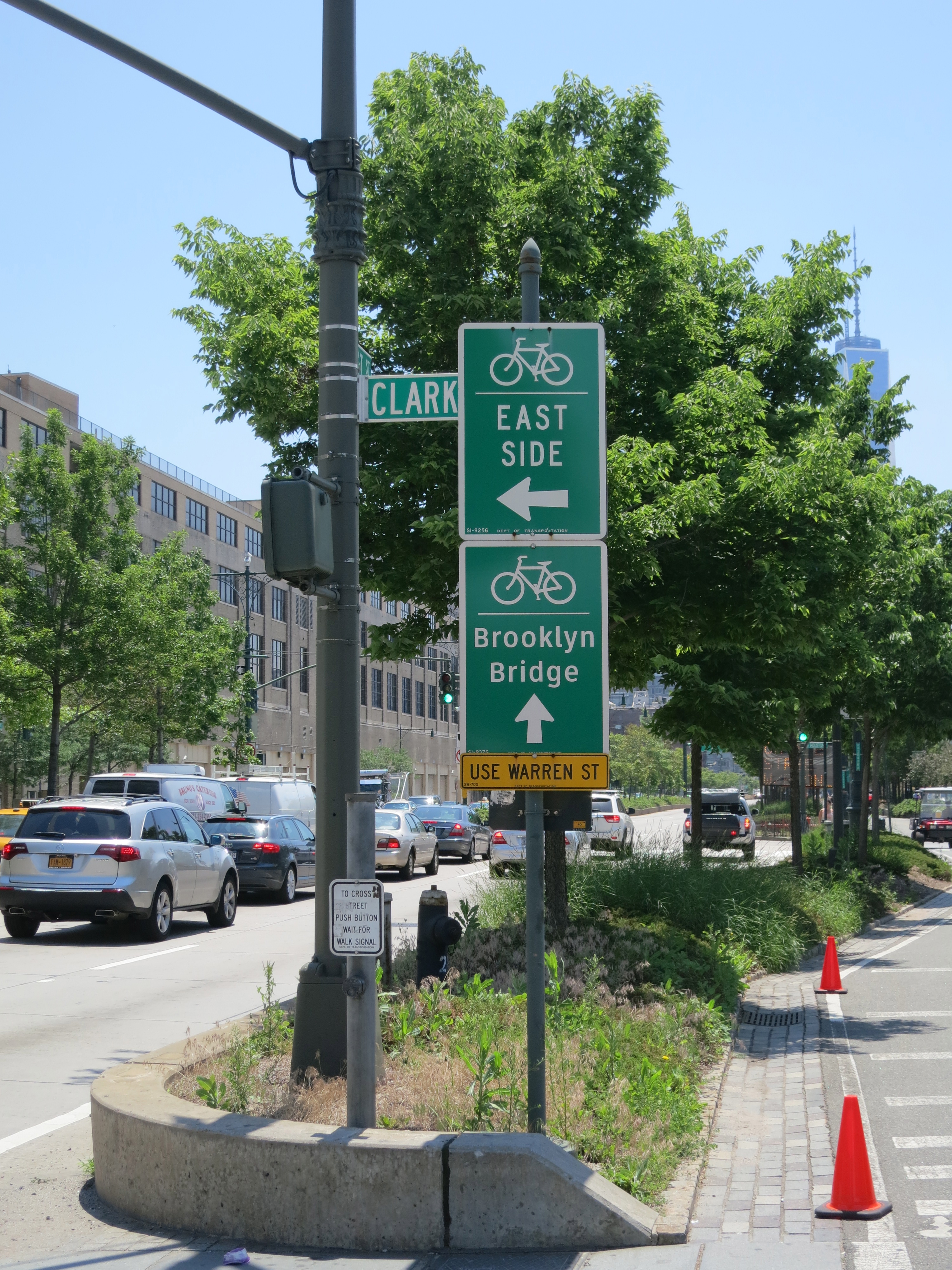
But there’s a problem. Even though the NYPD may want cyclists to start thinking like motorists as they prepare to exit the greenway, the greenway won’t let them:
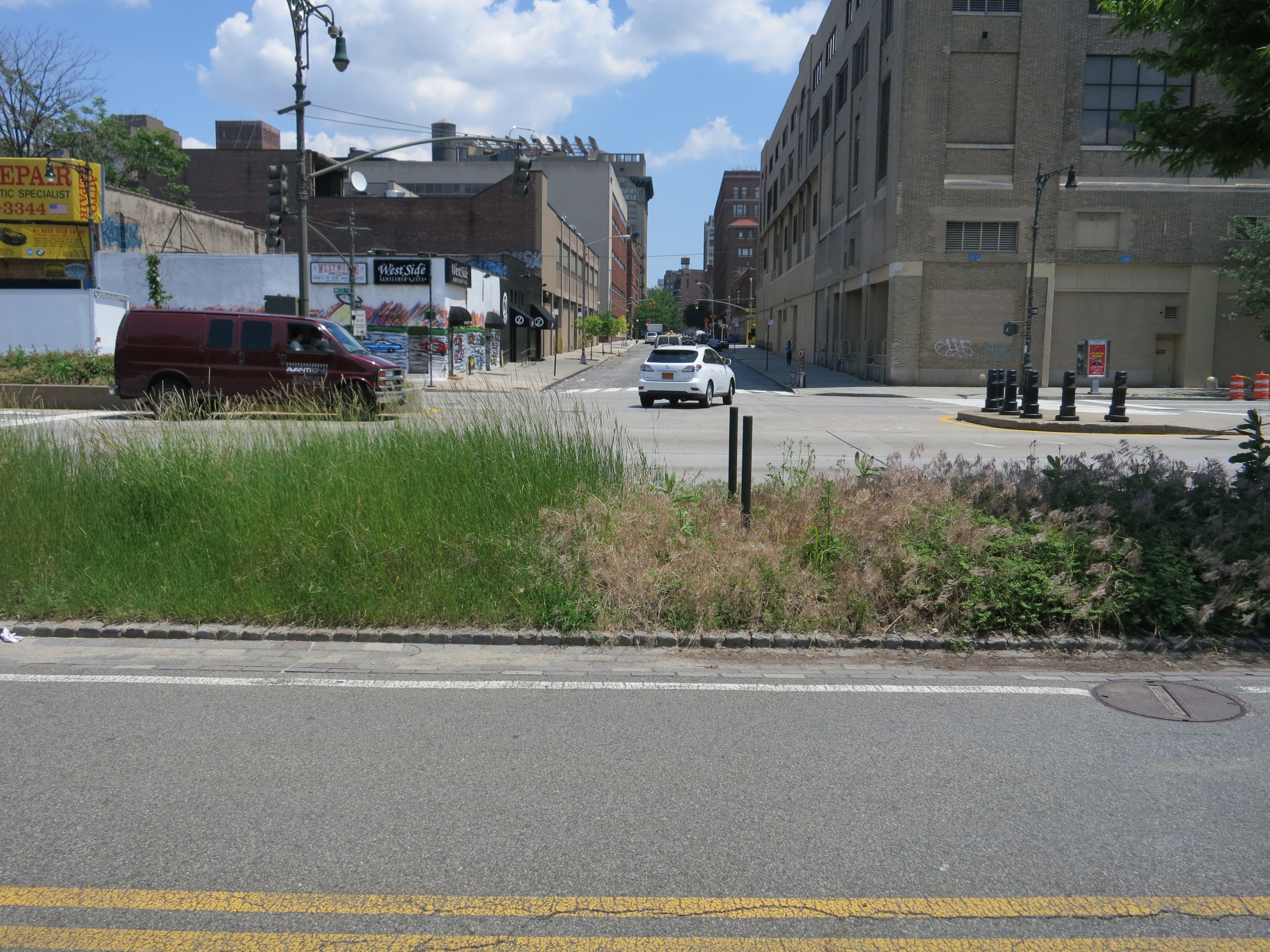
If bikes are “vehicles,” why is there no through access to the roadway for them?
Instead, the design of the greenway invites cyclists to wait in a shared space with pedestrians, positioning people on bikes so that they’re facing not a bike path or cycling-specific markings, but a crosswalk. There isn’t even a traffic signal facing cyclists looking to cross here, so it’s no surprise that cyclists wait for the walk signal and proceed with pedestrians, as this cyclist demonstrates:
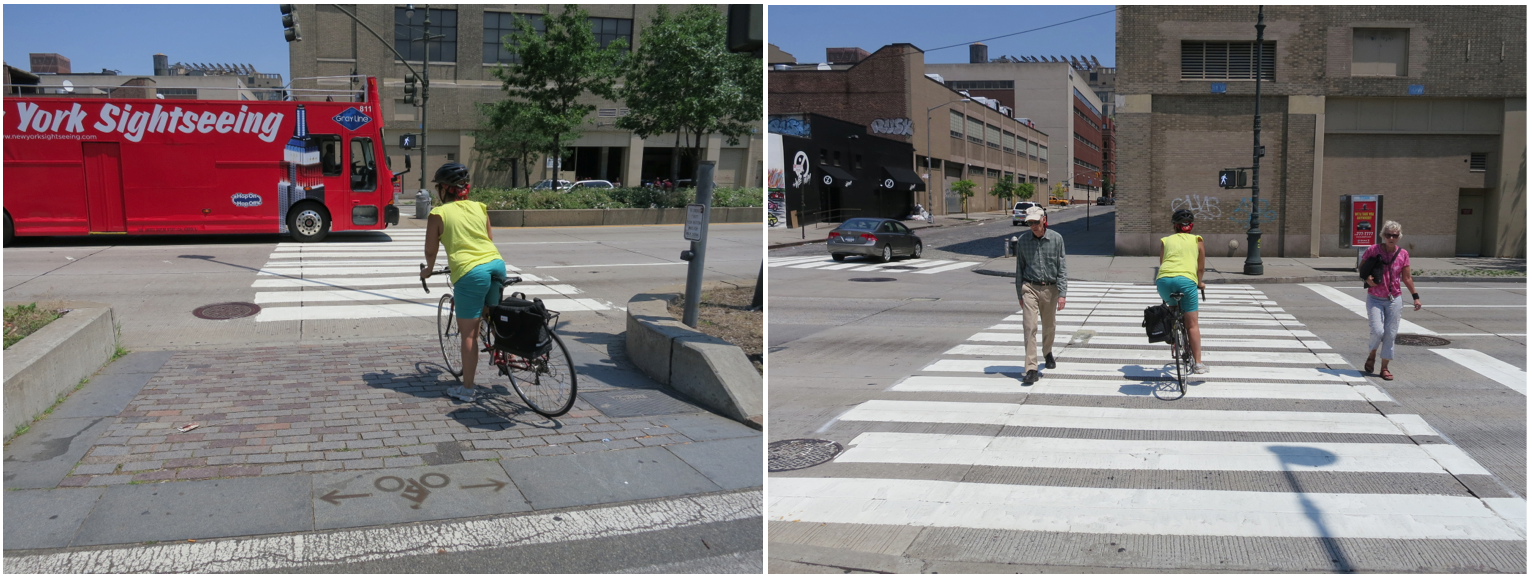
Click to enlarge.
Normally there’s a painted sharrow pointing cyclists to the street, but due to the high auto volumes on West Street it rarely survives for long after being repainted. Even when visible, the sharrows direct cyclists into the middle of an intersection where drivers have a left turn signal when the north/south car traffic is stopped. It’s no surprise that cyclists would rather mix with a few pedestrians than head straight into a shared space with turning trucks and cars.
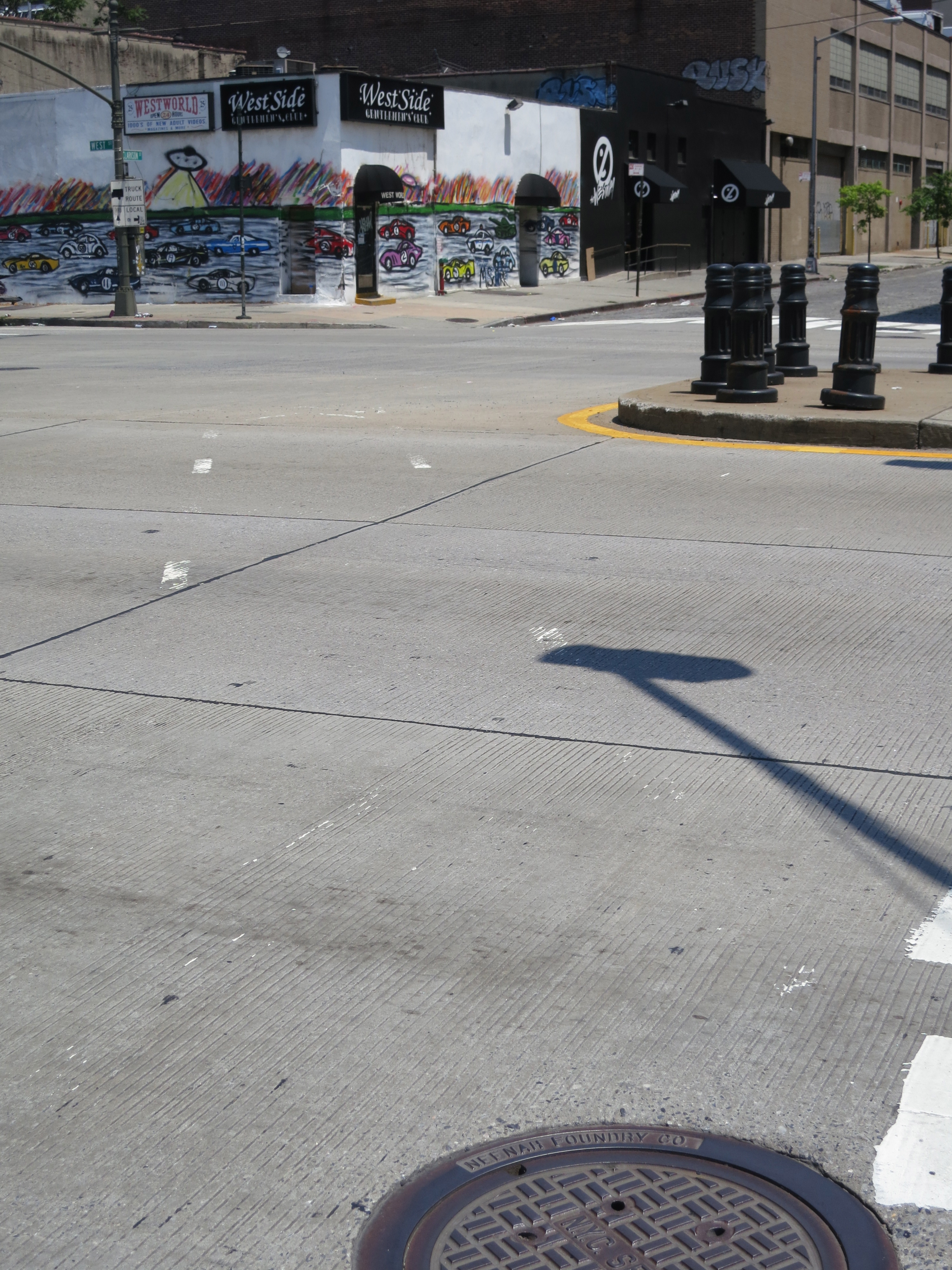
Faded paint does not a bike lane make.
So what do cyclists see when they get to the other side of West Street and find themselves staring down Clarkson? A poorly maintained, uneven cobblestone street that’s riddled with shoddily filled potholes:
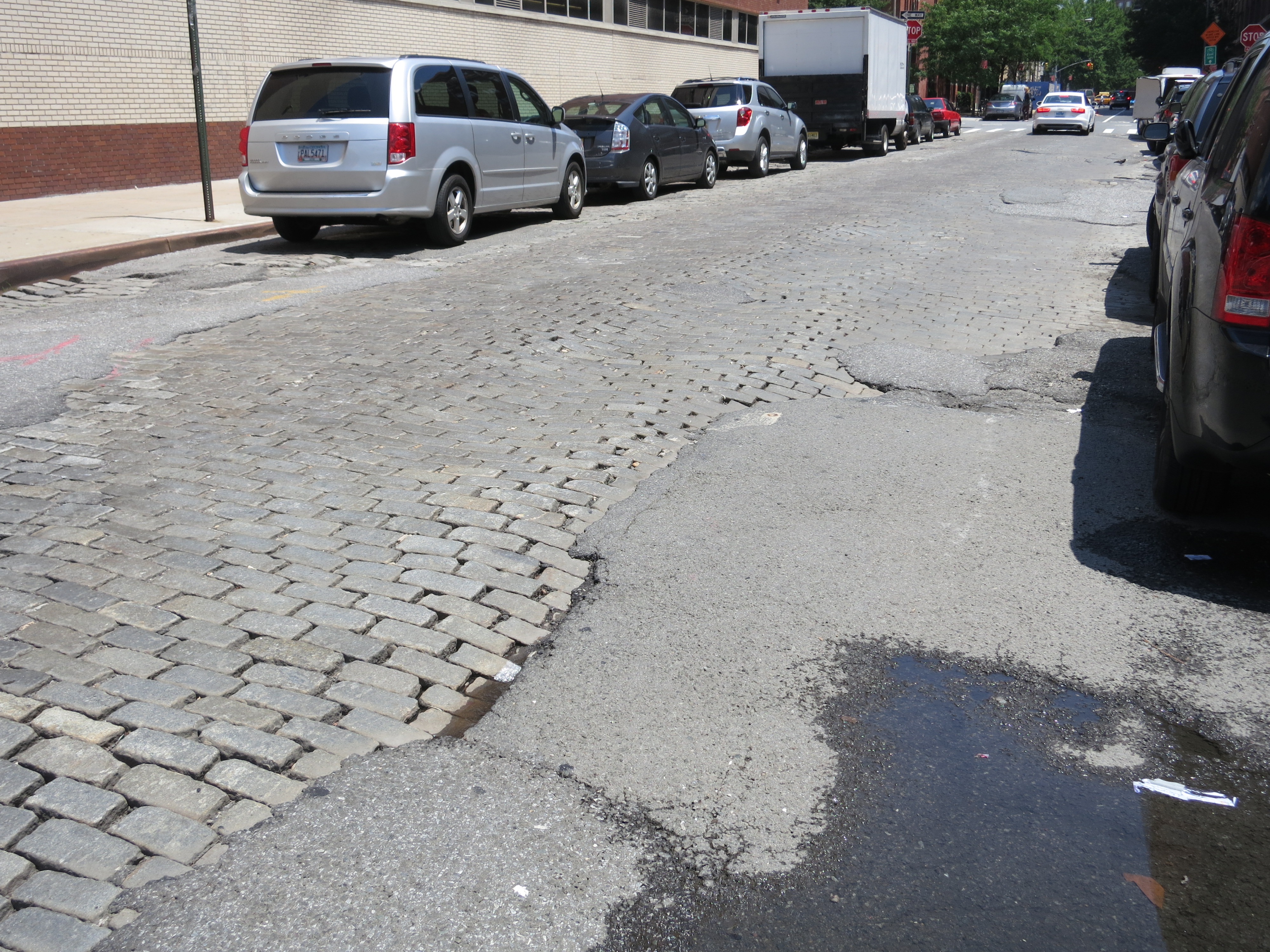
Cobblestones and poorly filled potholes. Doesn’t exactly scream “Please ride here.”
It’s not just that it’s uncomfortable for cyclists to ride on cobblestones. This close-up shows just how much a rider would have to be focused on the ground in order to avoid falling:
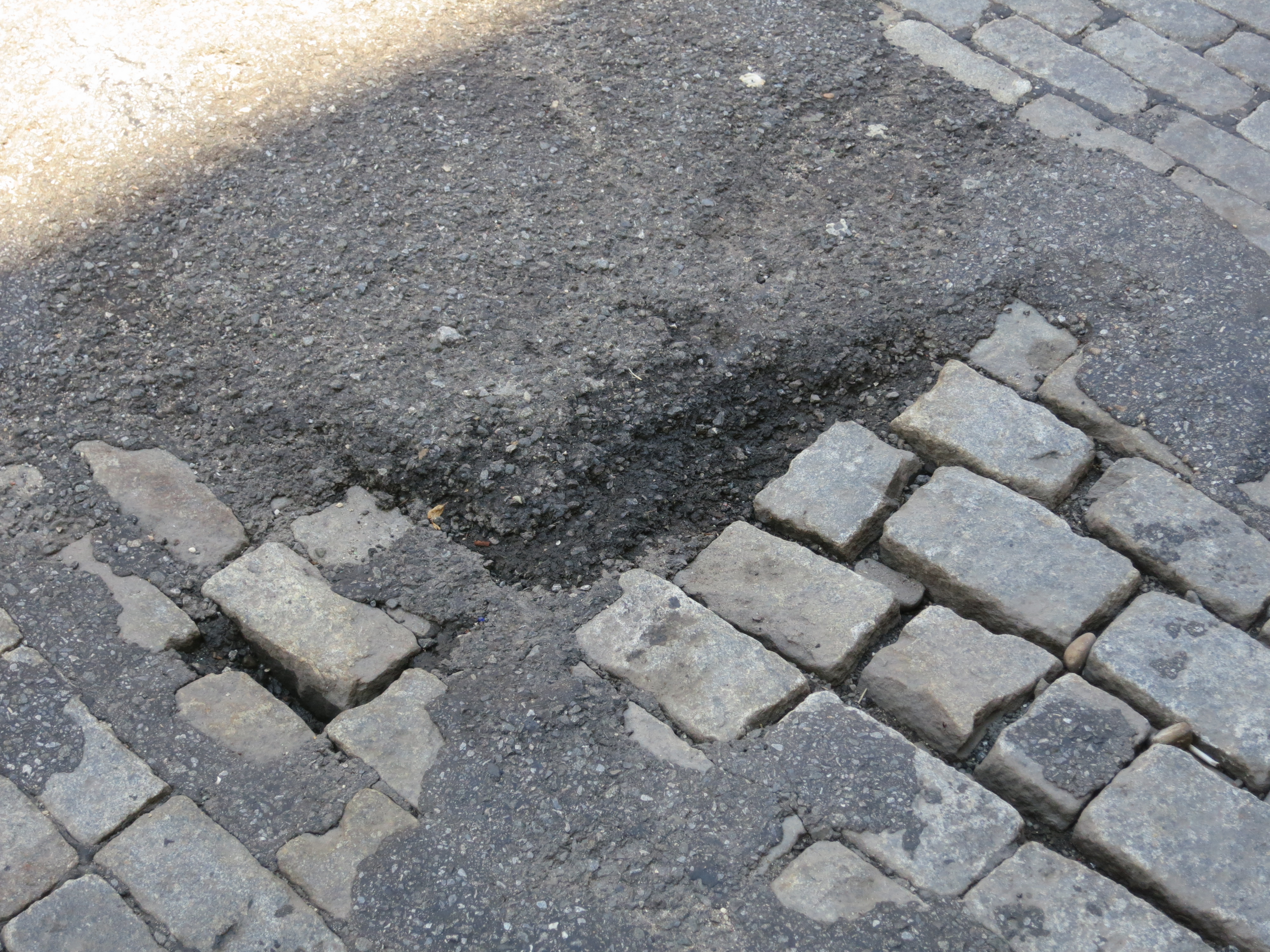
Even wide Citi Bike tires are no match for this street.
If you believe that a poorly maintained street might send you to the ground, you probably don’t want to think about what would happen if you fell while a truck was passing:
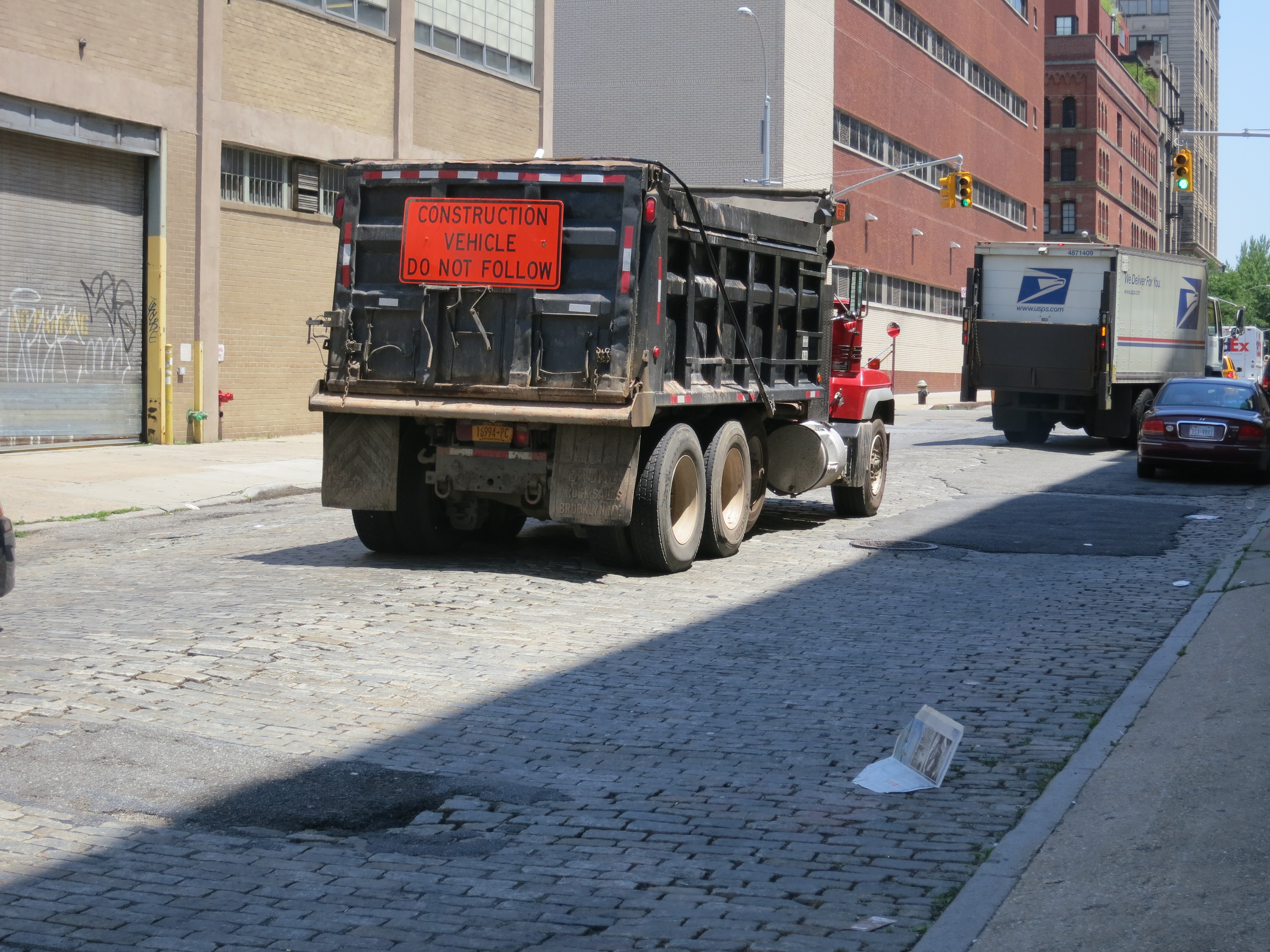
The timing was mere coincidence, but most cyclists take the sign’s message to heart.
So cyclists have a choice that isn’t much of a choice at all: ride on a street where the risk of falling onto a roadbed that’s shared with trucks is very real, or hop up on this:
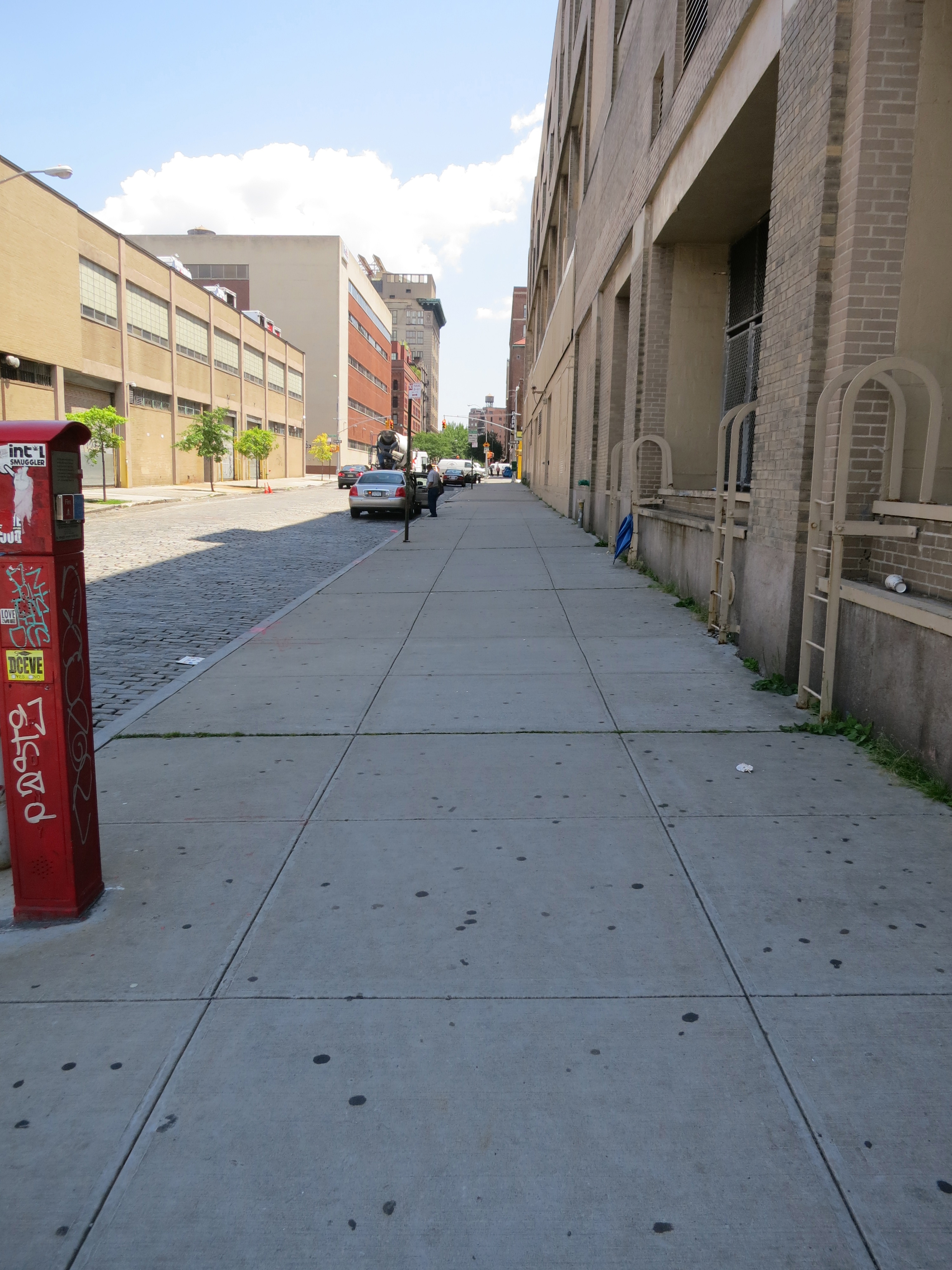
The lure of the open sidewalk.
I would argue that cyclists who ride on the sidewalk on this stretch of Clarkson Street are making an entirely rational decision, choosing the safe and smooth over the dangerous and rough. Even in the unlikely event of a pedestrian using the sidewalk here, sharing space with people on foot is far less dangerous here than it is on certain stretches of the greenway.
This person on a Citi Bike makes every single one of the choices I outlined above. He waits in the shared pedestrian space, crosses more or less with the crosswalk, and then hops up onto the sidewalk on the other side:
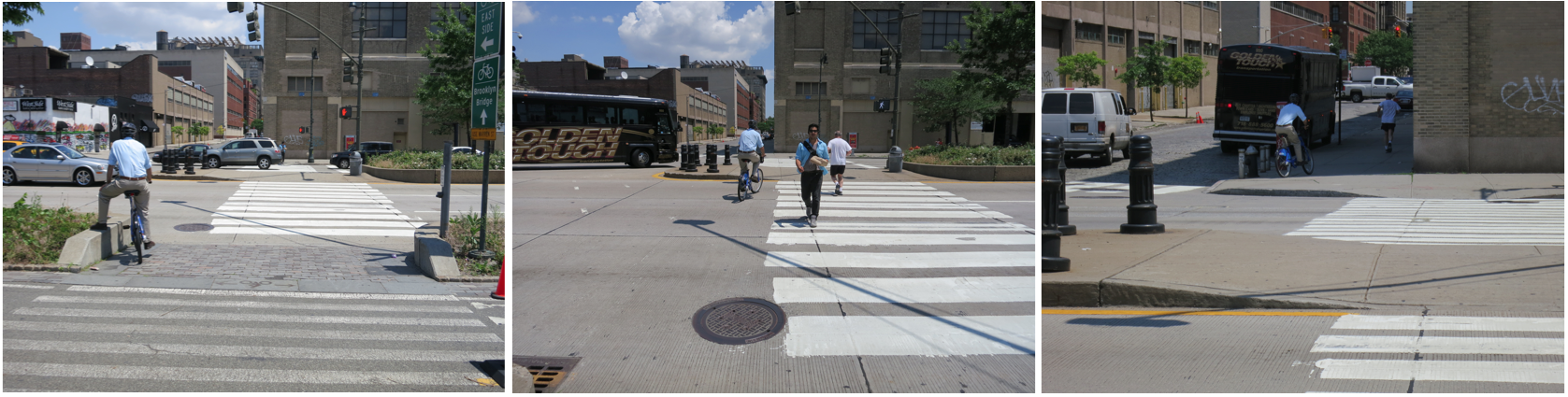
Click to enlarge.
The cyclist in the two pictures below may have been taking her first ride from the greenway to Clarkson. After riding in the crosswalk, she actually merges left with the apparent intention of taking the road, but less than half a block later realizes there a safer and smoother option.
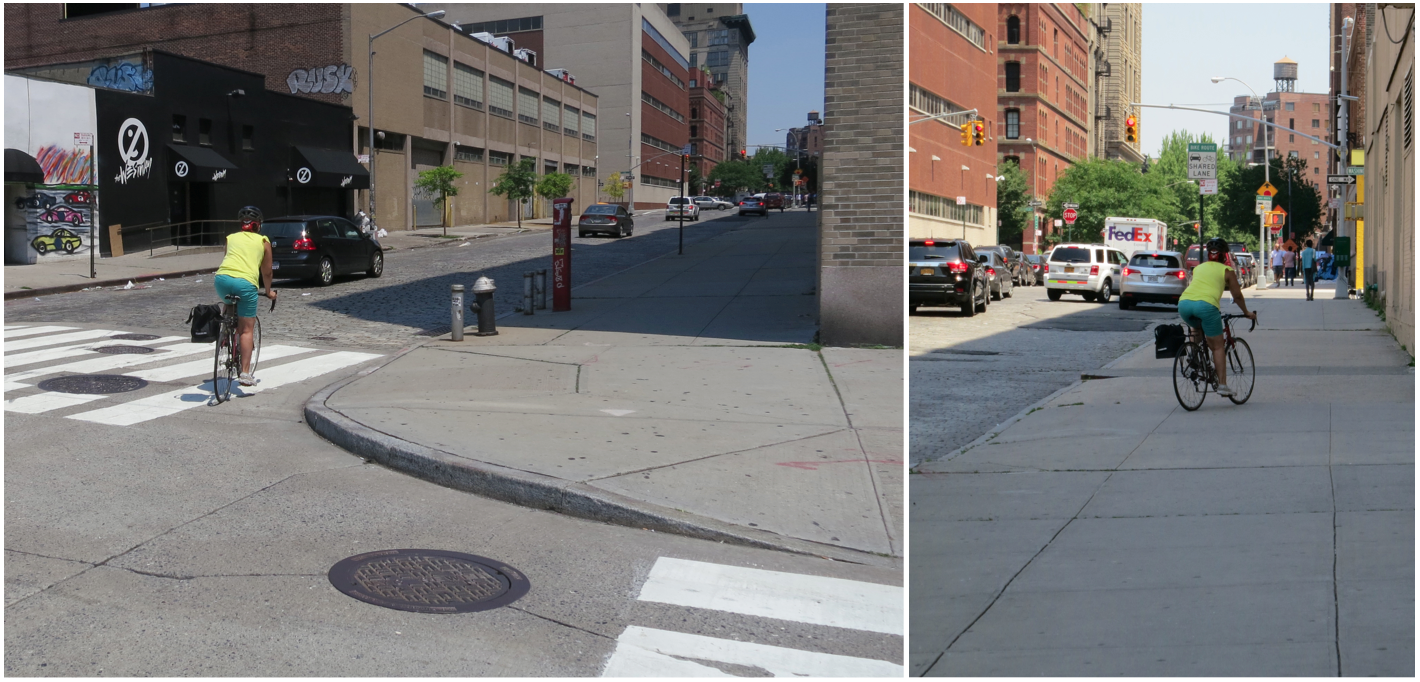
Click to enlarge.
Cyclists who take the sidewalk on Clarkson Street generally do so for two blocks. But when Clarkson crosses Greenwich the street changes from cobblestones to blacktop. There’s even a freshly painted class two bike lane that begins here:
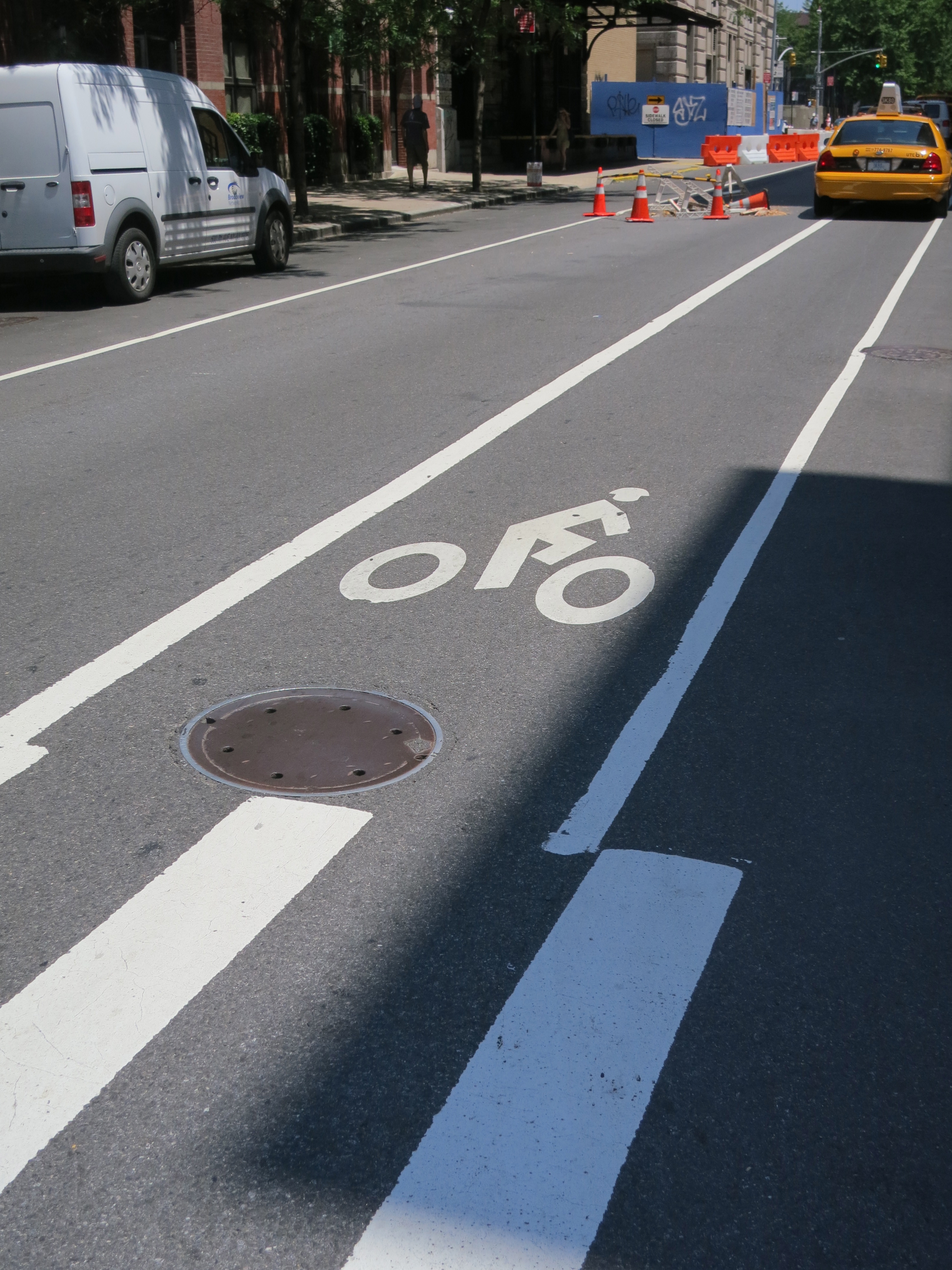
Smooth sailing and an inviting symbol.
So what do cyclists do when they reach Greenwich Street? They make another entirely rational choice and switch from the sidewalk to the bike lane. Here’s a Citi Bike rider doing just that:

Now he’s on the sidewalk, now he’s not.
I stood at the corner of Greenwich and Clarkson and watched as cyclist after cyclist made the same choice, riding on the sidewalk for two blocks to avoid the rougher parts before switching to the smooth bike lane at the first available opportunity:
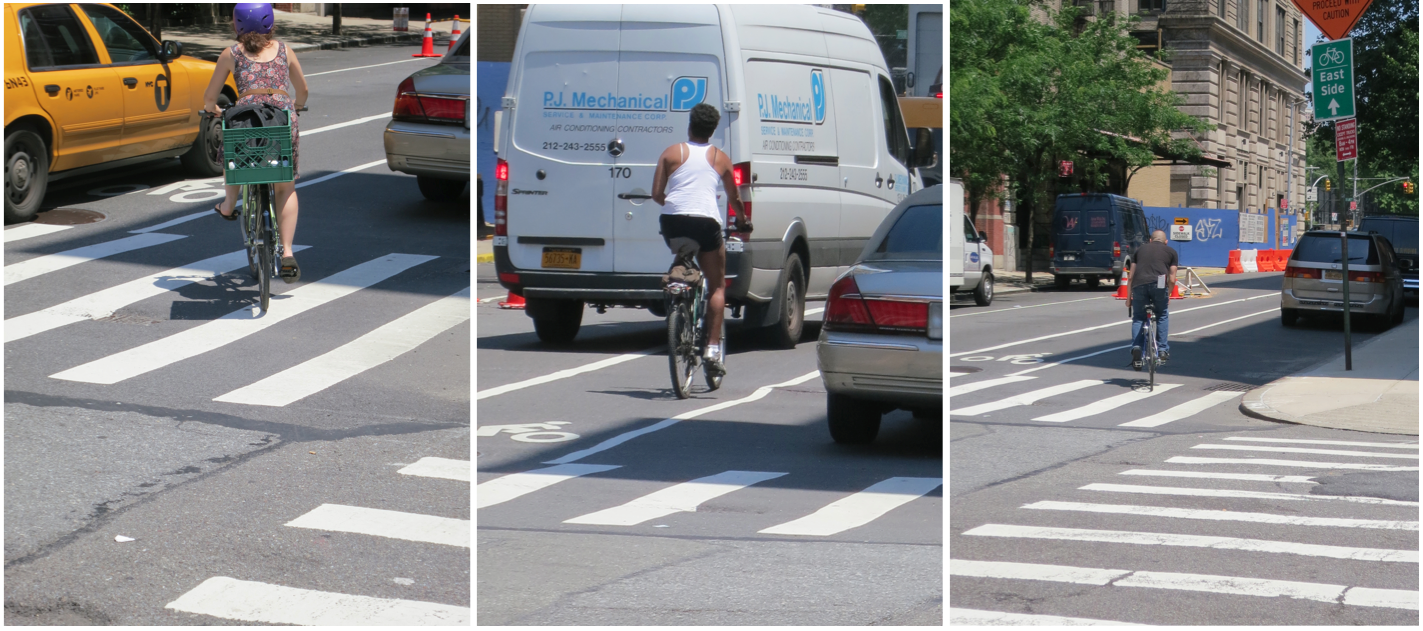
Click to enlarge.
So what does this prove? That cyclists are renegade scofflaws with little to no regard for the laws of a polite society? That the strong arm of the law needs to punish rule breakers with $50 tickets or criminal summons? That ticketing cyclists will get them to think twice about ever breaking the law again? No, no, and no.
In the absence of police officers punishing them for not doing the right thing, the cyclists in these pictures show that compliance with the law is rarely more than one usable bike lane away. In fact, by waiting for cyclists to ride on the sidewalk on this particular block and not just two blocks east, the NYPD is demonstrating a rather intuitive understanding of the concept that better infrastructure breeds better behavior.
Despite what the tabloids may tell their readers, most cyclists are rational actors. It’s the design of our streets and the priorities of our police department that are totally irrational.
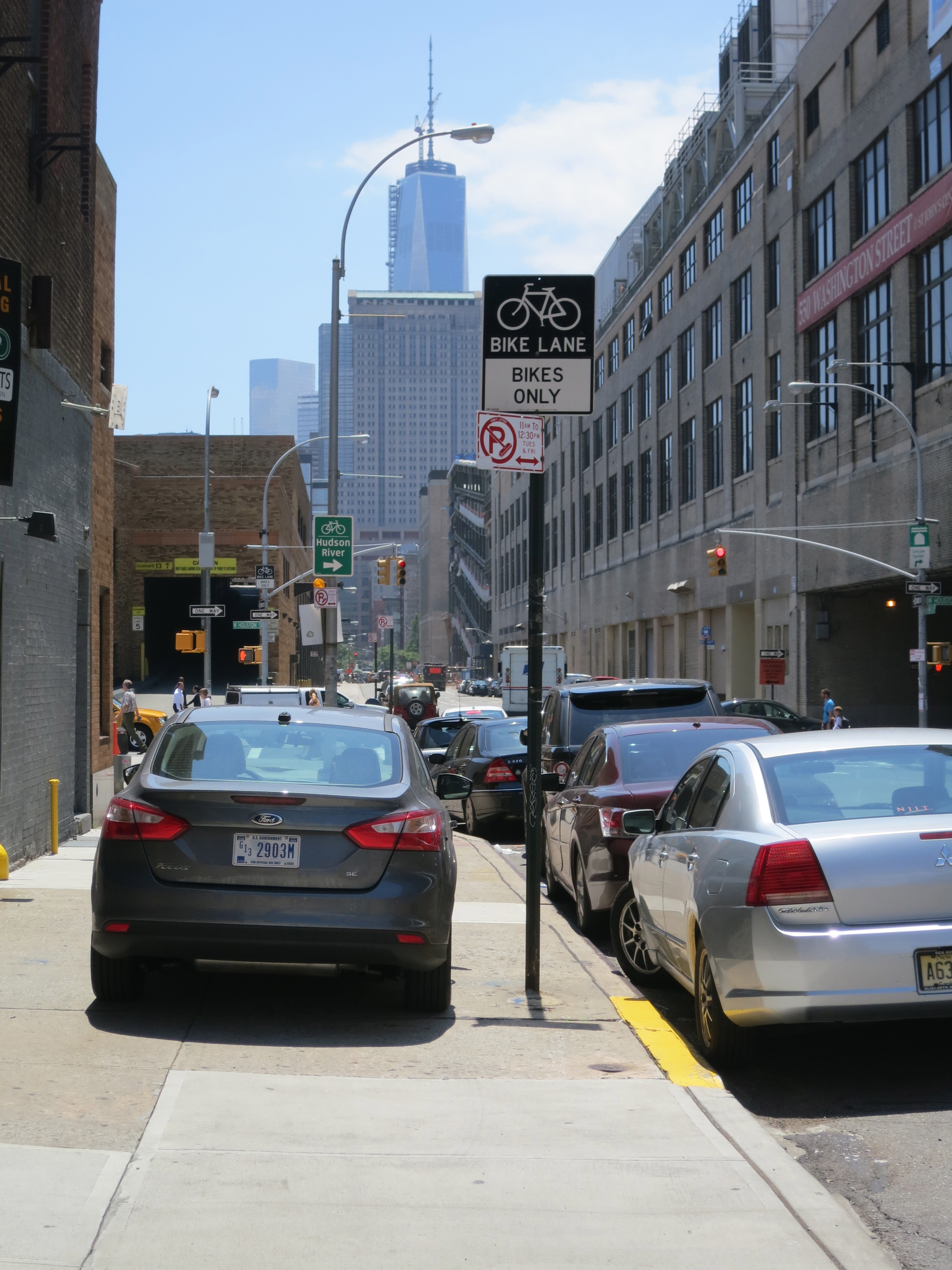
Any tickets for this behavior?
Getting the Facts

What do you do when live in some of the most expensive real estate in Brooklyn and have been availing yourself of the pro bono services of one of the city’s top law firms to get rid of a popular bike lane? Ask for money, of course. This appeal from Prospect Park West bike lane opponents Neighbors for Better Bike Lanes was included in a message that was distributed to the +1000 Friends of Parks email list last week.
GETTING THE FACTS ON PPW“At last, good news in the long legal process concerning the bike lane on Prospect Park West….months ago, the New York State Appellate Court upheld our appeal and returned the case to Justice Bunyan’s court. The issue now is to finally determine whether the lane was installed as a trial or not. As part of that process, the Judge compelled the city to reveal data on post-lane safety. The city’s own data shows INCREASED crashes on PPW and immediate side streets since the installation of the lane…20% and more in some cases. And characteristically, the city has not shared these data with the public, despite clear evidence that the lane has decreased public safety on PPW and nearby streets…..we have also won the right of discovery, so that we can finally determine who said what to whom and when about the lane being installed as a trial…..Our pro bono lawyers at Gibson Dunn & Crutcher have fought long and hard for us and they are still sincerely committed, but we have reached the point where we need to raise some real money…..Help us keep fighting. “Neighbors for Better Bike Lanes or Seniors for Safety c/o Louise Hainline, 9 Prospect Park West, Brooklyn, NY 11215.
Induced Demand
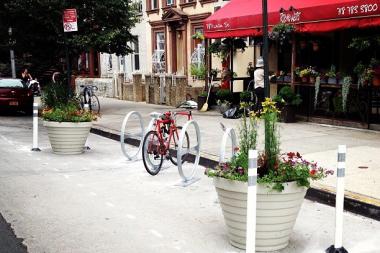
Photo via Rose Water
Want more bike parking? Make more bike parking.
Rose Water owner John Tucker told DNAinfo in March he was inspired to request the bike corral after he saw one in front of Gorilla Coffee on Fifth Avenue. “I’m a big supporter of traffic-calming measures and anything having to do with bikes and promoting bike and pedestrian traffic in NYC,” Tucker told DNAinfo.
So who will be inspired by Rose Water and request a bike corral next?
“We respectfully but strongly disagree”
Hats off to City Council members Brad Lander and Steve Levin for taking the lead on making Fourth Avenue safer. The two have penned a letter to DOT Commissioner Sadik-Khan asking her department to ignore Community Board 6’s obtuse objection to the street makeover.
Dana Rubinstein at Capital New York has the story:
Two Brooklyn councilmen have sent a letter to transportation commissioner Janette Sadik-Khan asking her to disregard a Park Slope community board’s vote by moving forward with a plan intended to make Fourth Avenue a safer thoroughfare.
“During our terms in elected office, there have been very few instances in which our position on an issue differs with that of a local Community Board, and doing so is not a decision we take lightly,” wrote Brad Lander and Stephen Levin, each of whom represents a district that contains a portion of Fourth Avenue. “However, given the severity of the safety risks along 4th Avenue, we respectfully but strongly disagree with CB6’s rejection of the proposal.”
On June 12, Community Board 6 overruled its transportation committee and voted against the city’s plan to remake Fourth Avenue, the anarchic dividing line between Park Slope and Gowanus. (Community Board 2, to the north, approved the plan.)
Between 2007 and 2011, 52 people were injured and one killed on the section of avenue bounded by Pacific and 15th streets.
Speeding is rampant. Crashes are common.
“Separate entrances for the north and southbound R train platforms mean that hundreds of subway riders cross the street on foot during peak hours near Pacific, Union, and 9th Streets,” wrote the councilmen. “In many cases, these pedestrians are offered only two-foot wide medians by the current design. In addition, several narrow intersections with limited visibility due to opposing left turns pose hazards for drivers that have contributed to scores of crashes in recent years.”
Board member Gary Reilly, with whom I have the pleasure of serving on the transportation committee, has the quote of the moment:
“This is really a matter of life and death,” Gary Reilly, a member of Community Board 6 who voted in favor of the plan, told me. “It is a major major safety issue on Fourth Avenue. And ultimately, if the community board can’t get it right. … I hope it gets put into play. One way or another, I think this is something that needs to get done.”
This letter alone will not guarantee a safer Fourth Avenue. Please voice your support and gratitude directly to the council members:
Brad Lander: blander@council.nyc.gov
Steve Levin: slevin@council.nyc.gov
Two steps back
In a roundup titled “Progress Being Made on the Region’s Most Dangerous Roads,” the Tri-State Transportation Campaign notes one exception:
Although New York City has led the way in making roads safer for all users in recent years, there have been some setbacks in the efforts to make one of New York City’s most dangerous roads safer for walking.
In Park Slope, Brooklyn, an initiative by New York City Department of Transportation (NYCDOT) and Brooklyn Borough President Marty Markowitz to transform Fourth Avenue from one of the City’s most dangerous roads into “Brooklyn Boulevard” has faced opposition from some members of Community Board 6, which voted down NYCDOT’s plan to reduce speeding and provide more space for pedestrians on the 1.4-mile stretch of Fourth Avenue in Park Slope, despite broad community support for the plan. Other segments of the plan have been implemented in Sunset Park and in Bay Ridge; Community Board 10 is expected to vote on its section of the plan tonight.
When people view Marty Markowitz as more progressive on transportation than a community board, you know something is wrong.
“Low-car streets work”

Photo via Jonathan Maus, BikePortland.org
Jonathan Maus of BikePortland.org recently explored Copenhagen and wrote a great piece about one of its best streets, Nørrebrogade. Automobile parking is practically non-existent there, yet the strip is as busy and vibrant as any commercial district anywhere in the world.
In city after city where people had priority over cars I saw small businesses, public spaces, and life in general — flourishing. How is it possible?! Don’t those businesses need cars to survive? What about emergency vehicle access? What about freight trucks? We are very good in the states at finding reasons we can’t do things; but even though I’m aware this is far beyond an apples-to-apples comparison, it does give me hope to know that there are places in the world where human beings live — and live well — without cars at the center of everything.
When I visited and rode down this street, it reminded me very much of Broadway through Soho or 5th and 7th Avenues in Park Slope. It was a perfect example of what happens when a city prioritizes the movement of people over the storage of their vehicles.
 Brooklyn Spoke