It Takes a Village to Change a Street
As I’ve written many times before, historic charm is often in the eye of the beholder. So when people say that changing a street will in some way ruin the historic characteristics of the neighborhood, it’s important to ask them which historic characteristics they mean. When, exactly, does their sense of New York City History begin?
For the residents of 99 Bank Street, the answer seems to be sometime in the 1960s. They’re currently pursuing whatever legal options they have left to remove a Citi Bike station in front of their building, and have played the “historic charm” card to make their case. Here’s attorney Jeffrey Barr as quoted in the Daily News:
“The placement of such a massive futuristic structure … (and) dropping … a slab in front of (their) 100 year old landmark building located on an historic street in a landmarks protected district is offensive to the public and residents,” the owners’ lawyer, Jeffrey Barr, says in court papers.
Futuristic structures on historic streets in a landmarks protected district? If the residents of 99 Bank Street care to leave their immediate street and walk barely one block east, they’ll find plenty of things that might not jibe with some people’s idea of history. Via Ephemeral New York, here’s a picture of nearby Abingdon Square in 1900:
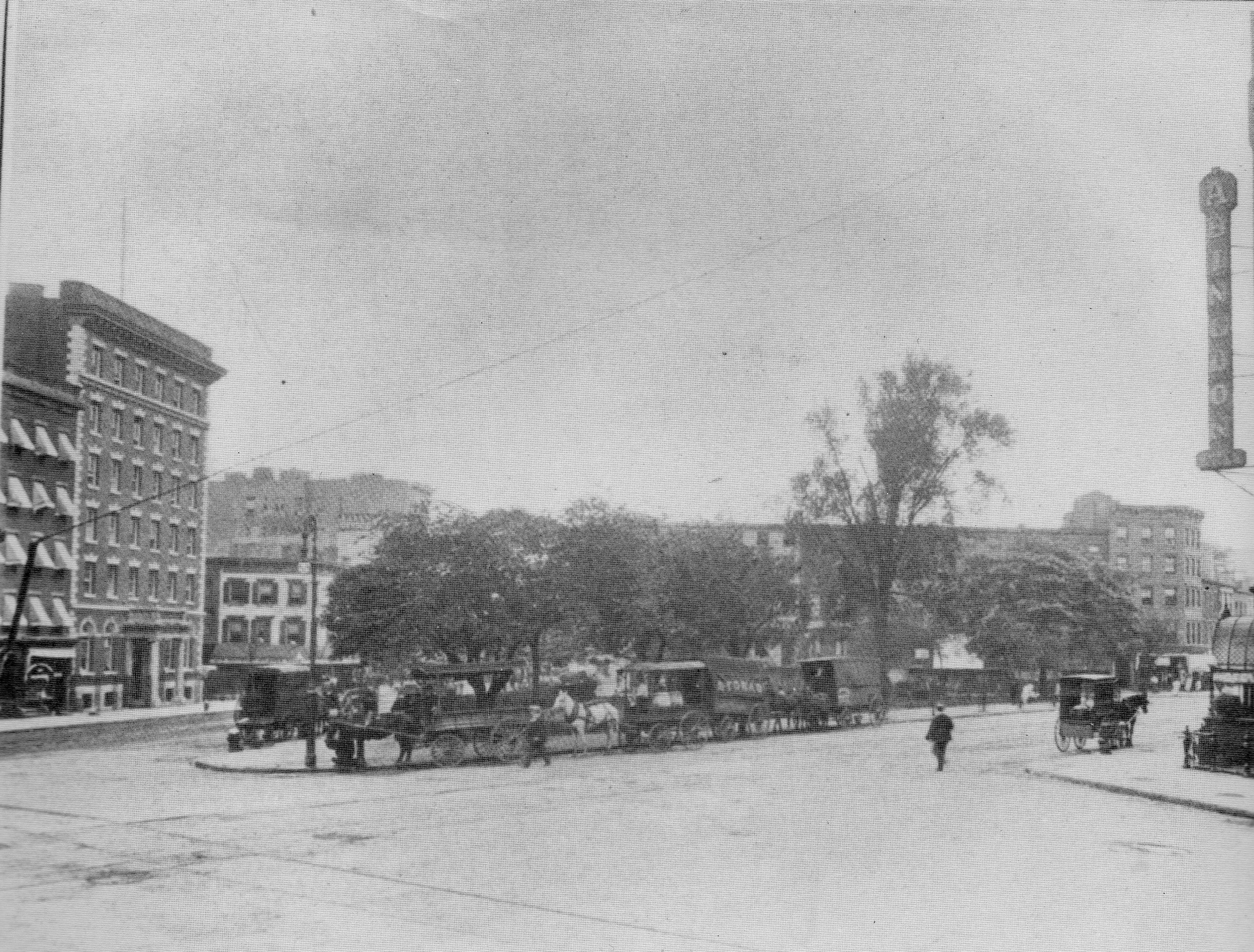
Click to enlarge.
Abingdon Square became a public park in 1831. Surely such futuristic structures as the electric cable stretching across Hudson Street and 8th Avenue and the [theatre? hotel?] sign that reads “Abingdon” would have looked completely odd and out of place to the Villagers of the pre-Civil-War era when they first laid eyes on them.
Now check out the futuristic structures surrounding Abingdon Square in this screen grab from Google Maps, taken from approximately the same angle:
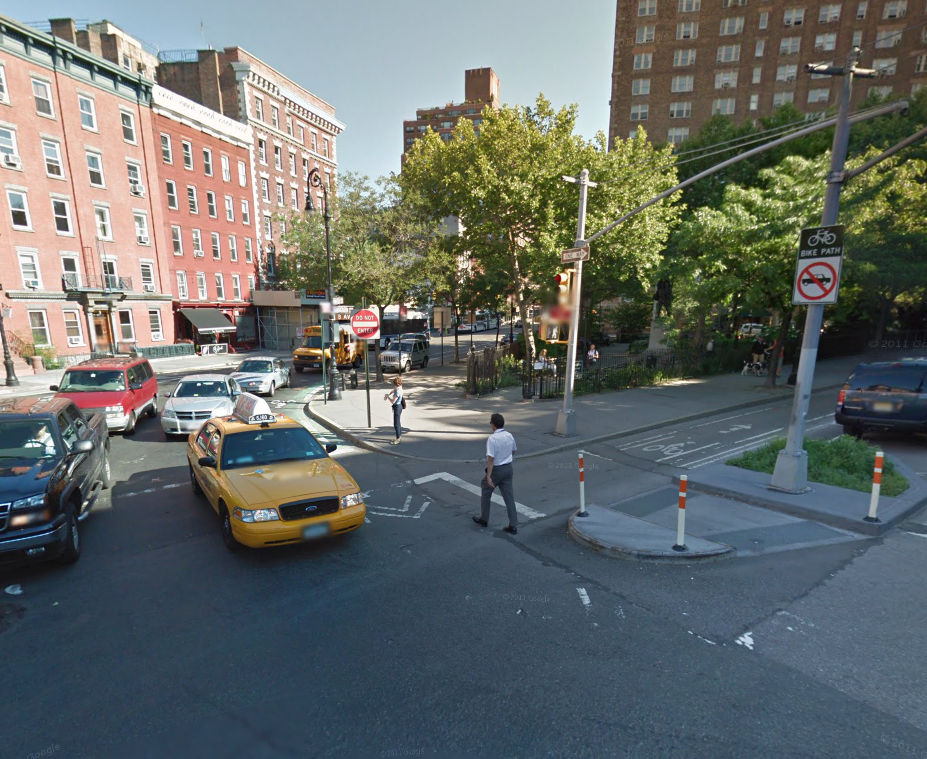
A few things haven’t changed, including some of the buildings along Hudson Street. Even the lamp in the 2013 picture at the edge of Abingdon Square seems to be historically accurate. But almost everything else, from the traffic signals to the brightly colored automobiles, would look shock the residents of 1900s-era 99 Bank Street residents if they were suddenly transported to today’s New York. (Not least of all the prices people are now paying to live in their old building!)
As Ben Fried at Streetsblog put it, “It’s Too Late to Preserve New York Streets in Amber.” When appropriate, we should fight to preserve buildings, blocks, and structures that reflect our city’s long and storied history, but the streets almost always need to reflect the current needs of today’s citizens.
Quote of the Day
Via Lloyd Alter at Treehugger:
99 Bank Street, in New York’s West Village is a lovely historic pile on a lovely historic cobblestone street. A hundred years ago, it was probably full of bikes. Then the cars came and filled up the streets, and suddenly they became the new normal, that we give up 150 square feet of road so that one person can park their private vehicle.
National Bicycle Week 1919
It’s Bike Month in New York City and across the country, and so far it’s turning out to be the bikiest Bike Month since… Bicycle Week 1919.
Via From Wheels to Bikes, a spread in the Ogend (UT) Standard celebrating National Bicycle Week some ninety four years ago.
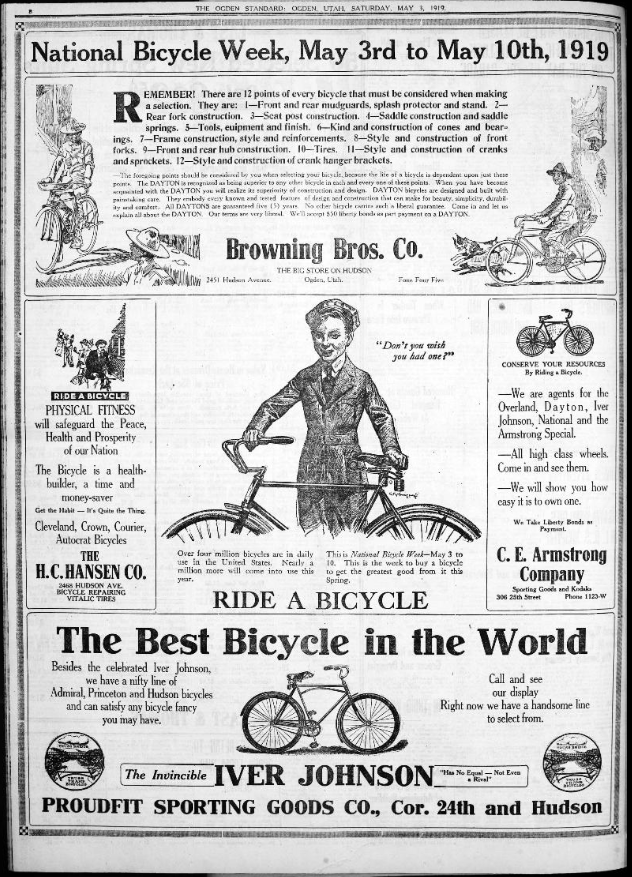
Click to enlarge
While I love the copy under the boy holding his bike in the middle — “Over four million bicycles are in daily use in the United States. Nearly a million more will come into use this year.” — the copy for the H.C. Hansen Co. ad is really great:
PHYSICAL FITNESS will safeguard the Peace, Health and Prosperity of our Nation. The Bicycle is a health-builder, a time and money-saver.
Improving my health and saving time and money. That’s why I ride.
Some of My Best Friends are Bike Share Systems
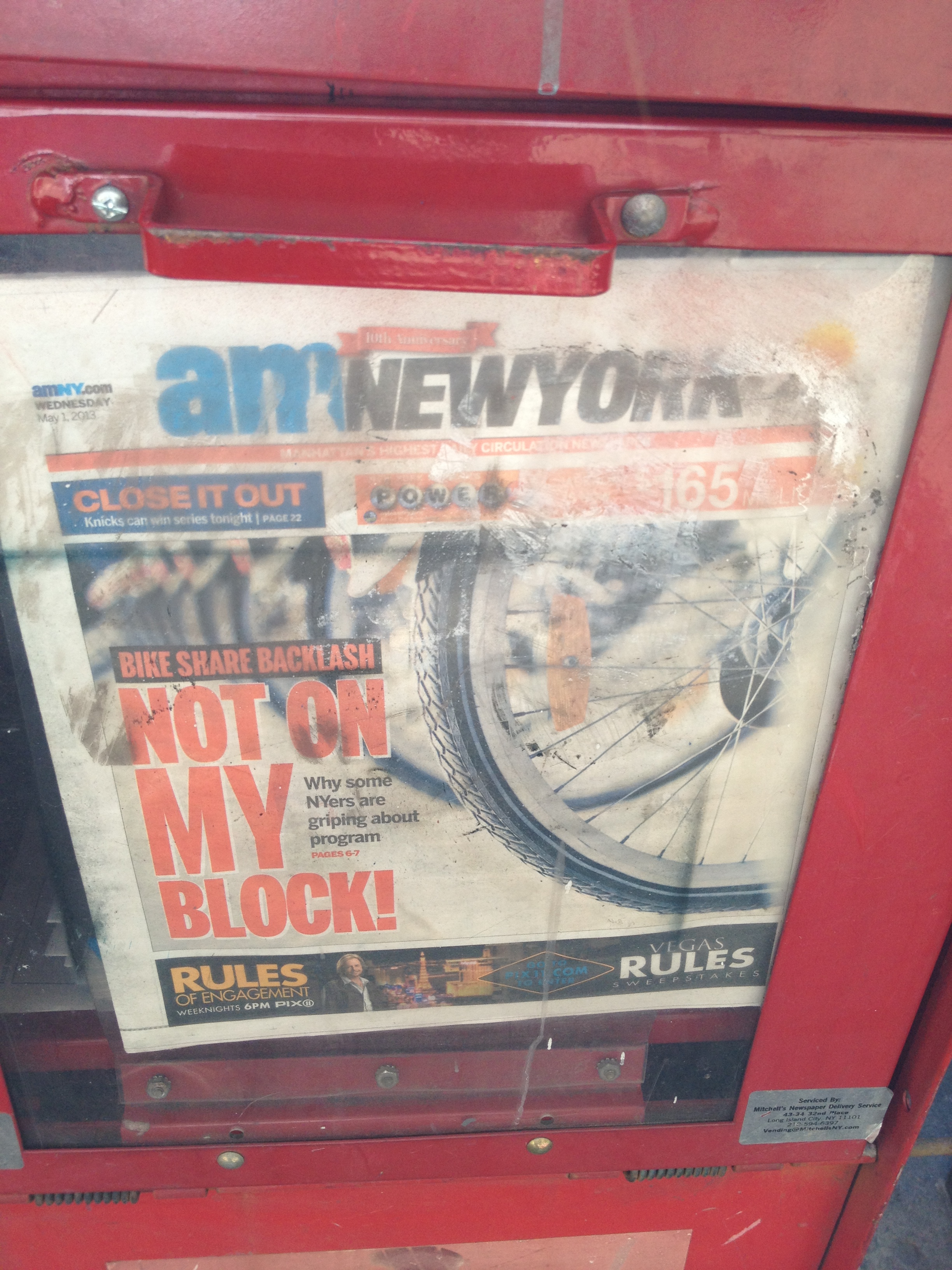
Ironically, this free newspaper is distributed in a sidewalk-hogging metal box that exists solely for the purpose of promoting a private business.
Well, here we go again. As regular readers well know, one of the requirements for anyone who hates bikes is to first establish how much he loves bikes. So it should come as no surprise that the people who have problems with bike share are also taking great pains to let people know how much they love bike share.
CBS2’s Tony Aiello, who’s filed three anti-bike-share pieces in one week, spoke to a business owner in the East Village:
“We like the idea of the bike thing. It’s a great idea and I’m sure I’ll use it, too,” local business owner Glen Gaylinn said.
Gaylinn is one of many worried about the impact on parking and traffic. The station in front of his shop has already been hit by a garbage truck making a tight turn. The installation of a docking station came as a total surprise.
“I’m here 19 years, block association president, I knew nothing about it,” Gaylinn said.
I don’t know what block Gaylinn lives on, but perhaps it’s time for residents to elect a block association president who checks the local community board’s calendar every now and then?
The cover of am New York this morning actually stated, “Bike Share Backlash: NOT ON MY BLOCK.” Here’s what one NOMB had to say:
“I’m not against the program but this is not the way to do it,” said tenant Dorothy Rowan, 57. “When the bikes come in there will be no room for anyone on the road.”
In order to make room for other people, perhaps the city can offer alternatives to private cars. Might I suggest a bike share system?
One resident of Battery Park City “expressed surprise” that a station had been installed at West Thames St near South End Avenue overnight:
“I’m not opposed to the bikes,” said Lipsky. “I think the mayor has done a wonderful job on it.”
But she thought that it was “a very inappropriate location for a very good program… West Thames is a very congested street and a number of buses pass there and kids from the school cross there. If the other [locations] are as bad as this one, I think they’ll run into problems with the community,” she said.
Translation: “The mayor has done a wonderful job with the bikes, but if he’s done as bad a job elsewhere as he has on my block then he’s actually done a terrible job.”
One of the residents of the now-infamous co-op building on Bank Street that sued to have a Citi Bike station would totally sign up for a membership, if only the stations weren’t so big:
“It’s just totally overwhelming the block,” said Mary Lucas, a 10-year tenant of 99 Bank St., near Greenwich Street.
“I would use the program, but this has put a rather bad taste in my mouth.”
Then there’s SoHo’s Sean Sweeney, who’s well aware of how he’s perceived:
Sean Sweeney, director of the Soho Alliance, admitted that some in the community refer to him as a “NIMBY” (not in my backyard). But, he said, he is not opposed to the idea of the bike-share but has issues with some of the proposed locations and, in particular, with Petrosino Square.
And, of course, there’s the quote to end all quotes, captured by Streetsblog at the Fort Greene forum hosted by Tish James:
“This all reeks of NIMBYism in terms of ‘not in my backyard,’” she said. “I’m not against the bike-share, I’m opposed to the locations.” She then requested that the station near her home be moved.
If you find more examples, please leave them in the comments.
“Bike to the Future” Jane’s Ride this Saturday
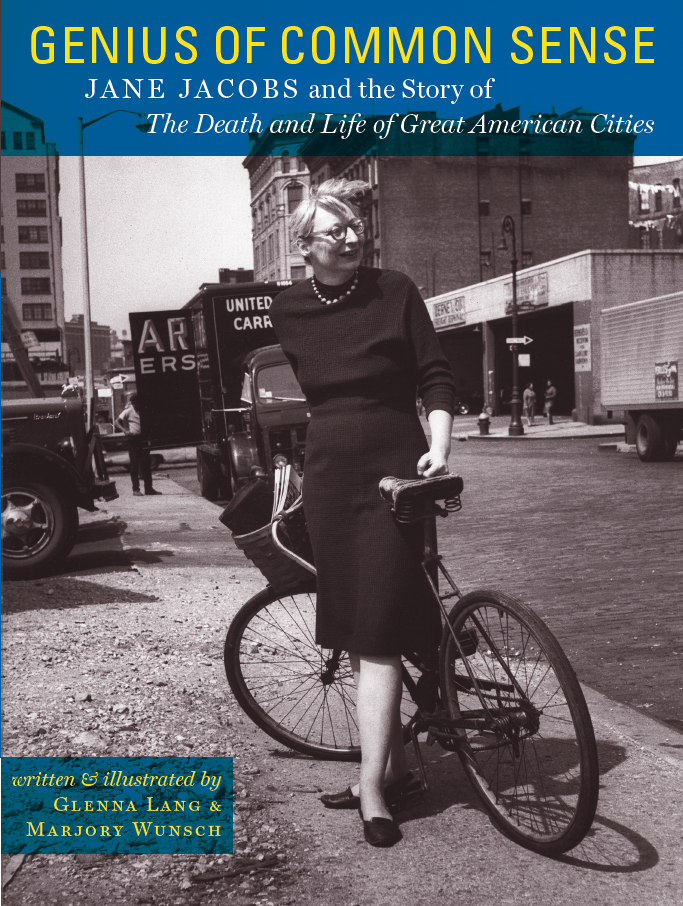
One of the few pictures of Jane Jacobs on a bike, from the cover of a book for young adults.
I’m co-hosting a “Jane’s Ride” with Eric McClure of Park Slope Neighbors this Saturday, May 4th. We’ll be taking a look at some of Brooklyn’s newest bike infrastructure and preview what’s still to come:
Cycling in New York City has grown by leaps and bounds during Mayor Michael Bloomberg’s 12 years in office. With his tenure coming to an end on December 31st, the city’s transportation department is busy putting the finishing touches on the Mayor’s bike-friendly legacy. This “Jane’s Ride” tour through historic Park Slope will highlight coming additions to the neighborhood’s biking infrastructure, including newly planned bike lanes, bike corrals and the first local station of the soon-to-launch CitiBike bike-share program. This leisurely paced ride is appropriate for cyclists 12 years old and up; please note that we will be taking to some streets that don’t currently feature bike lanes. A bike is required, but will not be provided, so please bring your own. Rental bikes are available at numerous nearby cycling shops, including Ride Brooklyn, located just two blocks from our end point. Helmets are mandatory in NYC for anyone under 14.
The ride runs from noon to approximately 1:30. Meet at Bartel-Pritchard Square (Prospect Park West & 15th Street) on the corner near the Pavilion Movie Theater. We’ll end at Gorilla Coffee at 5th Ave and Park Place.
Eric and I had a great turnout last year and are looking forward to seeing you this time around.
Ginia Bellafante and John Cassidy drive into a bar.
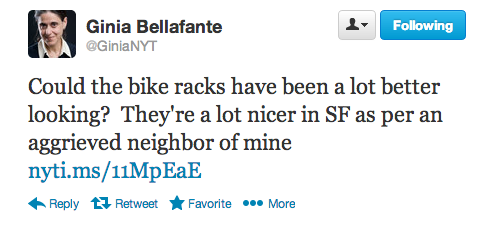
ABOVE: A tweet from the New York Times’ Ginia Bellafante. There are no bike share stations in San Francisco yet. When the system launches, most likely in 2014, the stations will be designed and operated by Alta, the same company operating New York’s system. Bellafante also tweeted that Los Angeles will “NEVER” get a bike share program.
When The New Yorker magazine’s John Cassidy published the first of two fact- and reason-deprived anti-bike lane screeds in 2011, Streetsblog founder Aaron Naparstek called it “a seminal document of New York City’s bike lane backlash era.”
The same can now be said for Ginia Bellafante’s “The Bikes and the Fury”, which does for bike share what Cassidy did for bike lanes. I’m sure a dumber story is yet to be written about the city’s highly anticipated bicycle sharing program, but it will probably appear in the Post or the Daily News, making the level of idiocy far less head-slappingly surprising than what Bellafante achieved on April 27th, 2013.
Herewith, my take on Bellafante’s most ridiculous paragraphs and lines, which is to say almost the entire piece.
In a very short time, New Yorkers will have the opportunity to show the world that they are just as virtuous, well-intentioned and offended by sloth as people in Copenhagen or Geneva or any other of a number of cities where mindful living and wonderful yogurts reign. The city’s long-anticipated bike share program is scheduled to make its debut in May, allowing New Yorkers to pick up and deposit rental bikes at hundreds of locations, most of them, so far, in some of the wealthiest neighborhoods. Anyone waking up on a Sunday morning in TriBeCa, finding nothing in her refrigerator and hankering to go to Smorgasburg in Dumbo, Brooklyn, for instance, will now be able to do that with relative ease.
In her effort to set a record for most cliches in a lede paragraph, Bellafante reveals that she has no idea what bike share really is: transportation. Although both neighborhoods make for convenient examples of New York’s bourgeois enclaves, a person waking up to an empty refrigerator in TriBeCa probably isn’t riding to the Smorgasburg in Dumbo. What she might do, however, is ride from her apartment in TriBeCa to the Whole Foods… in TriBeCa.
Now that the metal stalls and kiosks where bikes will be stationed are turning up in parts of Brooklyn and downtown Manhattan, the theater of operations in the war among cyclists and drivers and pedestrians has expanded and multiplied and bred new factions, even though the bike share program itself has been shown to have widespread support in polling.
Seventy-two percent approval, in fact, so my guess is that there are no new factions at all, just the same old factions targeting their anti-change, pro-parking rage at the latest and most dramatic examples of a city that’s changing faster than ever before. And the fronts in this “war” are the same as ever: brownstone Brooklyn and large swaths of Manhattan. (Sorry, Columbus Avenue, you’ll have to sit this one out!)
…Jacques Capsouto sat down on the curb to protest the placement of a bike rack in front his restaurant, Capsouto Freres on Washington Street, which possibly blocked a service entrance.
There is, of course, no way for a reporter to verify whether the “bike rack” actually blocked a service entrance, since all subway service between Times Square and Canal Street shuts down the minute anyone keys the letters, b, i, k, and e into a Times-owned computer.
The Friends of Petrosino Square, in SoHo, have fought the installation of a station close to the park of which they are advocates, believing that it would intensify traffic and impede safety. Such are the tempers in certain quarters that one member of the group created signage that called the Department of Transportation, which began the program, the “Department of Tyranny.”
Friends of Petrosino Square, the SoHo Alliance, and others aligned with Sean Sweeney believe that everything will “intensify traffic and impede safety,” even high-end furniture stores. But give Bellafante credit: by attributing a derogatory nickname for the DOT to a sign made by someone in one of these groups, she can get her dig in at Janette “Sadist-Con” by bending, but not completely stooping to Andrea Peyser or Steve Cuozzo levels.
It is hard to imagine that four decades ago, in early May 1971, fires were set and windows were smashed in the far reaches of Brooklyn in protest of cuts to Medicaid and other social programs, when so often now it is matters of lifestyle and taste that inspire our most expressive displays of contention and ire — our quaint revolutionary gestures.
Actually, if you look beyond brownstone Brooklyn to places like Brownsville and East Brooklyn, you’ll still find a significant number of people living in poverty and in constant fear of cuts to life-saving social programs such as Medicaid. Some of these issues might even make great stories for the Metro section. But hey, bikes!
On Wednesday night, a litany of grievances were heard at a town-hall meeting in Clinton Hill, in Brooklyn, which had been organized by Councilwoman Letitia James to address concerns about the way in which the bike program was unfolding.
A litany of praise and excitement were also heard, but there are newspapers to be sold and page views to be generated, for pete’s sake. This is no time for balance!
It is hard not to feel as though that strain of dispute might have been squelched if the bikes had been brought to us by Whole Foods, rather than an organization whose subprime mortgage dealings helped bring about the financial crisis.
Riiiiight. If the two ultimate symbols of gentrification — Whole Foods and bicycles — were combined into one parking-space-eating Frankenstein’s monster, the NIMBY-fueled supernova would be so powerful that it would destroy all life on this planet and any others on which intelligent life exists solely for the purpose of drinking lattes.
But even now, in an era of hyper-localization, of neighborhood blogs and Patch sites, many of us have little sense of what our community boards are doing, little time to pay attention, and the boards in turn often are short-staffed and cannot possibly disseminate information on every issue.
Bellafante, translated: “Even though there are many more ways to learn about things that will impact my community than at any time in the city’s history, there are also many more ways to ignore such information. ” Therefore, Janette Sadik-Khan made a critical error when she did not write personalized notes and hand-deliver them to every one of New York City’s eight million residents.
A friend of mine, who generally keeps abreast of things, learned of a bike station going up near her apartment in Brooklyn Heights only when she witnessed it being installed. “New York is too mean for this,” she told one of the workers. “We’ll see,” he responded.
A person gives an unsolicited opinion about how mean New York is to a Citi Bike crew member, who then responds with the polite-to-neutral “We’ll see,” barely rising to take the anger bait Bellafante’s friend was clearly dangling. So this doesn’t exactly provide the kind of Ratso Rizzo color Bellafante might have hoped this anecdote would impart. I’m always amazed by how much the city’s bike haters, those self-professed defenders of the “real” New York, actually hate this place. “New York is dangerous,” they seem to say, “but we should do nothing at all to make it safer.”
So if you’re looking forward to New York joining the ranks of London, DC, Paris, Minneapolis, Boston, Chicago, San Francisco, Los Angeles and any of dozens upon dozens of cities that either already have or will soon have bike sharing programs, take heart! It took at least a year of angry community board meetings and relentless attacks in the tabloids before Cassidy took the bikelash to its nadir of absurdity. The time between the first appearance of Citi Bike stations on Brooklyn streets to Bellafante’s column? Just twenty days!
Announcing StreetsPAC!
It is with great pleasure that I announce the official launch of StreetsPAC, a political action committee dedicated to electing public officials who are committed to improving the safety, mobility and livability of one of New York City’s greatest assets: our streets.
Via the official website:
Founded by a team of the city’s most committed advocates, StreetsPAC supports candidates who demonstrate unwavering devotion to the expansion of traffic-calming infrastructure such as neighborhood slow zones, pedestrian plazas, and bike lanes; increased and improved transit access for all New Yorkers; more thorough crash investigations; and better enforcement of traffic laws.
StreetsPAC is registered with the New York State Board of Elections and the New York City Campaign Finance Board.
The Wall Street Journal’s Ted Mann has more: (Subscription required.)
A group of activists who favor the city’s recent investments in bike lanes, pedestrian-only street plazas and other urban elements that don’t cater to cars have a plan for ensuring the movement continues: a political-action committee.
The group will announce the launch of StreetsPAC on Thursday, and has already secured about $30,000 in pledges from supporters, organizers said.
(Full text at the StreetsPAC website.)
I’m honored to be on the board of StreetsPAC, which has worked tirelessly to get to this day. Please like us on Facebook, follow StreetsPAC on Twitter and, if you’re so inclined, donate to carry the cause of safe, livable streets into the future.
Tonight: Bike Share Town Hall with Tish James
The location for tonight’s Bike Share Town Hall with Tish James has been changed. The new location is:
Citi Bike station installation in SoHo
I happened upon this Citi Bike crew installing a station at West Broadway and Spring Street yesterday. Specifically, the workers are raising the station’s solar pole into position.
Although I’m not one for the “war on cars” language that’s so common in mainstream media coverage of cycling issues, this does bring to mind the Marines raising the flag over Iwo Jima.
Quote of the Day
“And yeah, bike share stations are so noisy, what with their loud motors and slamming doors and alarms going off all night long.” – Bike Snob.
 Brooklyn Spoke