Progress
I listened to some of the Brian Lehrer show’s take on the recent “controversy” surrounding the extension of bike lanes on the Upper West Side and had one quick thought.
“This isn’t Brooklyn, this is the Upper West Side” has replaced “This isn’t Amsterdam, this is New York” as the rallying cry of NIMBYs. In fact, the dying gasps of the bikelash are so detached from any and all evidence that bike lanes and pedestrian plazas continue to work in neighborhoods across the city that we’re probably nearing the date when someone will proclaim, “This isn’t Columbus Avenue, this is Amsterdam Avenue!”
This is a good sign.
Arbitrary and Capricious
Here are two key passages from the decision handed down yesterday by the Appellate Division, Second Judicial Department of the Supreme Court of the State of New York.
The project was designed in response to, inter alia, a request in 2007 by Brooklyn Community Board 6 to the NYCDOT to “study traffic calming measures on PPW, including the possible installation of a one-way or two-way Class I bicycle path on the eastside of PPW.”
The proposed project was the subject of numerous public meetings, and modifications to the plans were made by the NYCDOT in response to community feedback.
This seems to undercut one of NBBL’s longest standing complaints, that the bike lane was installed in an “arbitrary and capricious” manner. It also counters Norman Steisel’s frequent assertions that “We’re not opposed to bike lanes. We’re opposed to this one and the way it was done.” I’m no legal expert, but the above passages seem to suggest that “the way it was done” was on the up and up.
While it is every citizen’s right to exhaust all available options provided under the law, it’s unfortunate that NBBL’s quest to undermine a community-driven process will continue. As my suburban, car-dependent mother said last year upon seeing the PPW bike lane and pointing to the curb, “What’s the big deal? They used to park there and now they park here? Who cares?”
Park Slope Neighbors Statement on PPW
Here’s a statement from Park Slope Neighbors on today’s decision in the lawsuit challenging the Prospect Park West redesign:
The Appellate Division’s decision today can hardly be spun as a “victory” for opponents of the Prospect Park West traffic calming project. Three of the four causes of action they claimed were dismissed, and the only remaining question — whether or not the bike path was a “trial” or not — is a claim they can’t possibly prove, since the record is clear that the city, from the beginning, intended the redesign of Prospect Park West to be permanent.
From the first discussion of calming traffic on Prospect Park West, at the Park Slope Civic Council’s transportation forum in March of 2006, through the many Community Board meetings following the project’s implementation, the redesign of Prospect Park West has involved the public at every step.
But like Ahab with his White Whale, this small group of malcontents, who are neither for better bike lanes nor for safety — nor representative in the least of the vast, vast majority of Park Slope residents — continues an irrational quest to undo one of New York City’s best and most popular complete-streets projects. We’re hard-pressed to understand what motivates them, but it’s clearly not the goal of making something better or safer.
Park Slope Neighbors is confident that the lower court will close the door on this frivolous legal action once and for all. On the merits, the case against the safer Prospect Park West we all enjoy today is a loser.The decision is here:
http://www.nycourts.gov/reporter/3dseries/2012/2012_08751.htm
I wonder how many people have moved to the neighborhood in the last two and half years precisely because it’s a safe, walkable and bikeable community. If they’re hearing about this “controversy” for the first time, they must think that this case is just totally and utterly batshit crazy.
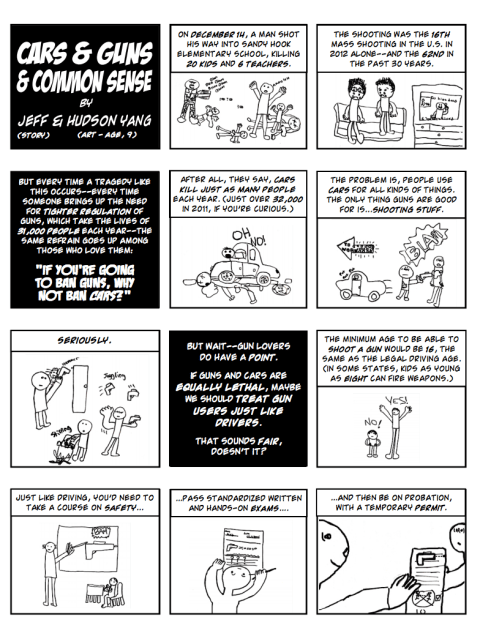
Cars & Guns & Common Sense
A brilliant take on America’s gun problem from comic book artist Jeff Yang and his son Hudson. (Click for larger images.)

What Lies Beneath
If I can pile on to these excellent Streetsblog and Gothamist responses to Steve Cuozzo’s latest tirade against bike lanes, allow me to offer my own observations.
Intentional or not, there’s an underlying racism — or at least an uncomfortable dehumanization of others — that is subtly woven into the fabric of some of Cuozzo’s bike lane rants. This ugliness certainly won’t stoke the outrage of politicians who are only now coming to realize the offensive material that regularly makes it into the Post, but it’s there nonetheless.
In this week’s column, the Cuozz says that the only cyclists he sees in bike lanes are deliverymen.
“I’ve clocked as few as a half-dozen cyclists in 20 minutes — nearly all of them delivering food.”
See how casually Cuozzo dismisses these cyclists? Take my total, subtract the number of delivery cyclists, and that’s the real rate of bike lane use.
Delivery cyclists count. Full stop. They deserve the same safe streets I want for myself. Full stop. In fact, since New York’s economy practically runs on quick and reliable access to Hot Food Now, I would argue that the city has a moral obligation to protect the hard-working, low-paid people who provide it.
In a previous rant, using an argument I’ve seen deployed countless times, Cuozzo complained that the city’s bike lanes were completely empty except for all of the cyclists who were using them. And just as he reasoned this week, those cyclists didn’t count because — wait for it — they were delivering food.
You don’t need a degree in statistics to grasp what’s obvious to any New Yorker out for a stroll: The DOT’s bike lanes are usually devoid of bikes except for food-delivery personnel. The lanes are the superhighway for General Tso’s chicken, but lonesome highways for everyone else.
In Cuozzo’s world, rather than being part of what Jane Jacobs called the “sidewalk ballet,” the “New Yorker out for a stoll” and the food-delivery person exist in separate universes. Even his sentence construction suggests that there’s a difference between “food-delivery personnel” and “everyone else.” It’s as if the people who live and work here providing food to the people who live and work here aren’t people.
While this analysis may sound like some sort of post-modern, p.c., liberal arts college Master’s thesis claptrap, there’s always been enough “there” there if you start to dig into Cuozzo’s Sadik-Khan-obsessed mind and poke around for his Rosebud. I wonder what would happen if he were allowed to fully express his feelings about how New York has changed during the last decade. My suspicion is that he’d have issues with more than just bike lanes.
More Bike Parking on Elizabeth Street
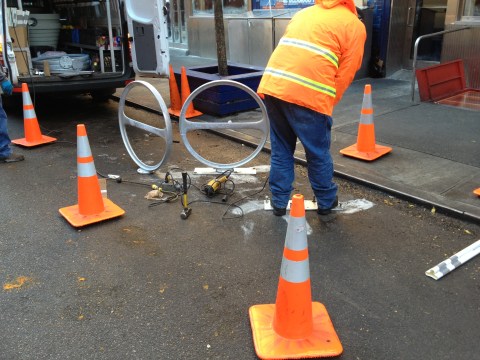
Bike parking is on a roll. (Sorry if that sounds too much like the opening of a Brooklyn Paper
story.)
During my commute across Prince Street this morning, I spotted this DOT crew installing the city’s latest bike corral in front of Cafe Habana on Elizabeth Street. Jennifer Harris-Hernandez from the DOT Bicycle Program, who you can see waving in the picture below, informed me that this is the same crew that installed the bike corral on Court Street last week.
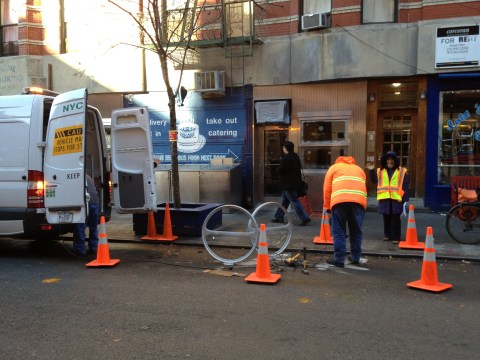
The corral will provide parking for ten bicycles parked at an angle. As is the case with other bike corrals in the city, the space will be protected by two large planters on either end. Cafe Habana is the bike corral’s maintenance partner and will be responsible for sweeping up litter, clearing snow, and caring for the planters.
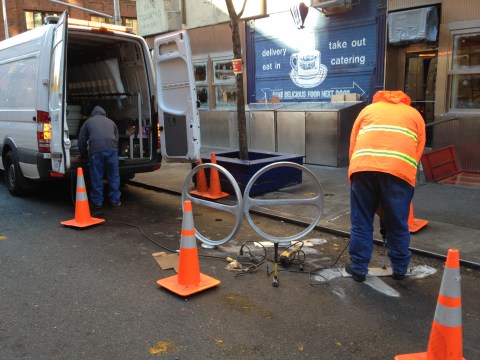
The project also includes daylighting at the corner to make it easier for trucks and large vehicles to turn off of Prince onto Elizabeth.
It only takes DOT crews a short amount of time to install a bike corral, and I would imagine that it’s already being used. So now that there’s bike parking right in front of Cafe Habana, who wants to meet there for breakfast before work next week?
Boerum Hill’s Slow Zone
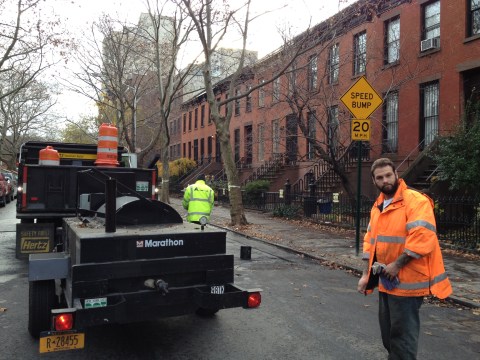
DOT crews were out early this morning putting in a speed bump on Wyckoff Street between Bond and Nevins in Boerum Hill. Additional speed bumps have already gone in on other streets, all part of the neighborhood-wide Slow Zone. As you can see, 20 m.ph. signs are going up in the neighborhood. Gateway treatments still have to be added but should be installed shortly.
Brooklyn’s Bike Parking Boom
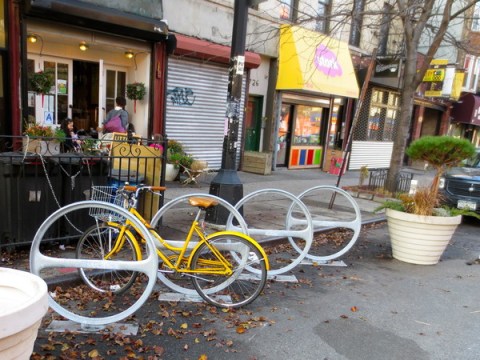
Photo: Prospect Heights Patch
Crown Heights (or Prospect Heights, depending on your sense of borders) got its first on-street bicycle parking last week, with an eight-spot bike corral installed in front of Little Zelda on Franklin Avenue. Via Patch:
The racks arrived late last week, about two months after Little Zelda owner Michael De Zayas put in an application for one at the suggestion of a DOT staffer who noticed the coffee shop’s lush plantings. As part of the deal, De Zayas agrees to put plantings in corral’s large flower pots and remove litter and snow from the area.
Just two months from application to installation is a very encouraging sign. While Patch says that this is the third bike corral in the borough, as far as I am aware it’s actually the fourth. In addition to this new location, there are now bike corrals at Smith Street and Sackett, in front of Gorilla Coffee at 5th Avenue and Park Place, and on Court and Pacific across from Trader Joe’s. Before August 2011 there were no bike corrals in Brooklyn, and now there are four. While our on-street bike parking inventory is lagging behind cities like Portland, the pace with which more is being added is nothing to shake a stick at.
And more bike corrals are still to come. Kinfolk Studios on North 11th Street in Williamsburg is waiting for their bike parking to be installed, most likely pending Community Board approval. There’s also a proposal for a bike corral in Bushwick at Wyckoff Avenue near Starr Street, though that location’s future is far from certain.
Most business owners are probably not aware that they can apply directly to DOT to have a bike corral installed, so if you know of a business that could benefit from this kind of street treatment let the owners know.
Congratulations to the advocates, DOT staffers, and, of course, the owners of Little Zelda for making this latest bike corral a reality. The next step? Bike corrals on residential streets.
“It’s time we stopped living with roads that are killing us.”
Last month, an elementary school teacher in Virginia was hit by a car while trying to cross the road. Greater Greater Washington’s David Alpert, writes this in The Washington Post in response:
But we have a very large blind spot. In 2008 and 2009, motor vehicle crashes were the leading cause of death for Americans ages 8 to 34, according to a National Highway Traffic Safety Administration analysis. We rightly demand explanations and corrective action after crashes of trains, boats and airplanes. Why not for cars, the most dangerous things in the lives of the children Hwang nurtured at her school?
Where does the blame rest? The sad fact is that we — our society as a whole — created this problem. That’s because we relentlessly build communities that aren’t safe to walk in.
Can Alta Keep Up Across the U.S.?
According to Tim Craig in The Washington Post, Alta is having a hard time keeping up with demand for new and expanding bike share systems.
The District’s long-planned expansion of Capital Bikeshare this fall has hit a snag because the city has been unable to get all of the needed equipment from its supplier, officials said Monday.
For much of the year, D.C. Department of Transportation officials have pledged that the city would be adding an additional 54 bike share stations throughout the city this fall. But with fall almost over, officials are recalibrating their timeline for the expansion.
John Lisle, a DDOT spokesman, said that although some new stations could be installed by the end of the month, many would not be.
“We are still waiting on equipment for the new stations,” Lisle said. “We are hopeful we will be able to get some down by the end of the year, but we will not get all 54 stations installed this year as planned.”
D.C. Council member Mary M. Cheh (D-Ward 3), the chairwoman of Committee on the Environment, Public Works and Transportation, said she is “very disappointed” by the delay. Cheh said she plans to consult with other officials to try to make sure Capital Bikeshare’s expansion is not slowed by demand from other cities.
Although Craig writes that “It’s unclear wether [sic] the demand from cities such as New York and Chicago could slow down expansion of Capital Bikeshare,” I’d imagine that making sure New York is ready to flip the the switch by March must be taking up a lot of Alta’s oxygen these days. Because of the different ways bike share systems are funded in cities across the country — private sponsorship in one location, federal funds in another, etc. — the economics may not lend themselves to rapid expansion. And while Alta’s system may be the iPod of bike share systems — well designed, intuitively easy to use, and cool — the company isn’t some $600-billion corporate behemoth with the ability to call Foxconn to order hundreds of thousands of extra widgets by the end of the week. Good things come to those who wait, so the Alta — and a bike-share hungry public — may just have to take it one city at a time.
 Brooklyn Spoke