Carmageddon
Via Atlantic Yards Report comes this press release from Gridlock Sam:
(New York, NY) – September 27, 2012 — Gridlock Sam has declared a Gridlock Alert for Downtown Brooklyn along Flatbush Ave. from Tillary St. to Grand Army Plaza and along Atlantic Ave. from the BQE to Bedford Ave. The Manhattan and Brooklyn bridges along with the BQE will be affected. Avoid driving in the area from 5 p.m. to 9 p.m. Friday,Saturday and Sunday. Expect a post-Jay-Z-concert surge just after midnight all three nights.
The concerts, all scheduled for 8 p.m., will draw almost 20,000 people to Brooklyn’s busiest intersection, Flatbush Ave. and Atlantic Ave, at the height of Friday’s rush hour. On Sunday, the Atlantic Antic, one of the city’s biggest street fairs, will close Atlantic Ave. from the BQE to Flatbush Ave. starting 6 a.m. The street may not reopen fully until 7:30 p.m.
Gridlock Sam’s Best Bet for fans is transit. He said, “Flatbush and Atlantic Ave. is the easiest place, next to Penn Station, to get to by transit. Eleven subway lines: 2, 3, 4, 5, C, D, B, N, Q, R and G stop at the arena or are a 2 to 3 blocks walk. The LIRR stops at Atlantic Terminal, right across the street from the arena. Pre-concert there’s already plenty of service. Post-concerts and events, the MTA is adding subways to certain lines and doubling LIRR service from Atlantic Terminal to ensure efficient and convenient travel.”
Holy scheduling overlap, Batman! I had completely forgotten about the Atlantic Antic, which officially ends at 6:00 PM on Sunday but, as the press release notes, may keep the street closed until just before the Jay-Z concert starts. And today’s rain may make a typically messy evening commute even messier, no matter how people choose to get to the Barclays Center.
“This isn’t really a call to share the road.”
Via Carlton Reid, who asks, “Why must cyclists behave before they get bike paths?”
When MPs, newspaper columnists and random haters on social media call for compulsory cycle training, mandatory cycle lanes, bicycle license plates, payment of ‘road tax’ (which was abolished in 1937), and total adhesion to road rules from all cyclists, this isn’t really a call to share the road with trained, registered, fee-paying, law-abiding cyclists, it’s a call for cyclists to get out of the way, a desire for transport cycling to wither and die.
This sentiment is similar to one I expressed this summer about people who constantly remind cyclists that they have all of the same rights and responsibilities as motorists.
What they really mean is that cyclists ought to have all the same inconveniences and annoyances as motorists. If drivers have to stop for every red light, so do cyclists. (So no Idaho stop laws.) If drivers have to take an indirect route every now and then, so do cyclists. (So no contra-flow or two-way bike lanes.) If drivers have to be licensed and get their vehicles insured, so do cyclists. (So no more “free” bike lanes.) And if drivers have to follow seat belt laws, cities also need to require cyclists to wear helmets. (So, you know…)
Make a Better New York Times Story
Matt Flegenheimer’s story in the Times about the recent uptick in traffic fatalities leads off with the impression that bike lanes and pedestrian plazas have not contributed to an overall increase in safety, despite the DOT’s own statistics. In fact, the sequence of the first two paragraphs — We have been told bike lanes and pedestrian plazas have made New York safer, but here is a study with some disquieting info — creates a completely illogical connection.
Five paragraphs into the story is this buried lede: “A preliminary analysis suggested that the crashes were concentrated on highways, far removed from many of the areas that have been the focus of the city’s initiatives.” In other words, the Times, for whatever reason, chose to use the city’s “bike lane battles” as a framing for a story totally unrelated to bike lanes. Eighth Avenue may be safer with a bike lane on it, but it’s a bit of a stretch to expect the Eighth Avenue bike lane to stop dangerous driving on the BQE.
In light of this, I decided to re-order Matt’s story in a more logical manner. I left in the bit about bike lanes and pedestrian plazas, but I left out all the stuff about the LOOK! campaign and Janette Sadik-Khan’s Ryan Gosling impersonation. (That Janette saved three or four distracted pedestrians is a fun anecdote, but it’s no more relevant to overall fatality rates than Ray Kelly tackling a purse snatcher would be to robbery stats.) I left out the “distracted walking” speculation since I don’t typically see too many pedestrians on the Cross Bronx Expressway. I also left out the quotes from James Vacca, since someone could stub a toe in Times Square and Vacca would call Janette before the City Council to explain herself. I rewrote nothing:
Traffic fatalities from July 2011 through June 2012 were up 23 percent from the previous year — to 291, from 236. It was the first increase since 2007, when there were 310 traffic fatalities, after years of consistent decline.
Though overall crashes fell slightly for the second straight year, 176 cyclists or pedestrians were killed in crashes, up from 158 the previous year. The other 115 deaths were motorists or their passengers, a sharp rise from the 78 drivers and passengers killed the year before.
According to the Mayor’s Management Report, speeding, driving while intoxicated, and running red lights or stop signs accounted for a combined 54 percent of motorist or passenger fatalities. A preliminary analysis suggested that the crashes were concentrated on highways, far removed from many of the areas that have been the focus of the city’s initiatives.
The release last week of the Mayor’s Management Report, a twice-yearly collection of city measures, revealed a disquieting figure. Total moving violation summonses fell by nearly 15 percent from July 2011 through June 2012, to a little over one million. These included over 150,000 summonses for prohibited use of a cellphone, a decrease of about 22 percent.
The Police Department did not respond to a request for comment.
The Transportation Department typically compiles figures for the calendar year, Commissioner Janette Sadik-Khan said, so the agency wanted “to reconcile what’s going on.” She allowed, however, that “it does look like there’s a rise.”
For years, the New York City Transportation Department has held a trump card in the roiling debate over its many roadway interventions: When officials said the measures, like pedestrian plazas and bike lanes, had made streets safer, the numbers appeared to back them up.
The traffic data appears more encouraging when set against figures from past years, before the city experienced its recent sharp decline in annual deaths. There were 243 traffic fatalities in the calendar year 2011, about a 38 percent reduction from 2001.
Paul Steely White, the executive director of Transportation Alternatives, a cycling and pedestrian advocacy group, called the new statistics “alarming” and attributed much of the uptick to what he deemed lax police enforcement of traffic laws.
“Anyone who walks or bikes across a New York City street knows that motorists are getting away with reckless driving, day in, day out,” he said.
The announcement came five hours after a 38-year-old cyclist was struck and killed by a vehicle on Queens Boulevard in Kew Gardens, and about 14 hours after Francisco Camacho, 59, was fatally hit as he crossed the Cross Bay Boulevard in Ozone Park.
The police, Mr. White said, are “not doing their job.”
Put your feet up
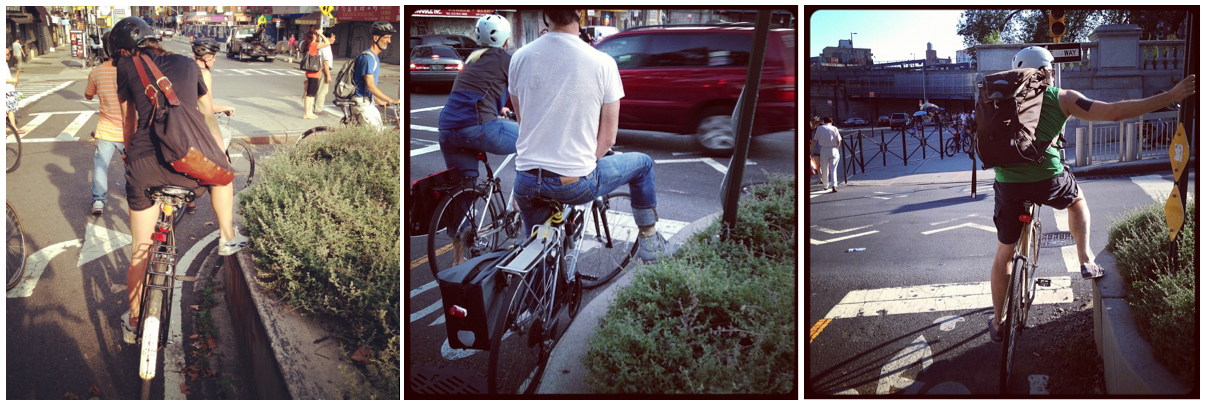
Cyclists resting a foot while they wait for the light. (Click to enlarge.)
Perhaps my favorite piece of cycling infrastructure in New York City is its most unintentional. No one designed a footrest for cyclists to use as they wait for the light to change to get onto the Manhattan Bridge, but that’s exactly what you’ll find at the end of the concrete planter that protects the short bike lane on Canal Street. Not a day goes by that I don’t see someone using the ledge to get a leg up, so to speak, and when I’m at the front of the herd I love taking a short break there myself.
This little piece of New York cycling reminds me of this footrest in Copenhagen:
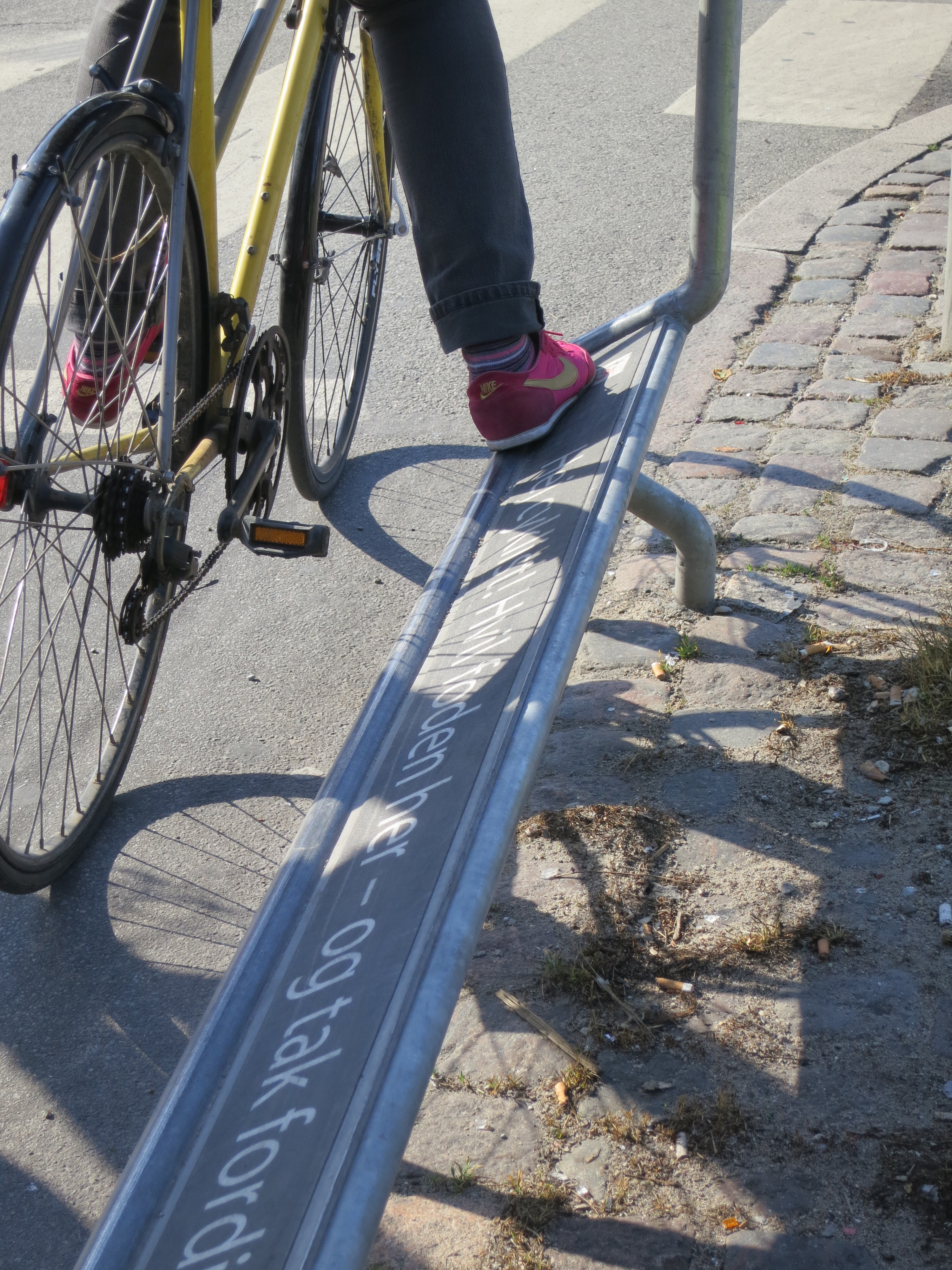
Here’s a better view:

The message reads, “Hi, cyclist! Rest your foot here… and thank you for cycling in the city.”
While New York’s version is purely unintentional, cyclists are certainly taking advantage of it. As Copenhagenize’s Mikael Colville-Andersen notes, “people will always put a foot up if they can.” And since that’s the case, it makes sense to use it as an opportunity to reward people who ride:
When riding about in schools of Copenhagen cyclists and rolling up to a red light, the cyclists along the curb will all wait with a foot on the curb. If there is a traffic light post close enough to the sidewalk there will, as a rule, be a hand resting on it and holding the person in question up.
Why not spoil a few cyclists with a fantastically cheap and practical idea? A couple of metal railings. Slap ’em up. Make a few hundred cyclists a day feel loved.
Fair enough, it’s not a solution that can be implemented at every intersection. Nobody wants metal railings all over town. But find a place where they work and just do it. At some other intersection, perhaps another idea will fit perfectly.
There are certainly a few spots around New York where a Copenhagen-style railing with some sort of positive message would make sense. In addition to brightening someone’s day it might have the unintended effect of getting people to stop for red lights. In fact, why not give Copenhagen’s version a New York twist? “Hi, cyclist! Rest your foot here while you wait for the light…and thank you for cycling in the city.” Since I’m of the opinion that it always makes more sense to tell people what you want them to do rather than not do, this would be a far more positive and effective message than “Don’t be a jerk,” no? It would be like the city saying, “We’re doing our part, now please do yours.”
Ever since I started noticing people putting their feet up at the end of the bike lane on Canal Street, I started noticing it elsewhere. Here’s someone taking advantage of a water fountain on the newly designed Allen Street bike lane at Delancey Street:
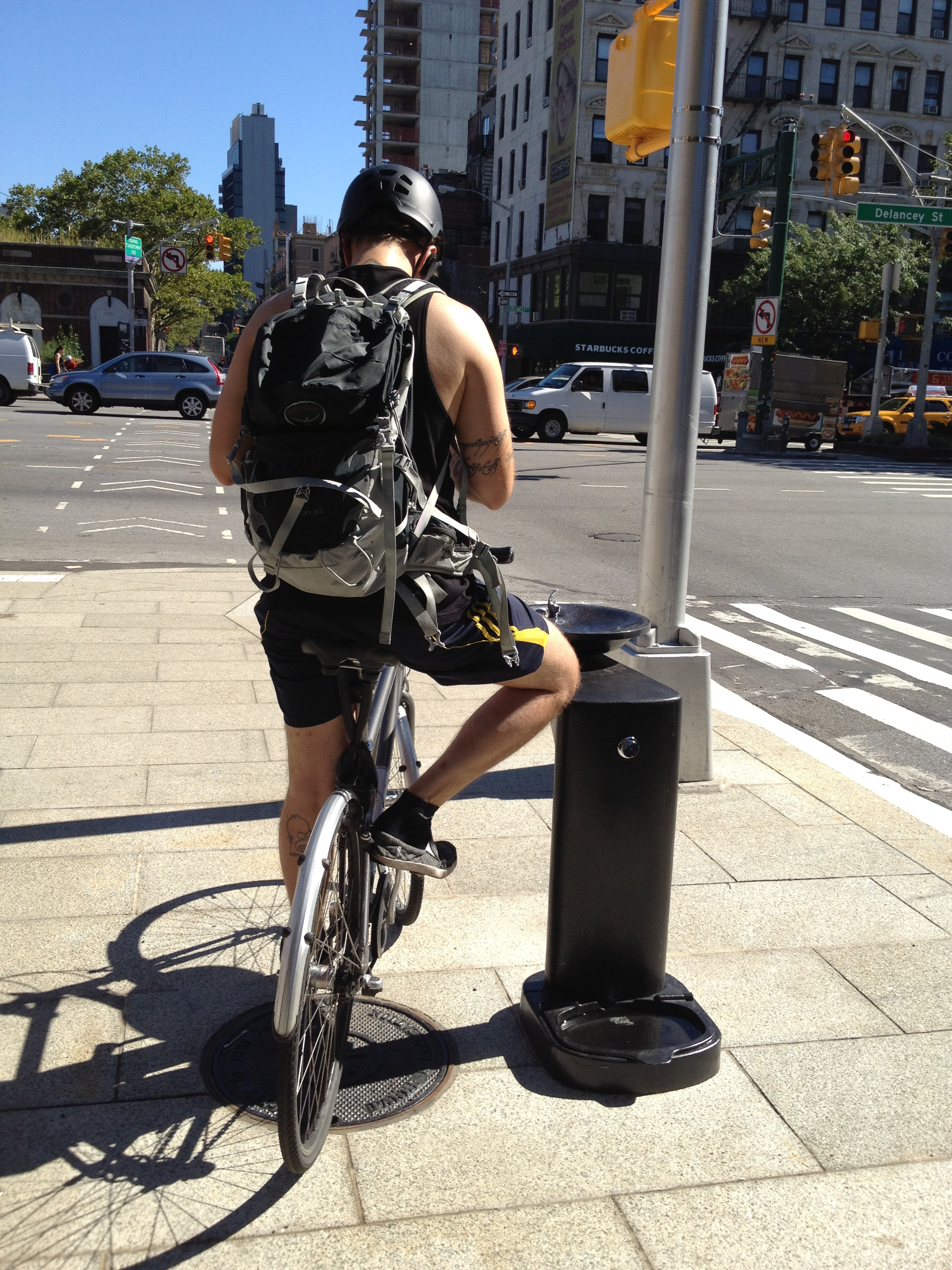
The city might not be too keen on the idea of hundreds of cyclists putting their knees up against a public water fountain, but if it’s what hundreds of cyclists wind up doing they might want to think about making it official. It would be just a tiny way for the city to say “thank you” while responding to how people are actually using their streets.
UPDATE 9/25: Since I have footrests on the brain, I was tuned in enough on my ride this morning to notice the most basic footrest of all, a curb.
The “Kvetchocracy”
Cap’n Transit takes a look at the limits of 311 and cautions against using the data it gathers as any sort of reliable gauge for the public’s true top concerns. Why? Because people who use 311 tend to be “retirees and people on long-term disability” with time on their hands and therefore do not reflect the breadth of opinion within the population at large:
These retirees are the same people who show up at all the community board meetings. Many of them are nice people who care about their neighbors, but most of the current batch are trapped in the middle-class Baby Boomer ideology. This is the worldview that equates car ownership, parking and use with freedom, opportunity and upward social mobility, and sidewalks, apartments and transit with dirt, crime and corruption. This worldview colors and pervades their activities, making them more likely to care about noise, parking and congestion, and less likely to care about sidewalk obstruction, transit delays and pedestrian harassment.
Knowing this, it is not surprising that the 311 calls reflect the priorities of middle-class Baby Boomers more than any actual reality on the ground. That will always be present as long as a 311 call takes so long and other populations feel discouraged and disenfranchised. Cutting the alternate-side announcements to ten seconds or less would make a difference, but the totals are not representative of public opinion in general. We need to be very careful that they’re not taken out of context.
Rogue cyclists and the dangerous behavior of food delivery men on e-bikes are “among the top quality-of-life complaints on the Upper East Side,” even though I’m willing to wager that cyclists are no more or less likely to break laws there than in other parts of the city. I understand that politicians must respond to their constituents most urgent concerns, but one would hope that such leaders would filter all complaints through the reality of statistics. People who are “almost” hit by bikes tend to live to report the incident to their local representatives. People who are hit by cars? Not so much.
Carry a rabbit’s foot, too.
Via WBUR, Boston’s public radio station, here’s the intro to a story by “science and automotive journalist” David Holzman titled “Don’t be a Bicycling Statistic.”
Tanya Connolly, 37, crushed under a tractor-trailer in South Boston last Monday. Doan Bui, 63, killed by a speeding pickup truck on a busy Dorchester thoroughfare the Friday before. Alexander Motsenigos, 41, victim of a hit-and-run in surburban Wellesley late last month.
In major metropolitan areas like Boston, it often seems as if every week brings news of another bicycling death — or, as in this past week, more than one — usually in an unequal clash between vehicle and rider. Biking experts say that as more people take to two-wheel travel — surely a good thing — more accidents are also likely. Below, writer David C. Holzman describes his own bike crash, and shares a key safety technique that many riders ignore: Helmets save lives, but they have to be worn right.
“Helmets save lives, but they have to be worn right.” Sure. Because everyone knows that styrofoam helmets are the perfect defense against tractor-trailers, speeding pick-up trucks, and hit-and-run drivers.
“Bike lanes are not a fad.”
Via Brent Toderian, the former planning director of Vancouver:
Mr. Toderian bemoaned the fact that bike lanes have become a hot-button issue, noting that biking is merely one pragmatic part of making a city function.
“Only in North America has this become an ideology,” he said, blaming both those who call bike lanes a war on the car and “self-identified cyclists” who don’t help the discussion.
Mr. Toderian, now an independent planning consultant, said bike routes are the only aspect of the city’s entire transportation puzzle that the public and the media tend to talk about.
“Bike lanes are not a fad. They are part of a multi-modal city, a critical part of the city working well in the future.”
Given New York’s recent tabloid hysterics, I share Toderian’s concern that “we’re starting to sound like Toronto with Mayor [Rob] Ford.”
Some thoughts on LOOK!
Today, DOT announced officially launched its LOOK! Safety Education Campaign, and will ultimately spend $60,000 to mark 200 intersections with the exclamatory admonition. Why?
“Having the right of way does not guarantee your safety,” LaHood said, while standing beside an intersection that saw 75 pedestrian injuries between 2006 and 2010.
“We need motorists to pay attention as they’re taking the turn,” Sadik-Khan urged.
Think about that. Instead of spending $60,000 to fix a single intersection where about nineteen pedestrians are injured per year, DOT is spending $300 at each of 200 intersections to tell people to watch out. While I know there isn’t one giant budget from which all DOT projects are created, this still seems like a strange priority. It’s like looking at a patient with brain cancer who needs a single chemo treatment for a chance at survival and announcing that you’re instead going to use your medical insurance to give 200 people with migraines a fancy card that says, “Get a good night’s sleep.” Even worse, it’s like making that announcement with the cancer patient standing right behind you for the photo-op.
There’s a weird disconnect between the project’s goals and its execution. The problem with drivers isn’t so much that they don’t pay attention, but that they speed and are downright hostile towards people in their paths. Just today I checked before crossing Varick Street with the light in front of my office and saw no cars coming in any direction. But as I made it well into the middle of the street a driver came barreling around the corner at full speed, passing in front of me by mere inches. Had I been walking slightly faster no reminder to LOOK! back at the curb would have saved my life. LOOK! may make the difference for a few iPhone-obsessed pedestrians, but I doubt if it will help too many seniors cross a three- or four-lane avenue in thirty seconds.
According to Streetsblog, the LOOK! campaign was inspired by the “ubiquitous crosswalk markings in London that instruct pedestrians to look left or right.” But there’s one hugely obvious difference between London’s reasons for doing this and New York’s. In London, “Look” is a signal to Americans, Continental Europeans, and other foreign visitors who may not be used to walking in a city where cars drive on the “wrong” side of the road. Translated from the British, “Look” essentially means, “Please try to overwrite the ingrained brain patterns that you’ve developed over a lifetime of crossing the street in your home country since failing to do so in jolly old England may result in you accidentally getting crushed by a law-abiding black cab driver.” In Noo Yawkese, “LOOK!” simply means, “Our drivers here are KA-RAY-ZEE, so good luck, pal.”
For educational campaigns to work at all they need to be ongoing. DOT will also be targeting “drivers with ads on the backs of buses,” but those ads will only be up for six months, will likely only reach a tiny fraction of New York City motorists, and will be competing for attention with ads for 1-800-DIVORCE and Resident Evil: Part 36. Long after the ads are taken off of buses, these thermoplastic letters will still be left on the ground at hundreds of intersections, leaving the longterm impression that street safety is solely in the hands of the most vulnerable users.
And speaking of vulnerable users, compare the messages DOT has recently relayed to these different categories of street users:
- DOT to pedestrians: LOOK!
- DOT to cyclists: Don’t be a jerk.
- DOT to drivers: Hit at 40 mph, there’s a 70% chance they’ll die. Hit at 30 mph, there’s an 80% chance they’ll live. That’s why it’s 30.
As I’ve said before, there’s something wrong with your messaging when the abstract lesson in physics and statistics is given to the people whizzing by your ads at 40 mph, while the short, curt admonitions are reserved for the people experiencing the city at biking and walking speeds.
So, look. Even in the most pedestrian- and cyclist-friendly cities it’s still a good idea to raise your eyes from up your cellphone before stepping off of the curb. Given the unpredictability of New York City streets, I have no problem with anyone, even the government, telling people to be a little more careful out there and to take responsibility for their own safety. I also recognize that DOT’s hands are tied. If livable streets depend on finding the right balance of the three E’s of Engineering, Education, and Enforcement, it’s never going to be easy for DOT to accomplish its goals when the NYPD doesn’t seem to care that much about the last E.
Still, that’s no excuse for the DOT’s overall pattern of ignoring the bull, as Mikael Colville-Andersen would say. Ultimately, I don’t think LOOK! will hurt; in limited cases it can only help. If a little thermoplastic will remind someone to stop texting before they cross the street, fine. But why can’t the department that gives us bold and visionary street designs also give us bold and visionary safety campaigns?
My New Hero, Emily Finch
Man oh man, is Emily Finch inspiring. She went from driving her kids around in a nine-passenger Suburban to biking them around in a bakfiets rigged with some special attachments. I’ve previously described her as that rare combination of outlier and inspiration. While there may be few people like her, if she can do what she’s done it shouldn’t be that hard for other parents to do something at even a much smaller scale.
Everything I’ve read about her and by her suggests to me that she just radiates positivity. If this woman hasn’t been offered her own reality show soon then America has failed.
The Rules
Zingtapan had been returning from lunch with a friend when the cabbie tore westbound across 69th Street, honking his horn, witnesses said.
They said the driver was trying to make the yellow light. Pedestrians including Zingtapan were already crossing 69th.
Whether or not Zingtapan was jaywalking is beyond irrelevant. If the cabbie was honking his horn, he saw her and her fellow pedestrians. End of story. A pedestrian is not an immovable object, but a car is not an unstoppable force. It has a brake pedal and a driver who can press down on it. And when a driver sees a thing, speeds up toward that thing, honks at that thing, and runs into that thing and that thing is a human being, that’s where criminal charges should most definitely come into play. There’s no other way about it.
But we New York City pedestrians are used to this, aren’t we? Drivers see us in crosswalks and keep going at speed, leaning on the horn the entire time as if to say, “I see you, but if I kill you it will be your own damned fault.” Why? Because they have the light. In such instances, the social contract of the street gets sacrificed on the altar of The Rules.
I’m not sure where along the line it happened, but in today’s New York City there is a strict fidelity to The Rules that now trumps courtesy and common sense; we’ve become so beholden to The Rules that we can no longer distinguish between the irritatingly annoying and the downright deadly. If a person breaks The Rules, the current thinking goes, he deserves what he gets, whether it’s the severe financial punishment that now accompanies some leisurely rides in the park or the potential for injury and death that comes with crossing the street two seconds before the light turns red.
This adherence to The Rules above all else has not made us safer. However, it has left us with a city where riding your bicycle on the sidewalk for ten feet warrants a summons because, look, I know that no one was around but The Rules say its illegal to ride on the sidewalk and we need to enforce the law, okay? And if you roll through an empty intersection on your bike when the light is red you can’t very well ask police to use their discretion when it comes to The Rules, can you? What are you, an anarchist?
But mow someone down with your car? Even if there’s indisputable evidence that you saw the person and had plenty of time to make a different choice other than aiming your vehicle directly for them and accelerating, as long as you were obeying The Rules — or at least not violating a bunch of them at once — you’re in the clear. In the words of the NYPD, it happens.
Ray Kelly, the department he commands, and the tabloids that cry bikes every time a person is almost hit by one have essentially sanctioned the sociopathic behavior of drivers with this mentality. Because in their universe, so long as a motorist doesn’t violate the most basic, microscopically technical reading of The Rules, he has a license to kill.
 Brooklyn Spoke