A Thousand Words
I finally got around to uploading my pictures from my trip to Amsterdam and Copenhagen. Here are two of my favorites, one from each city.
First up, Amsterdam:

No helmets, no cycling gear. A person who did this in New York City would have their child taken by Child Protective Services. Most impressively to an American’s eyes is the casual “hang on” manner in which the kid is riding. The young girl isn’t even really using the child seat on the back of the bike and is so relaxed that she can look around and take in her environment. And given the fact that the streets are so quiet, with no drivers honking at them to get out of the way, mom and daughter can even talk. Simply wonderful.
Copenhagen:

I took a bunch of pictures on Istegade, the street where this was taken, and many of them were of parents transporting or riding with children. This isn’t an especially artful one–I’ll leave the real “cycle chic” photos to Mikael Colville-Andersen–but it does show so much about what makes Copenhagen special. Once again: no helmets, no gear. Just regular clothes as any dad would wear while pushing a stroller…or casually pedaling a nihola cargo bike.
While Copenhagen is famous for its separated bicycle lanes, what struck me about Istegade, or at least the stretch I was one, was that it had none. It didn’t even have “sharrows,” that cursed street marking in which Americans put way too much faith. But when drivers are used to seeing cyclists–and likely to be cyclists themselves–they tend to be patient and careful. Not only that, but when a city treats cyclists as equally deserving of space on the road, drivers have less of a license to squeeze them off of it. It proved to me that changing the culture will be as important a factor in New York’s evolution into a cycling city as changing the infrastructure.
Some of John Liu’s best friends are bike share systems
“I support bicycling in the city, but I also think we need to be realistic about the potential exposure the city faces.” John Liu, New York City Comptroller.
Now where have I heard that phrasing before?
The story in Saturday’s Times about Liu’s concerns over the city’s potential legal liability should someone a Citi Bike user be involved in an accident could have ended after this graf…
The bike-share contract with Alta Bicycle Share protects the city from claims, Mr. Solomonow said, even those above the insured amount; the company has not faced claims so far over the bike-share programs it operates in Washington or Boston.
…but, of course, it devolves into baseless conjecture after that, with detail-free scare stories which would make the average reader think bike share was about to unleash a wave of financial trouble for the city.
Including the 2006 death of Dr. Carl Henry Nacht on the West Side Greenway as an example of the city’s potential liability from bike share is as senseless and tasteless as it is unrelated. Dr. Nacht was hit when a tow truck driver crossed the bike path without slowing, “Despite signs telling drivers to yield to pedestrians and cyclists.” A jogger could have very well been crushed by this same driver in this same spot, but no one would use that tragedy as a reason to stop the New York Road Runners club from handing out 10,000 pairs of free sneakers, if the NYRR wanted to do such a thing.
As Citi Bike gets set to launch this summer, let’s live in the real world. If an improperly installed air conditioner falls out of a window and hits someone as they’re pulling a blue bicycle out of a docking station, it will not be a “bike share accident.”
Free Beer

If you rode home via the Manhattan Bridge on Friday evening, this sign might have enticed you to stop on the Brooklyn side just before the turn onto Sands Street. In a spot most busy New Yorkers typically want to get through quickly due to the rumble of the train on the bridge and the deafening sound of drivers leaning on their horns, a small group of people were gathered, enjoying their free beer and chatting with total strangers who just happen to commute by bicycle. This simple sign and a cooler full of cheap, cold beer gave people permission to create a momentary sense of place and an improptu community.
I didn’t catch the name of the guy who threw it together, but heard him mention that he’s a sign maker based in the Navy Yard. If you have more info, please share in the comments. And in case you’re interested, no open container laws were violated. Every beer came in a plain brown wrapper.
Quote of the Day
“Logically then we should get rid of all of these things along with bike share, and if anything we should institute a historically accurate horse share system. We should also put it to a vote–but women shouldn’t be allowed to vote, since New York City wasn’t designed for women’s suffrage.” – Bike Snob
Park or Ride
Via Streetsblog:
At last night’s meeting, DOT explained that Lafayette Avenue handles 769 cars per hour during the evening rush. Removing a general travel lane for a bike lane, the agency said, would affect traffic flow too much for it to consider the option.
If Lafayette is so vital a corridor that “removing a general travel lane for a bike lane” would adversely affect traffic flow, then perhaps the city should sacrifice a parking lane and let the cyclists have it instead. Surely the movement of thousands of people traveling home from work or school by car or by bike over the course of an evening rush is more important than the long-term storage of dozens of private cars on each block. Remove a lane of parking, install a raised curbside lane, and let the motorists continue to have their travel lanes as before.
While retiming the lights to 20 mph is a step in the right direction, I don’t have high hopes that “signage informing motorists that passing cyclists within the lane is prohibited” will enlighten drivers all that much about a cyclist’s right to full use of the lane. Are we to expect that the the 39% of them who currently ignore the posted speed limit will suddenly read a sign and lay off the horn as they wait behind an uphill-climbing cyclist?
One day we’re going to have to pull these band-aids off a lot faster and build our way to better streets, not just slap down some paint and hope for the best. Until the safe passage of cyclists trumps the free storage of automobiles we will never solve New York City’s “travel lane” problem.
Make Lafayette Safer Tonight
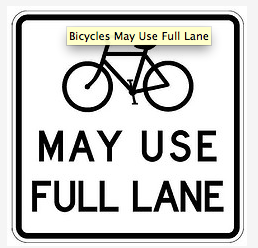
The inexorable march toward a safer New York continues tonight, Tuesday, June 19th at 6 pm in Fort Greene. Via Transportation Alternatives and Make Lafayette Safer:
…the New York City Department of Transportation will present plans to install an enhanced shared bicycle route along this popular street. Over the past year, the community organization Make Lafayette Avenue Safer built overwhelming community support for a safe bicycle route and reduced speeding along this busy street. Now they need your voice in the room to make this vision for a safe Lafayette Avenue a reality.
The Department of Transportation’s plan calls for sharrows, more bicycling signage and traffic lights timed for 20 mph speeds. These improvements are a good start, but the installation of an actual bike lane is a must for this street. We encourage you to speak in support of these first steps at the meeting, but also to ask the Department of Transportation to do more by creating a dedicated bike lane in the future.
DOT’s proposal, which does not include an on-street bike lane, is a compromise from many advocates’ initial hopes, but a step in the right direction. Make Lafayette Safer is calling for additional enhancements to make sure it’s done right:
Make Lafayette Safer still wants additional safety measures, including color enhancements for centrally located sharrowed bike markings, and an adequate repeating of the symbols so drivers are always aware of the priority for bikes in the lane.
Community Board 2 will meet at St. Francis College’s Callahan Center at 180 Remsen Street. I hope you can make it!
I Want to Park My Bicycle
Add Wythe Avenue to the growing list of Brooklyn locations with on-street parking for bicycles.
Via DNAinfo:
Racks for eight bicycles will soon replace one parking spot on Wythe Avenue, city officials said.
The Department of Transportation will install bike racks in front of Kinfolk Studios, a cafe, bar, and studio (which designs bikes) that has requested the change, officials said.
The spot, 22 feet long and 8 feet wide, will have racks bolted to the street and a planter pot at each end, a DOT spokesman said at a Williamsburg Community Board One meeting earlier this week. At his announcement the room broke into applause supporting the initiative.
Kinfolk’s owner Maceo McNeff, who approached the DOT about the plan, said the change made complete sense for his business.
“All of our clients and employees arrive here by bicycle,” he said of the design studio, and as for the cafe he estimated that 80 percent of customers showed up on two wheels.
“I see 12 bikes that are all attached to stop signs right now — every sign here has at least two bikes on it,” Maceo said standing outside his business Thursday. “There’s plenty of car parking here and not really any bicycle parking.”
Only one minor quibble with the above: let’s stop calling them bike racks. A rack is something that belongs behind a school or next to a playground. Parking is what we should call any space where bicycles are given equal or preferential access to the valuable, but free real estate we call our city streets. Plus, using a word like parking is one minor way to legitimize bicycles as a form of transportation. Hats off to McNeff for his astute comments and his understanding of his business. Far too often, one gets the sense that business owners actually have no real understanding of how their customers arrive. (By the way, how wonderful is it that “the room broke into applause” at the CB1 meeting?)
As the DNA story notes, DOT says that “any business could approach the agency with interest in putting racks outside their cafe or store,” so get to it, local business owners! (Why every bike shop in the city isn’t requesting on-street bike parking I do not know.) I had a great experience working with Park Slope Neighbors’ Eric McClure, Irene LoRe of the Fifth Avenue BID, Darlene and Carol at Gorilla Coffee, DOT and CB6 to get 5th Avenue’s new bike parking installed and am happy to answer any questions about how the process works. It’s easy and good for business.
Acts of God
A cyclist was killed in Queens yesterday after colliding with an open door of a parked car.
A circus worker died in freak bicycle accident yesterday when he slammed into an open car door on a Queens street and was impaled on his bike’s handlebars, sources said.
The man, in his early 30s, peddled into the driver’s-side door of a parked Toyota Camry on Union Turnpike Fresh Meadows at around 8:10 p.m., police said.
Read these reports and you’d think cyclists are in the habit of running into stationary objects and impaling themselves on their own handlebars. One story barely mentions a driver at all and the other says that the cyclist “peddled into the driver’s-side door of a parked Toyota Camry,” leaving the casual reader with the impression that the cyclist hit a curbside vehicle like an idiot. When no actors other than the victim are identified in a story, then there’s no need to question why “no criminality is suspected.” It’s the Darwin Awards, plain and simple.
The Queens Courier is, at best, a benign example of passive act-of-God style of writing; the door was not opened by anyone but was merely “open.” The Post story, however, simultaneously puts the blame on the cyclist (he “slammed into an open car door”) and on random circumstance (a “freak bicycle accident”) leaving the cynic to think there is an actual editorial policy in place at our city’s tabloids to never, even in the case of a clear violation of traffic law, give the impression that a motorist might have some responsibility for what happens in or around his vehicle.
The “Ahh factor”
Martha Roskowski, project manager of the Green Lane Project, gives as good a definition of a successful bike lane as any I’ve read. Via Grid Chicago:
“It’s called the ‘ahh factor’. You’re riding your bike through downtown Chicago, and you’re like, ‘Gotta be on it, gotta be an A-cyclist, gotta go fast’. You’re a little bit nervous, ‘the light’s gonna turn, I gotta go, I’m gonna get run over, okay I made it’. And then you get over to the Kinzie Street protected bike lane…’Ahhh, I made it’”. Streets like those get people out on bikes, she declared.
This is exactly the feeling I have when I’m riding up Hudson Street and finally enter the 8th Avenue bike lane, when I reach the protected portion of Flushing Avenue, or when I turn onto the Manhattan Bridge after leaving the traffic at Jay Street during my morning commute. It’s an especially noticeable sensation when I’m taking my daughter up to soccer in Prospect Park and I cross from Plaza Street onto Prospect Park West.
As I experienced in Amsterdam and Copenhagen, when a city builds that “Ahh factor” into all of its cycling infrastructure its citizens don’t even notice they’re feeling it anymore.
It’s planning, not DNA
Via Jay Walljasper:
It’s planning, not DNA. Holland may seem unique, but there’s nothing all that special about Dutch bikers. Rather, almost all of the bike-friendly innovations Holland now boasts stem from careful government planning. The spark was the 1970s oil crisis. Desperate to find alternatives to a car-dependent culture, Holland embarked on a generation-long experiment that’s now bearing fruit. The takeaway, says Walljasper, is that this success can be repeated anywhere—even here.
 Brooklyn Spoke