9th Street Traffic Jam
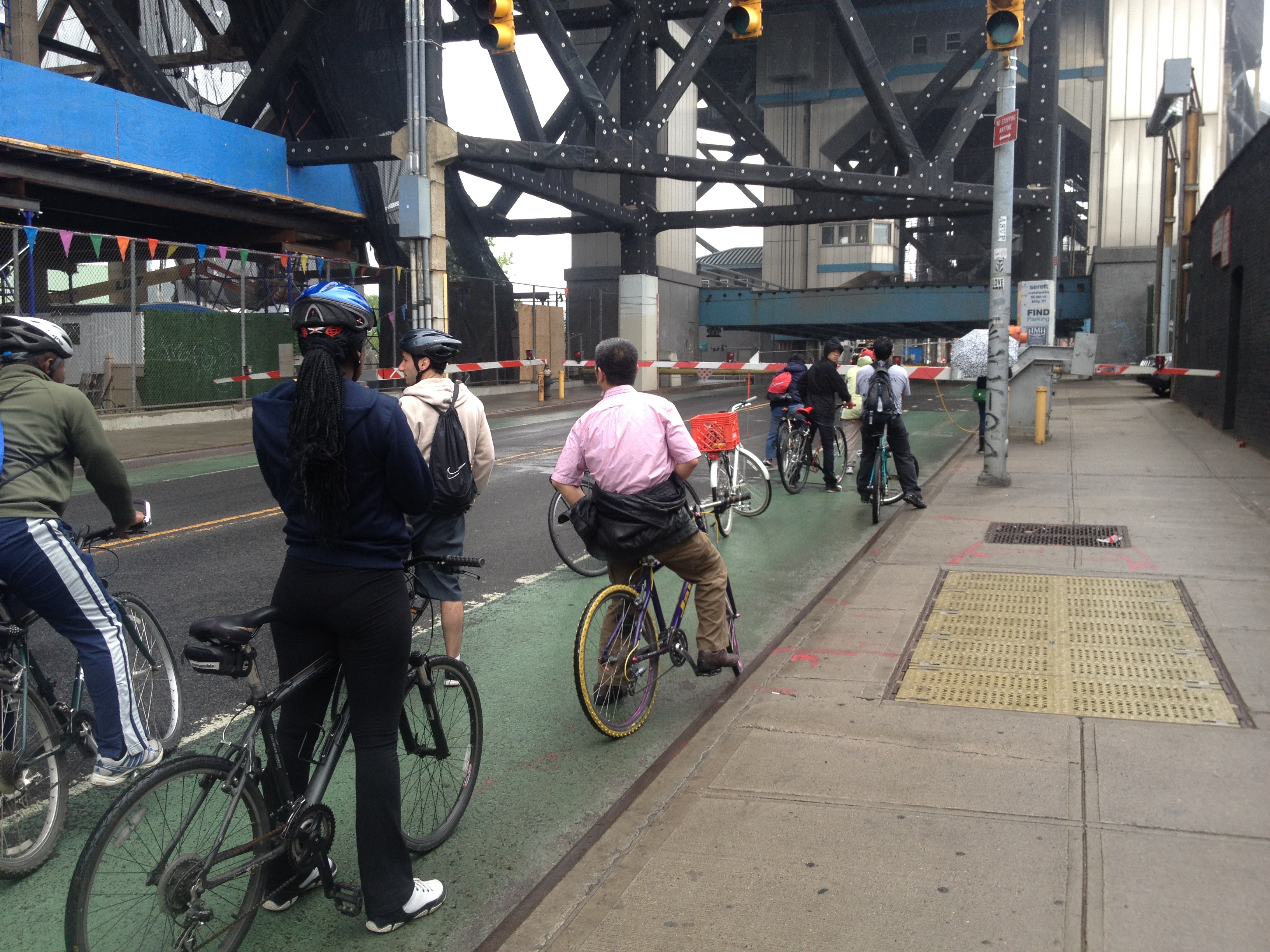
I snapped this picture last Saturday while waiting for the drawbridge over the Gowanus Canal on 9th Street on my way to Red Hook. There were at least a few cyclists behind me, bringing the total number of people on this side of the street to about twelve. And that’s not including the five or so cyclists I saw on the other side of the bridge once it went down. To top it off, it was a cold and misty morning. Not bad, #bikenyc.
Bike to Work Day – Friday, May 18th
Next Friday, May 18th is Bike to Work Day here in New York and across the country and to celebrate I’m hosting a ride from Gorilla Coffee to the Manhattan Bridge. Full details are at the new BikeNYC.org:
Celebrate National Bike to Work day Brooklyn style! Join fellow two-wheeled commuters for a social ride from Park Slope to the Manhattan Bridge. We’ll enjoy some coffee and muffins and then meet up with other Bike to Work Day rides coming from other parts of Brooklyn. Our route will take us through downtown Brooklyn to the Manhattan Bridge where Transportation Alternatives volunteers will be on hand with snacks and, of course, more coffee. From there, riders will have the option to continue on to Manhattan destinations with other riders. Don’t worry! If you’re new to bike commuting we’ll make sure you’re hooked up with a great guide.
Meeting time is 8:00 AM. I’ll have “I Bike Brooklyn” buttons on hand to give out to anyone who comes. And if you don’t live near Park Slope there’s also a Bike to Work ride from Ditmas Park leaving at 7:30 AM.
Off the Charts

The numbers alone do not tell the story.
The bar graph above is, of course, as meaningless as it is tongue-in-cheek. Missing is any contextual data, such as bikes per capita, station density, or annual membership fees. My point in making such a crude graphic is that throwing up a chart titled “What Bike Share Costs — A Comparative Chart,” and not including a host of other factors doesn’t tell anyone much about what regular bike share usage will in fact cost.
Andrea Bernstein imagines some very extreme scenarios in her Transportation Nation post. Scenario one:
…when the system expands to Bedford-Stuyvesant and the Upper West Side, one can easily imagine a one-way commute of an hour. Alta officials have said one-way commutes are frequent in Washington, DC. When it’s raining in the morning but nice in the afternoon, a user might want to ride home from, say, Lincoln Center to Crown Heights.
Emphasis mine. That one way-commutes are frequent is not at all the same as them being long. And when the system expands, it does not necessarily follow that commuting distances will increase with it. An Upper West Side resident who lives at 79th Street might be anxiously awaiting for the system to expand so he can ride to 72nd before hopping on a downtown 2/3, thereby avoiding the need to transfer from the 1 train.
Scenario two involves the idea of new riders and fairness, which Andrea brings up in response to some critical comments:
In Washington, many riders have been lured into the system who are not regular cyclists. Should it cost newer riders with longer commutes $4 to get to work on a bike?
There’s no proof that newer cyclists live any further away from their place of work than veteran bike commuters. In fact, there may be thousands of bike commuters waiting to be born who live in or near the Manhattan CBD. Bike share will provide an easy and risk-free way for them to experiment with riding to work.
Additionally, fairness is not necessarily a built-in feature of transportation systems. Subway fare to Midtown Manhattan is the same whether the journey begins at Brighton Beach or Bowling Green. But if someone is currently spending $104 each month to get from Union Square to Grand Central and back, switching to bike share could bring that person’s montly commuting cost down to just $7.92. Seems pretty fair to me.
Second, no one is “lured into the system.” At a certain point people need to take personal responsibility for understanding how bike share works before signing up. How very Conservative of me, I know.
All of this hemming and hawing about “expensive bike share” is a bit like saying that using an iPhone is more expensive than other types of smartphones, but basing the comparison on the true-but-rare case of an American forgetting to turn off data roaming while traveling abroad. Such bank-busting bills satisfy the media’s insatiable need for faux outrage, but they don’t tell the real story of how cell phone plans are meant to work.
Some of Marty’s Best Friends…
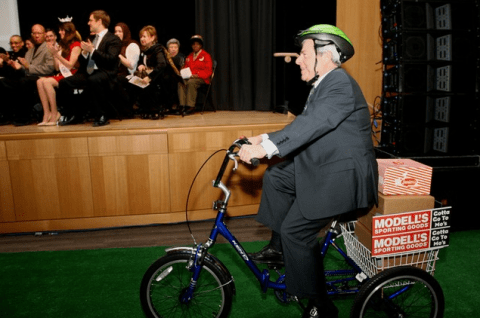
Image: Gothamist
What can someone say about a man as clearly off-the-rails when it comes to understanding cycling as transportation and the future of Brooklyn as Marty Markowitz? You can barely deconstruct such nonsense; letting him speak for himself is its own hoisted petard.
But please do take this brief peek into the thought process, if you dare, of our borough president:
- I am not a “bike-hating politician.”
- I’m happy to come on your show to promote a Barbra Steisand concert, but I’d really love to discuss, at length, how most bike lanes don’t make any sense, except for the ones on Kent Avenue and inside Prospect Park.
- Speaking of which, cycling should be “contained” inside Prospect Park as a leisure activity, which I myself enjoy. Honestly, who’s against leisure? Just watch out for cars, which should get 30 more minutes of time to drive through the park than they currently have.
- I have not come out against bike share. However, I don’t think it’s a good idea, think inexperienced riders are likely to kill or be killed, believe the city is too “bustling” to handle blue bikes all over the place, and must insist that the storage of one private automobile always be considered more valuable to New York than the storage of fifteen public bicycles. But, no, I’m not against bike share.
- Also, bikes are only good for “young people.”

Via Copenhagenize and Classic Copenhagen.
Doors like this are currently found on posts throughout Copenhagen. They read, “Catch the cyclist with your eyes – not your door.” It’s far more effective than curbside haikus and places the responsibility for avoiding dooring squarely on motorists. I’d love to see something like this in New York, especially with new cyclists about to jump on Citi Bikes.
Transportation, not Recreation

Yesterday New York City announced the sponsor (Citi) and pricing for its bike share system which will hit the streets this July! Some in the media seem to be missing an important point though. Bike share is not the same as bike rental. Gothamist (among others) whines, “For instance, you were to just show up in town and join CitiBike for a single four-hour ride that would cost you $86.95”. Yes, that’s why there are still numerous bike rental businesses in New York that will continue to thrive. Bike share is great for one-way commute and quick trips, say to a meeting or between Chinatown and Katz’s Deli. Bike rental or buying a bike is still the best choice for those wanting a longer ride.
Bike Share is Amazing and Nobody’s Happy
Leave it to Louis C.K. to say it best.
My wife likes to say that there are some people in the world who are so inclined to find fault with everything that they could win a $500 million lottery jackpot and still gripe about how much is taken out in taxes. To read some of the early criticism of bike share by bloggers and some of the commenters over at Streetsblog, you might understand what she means.
Is it disappointing that bike share won’t be everywhere immediately when it rolls out this summer? You bet. Are there criticisms one can make about the pricing structure, especially when compared to other cities? If you want. And is the extremely unlikely case of an epic four-hour bike share ride to City Island shockingly expensive? Sure. But so is a taxi ride from New York to Massachusetts. Just ask Tom Hanks.
But guess what, citizens of New York? After watching Paris, London, Boston, DC, Minneapolis, Denver, and countless other cities win the bike share lottery we’re hitting our own jackpot, even if it means some taxes will being taken out, so to speak. But compare where we are right now to the early days of Bloomberg’s third term, when not just bike share but the future of bike lanes in New York City seemed completely uncertain, and you’ll see just how far we’ve come.
In the winter of 2009 and 2010 we were in the thick of a tabloid-induced “bikelash.” In 2011 the Times published a feature story on Janette Sadik-Khan that came to bury her, not praise her. That same year, Christine Haughney wrote that bike share was “plagued by questions” and reported that “Community board members have raised concerns about whether bike-share kiosks and racks would encroach on precious sidewalk areas, or swallow parking spaces,” conjuring images of six hundred Article 78 lawsuits, one for each bike share station.
A lot has changed between 10:59 AM and 11:01 AM yesterday. We now know who’s sponsoring bike share, the color of the bikes, exactly how much membership will cost, a little more about where the stations will go and when parts of the system will be online. The fact that bike share may come to certain neighborhoods later than expected is a heck of a lot better than the previous fear that it wouldn’t come at all. And about those precious parking spaces? Community board members have figured out that using them to site bike share stations makes a lot more sense than using them to store private automobiles.
Cycling advocates and enthusiasts should not take so much of an inside baseball look at bike share that they can’t see the progress we’ve made. We could be fighting about lines of paint on a street or moving parked cars six feet from the curb, but instead we’re arguing over the difference between bike share’s $9.95 day pass and an annual membership. If I took a time machine back to the darkest days of anti-bike hysteria, the 2010 me would be astounded that such nitpicky arguments would one day be possible in New York City. That is, after the 2010 me recovered from the mind-numbing realization that time travel is actually possible.
New York is about to begin an unprecedented and transformational experiment in redefining how our streets work. Bike share is not simply about putting bikes on the street — it is about fixing streets so that they work for people. The fact that every detail of the system is not happening in a way that pleases everyone all of the time should be so minor a concern as to hardly even register in the discussion right now. Bike share is coming–slowly at first and then all at once–and it’s going to change everything.
The Fine Print
No bike share for most of part of Brooklyn until 2013. Via the relaunched Citi Bike website:
By August 2012, we expect to have 7,000 bikes and 420 stations available, with the rest of the system implemented in the spring of 2013, expanding to include parts of the Upper West and East Sides, and Park Slope, Prospect Heights and Crown Heights in Brooklyn.
As commenter Mike points out, Fort Greene and Williamsburg — and I’m assuming other areas of the borough close to the bridges — will be included in the early roll-out.
But the good news is that the operations center will be at the Brooklyn Navy Yard before moving to Sunset Park, according to first reports.
Jane’s Ride 2012
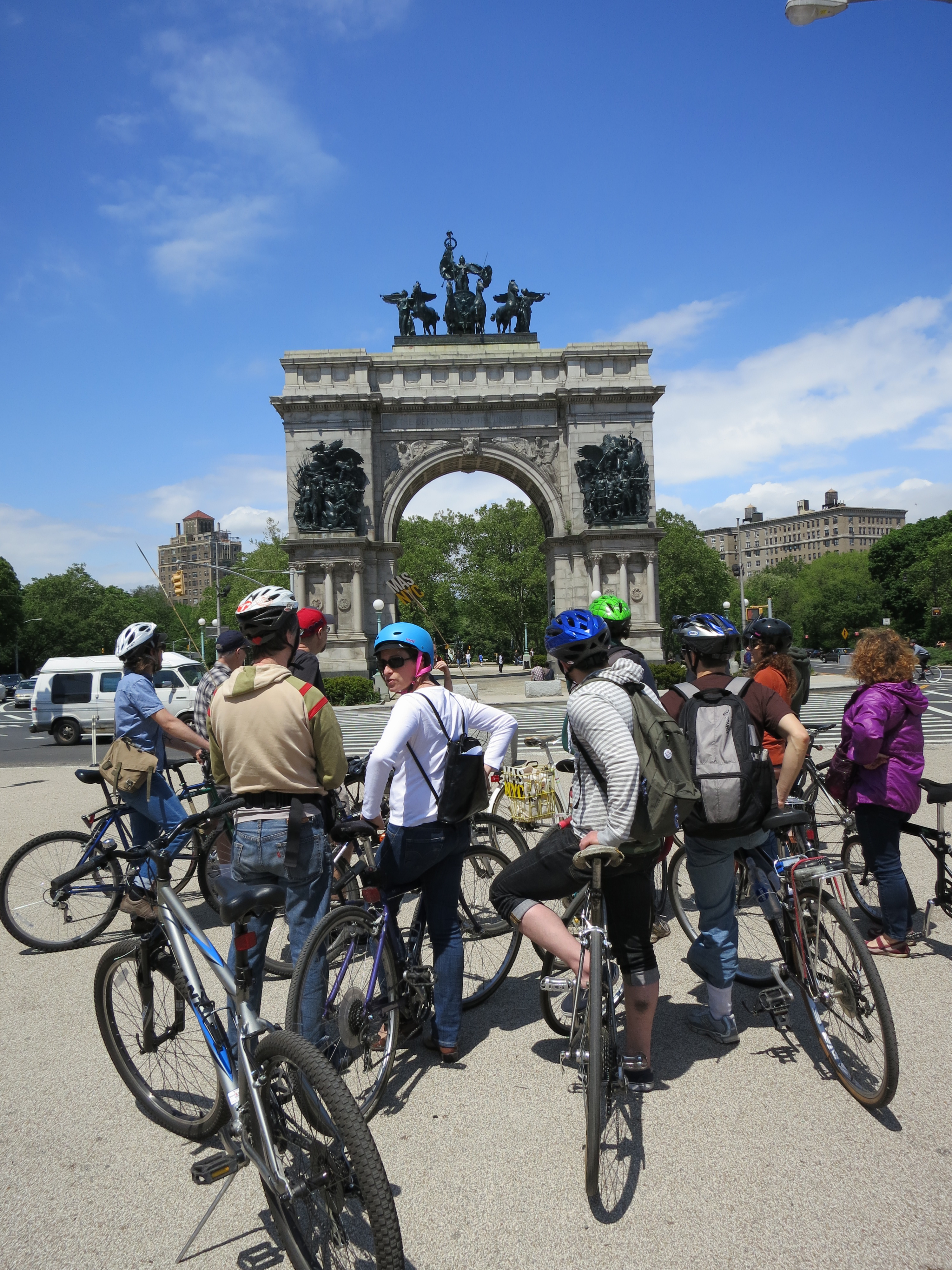
We had a great turnout and fantastic weather for yesterday’s Jane’s Ride. Many thanks to the Municipal Art Society for another great year of outstanding Jane’s Walk programs and to Will Yakowicz at Patch for the last-minute publicity push. I wasn’t able to take too many pictures, but you can see a few more here. MAS will also have pictures up soon.
And if you’re wondering how a Jane’s Ride fit into a weekend of Jane’s Walks, here’s your answer:

A Brand New Start of It
“At around 9:30 p.m. last night, a woman came on to the 4 train I was riding heading into Brooklyn from Manhattan. She got on in Downtown Manhattan, had a bicycle with her, and she propped it in front of one of the doors and would only move it slightly to let people on and off at various stops. A woman sitting across from her told her she was giving all bicyclists a bad name by blocking the door, and requested that she move back to the Midwest or West Coast.”
Emphasis mine.
Never mind whether or not you can tell where a person is from based on their preferred commuting method. And please don’t pay attention to the ridiculous notion that one person engaged in the perfectly legal act of transporting a bicycle on the subway reflects poorly on all cyclists. (Do you know how many brunettes I’ve seen clipping their fingernails on the N train? Damn brunettes!) Why are people who bike always told to “go back to the Midwest,” but the many drivers of cars bearing Pennsylvania, Virginia, North Carolina, Florida, and, yes, even Midwestern license plates assumed to have the right to roam free on congested New York City streets?
Even if one assumes that all cyclists are, in fact, Midwestern or West Coast transplants, the idea of young people moving to the Big Apple from across the country to find opportunity is an integral part of this city’s history, mythology, and pop culture. “I want to be a part of it,” and all that. One gets the sense that if today’s “real” New Yorkers could rewrite the Broadway musical 42nd Street the show would end almost as soon as the curtain rises with Peggy Sawyer being told to get on the bus back to Allentown.
Of course, with biking growing as a viable transportation option across the nation one big question remains: where are cyclists in Minneapolis, Chicago, Long Beach, and San Francisco told to go back to? Brooklyn?
 Brooklyn Spoke