Speak up for Fowler Square Tuesday Night

Come out on Tuesday night, March 2oth, to support the creation of a new pedestrian plaza in Fort Greene. Opposition to this plan is small, but vocal, and the community needs your support to make it happen.
In response to community feedback, DOT is proposing a temporary plaza in the summer of 2012 to test the closure of South Elliot Place between Fulton Street and Lafayette Avenue. Enhancements may include a gravel surface treatment, moveable tables and chairs and other informal seating, benches, planters as well as more in-ground plants/flowers, umbrellas, additional lighting, repairs to damaged sidewalk within Fowler Square triangle, and public art. DOT will monitor the temporary closure, re-evaluate the proposal with community input, and present findings to Community Board 2. The meeting will take place at St. Francis College, 180 Remsen St.
The meeting begins at 6:oo PM. It’s imperative that rational, calm voices speak up to support this plaza so that Fort Greene can get a little extra green space.
The Prospect Park West Bike Lane Fight is Over

It’s the Tweet heard ’round the #bikenyc world:

As Streetsblog notes, Schumer is wearing earbuds in both ears, which is illegal in New York City.
This Week in a Car-Free Prospect Park
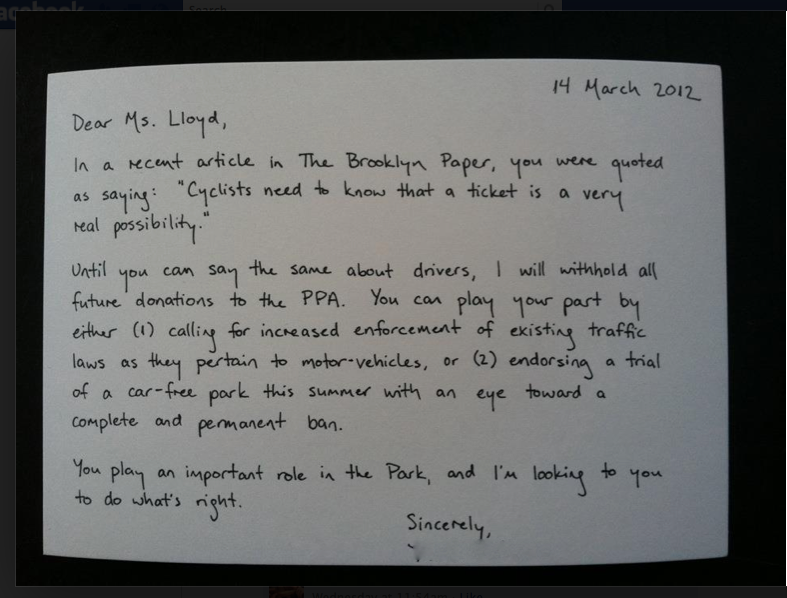
Here’s a small sampling of this week’s news and happenings in the movement to get cars out of Prospect Park once and for all:
- Patch asks readers to vote in an online poll, “Should Cars be Allowed in Prospect Park?” As of this posting 85% of respondents said no.
- The Brooklyn Paper reports that the 78th Precinct wrote 188 tickets to cyclists over the past four months for such infractions as “running red lights, speeding, and riding against traffic.” As a comparison, the 78th wrote just 22 speeding tickets to drivers for the entire precinct in January.
- A member of the Car-Free Prospect Park Facebook group dropped off a hand-written note (above) to Prospect Park Alliance President and Prospect Park Administrator Emily Lloyd at the Litchfield Villa on Wednesday.
- And here’s proof that it ain’t working stiffs who need to drive to Prospect Park.
Back to the Future

Photo: Getty Images
After bumping into a certain senator and senator’s wife at the White House state dinner this week, Ed Koch has an idea about who should succeed Janette Sadik-Khan in 2014:
Mr. Koch, who took as his date Diane Coffey, the chief of staff in his mayoral administration, said he conversed with Justice Antonin Scalia — a “charming guy” — as well as Senator Charles Schumer and his wife, Iris Weinshall, a former New York City transportation commissioner. (Mr. Koch said he suggested Ms. Weinshall reprise that role under a new mayoral administration. “I think she said, ‘No, thanks,”’ he said.)
“No one warned me…”
Via the Slow Bicycle Movement and Copenhagenize. (H/T, n8than.)
No one warned me when I started to use a bike that absolutely everyone who doesn’t ride one has an opinion about them… and about me because I ride one, and about whether I wear a helmet and why I should and why ‘cyclists’ should stay off pavements and also off roads and stop getting in the way and causing constant death and about how stupid we all are, how arrogant, how selfish and how none of us know how to drive or use roads or read signposts and are all calling for stupid infrastructure for roads we don’t pay for… because we are ‘the green lobby’.
Nicely put. I’d say it sums up about every tabloid article and web comment I’ve ever read.
Neighbors for Better Bus Lines

Photo: Brownstoner.com
Take a look at the photo above, which accompanied this post on Brownstoner.com about a small group of residents who are outraged by the “dangerous” B25, and ask yourself which seems to be the bigger problem: a nine-times-per-hour bus which can carry forty or more people or a constant flow of taxis and private vehicles streaming through DUMBO’s Main Street.
The arguments against keeping this bus route on Main Street are almost comically bad:
- One resident says that “Main Street is simply not big enough to service this sort of constant, never-ending daily bus traffic,” yet seems utterly unconcerned about the high volume of automobiles wedged into the same space.
- Another writes, “The busses are huge, the drivers are frustrated and always in a hurry, honking their horns as they try to weave around the many cars or trucks already on our block.” Perhaps they wouldn’t have to honk their horns if there were fewer cars blocking their route. I can also imagine that the drivers aren’t the only ones who are frustrated; passengers probably don’t appreciate bus delays caused by double-parked cars and trucks either.
- Here’s another resident: “The bus drivers regularly lay on the horn for minutes at a time if their route is blocked by delivery trucks, cars, or even people simply unloading or loading in front of their own residential building.” This attitude may be the downfall of New York City and is currently the reason we’re choking on traffic. What right do people have to park or unload their cars directly in front of their buildings? As Lewis Mumford wrote in The Highway and the City, “The right to have access to every building in the city by private motorcar in an age when everyone possesses such a vehicle is actually the right to destroy the city.”
- This may be my favorite quote, a true example of ignoring the bull: “…on Saturday and Sunday there is a steady stream of limos coming down Main Street dropping off their parties on the street to take photos in the park and to go to various restaurants in the neighborhood.” The letter writer’s solution, like all of the others, is not to reroute limos carrying privileged passengers on discretionary trips, but the bus.
- Many residents complain of bus bunching where two or three buses group together on one street. It’s a frustrating problem, I’m sure, but did anyone stop to think that one reason this happens is because of the effects clogged streets have on bus schedules? If one bus is stuck behind a limousine, it won’t be long before another bus or two catch up. Clear the traffic and the drivers will be able to stick to their schedules.
I won’t quibble with those who say that the bus drivers speed without regard for the safety of pedestrians when the street is largely traffic-free. That is, of course, a valid concern, a problem everywhere, and one that ought to be addressed immediately. (Interestingly, the problem of speeding drivers in general barely warrants a mention in any of these letters, even though the scourge of barreling buses potentially mowing down families lingers large in every last one.)
But the idea that buses cause traffic is a leap of logic so big that a jump from Main Street to Wall Street seems simple in comparison. The residents’ solution to reroute the bus somewhere else is textbook NIMBYism, akin to NBBL’s “compromise” solution of a bike lane on 8th Avenue out of view of Prospect Park West. The specter of dead children and seniors, businesses rendered bankrupt by delivery delays, the perceived hardship of not being able to park directly in front of one’s residence, and the amount of pollution caused by a transportation option that takes people out of their cars are scare tactics these DUMBO neighbors for better bus lines share with Weinshall, Steisel, and company. Same shit, different neighborhood, if I may be so blunt.
DUMBO, with its compact size and defined boundaries, would be a ripe neighborhood for experiments with loading zones, permit parking, and other creative solutions that could allow people to get goods and supplies directly to their doors without the need to drive. One resident wrote, “On any given day, trucks such as UPS, USPS, FED EX and Fresh Direct can completely clogged [sic] the street.” So imagine if UPS or Fresh Direct set up a fleet of cargo bikes on York Street or Front Street, ending the need for big delivery trucks to barrel down to the water. Or imagine if the city instituted residential parking permits, limiting the number of people who choose to drive to work because they can park on the street for free. You have to imagine it, because you won’t find any creative solutions proposed by the people who just want the bus rerouted.
New York is in a strange place right now. We have visionary leadership transforming our streets every day. We are home to some of the most innovative thinkers, business people, artists, and techies. But when it comes to thinking our way out of the traffic hell that engulfs so many neighborhoods–and the climate change that will come to swallow low-lying neighborhoods like DUMBO–it’s all too easy for the narrow-minded and loud to win out over the nuanced and creative.
Thursday: CB6 Bike Share Workshop

If you live or work in Community Board 6, Thursday night is your night to be part of the bike share planning process.
Join Brooklyn’s Community Board 6 and local residents and business owners at a roundtable planning workshop to help decide how bike share should work and where stations should go in Cobble Hill and Park Slope. In cooperation with Congresswoman Nydia Velázquez, Community Board 6, NYS Senators Velmanette Montgomery and Daniel Squadron, NYS Assemblymembers Joan Millman and James Brennan, and NYC Council Members Brad Lander and Stephen Levin. The Workshop will be held at Old First Reformed Church, 729 Carroll Street, (at 7th Avenue) Brooklyn, NY 11215. The entrance to the workshop will be on Carroll Street.
CB3 (Bed-Stuy) will be next, with a workshop on Wednesday, March 21st. CB1 (Greenpoint/Williamsburg) is the next night, March 22nd. A full timeline with event listings and more info can be found here.
“Traffic calming should rely on the laws of physics.”
A reader forwards me this fantastic quote from, of all places, Delray Beach, Florida. It’s taken straight from the city’s official website, filed under “Neighborhood Traffic Calming Policy & Guidelines.”
The major difference between traffic calming measures and other forms of traffic control devices, such as stop signs and speed limit signs, which require enforcement, is that calming measures are self-enforcing. Also, traffic calming should rely on the laws of physics rather than human psychology to slow traffic.
Of the three E’s of traffic safety–engineering, enforcement, and education–only engineering is permanent. Long after the police radar gun is put away and the PSA campaign has ended its run on local radio and TV stations, a neckdown, bikelane, speed bump, or other street design will be there doing its job.
What Say Thee, Seniors for Safety?
Clyde Haberman files this excellent piece on the sad reality — and even sadder acceptance — of traffic deaths in New York City:
Not surprisingly, no group is more vulnerable than older New Yorkers. Maybe it’s because they don’t step as lively as they once did to avoid, say, a driver who barrels into an intersection. If hit, they may be more likely than younger people to die of their injuries.
In the city and surrounding counties, the death rate for pedestrians age 60 and up was three times that of younger people, Ms. Slevin’s group reported last June. Those 75 and older were nearly four times as likely to be killed.
Numbers like these will only acquire greater urgency over time, for we New Yorkers are getting steadily older. The city’s Department for the Aging says that 16 percent of us are at least 60 years old; within two decades, that figure is projected to rise to 20 percent.
Haberman writes that “traffic deaths are not acts of nature.” It nicely sums up what livable streets advocates have been saying for years.
Leading By Example

This was the scene at the 78th Precinct yesterday. While it’s not unusual to find cars all over the sidewalks around police stations in the city, I found this situation to be fairly egregious; the essential blockading of the crosswalk left very little room for pedestrians to squeeze by and rendered them more or less invisible to drivers coming down Bergen Street.
How can we expect others to stop parking on the sidewalk if this is standard NYPD practice? I can only imagine how terrible this particular intersection is going to be for pedestrians when the area is flooded by hordes of drivers attending events at the Barclays Center in the fall.
 Brooklyn Spoke