“I’m on a Motherf**king Bike
If you’re offended by f-bombs, liberal use of green screen technology, brilliant skewering of cyclist stereotypes, riding on the sidewalk, or all of the above, do not watch this video.
“I would be in favor of speed bumps”
Via Copenhagenize.
I can’t quite imagine this kind of plot making its way into an American television show, given the influence car companies must have on the major networks, but at least I can live vicariously through a BBC character telling off a fear-driven NIMBY. By the way, I love the episode description on the video’s YouTube page: “Pete takes on the neighborhood busybody who opposed traffic-calming measures.”
As an aside, the next time you watch Modern Family, or just about any other show on TV these days that isn’t set in New York City, see how long it takes before there’s a scene involving someone driving a car and talking on a cellphone, even hands free.
Brooklyn Bike Share Planning Workshops
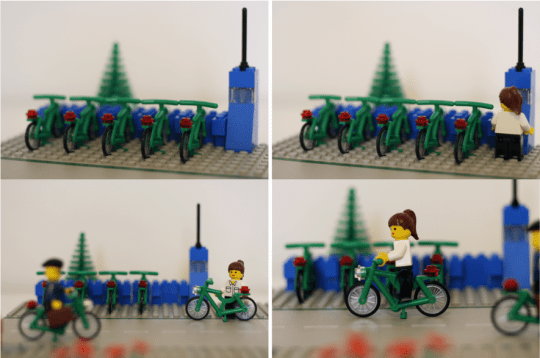
Brooklyn residents, workers, and business owners still have a couple of few chances to be part of the bike share planning process, with two three workshops planned for March. This Tuesday, March 6th, sessions will be held at 6:00 and 7:00 PM at CUNY Medgar Evers College at 1650 Bedford Avenue to plan bike share station locations within Community Boards 8 and 9.
The second is a workshop for the area covered by Community Board 6 and will take place on Thursday, March 15 with sessions beginning at 6:30 PM and 7:30 PM. It’s at the Old First Reformed Church, 729 Carroll Street, on the corner of 7th Avenue. I’m looking forward to attending this one, since it’s in my backyard.
Update: The third is scheduled for Thursday, March 22 at 6 and 7 PM at the Swinging 60s Senior Center, 211 Ainslie Street for everyone in Community Board 1.
Please check out more of my Lego bike share geek-out photos Flickr. I have no idea what the New York system’s bikes and docking stations will look like; I simply chose the colors I used because I’m a fan of Minnesota’s Nice Ride I had a lot of green bicycles.
By the way, Lego bike share stations have a lot in common with real bike share stations: they’re completely modular, have a pleasing symmetry, don’t need to be connected to a city’s electrical grid to work, and can be put into place in a very short amount of time.

Reminder: Manhattan Bridge Detour Ends Monday
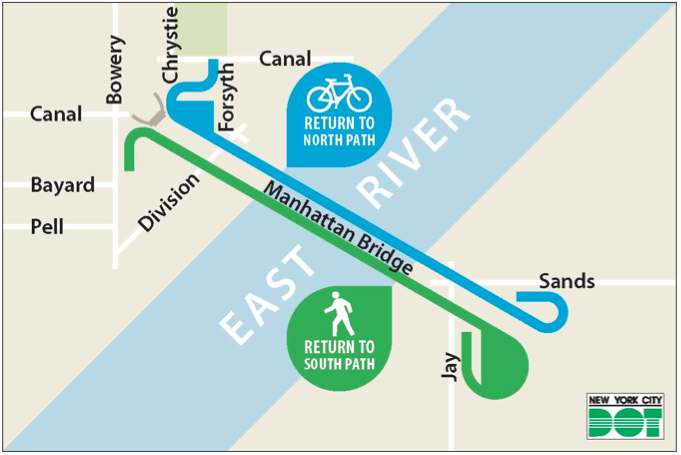
From DOT:
Due to construction on the north path of the Manhattan Bridge, cyclists and pedestrians “swapped” paths in July 2011. This temporary swap/detour will end on March 5, 2012.
Effective March 5, 2012, cyclists will return to the north path and pedestrians will return to the south path.
Construction work will transition from the north to the south side of the bridge, so some construction sheds will remain in place for several months. On-street bicycle detours and pavement markings will be removed beginning March 5, 2012.
It sounds like there will be a bit of a squeeze under those construction sheds, so be courteous to your fellow bike commuters as you pass. The good news is that cyclists will once again enter Manhattan via Forsyth Plaza and Christie Street, which is a far more pleasant how-do-you-do than the Bowery. Savor the view on the ride home tonight, because it’s the last time you’ll get to see it until the next cable replacement job about fifty years from now.
If you ride via the Manhattan Bridge, be sure to stop and say hello to Transportation Alternatives volunteers who will be alerting cyclists to the switch on Monday morning.
Quote of the Day
“If you’re from some other country you may be wondering why cars should be ‘sharing’ a park with people at all, but don’t worry–I’m sure one day we’ll reach our goal of having a 100% people-free Prospect Park” – Bike Snob NYC
Some Thoughts on Prospect Park

When the Prospect Park Road Sharing Taskforce announced its proposal for a new design of the Park Loop (note: can we please all stop calling it the Drive?) I mostly held off from rendering my judgement until after I attended the public forum, held last night at the Picnic House. I figured it was worth waiting to see what other details emerged at the presentation.
Overall, my feeling is that the design is a step in the right direction. Anything that reduces the effects of cars in the park is worthwhile, even if it’s not the full-on ban on cars that many advocates, neighborhood residents, and other interested parties had hoped the Taskforce would at least recommend. Sadly, such a recommendation was not part of the proposals last night. (More on that later in this post.)
Still, there are many reasons to like this design. A few, in my mind, are:
- It can be implemented almost immediately, hopefully reducing the likelihood of injuries to park users just as quickly.
- The design reflects the fact that the vast majority of people experience the park on foot or by bike, and not behind the wheel of the car.
- Pavement markings will be more clear. No longer will symbols reflect the minority of time when cars are allowed in the park. Instead they will reflect the majority of time when they are not.
- Reducing motorists to a single lane limits opportunities for speeding by motorists and eliminates their ability to weave in and out of multiple lanes. (Provided they are driving behind a slow “lead car.”)
- The design sends a strong message to drivers: you are guests here. Please remember your place.
I’ll dive into a few nitpicky details later–there’s too much emphasis on outreach and enforcement, for example, and cyclists will soon have to stop for all red lights, which is not going to work on a number of levels–but for now I wanted to address what Eric McClure of Park Slope Neighbors has elegantly labeled, “the S.U.V. in the room.”
Emily Lloyd, the Park Administrator, said that the idea of banning cars from the park was taken “off the table,” which came as a shock to the ninety-nine people–out of one hundred–who voiced their support for a car-free park at November’s hearing. It was also something that was stated by speaker after speaker at the Picnic House last night.
In the Times, Lloyd mentioned that the Taskforce “did not see this as an issue of cars in the park,” but, that, of course, is 100% wrong. The reason the pavement markings are currently as confusing as they are is precisely because they are designed for the four hours every day that cars are in the park. The reason we are having conversations about what cyclists and pedestrians should do at traffic lights is because of traffic lights that were installed to accommodate car traffic. Indeed, nearly every element of the Taskforce’s proposed design change grows directly out of the decision to allow cars in the park. I found Lloyd’s black-and-white stance that even a trial ban is not in the cards right now to be a complete misreading of public sentiment as well as a failure in her duty as a steward of what, it should not need repeating, is a park. As Brooklyn resident Hilda Cohen said last night, when she tried describing to her son why cars are allowed in the park she realized that “the idea of cars in the park makes about as much sense as cars in the kitchen.”
The choice is not between either banning cars from the park permanently or taking the idea of a ban “off the table” altogether. In a way, Lloyd missed a perfect opportunity to serve as an ally for the people who, after two public meetings and decades of advocacy, overwhelmingly favor a car-free park. Plus, she could have done it without the burden of actually having to do anything. All it would have taken was a simple statement: “The current proposal allows us to address safety concerns immediately while allowing DOT to explore the possibility of further limiting cars in the park in the future.”
Is closing the park to cars a political football? You bet it is. Council Member Brad Lander mentioned publicly that banning cars in the park would ignite a “culture war.” But that’s for the politicians like Lander, Marty Markowitz, Janette Sadik-Khan, and Mayor Bloomberg to sort out and for our conflict-driven media to cover. The Prospect Park Road Sharing Taskforce’s duty was not to consider politics, but to consider one thing and one thing only: safety. Being able to enjoy a stroll or a bike ride in a park without worrying about getting hit by a car racing at 53 miles per hour should not be a political issue.*
*From a recent Park Slope Neighbors study of car speeds in the park:
Park Slope Neighbors conducted a radar study on the park’s West Drive, about 100 feet northwest of the Prospect Park Lake, on Thursday, February 23, between the hours of 5 p.m. and 7 p.m., when cars are permitted in the park. The study revealed that a shocking 99% of drivers (193 out of 195 vehicles measured discretely) were exceeding the park’s 25-mile-per-hour speed limit, averaging nearly 39 MPH. Close to half of drivers (45.6%) were driving at 40 MPH or faster, and PSN recorded a top speed of a highway-like 53 MPH.
Quote of the Day
This story runs deeper than just some neighborhood opposition to a new subway entrance. It’s about a group of people who think they’re better than everyone else and want to keep their quote-unquote pristine block of urban space shoved between Lexington and Park Avenues in Manhattan, the nation’s most densely populated area, to themselves. This isn’t a quaint dispute with some self-centered Upper East Siders. It’s elitism, classism and maybe even some racism at its worst, and that deserves attention. – Ben Kabak, Second Ave Sagas.
Many of the arguments outlined by opponents to a subway entrance on 69th Street read a lot like those used by opponents of the Prospect Park West bike lane and the Fowler Square Plaza, although no one from NBBL ever made public comments that could even be remotely construed as racist. (Although some Fort Greene residents did complain publicly about “undesirables” who might populate a proposed public plaza in “their” neighborhood.) Still, Ben’s analysis is as applicable to certain parts of Brooklyn as it is to the Upper East Side.
Breaking: Prospect Park Task Force Announces Changes to Loop Drive
Ahead of Tuesday night’s public forum, the Prospect Park Road Sharing Taskforce has announced its proposal for changes to the park loop. Via the New York Times:
Under the proposal, the center lane, which is now used by motorists during morning and evening rush hours and by bicyclists at other times, would be for bicycles all day. (Car traffic is allowed from 7 a.m. to 9 a.m. on the East Drive, and from 5 p.m. to 7 p.m. on the West Drive.) The left lane, which is currently divided between pedestrians and bicycles during the rush hours, would be for pedestrians only. And the right lane would be the only place for vehicular traffic: individual drivers when the park is open to cars, and parks department and other working vehicles in the off hours.
I’ll have more on this later, but for now it’s best to say that this is a step in the right direction. While no version of Prospect Park that includes space for cars is a good one, this may the best the current political climate will allow.
The public forum is still scheduled for Tuesday night at 6 PM at the Picnic House.
Sharing the Prospect Park Loop
The orange traffic barrels in Prospect Park, installed last year after a series of cyclist/ped accidents, were removed last month due to “anticipated snow removal” needs. Via The Brooklyn Paper:
The street will remain cone-free until the city gets more feedback on how to fix the treacherous slope — which has played host to several near-fatal bike-pedestrian collisions — at a public meeting on Tuesday.
It’s interesting to note that there were two collisions in the park prior to the installation of the traffic cones, one accident after they were installed, and none since they were removed, so it’s hard to say with much confidence whether or not the traffic barrels had much of an effect on safety. I’ve long felt that without year-over-year data on accidents in the park it’s difficult to make any sound judgments about potential solutions. Were last year’s accidents part of a growing trend or were they unfortunate statistical blips? That information was not mentioned at the last public forum and I do not know if it will be discussed tomorrow night.
One thing is certain, however. Unless and until cars are banned from the park, one source of confusion and potential conflict in the park will remain:
Some park advocates suggested banning cars from the park, then correcting a series of confusing bike symbols on the street, which are only supposed to apply during limited weekday hours when the park is open to automobiles.
I was in the park last weekend, riding my bike in the middle lane, when I noticed a jogger coming straight at me, running against the flow of traffic. She pointed to the inner lane and the bike symbol painted on the pavement. “Bike lane’s over there!” she screamed. What could I say? “Just so you know, those markings only apply to evening rush hours between 5 and 7 PM when the West Drive is open to automobile traffic,” doesn’t quite roll off the tongue as a quick retort.
Reminder: Park Road Sharing Taskforce Meeting Tuesday
From Prospect Park:
On Tuesday, February 28 at 6pm, the Road Sharing Taskforce will present the recommendations it made to Parks and DOT on how Park users can safely utilize the Park Drives. If you use the Park in any way, you are welcome to attend the meeting.
Taskforce Members include:
• Department of Parks and Recreation (Prospect Park Administration)
• Department of Transportation (DOT)
• Fellowship For The Interests of Dogs & Their Owners (FIDO)
• Jack Rabbit Sports
• Kissena Cycling Club
• New York Police Department (78th Precinct)
• Office of Brooklyn Borough President Marty Markowitz
• Office of NYC Council Member Brad Lander (39th District)
• Park Enforcement Patrol
• Prospect Park Alliance Playground Committee
• Prospect Park Community Committee
• Prospect Park Senior Residence
• Prospect Park Track Club
• Transportation AlternativesPublic Meeting: Sharing the Park Drives
Tuesday, February 28, 6pm
Picnic House in Prospect Park
For more information, contact Prospect Park at 718-965-8951 or info@prospectpark.org.
I’ve mentioned before that I believe a trial closure of Prospect Park to automobiles must be a part of the Taskforce’s recommendation and I hope it’s something that’s presented on Tuesaday night. Speaking of which, if you’re walking or biking along the Park drive to get to the Picnic House, please be careful; it’s open to cars at that hour.
 Brooklyn Spoke