Minivan Driver Crashes into Playground
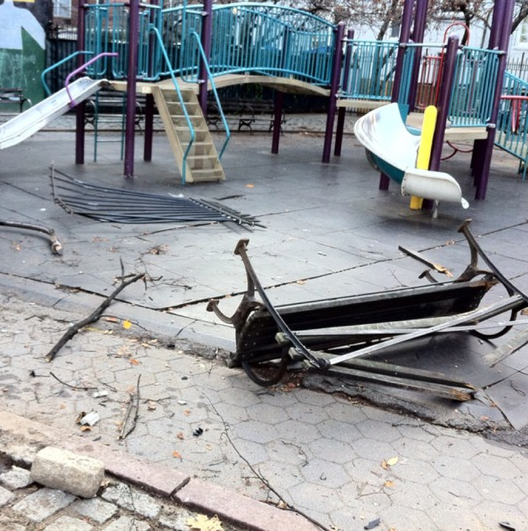
The Tot Lot on the corner of Cortelyou and Argyle is a mess this morning, following an accident last night in which a minivan crashed into the fence. You can see in the photo above, sent in by Ben, that the force was enough to toss a a section of wrought iron fence across the lot and mangle a bench.
A neighbor who drove past last night at about 2am reports on the Flatbush Family Network that she stopped to look and asked the police what had happened, and they said that someone had cut off the driver, and that no one was hurt.
I shudder to think what would have happened had this incident occurred in the middle of the day. Take a look at these pictures of the crash’s aftermath and ask yourself if Christopher Gray was right about cars on the sidewalk.
Quote of the Day
“I can’t understand living in a city that can ban cars from Times Square, but not Prospect Park,” said runner and biker Jerry Mascuch, of Ditmas Park, to applause.
This may be the quote of the year, in my book. Of the one hundred or so people who packed the picnic house two nights ago to sound off on safety in Prospect Park, all but one suggested banning cars as the necessary first step towards making it safer. Unless someone invents magic paint that appears and reappears on the roadway as the usage restrictions change, having one set of rules for the four hours each day that cars are in the park and another set of rules for the vast majority of time that they are not is a recipe for confusion and conflict.
Of course, something must be done to reign in cyclists who train in giant pelotons and scream at slower riders, pedestrians, joggers, and children to get out of the way. Whether that involves limiting training hours or banning large groups of cyclists will be something for the Task Force to debate. But I still believe the focus must be on getting cars out once and for all. If we don’t, we’ll all just meet in a year or two for another public forum.
Forrest Cocogni, the husband of a woman who was gravely injured by a cyclist earlier this summer, said, “You don’t allow cars to race in the park; you shouldn’t allow bikes to race, either.” But the thing is that we do allow cars to race in the park, every day for two hours in the morning and two hours in the evening. They may not have NASCAR sponsorship stickers plastered on their hoods and doors, but they use the park as their own personal short-cut, much to the detriment and danger of everyone else. As Lauri Schindler of the Park Slope Civic Council said, “It’s a park, not a parkway.” (This might be the second best quote of the year.)
I’m grateful that the Road Sharing Task Force offered members of the public the opportunity to provide comments, suggestions, and a chance to vent. But if it does not eventually recommend at least a temporary or trial closure of the park loop from, say, Memorial Day to Labor Day this summer, it will have sent a clear signal that Wednesday’s forum was all for show.
I’d Like to Use a Lifeline, Please

One thousand dollars for a video camera divided by seventeen seconds of footage of an ambulance using a bike lane comes out to about $60 per second. That may seem like a bargain for getting your propaganda aired on local TV, but the long-term reaction didn’t quite pan out the way Hainline may have hoped.
Here’s DNAInfo just last week, in a story on East Harlem bike lanes:
[DOT Manhattan Borough Commissioner Margaret] Forgione said FDNY officials also like the protected lanes because they use them to traverse the roadways when there is a traffic jam.
“What we find when we implement this plan is that it makes the street safer for all users,” said Forgione.
If Hainline and her fellow NBBLers had been paying attention to the rest of New York’s bike lane story and not filtering everything through a heavy cloud of confirmation bias, they might have been able to read the tea leaves long before their Marcia Kramer co-production. Here’s a story from DNAInfo from November 2010:
The department doesn’t track response times on a neighborhood level, but response times citywide for the first 10 months of 2010 were better than they were last year, said FDNY spokesman Frank Dwyer. The northern stretch of Columbus Avenue bike lanes were installed in late August.
Firefighters this year arrived on average two seconds faster than they did in 2009, Dwyer said.
“Overall, we’re getting to fires faster and better than we ever have before,” Dwyer added.
Dwyer said he couldn’t comment on anecdotal remarks made by neighborhood fire officials.
Prospect Park Safety
Today, the Emily Lloyd, the Prospect Park Alliance President and Prospect Park Administrator, announced a series of safety initiatives in the wake of a two very serious cyclist/pedestrian incidents.
Prospect Park Administration and the NYC Department of Transportation (DOT) are taking steps taken to ensure the safe enjoyment of the Park Drives by everyone. In an effort to slow cyclists at crosswalks and remind them to yield to pedestrians, DOT has introduced a pilot program on Prospect Park’s West Drive between Center Drive and Wellhouse Drive:
- Orange traffic barrels have been placed along the drive, narrowing the right lane of vehicle/cycling traffic into one lane. The narrower travel lane is expected to both slow traffic and alert drivers and riders to the upcoming pedestrian crossing.
- In addition, signs have been posted to alert cyclists that the intersection of West Drive and Wellhouse Drive (near Vanderbilt Playground) is a pedestrian crossing, as well as to remind pedestrians to use the crosswalk.
- This week, DOT will be placing a high visibility crosswalk at the intersection.
- NYPD is planning roving enforcement of yield-to-pedestrian laws as well.
While I don’t question the need for safety enhancements or the efficacy of narrowing of travel lanes from two to one, I do wonder about some of these proposals. I don’t think the park needs more signs, since if you’re the type of cyclist who speeds around the loop in a peloton and screams at walkers and slower riders to get out of the way, I doubt you’re going to heed signs at the top of a hill alerting you to the presence of crosswalks at the bottom. I am also afraid that the last item on the list will simply be a license for NYPD to ticket cyclists, even those who are at no risk of causing harm to others. (Will the stalwart stewards of the park’s aesthetic legacy have anything to say about a bunch of orange barrels lining parts of the drive? Don’t hold your breath.)
There’s a big thing missing from this list, the elephant in the room that no seems to want to deal with once and for all. That elephant is the presence of cars in the park. Of course, it’s not just speeding vehicles that cause problems for park users. Cars’ deleterious effects are felt even when drivers are not allowed to use Prospect Park as a rush-hour short cut. Traffic signs and road markings confuse park drive users during the 16 hours each weekday and 40 hours each weekend that it is closed to automobiles. That confusion, in turn, is the source of many of the conflicts currently playing out between cyclists and pedestrians.
While it may be politically unfeasible, at least for now, to completely eliminate cars in the park, I think there are ways to both reduce their number and decrease the negative effects they have on park users at all hours of the day. Here are my proposals:
- Lower the speed limit for drivers from 25 miles per hour to 15. As has been documented in Central Park, most drivers in Prospect Park travel at 30 to 40 miles per hour, coming dangerously close to cyclists, joggers, pedestrians, dog walkers, and others squeezed into the narrow “recreation” lane. Prospect Park can’t very well ask cyclists to not go 20 or 25 miles per hour down a hill when drivers routinely break those speeds in violation of the law. Even if there’s no enforcement, if lowering the posted speed limit to 15 mph for automobiles has the effect of reducing speeds to the current limit of 25 that wouldn’t be a bad thing.
- Lower the speed limit for maintenance and non-emergency vehicles to 10 miles per hour at all times. This would have two effects. First, any park vehicles using the drives during the hours in which cars are allowed would serve as pace cars for the rest, setting the tone for all drivers. Second, when the park is closed to general automobile traffic these vehicles ought to be traveling at speeds that mix well with pedestrians and cyclists. Any NYPD vehicles or ambulances driving faster than 10 or 15 miles per hour should only do so in response to an emergency and should also be required to have sirens and flashing lights on. This is something the powers that be at the Parks Department and Prospect Park could institute immediately.
- Charge for parking. There is absolutely no reason why Prospect Park should be giving away parking in the middle of one of Olmsted and Vaux’s greatest treasures, yet this is exactly what happens every day at Wollman Rink as cars enter and must cross the loop to reach the rink’s lot. I understand that people need to bring sporting equipment or other gear into the park and that this need will only increase once the rink reopens, but many people have long managed to do this without vehicles. (Wollman Rink has actually been closed for months due to construction and yet people were still able to get to the park all summer.) To encourage people to leave the car at home, parking should be priced to make it comparable with the cost of three or four round-trip subway fares. In fact, the reopening of the rink presents a unique opportunity to introduce some form of priced parking.
I’m sure many people will decry scofflaw cyclists, weekend warriors, Lance wannabes, texting pedestrians, and iPod-deaf joggers at this Wednesday’s Road Sharing Taskforce public forum, but I hope everyone can come to that meeting with a healthy dose of perspective. I jog in Prospect Park, I train on my road bike there, and I ride with my daughter on the back of my commuter bike when we visit the zoo. Many other people also experience the park in many different ways and hope to experience Brooklyn’s giant backyard as Olmsted and Vaux intended: free of automobiles.
Two Great Tastes That Taste Great Together

A graduate student writing a thesis on gender depictions in the media could have a field day with this cigarette ad from 1967.
Fourth Avenue Traffic, Transportation and Safety Meeting Tonight
Tonight the Borough President’s office is holding the first meeting of the Traffic, Transportation and Safety committee of the Fourth Avenue Task Force. The committee will be headed by Ryan Lynch and Task Force Chair Carlo Scissura.
The details:
Monday, November 14th, 6pm – 7:30pm
Brooklyn Borough Hall, Community Room
209 Joralemon Street
From the official announcement:
This committee is charged with directing the community-focused transformation of Fourth Avenue into a place that safely accommodates all road users: specifically pedestrians, cyclists, and drivers. This committee is also charged with directing all Task Force efforts relating to the MTA’s subways and buses, taxi’s and livery cabs, the Prospect Expressway and nearby Gowanus Expressway, and all other modes of transit. Anyone interested in joining this committee is welcome.
As a Fourth Avenue resident, I believe that all of the grand goals for the boulevard will be moot without a proper focus on safety. The street is a de facto highway, and few drivers respect speed limits or even traffic signals. As nice as it is to envision a livelier streetscape with sidewalk cafes, retail, and friendlier building facades, it all has to stem from a focus on making the experience of crossing and walking along Fourth Avenue safer.
Please add your voice, solutions, and ideas, to tonight’s committee meeting. Everyone, even those who live or work no where near Fourth, can contribute. See you there.
If you can’t make it tonight, there’s also a Town Hall meeting scheduled for tomorrow night that will have a broader focus than the individual committees. It will be held at the St. Thomas Aquinas Church in Park Slope, 249 Ninth Street at 6 PM on Tuesday.
Quote of the Day
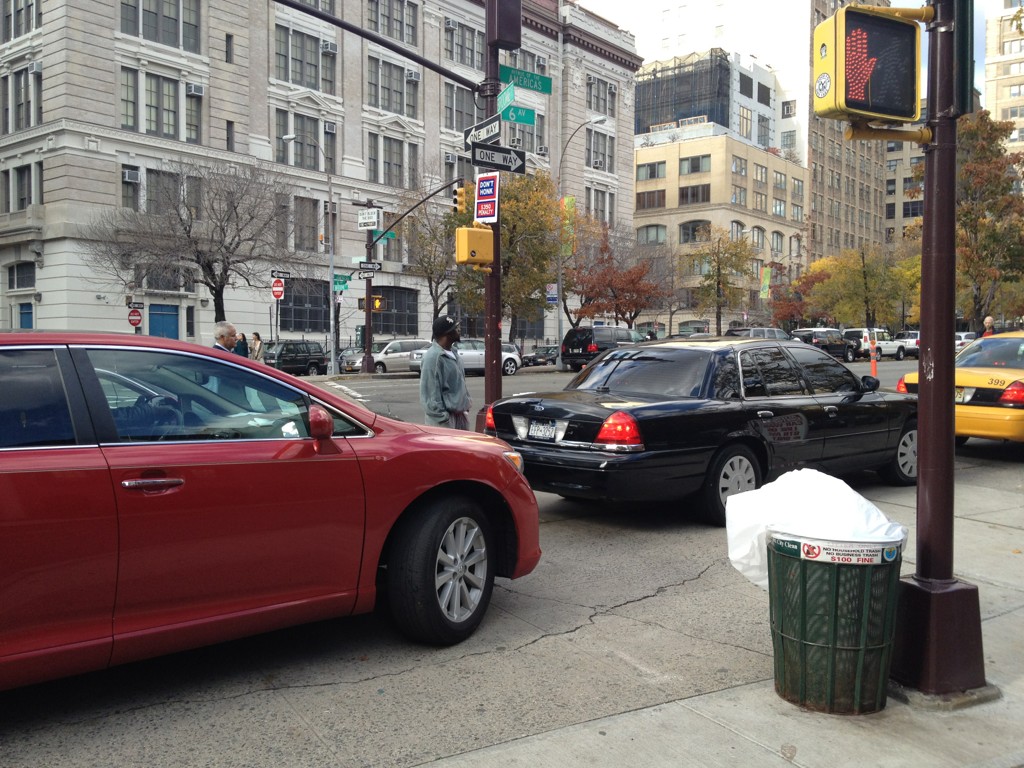
“I note that, in half a century in New York, I have never seen an automobile driving down a sidewalk.” – Christopher Gray, commenting on his New York Times story, “The Pedestrian Loses the Way.”
I’d upload more photos that confirm what any New Yorker who’s lived here for fifty minutes, much less fifty years, already knows, but I don’t think the Internet is big enough.
If you have pictures of cars driving down or on a sidewalk, please post links in the comments or Tweet at me.
“This is not a scientific poll”
The Patch has a fairly ridiculous poll up today on the subject of the nixed-for-now Plaza Street bike lanes. Here are the choices:
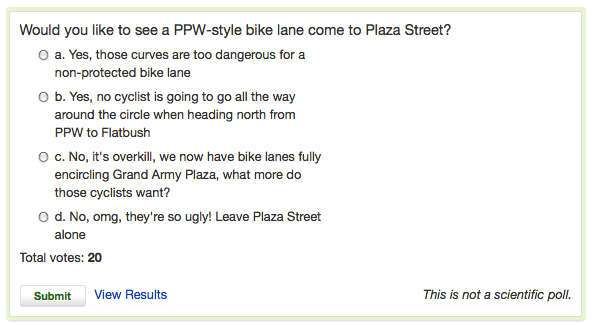
Polls like this are little more than bait for page views and comments, but rarely have I seen one written in a manner so obviously geared towards ginning up controversy. Not only is the poll unscientific, but phrases such as “what more do those cyclists want” and the high-journalistic acronym “omg,” hardly lend themselves to rational discussions of why, exactly, the Plaza Street bike lanes were taken off of the table for now.
Still, the way this poll is phrased reveals a lot about the two “sides” of the Great Bicycle Wars. The first two response choices speak to questions of safety and convenience while the second two suggest that uppity cyclists have more than enough aesthetically displeasing bike lanes on which to ride. As such, this thow-away post gives me hope; the future belongs to the calm and rational, while NIMBYism has little more than shallow desperation on its side.
Grand Army Plaza 2.0

In honor of yesterday’s ceremony marking the completion of the Grand Army Plaza redesign, here’s a picture via The Smoking Nun of what appears to be a 1940s era GAP.
The new design is really great, and I’ve used the bike lanes around the circle quite a few times. They make Prospect Heights and Vanderbilt Avenue seem so much closer now since the task of reaching the neighborhood from Prospect Park West is much less daunting. Congratulations to all of the political and civic leaders and organizations who saw this process through all the way from 2006.
Bike Share Presentation Tonight
Sorry about the late notice, but if you’re curious about bike share and live or work in Brooklyn, tonight’s your night. DOT takes its bike share presentation on the road again when it meets with Brooklyn’s CB1 at 6:30 PM.
DOT will present an overview of plans for Bike Share in New York City to Brooklyn Community Board 1. An operator for the system has been selected and DOT will outline the community engagement process. The meeting will be held at the Swinging 60′s Senior Citizens Center, 211 Ainslie Street (at the corner of Manhattan Avenue).
This is the last Brooklyn bike share presentation scheduled for the rest of the year, so if you are curious about bike share please attend. CB1 represents Greenpoint and Williamsburg and all are welcome to attend.
 Brooklyn Spoke