The Theory of Relativity
I have no interest in picking apart Samuel G. Freedman’s recent post at The New Yorker, “A Bicycle Crash Kills Another Pedestrian in Central Park,” point by point. If you want to do that on your own, please check it against Adam Sternbergh’s now-evergreen guide to writing anti-bike stories, which was originally posted in 2011. Trust me, Freedman hits all the notes.
Instead, I wanted to zero in on what seems to be an interesting psychology at play in Freedman’s piece, one that’s also happening across the city right now.
Freedman begins his piece by mentioning his own experience of being hit by a cyclist in the park:
One chilly morning in December, 2003, I was midway through my daily run in Central Park when I felt a powerful jolt from behind. The next thing I knew, I was splayed across the asphalt, certain that I had been hit by a car. But, as I gathered myself, groaning, and checked for blood and fractures, I saw the culprit sitting on the ground beside me: a bicyclist with his exercise gear and helmet still in place. I did the reasonable thing, hurling his bicycle over a low fence, cursing him profusely, and demanding his name and contact information. Then, because I had no money on me, I limped three anguished miles home.
In retrospect, I can appreciate how fortunate I was. I had fallen forward, staying within the running lane, rather than diagonally, into the path of trailing cars. I had managed to throw my arms down ahead of me so that my head did not crash onto the pavement. Because it was winter, I was wearing two layers of cold-weather gear, absorbing the worst of the impact.
My near-miss, though, left me with a heightened awareness of the dangers posed by bicyclists. Their numbers have grown dramatically in New York in the eleven years since my episode, with commuter biking more than doubling in that time.
Later in the piece he brings up his experience of being hit by a driver while riding his bike. So as to provide the full context, here’s the entire paragraph in which the account appears:
I have no animus toward bicycles in and of themselves. I have owned a bike for all of the thirty-one years I’ve lived or worked in New York. At points, I have commuted to and from my Columbia University office by bike. I’ve cycled along the Hudson with my children, and by myself for exercise when I was unable to run. And, yes, in my benighted past, I’ve known the guilty pleasure of rolling through a red light when no cars or pedestrians were in sight. I also have no illusions about the danger that autos and trucks pose—fifteen cyclists have died in traffic accidents in New York City so far this year. A few years ago, a livery cab making a sudden right turn cut me off as I was heading uptown on my bike along Amsterdam Avenue. I braced my fall with my right arm, and it took months before I could fully straighten it.
In Freedman’s first example, being hit by a person on a bike serves as the narrative framework for an essay in which he indicts all cyclists for the growing danger on New York City streets. In his second example, being hit by a person in a car serves merely to establish Freedman’s cycling bona fides.
I don’t think I’ve ever seen such a stark disconnect contained in a single piece of anti-bike writing. In Freedman’s own words, the recent tragedies in Central Park “lay bare two realities of what we might call bike culture in New York City.” But when fifteen cyclists die in traffic crashes in the span of nine months — not to mention upwards of 120 pedestrians, motorists and passengers so far this year — that apparently exposes nothing about what we might call car culture in New York City.
So why is that? It’s a fascinating psychological question, and one that I think we need to answer if we’re going to make our way to Vision Zero.
Let me be clear: I am in no way excusing reckless cycling just because reckless driving is more consequential. “But other people are worse!” is a terrible moral argument. Any death caused by a person’s negligence or recklessness, be it on a bike or in a car, ought to stoke our moral outrage as concerned citizens of New York. Please read that disclaimer again before you decide to comment.
Bored to “Death”
By this point in my bike blogging career, I’m probably programmed to be wary of anything with the words “death” and “bike” or “bicycle” in the title that appears on a mainstream news organization’s website. One doesn’t get over the shock of seeing Dorothy Rabinowitz in her bikelash debut, “Death by Bicycle,” for a long, long time.
So it was with great skepticism that I read “Death on a Bike,” by the Times’ Timothy Egan. In fact, I was only able to get around to reading it a full 24-hours after it was posted because New York was in the midst of reacting to a very real and tragic death by bike, a case that — rightfully — caused a lot of soul-searching by advocates and — predictably — caused a lot of “Off with their heads!” stories from the tabloids.
In the space of that 24-hours a lot of my non-cycling friends posted Egan’s piece on Facebook, which is now more or less the place where I learn about how dangerous cycling is from people who rarely or never bike. So I’m probably also inclined to react to anything bike-related that first comes across my radar over Facebook the same way I might want to change the subject after a racist great-uncle says something about Barack Obama at Thanksgiving dinner.
When I finally did get around to clicking over to the Times to read the article, another red flag was raised immediately. As of this posting, Egan’s essay has 765 comments. And one of those comments — which received the coveted-by-the-petty “NYT Picks” status, by the way — is from Gary Taustine. Remember Gary? He once argued that bike parking portended his “worst fears about New York City,” ISIS not being a thing most people could have predicted in 2013. For this bit of histrionics he was awarded a “dialogue” with Times readers in the Sunday paper.
So forgive me if I went into Egan’s piece with more than a fair amount of certainty that it would not provide the most nuanced picture of the threat posed to cyclists and how to deal with it. Sadly – or thankfully, considering the material it provided me here – it did not disappoint.
Egan begins with the tragic story of Sher Kung, a young, promising lawyer and new mom who was killed while biking to work on 2nd Avenue in Seattle by a truck driver. Egan paints a vivid picture:
She was doing all the right things in the morning commute, traveling in the bike lane, wearing a helmet, following the rules of the road. In an instant, Sher Kung — new mother, brilliant attorney, avid cyclist — was struck and killed by a vehicle making a turn in downtown Seattle last month.
At the scene, the truck driver wept and swore he never saw her. Mourners placed a ghost bike, painted white, at the corner. In the local law office of Perkins Coie, where Ms. Kung worked, colleagues passed by the poster in her office — “It’s a girl!” — and couldn’t believe she was gone, dead at 31.
As a piece of writing, Egan’s prose is concise, chilling and heart-wrenching all at once. What happened to Kung is awful. But what happened to Kung does not in anyway support Egan’s thesis: that all those bike lanes cities across the country have been installing over the past number of years to “accommodate the new urban commuter” just don’t work. Egan essentially blames bike lanes for deaths like Kung’s since they lure people into a false sense of complacency:
But lanes for cyclists and signage for special routes might offer little more than the illusion of safety. The designated bike corridor on the street where Ms. Kung died, Second Avenue, is known as the Lane of Death for all the accidents. She was struck down just days before a new signal system was put in place.
To those not in the know, this suggests that all that happened on the “Lane of Death” after Kung’s death was the addition of just a few flashing lights or perhaps a lone traffic signal with a bike symbol on it. What actually happened was that Second Avenue was upgraded from a painted bike lane placed next to cars to a two-way protected bike lane along the curb. This fact, which is completely omitted from Egan’s piece, actually makes Kung’s death all the more tragic. Seattle Bike Blog has some good videos of Second Avenue before and after the upgrade, and while it still has a few weak spots, had this new design been installed earlier it might have prevented the collision that killed Sher Kung.
Yet Egan never mentions this, nor does he mention how bike traffic tripled in the week after the new Second Avenue bike lane was installed, adding something else to the street that might have helped Kung, which is safety in numbers. To do so in service of a larger point – Biking is dangerous! So just listen to me and stop it, people! – seems lazy at best and dishonest at worst. In fact, if the latter is true, I suspect it has something to do with Egan’s probable status as a former vehicular cyclist:
I love to daydream when I ride. I used to love to pretend I was Lance Armstrong in the Pyrenees, until he was proven a pathological liar and cheat. But I’m my own worst enemy, because every cyclist must assume that every car driver could kill them. And you should never daydream.
This sounds a lot like what I often read on vehicular cyclist forums: that if you just have your wits about you and do your best to pay attention and keep up, you can ride anywhere. Look, I always assume that every car driver could kill me. That’s why I breathe a sigh of relief every time I get to Prospect Park West or the Brooklyn Waterfront Greenway. Something about my entire body – my posture, my pace, the expression on my face – just becomes more relaxed. Even the protected lanes on 8th and 9th Avenue, while not quite places where daydreaming is a good idea, are still far more relaxing than a trip on 6th Avenue.
Egan then brings up the example set by the Netherlands, only to completely misunderstand the Netherlands’ example:
It’s better to learn from places with long biking traditions, and to change the way we think about the road when on the road. In the Netherlands, deaths per total number of miles cycled are much lower. This is attributed to educated bike riders, who stay in the lanes, signal properly and obey traffic signals. In turn, drivers learn to look for cyclists who may be just out of mirror range.
Yes, it is a good idea to learn from places with long biking traditions, especially if those traditions include people not being crushed by automobiles in significant numbers. But the lesson to be gleaned from these places isn’t “think differently” in the philosophical sense. It’s “Think Different®” in the Macintosh computer sense: design. Fatality rates in the Netherlands are significantly lower than in the U.S. not because of education, but because of infrastructure. Bike riders “stay in the lanes” because they have lanes that are easy to stay in; they’re either physically separated from automobile traffic or they’re located on streets where speed limits are kept low with narrow car lanes, chicanes, and other physical traffic-calming elements. I’m oversimplifying Dutch design by about a mile, but at least I’m not leaving it out of the discussion entirely, as Egan does.
As for the other behavioral examples Egan cites — signaling properly and obeying traffic signals — they too are influenced by design. In fact, Dutch infrastructure is so good relative to ours that the signals cyclists send each other on the road to signify their intent are so understated as to be almost invisible to the average American. They don’t bend their arms at right angles to announce a turn. They point with their hands held out just slightly and angled down, if they signal at all. Why? Because you don’t have to make giant, grand gestures when you’re communicating with people who are also moving at a human-powered pace. You also don’t often hear people calling out warnings like “on your left” largely because passing another cyclist probably won’t result in that person catching a door prize or being nudged into fast-moving car traffic. Dutch infrastructure not only lessens conflicts and confusion between motorists and cyclists but also minimizes conflicts between cyclists and other cyclists. (Or “people” as they’re called in the Netherlands.)
As for Egan’s other points about traffic signals and attentive drivers? Well, again, it’s the infrastructure, stupid. It’s easy and quite pleasant to obey a system that’s designed with you in mind. Egan makes the mistake that it’s this good behavior that earns Dutch cyclists the respect of drivers – “In turn, drivers learn…” — but that couldn’t be farther from the truth. Drivers learn to be mindful of cyclists because the infrastructure is designed to make them mindful. Plus, most Dutch drivers are also Dutch cyclists.
Egan writes that “If each side could just think a little more like the other side, it would go a long way toward improved safety.” And while this sounds nice, it’s actually my biggest personal gripe with the Vision Zero conversation as it exists in New York City right now. Yes, mutual respect and empathy are important skills to have if one wants to build a civilized society, but depending on people to be respectful or to bike a mile in someone else’s saddle will only get society so far. Some people just can’t be convinced that giving space to cyclists is worth it. Like, for example, local TV news reporters.
Laws and stiff consequences for injuring and killing people are certainly one important part of changing the tone and making people safer, but in discussing how laws work Egan once again blows it:
In California, after 153 cyclists were killed in collisions in 2012, the state tried to do something about it. This week a new law took effect — the Three Feet for Safety Act. It mandates a yard-long cushion between autos and cyclists, with fines for violators. It’s a start, born of good intentions, but best of luck enforcing that.
No one thinks that three-feet-to-pass laws will suddenly create magic forcefields preventing drivers from hitting people, or that drivers will automatically know exactly how far away they are from a person on a bike at any given moment. And no one thinks that cops will be out there with measuring tape. “Sorry, sir, but we had you at just two feet, ten inches from your side mirror to Lance over there. He’s dead now, so that’ll be $500, please.” What will happen, however, is that when a person on a bike is hit by a driver from behind, for example, it will almost automatically be seen as evidence that the driver didn’t keep his car far enough away from the cyclist. As a result, a stiff fine may be levied against the driver. And as a result, a person who hears about a driver getting a stiff fine for not passing with enough clearance will be more likely to take it into consideration the next time he tries to do it. And he’ll tell two friends, and they’ll tell two friends, and so on. And in a time frame that’s probably longer than a day but definitely shorter than fifty years, people will eventually just know that you have to pass people on bikes safely when you’re behind the wheel of a car.
Egan then sounds a bit Cuozzo-ian, and conjures up images of bike zealots who want to take away Americans’ god-given right to drive by installing bike lanes — bad bike lanes — all over the place willy nilly.
Seattle has a bike master plan, and bike lanes all over the city. The last mayor was bike-crazed, prompting many to complain about a “war on cars.” None of that prevented the kind of collision that took the life of Sher Kung one bright summer morning.
I’m not hip to everything going on in Seattle, and I don’t know how deep their bikelash has been, but based on my experience here in New York, deriding a mayor as “bike-crazed” and complaining about a “war on cars” is a great way to prevent the kind of infrastructure that can prevent the kind of collisions that take lives. (And isn’t it funny how effective mayors are never written off as “education-crazed” or “balanced-budget-crazed.”)
Egan concludes by inadvertently making the case for protected bicycle infrastructure:
A bike rider is flesh, bones, tendons and skin against a two-ton S.U.V. What would be a fender-bender, scrap or brush between cars can be fatal to a cyclist.
Exactly! For some reason, Egan can not bring himself from this very obvious fact to its very logical conclusion: separate the squishy bike rider from the heavy S.U.V.s as much as possible or slow the two-ton trucks down to a crawl when it’s not.
But Egan is right about one thing. He writes, “Getting on a bike in the city is an act of faith in a flawed urban contract, and in beating the odds.” The urban contract is flawed because the wrong people – poll-minded politicians, NIMBYs, local TV news anchors, tabloid columnists, and parking-obsessed community leaders — are writing the terms of the contract.
As I’ve mentioned before, most arguments against bike lanes are actually arguments for bike lanes. Never has that been more true than with Timothy Egan’s widely shared opinion piece. Sometimes, the worst enemies of safe cycling are people who claim to be cyclists.
Park(ing) Day 2014
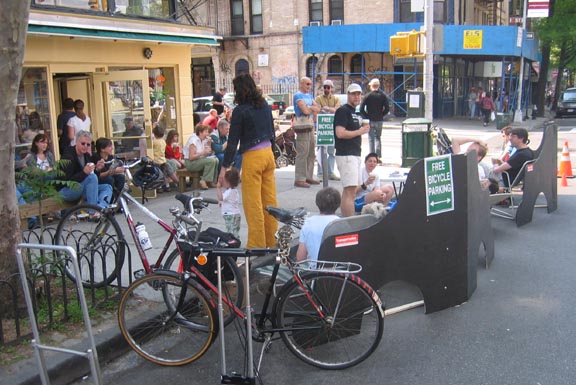
Park(ing) Day, an “annual worldwide event where artists, designers and citizens transform metered parking spots into temporary public parks” is tomorrow. And this year’s Park Slope edition promises to be great.
Via Eric McClure of Park Slope Neighbors:
We’ll be taking over a metered parking space in front of Ride Brooklyn at 468 Bergen Street in Park Slope, just across Flatbush from the 78th Precinct’s famous guerrilla bike lane. We’ll be there from 8 in the morning until about 3 p.m., and the 78th Precinct will be offering bike registration (handy if your bike ever gets stolen). We’ll be handing out Vision Zero literature, and you may get the chance to say hello to new 78th Precinct Commanding Officer Captain Frank DiGiacomo and his Community Affairs staff. Stop by, say hi, grab a latte and muffin from Gorilla Coffee, pick up any bike accessories you may need from Ride Brooklyn, and help us make our little slice of International PARK(ing) Day a big success.
Josie and the Fourth Grade Bike Brigade
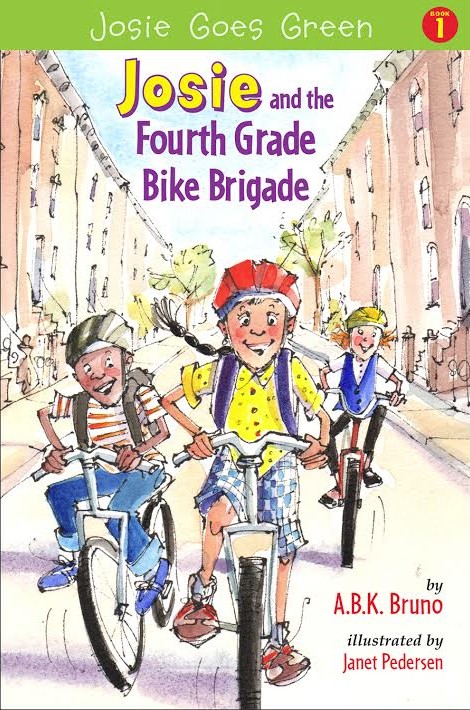
If you’re in the neighborhood or able to make it out to Park Slope this evening, there’s a fun event featuring two things that should be part of every kid’s life: bikes and books.
Kenny Bruno; his wife Beth Handman, assistant principal of P.S. 321; and their daughter Antonia Bruno, co-wrote “Josie and the Fourth Grade Bike Brigade,” the first in what will be a series about an active and environmentally minded Brooklyn girl. Via The Brooklyn Eagle:
“Josie and the Fourth Grade Bike Brigade” follows fourth grade student Josie. After spending a summer with her grandmother in Ecuador and taking a class trip to the zoo, she is prompted to take action to slow global warming. In an effort to go green and discourage the use of cars, Josie organizes the Fourth Grade Bike Brigade. Her best friends, brothers and other characters from the neighborhood go along for the ride, but not everyone joins in – and when those who oppose the plan voice their opinion, trouble begins for Josie and the Bike Brigade.
Kenny, Beth, and Antonia are celebrating the book’s release with two events, starting tonight:
- Friday, Sept. 12, 5:30 pm, Barnes & Noble (267 Seventh Ave.)
- Wednesday, Sept. 17, 7 pm, Community Bookstore (143 Seventh Ave.)
I’ll be at the event this evening with my own members of the bike brigade and hope to see you there.
This isn’t New York!
It used to be that New York wasn’t Amsterdam. Now Jersey City isn’t New York!
There are some longtime Jersey City residents who oppose the plaza.
“It’s bad enough they closed it to traffic, but the space is only going to attract a bad element,” said Frank Mezilli, who has lived in the city since 1961.
A friend of Mr. Mezilli’s, Christina DeFelice, agreed.
“They’re trying to turn it into New York City or Hoboken, and it’s not,” she said.
Postscript: Operation Safe Cycle
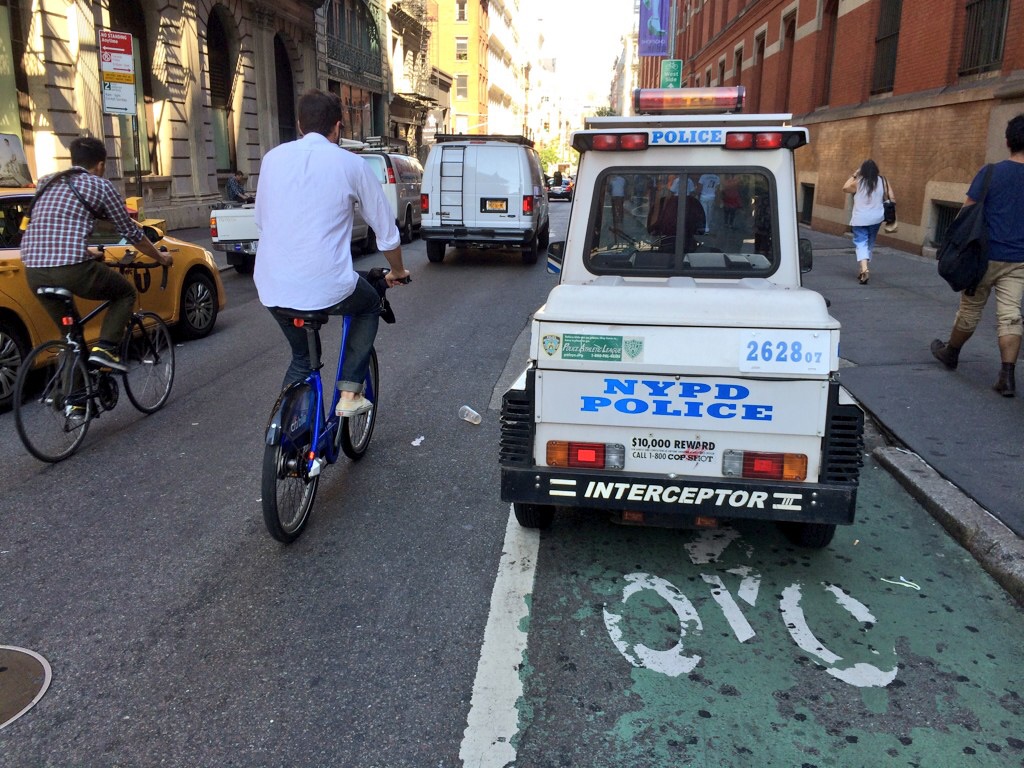
Margaret Badore at Treehugger asked for my thoughts on Operation Safe Cycle:
It may be too early to know if the enforcement effort will make any impact on the number of cyclist injuries this year. Gordon is doubtful that the average bike commuter will feel any different about their daily bike ride after Operation Safe Cycle. “The streets are going to be exactly the same and they will not have moved the dial with cyclist behavior,” he said. “The problem of scofflaw cycling isn’t going to be solved through periodic crackdowns, it’s going to be solved with infrastructure.”
Operation Safe Cycle officially ended yesterday yet – surprise! – my ride in today felt no safer than any other day. This being the last week before Labor Day, the streets certainly were quieter than normal, but I saw no shortage of “bad” behavior for all kinds of road users. Starting next Thursday, parents will begin clogging bike lanes with their cars as they drop their kids off at school, car services will be back up at full capacity as people return to work, and the streets will be filled with angry drivers who wish they were still on vacation rather than sitting in gridlock. A real Operation Safe Cycle might involve building better infrastructure to give all those drivers more attractive options.
The Post Versus Reality
It’s almost the end of week one of the NYPD’s “Operation Safe Cycle” and the New York Post is very concerned about the efficacy of such a limited crackdown.
Our only problem with Operation Safe Cycle is that it’s a two-week pilot program. So at the end of the month, cyclists will feel free to go back to breaking the law — riding recklessly and endangering themselves and others.
Would Bratton do the same with other quality-of-life initiatives? We doubt it.
Lawless bikers require permanent reminders. Otherwise, the problem will just keep going round and round.
Emphasis mine.
So, would Commissioner Bratton do the same with other quality-of-life initiatives? You will not be shocked to learn that the Post’s rhetorical question doesn’t stand up to a basic Google search.
Drivers, think twice before failing to yield to pedestrians or using your cellphone: The NYPD is on day one of a two-day crackdown on drivers who aren’t paying attention to the rules of the road.
…the NYPD is starting a “48-Hour Speeding Enforcement Initiative” starting at midnight Tuesday through Wednesday.
That’s a grand total of four days spent cracking down on driver behavior that is known to cause death and grievous injury. And on just two of those days, the NYPD wrote over 5,000 tickets for failure to yield and cellphone use. Imagine what “permanent reminders” to lawless drivers would yield!
But, you know, bikes.
UPDATE: Jen Chung at Gothamist points me to a seven-day motorist crackdown, also in May of this year, “conducted in 21 selected precincts throughout the five boroughs.”
Clusterf*ck on Varick Street
It’s said that doing the same thing over and over again and expecting different results is the definition of insanity. It’s also the definition of New York City traffic.
As anyone who follows me on Twitter knows, my office is located just above one of the most gridlocked intersections in Manhattan, if not the entire city: an oddly angled spot where 7th Avenue South becomes Varick Street and Clarkson turns into Carmine. This intersection is also located about eight blocks north of the entrance to the Holland Tunnel. And while that vital connector to New Jersey is actually named for Clifford Milburn Holland, the chief engineer on the Hudson River Tunnel Project, I like to think it’s a cruel joke, meant as a poke in the eye to all those who understand New York City’s shared heritage with the Netherlands and the vastly different approaches both places take to streets and automobiles. This isn’t Amsterdam, that’s for sure.
Each weekday, starting at around 4 PM — but sometimes as early as 3 or even 2 — the traffic funneling to the tunnel begins to back up. The streets soon grind to a halt, and intersections like the one just under my office become moats of steel and exhaust, impassable for all but the most intrepid of pedestrians. Anyone in a wheelchair or pushing a stroller is mostly out of luck and either has to take their chances in the narrow trenches between grills bumpers or detour a block or two out of their way to get safe crossing. Drivers, obviously not respecting signals and only interested in filling up any space that opens before them, don’t tend to care much that people may be crossing or that crosstown traffic also needs to get through. Emergency vehicles? Forget it.
The Hudson Square BID employs pedestrian safety managers at intersections along Varick Street, and they do an admirable job keeping the intersections clear, but their northern border is just one block below the 7th Avenue South/Varick/Clarkson/Carmine tangle. In my two-and-a-half years in this location, I’ve never seen an NYPD traffic enforcement agent assigned to this or any other intersection on 7th Avenue South. Community Board 2 is aware of the issue and has spoken to the NYPD about it, yet the situation continues. And you can see the consequences on a daily basis. Both of the above videos were shot within the last hour of this posting.
Dawn of the Planet of the Longtails
Mikael Colville-Andersen, in one of my favorite Copenhagenize posts, describes Denmark and the Netherlands as “the Galapagos Islands of modern Bicycle Culture.”
These two countries and the main city in each have evolved in each their own way over the past thirty or forty years. Many of the details are interesting anthropological observations that would probably be difficult to trace to the root.
In “very general” terms, Mikael describes the peculiar differences between bicycle riding in each country, from the Dutch preference for panniers and the Danish preference for front baskets to the different bikes used for hauling cargo in each location. These differences are small but noticeable, and any fan of livable streets who’s been to both countries can’t help but wonder when and how the two locations parted ways along the evolutionary trail.
But here we are in New York City, standing at the dawn of our own biking civilization, so to speak, and we have the opportunity to watch one unique species take the very first steps on an evolutionary path that may define it for generations. That species is the bicycling parent.
Carrying children on one’s bicycle is nothing new in New York City. People have been using things like the Topeak Baby Seat to carry very young kids for years. But something has happened as the city has grown increasingly safe and family friendly. Parents who want to continue bicycling as their families grow have to figure out the best bikes for carrying multiple kids, all the while doing the many things that parents do, from schlepping to school and soccer practice to grocery shopping and doctor’s appointments. If you want to carry a growing child or two and the supplies and provisions that go with them, the old Topeak seat just won’t cut it anymore. That was Phase 1 of New York’s evolution as a biking city.
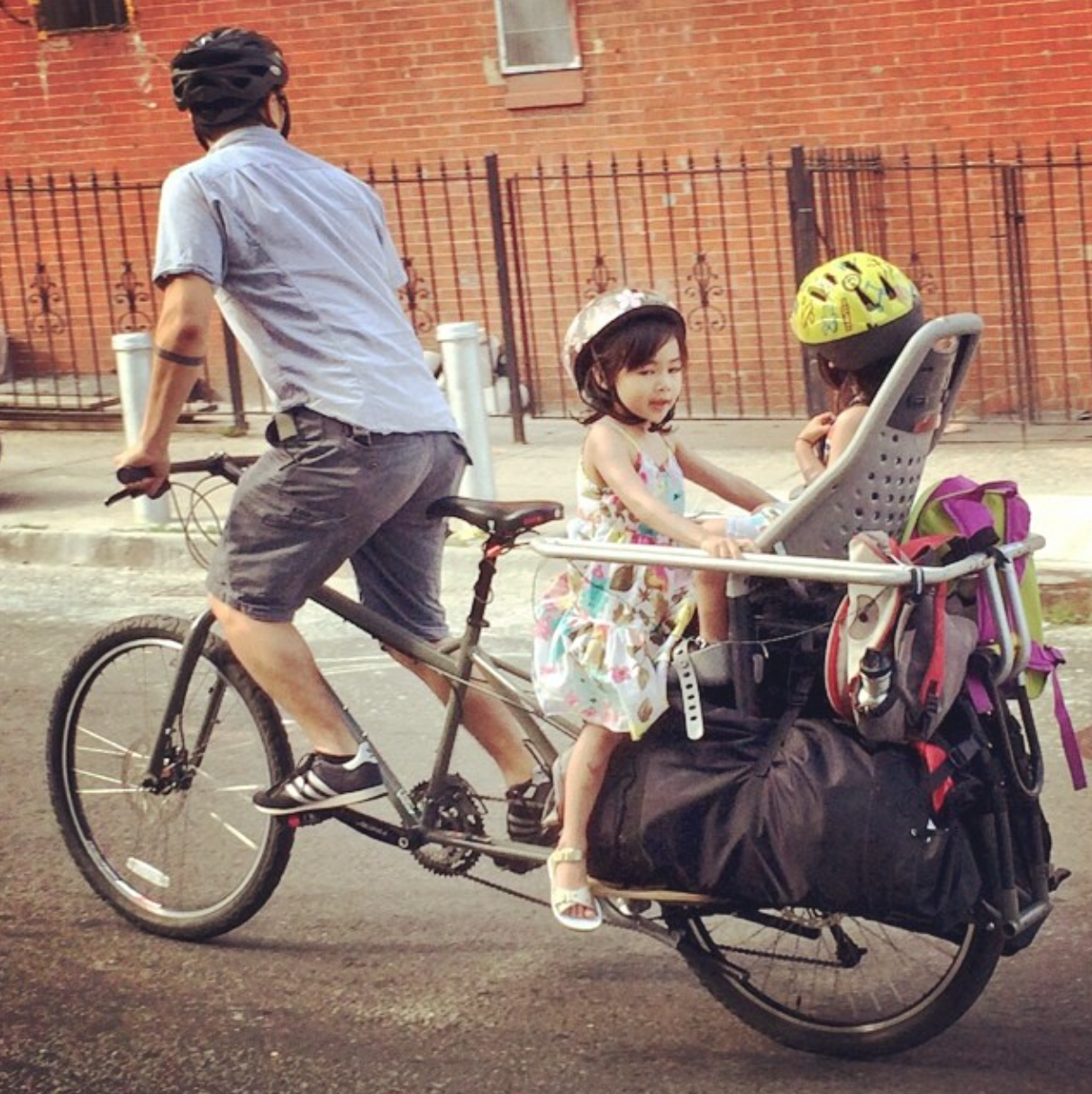
Judging by what I’ve seen recently, Phase 2 has firmly begun. But rather than the Dutch bakfiets or the Danish cargo trike, the bike that’s taking hold among New York City parents seems to be the longtail.
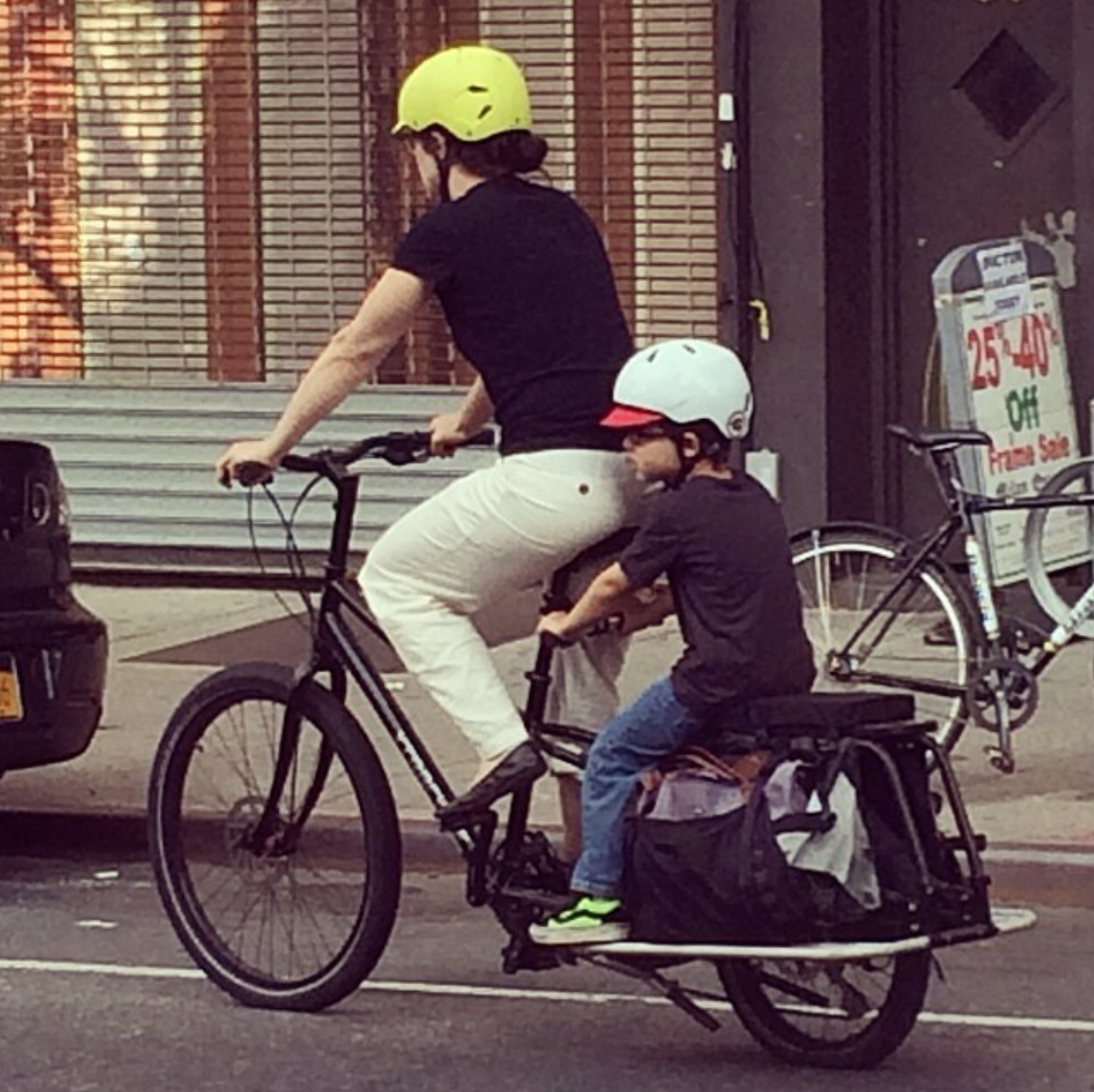
The longtail, as its name suggests, has an extended rear “tail” or longer wheelbase than a conventional bicycle, allowing for a long rack and more than enough space to fit two or even three children and, depending on the model, enough groceries to feed a family for a week. Popular models include the Yuba Mundo, Xtracycle, and the Trek Transport. Dutch versions such as the WorkCycles Fr8 — which I ride with my kids — and various models by De Fietsfabriek can also be spotted with increased frequency, thanks in part to Rolling Orange in Cobble Hill and Adeline Adeline in Tribeca.
Like Mikael, I’m speaking in very general terms. One does see the occasional bakfiets here and there and I can recall seeing at least three cargo trikes around New York this summer. But longtails seem to be growing in number by the day. Just a few years ago one would have been hard-pressed to see two or three of these all year. But just this morning during my commute to work I saw three such bikes, likely fresh from summer camp drop-offs. Evolution on steroids, one might say.
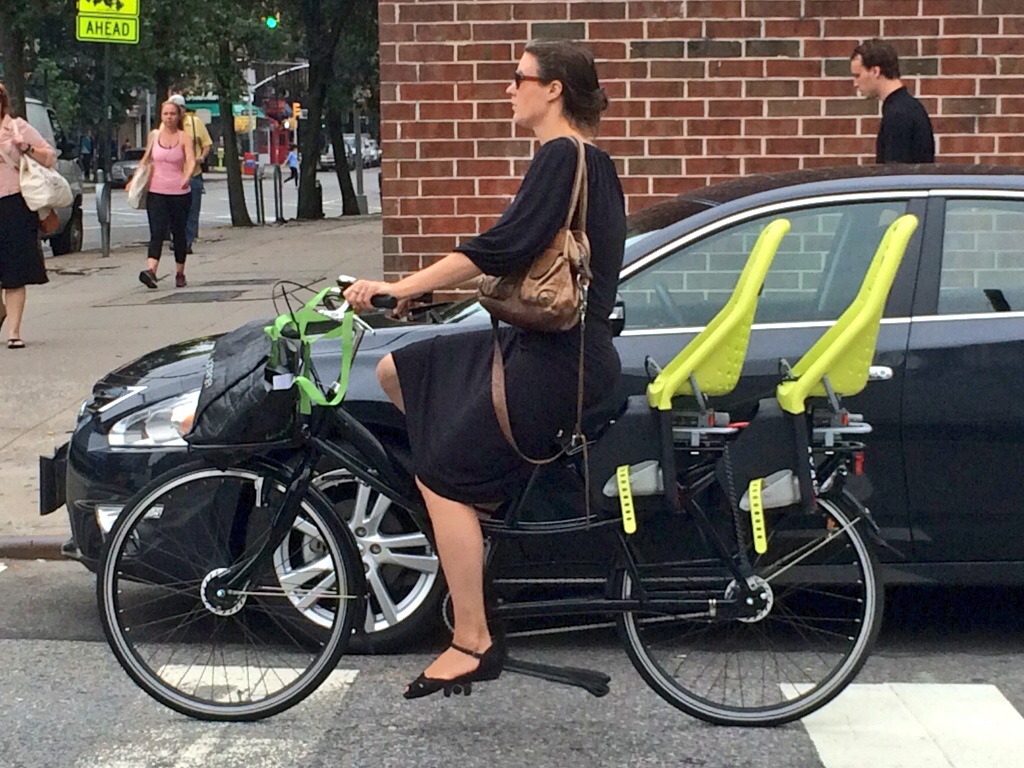
So why have these bikes taken root here? Why have New York City parents largely chosen these models over the kind of kid-hauling bikes their Dutch and Danish brethren prefer?
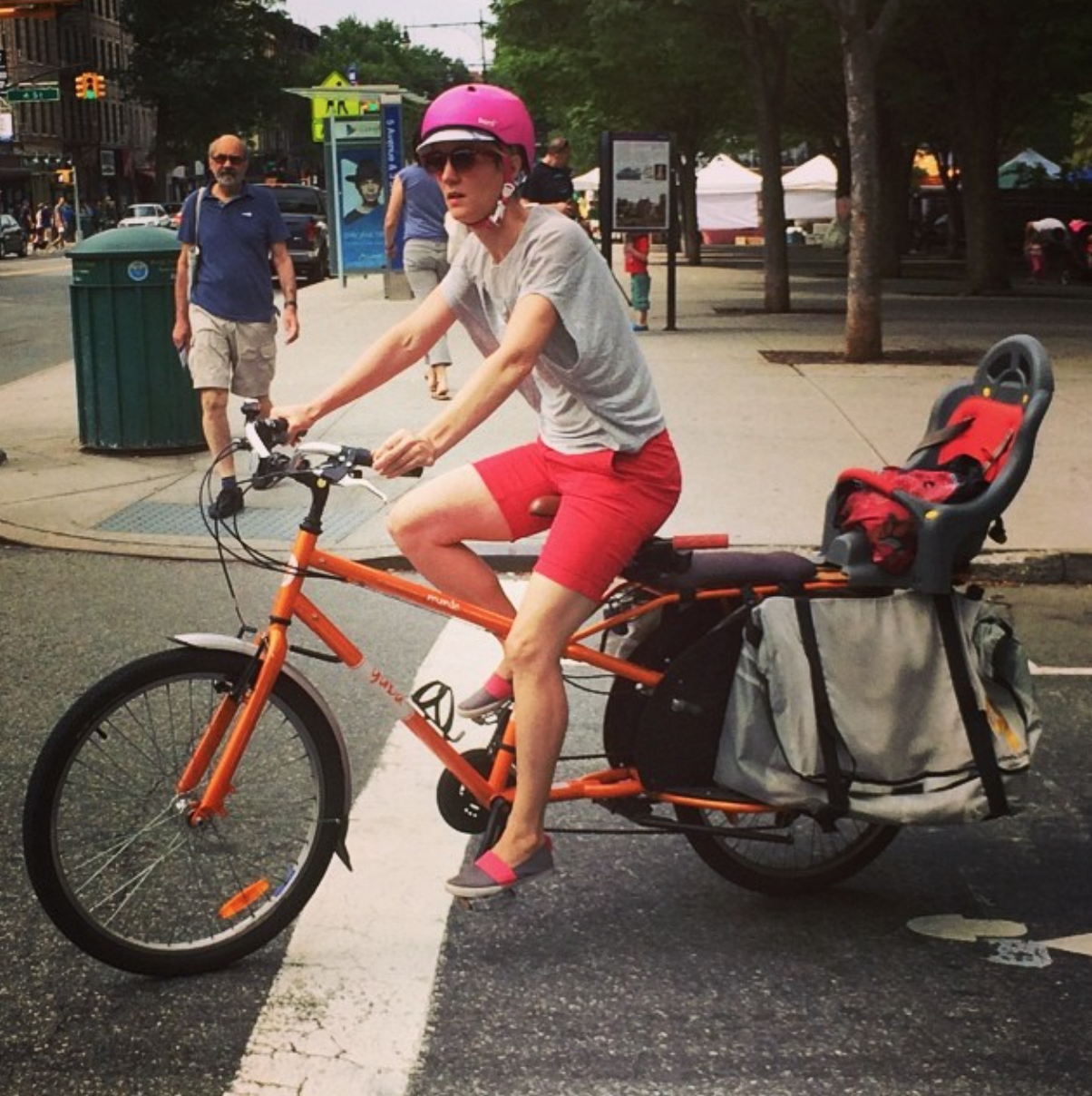
First and foremost, it’s about the size. Lacking a large box in front, these bikes are lighter and easier to navigate through New York’s narrow, squeezed-by-cars bike lanes than a bakfiets. Dropping the kids off at school or camp and then heading to work is a piece of cake, whether it’s up and over a bridge or via a bike lane that’s frequently squeezed by motorists, such as Jay Street.
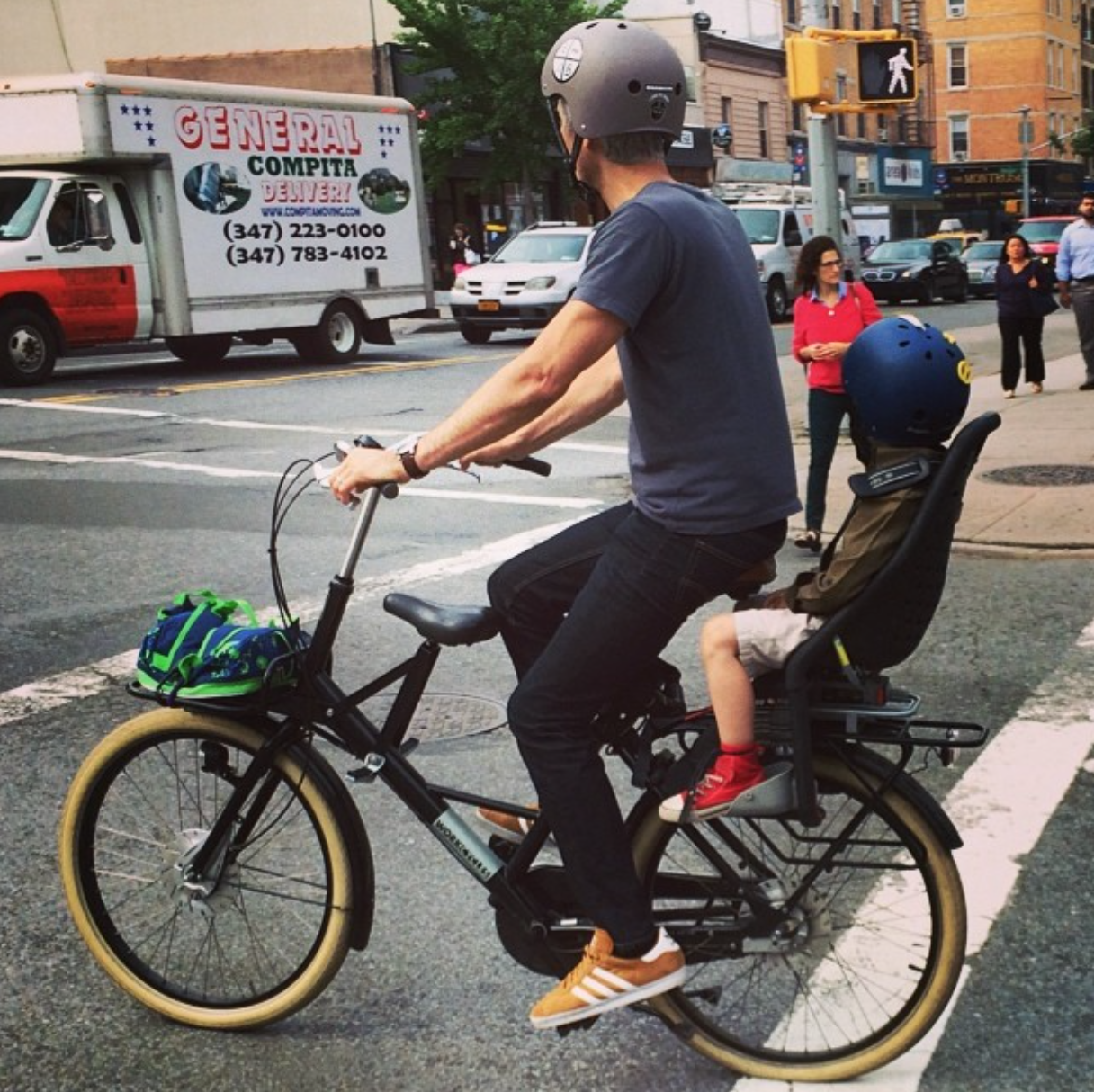
Then there’s the parking. The threat of theft being what it is, New Yorkers like to park their bikes inside if they can help it, and a heavy bakfiets or cargo trike isn’t exactly the kind of thing that makes it up a brownstone stoop or through an apartment hallway very easily. Not that longtails are made of carbon fiber, but they’re not impossible to lift up and down a set of stairs. And for people who do have to leave their bikes outside, these bikes are no wider than a conventional bike, making them pretty easy to lean against a railing without being too obtrusive. Until the city starts providing more on-street bike parking in residential areas — and making some of its secure in the form of bike cages or this Danish design — I don’t see how bakfiets or cargo trikes will ever have the chance to evolve into the mini van of choice for New York City parents.
So there you have it. Evolution in progress. And you were there at the beginning. Let’s check back in 10 or 20 years and see what’s happened.
The Bikelash is Dead, Long Live the Bikelash!

A “biker terrorist” in training.
Left to its own devices, the bikelash will sow the seeds of its own demise.
That sentiment, first articulated by former DOT policy director Jon Orcutt in 2012, has been echoing through my mind as I’ve read the reaction to columnist Courtland Milloy’s Rabinowitzian rant against “bicyclist bullies” in the Washington Post. Here’s what Orcutt had to say back then:
Last year’s media-fomented “bikelash” had the unintended effect of arousing public interest in bike lanes when many New Yorkers might otherwise have been indifferent, he said. When opinion polls consistently showed overwhelming support for bike infrastructure, said Orcutt, the negative stories disappeared.
Much of the discussion surrounding bicycling and safe streets takes place on niche blogs like mine or on the smart and informative WashCycle. We’re little fish in a little pond. Even Streetsblog, Greater Greater Washington, an BikePortland.org, which each have a readership and influence I can only dream of, still reach a relatively small sliver of the Internet pie. So, if there’s any value to Milloy’s call to arms against the “biker terrorists out to rule the road,” it’s that his odd collection of, let’s face it, sociopathic rantings have been published in a place where a ton of people will see them. (Whether the Post should have published a piece in which a writer recommends sticking a broomstick in cyclists’ wheels and diminishes the life of fellow human beings to $500 is another story, but here we are.)
If the Wall Street Journal’s Dorothy Rabinowitz had written a thoughtful and reasoned take on bike share and the policies of the Bloomberg Administration, the most such an op-ed would have garnered might have been a few tweets and perhaps a link on a roundup of daily headlines. Instead, she starred in “Death By Bicycle,” launching the irrational hatred of bicycles into stratosphere and prompting Jon Stewart, who’s surely never heard of Streetsblog or Brooklyn Spoke, to tell his viewers, “They’re just fucking bikes!”
So while I think responding to Milloy’s open endorsement of violence is right and necessary, a point-by point rebuttal – a tactic I’ve been known to take – may be cathartic but perhaps beside the point. Unless, that is, it prompts Milloy to write not one but two follow-up columns of equal or greater insanity, as The New Yorker’s John Cassidy did in 2011. Then it’s totally worth it.
In “Moving Beyond Bikelash,” a presentation I do with Aaron Naparstek, we discuss various ways to combat the opposition that tends to arise over changing streets to serve more than just motorists. While each of us draws on examples from our specific areas of expertise, from new media and journalism to television production and humor, we ultimately arrive at one of the most important tools for resolving conflict: letting people talk.
On the person-to-person level it can really make a difference. A community member hates bike lanes and thinks they’re dangerous? Fine. Don’t shout them down. Let them talk for a minute. Eventually you might find what the real issue is, whether its a simple misunderstood fact or an outright a fear of the unknown, change, and gentrification. On the person-to-established-media-figure level, it can make an even bigger difference. It can cause people far beyond the orbit of livable streets advocates to sit up and listen, bringing attention to a cause that no amount of letter-writing or donations to advocacy organizations could ever hope to accomplish.
So when a cranky newspaper columnist — or local TV reporter — says that bike lanes are an instrument of terrorism, embrace the crazy! Let it go on for as long as it can. It’s the only way to make sure it ends quickly.
 Brooklyn Spoke