CB10 Meeting Tonight
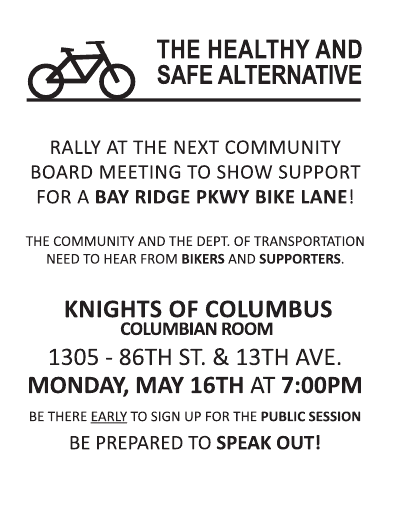 After getting “scuttled,” there’s hope of resurrecting a bike lane on Bay Ridge Parkway, albeit in a lesser form than what was originally proposed:
Community Board 10’s Traffic and Transportation Committee…member Bob Cassara put forward a motion to call on the Department of Transportation to paint a “shared route” along the wide stretch of the parkway between Shore Road and Bay Parkway in Bensonhurst — a lesser category of bike lane than a full-fledged path.
It’s certainly not as safe as a class 2 bike lane, but sharrows are better than nothing and may lay the groundwork for true safety improvements on this stretch of road.
Just in case you thought illogical anti-bike statements were the exclusive province of Neighbors for Better Bike Lanes members and New York Post writers — okay, you probably never thought that — here’s what supporters of safer streets are up against:
“Bike lanes are dangerous because cyclists can get doored or hit by cars,” said CB10 board member Larry Stelter. “And if that happens, the cyclists have no obligations; it’s the drivers who are always at fault.”
Right.
The meeting could really benefit from local, rational voices who can speak up in support of this project.
Taking Down Mob Bosses and Taking Out Bike Lanes
Crain’s New York business has a fluff piece on Gibson Dunn attorney Jim Walden. The interview plays up his case history and pro bono work, and includes some questions about his involvement with Neighbors for Better Bike Lanes:
Do you bike?
I did bike until my bike was stolen out of my building in 2005. I had this amazing Jazz Vertical mountain bike. My wife had a Trek, and during our courting period, we used to go on these completely reckless rides in Philadelphia. With three young kids, I don’t ride that much anymore, but hopefully when they are older, we’ll all bike more.
Someone in his firm should tell him that if there were more separated bike lanes like the one he’s suing to remove, he’d wouldn’t have to wait until his kids are older to go biking with them.

And since he’s been gone from Philadephia it’s turned into one of the best cities for bike commuting in the country. Thank goodness there’s no one in Philly like Jim Walden trying to roll back that city’s progress.
One Got Fat
“One Got Fat” is a 1963 safety video that will either make you laugh or keep you up at night, terrified of monkeys, children, and bicycles. Rifftrax describes it perfectly:
One Got Fat is the real deal – a concentrated dose of lab-purified nightmare fuel. To give away too much would be to blunt the surprise of your upcoming trauma… but here’s a hint: A teeming sea of pre-adolescent ur-monkeys are murdered one by one, all to the whimsical narration of the lubricious Edward Everett Horton! Yay!
Spoiler alert: I can assure you that cyclists do not going “boing” when they’re hit by cars.
Brooklyn Bike Jumble – Saturday
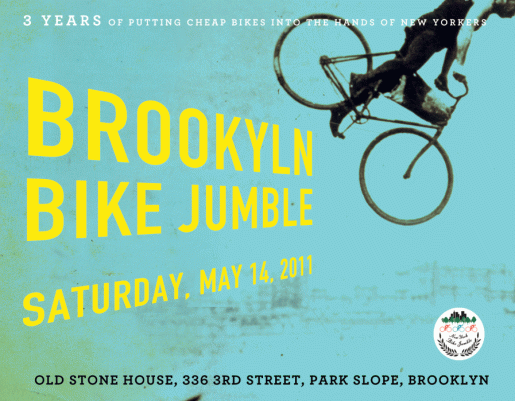
I went to this last year and it was a lot of fun. Everything from vintage bikes to t-shirts and buttons. Well worth your time!
Quote of the Day
When I hired Janette Sadik-Khan to be the commissioner of the city’s Transportation Department, I urged her to be bold and to think outside the box. That is exactly what she has done. She has taken what her predecessor Iris Weinshall did so ably and took it to even higher levels. – Mayor Michael Bloomberg.
Don’t Rain on My Parade

I’m a little late to this story, but thank you to reader Deb for bringing it to my attention. Someone wrote to the Ditmas Park Blog and gave this account of his ride home on May 1:
Tonight, at about 11:30 PM, I rode my bike through the driveway in the Parade Grounds – the one lined with Parks Department cars and trucks, connecting Parkside Avenue with Caton Avenue. Two very polite police officers from the 70th Precinct stopped me and gave me a summons for being in the park after dusk (the summons reads “fail to obey park sign”), and told me that bicycles aren’t allowed there at any time anyway (they did not issue a summons for that offense). They explained that they were posted there to keep people out of the park at night due to the recent shooting.
Like everyone at DPB, I was surprised to learn that biking isn’t allowed in this area at any time. A cyclist who bikes in this area deserves instructions from the police, not a summons. I used to live in the Ditmas Park/Midwood area and frequently biked through this driveway to get between my apartment, Prospect Park, Park Slope, and elsewhere. It’s the best of a lot of bad options.
The Parade Grounds are bordered by Coney Island Avenue, which is a deathtrap for cyclists, and Parade Place, which is one way headed east. Cyclists often use the path through the middle of the Parade Grounds, but it’s a busy pedestrian walkway with ball fields on either side and a snack bar and picnic tables in the middle. While many use it to ride between Parkside and Caton Avenues, it’s not a good idea during the day and not allowed either way at night.
Whether or not it should be open after dusk is a matter for another debate, but the driveway is, in fact, a natural place to put a cycling route. It would keep cyclists away from pedestrians in the Parade Grounds, off of a very busy street, and prevent them from riding the wrong way down a one-way street.
“Something stunningly logical”

Don’t miss this great Metropolis Magazine article by Karrie Jacobs, “Anatomy of a Takedown,” published today. It’s largely about the steady drumbeat of bad press that’s been targeted at Janette Sadik-Khan and its disconnect from the reality, but uses Neighbors for Better Bike Lanes and Prospect Park West as a prism through which much of the larger “controversy” is filtered.
Writing about the March 10 Community Board 6 meeting, Jacobs offers one of the best descriptions of NBBL I’ve read yet. It is not their age that defined them at that meeting, she writes, since “supporters and opponents didn’t break down neatly along demographic lines.” What set them apart was their insularity:
In a way, they were as culturally isolated from the rest of Park Slope as the Hasidim are from hipster Williamsburg. It was less the issues they raised—the potential hazard that a two-way bike lane presents to pedestrians, the inconvenience for drivers—but that they had just woken up to the fact that Prospect Park West is part of a larger city and that the city is changing.
Karrie Jacobs describes her own bike ride to check out the epicenter of New York’s bike lane battles:
On the first tolerably warm Saturday following all this uproar, I rode my three-speed from Soho to Prospect Park, a trip that can now be made almost entirely by bike lane. And as I pedaled along Prospect Park West, being careful to brake for pedestrians, I came to the realization that the lawsuit was not filed because Sadik-Khan and her department had built a bad bike lane, one so flawed that it needed to be expunged. No, the plaintiffs sued because the Prospect Park West bike lane is a great one, with plenty of space for two-way bike traffic and enough of a cushion next to the parked cars to prevent bikers from getting “doored” and drivers from stepping into the path of oncoming bikes.
Yes, the article includes the requisite mention of the Food Co-Op, but the entire piece is snark-free, as evidenced elsewhere by Jacobs’ embrace of the frightening specter of New York becoming a little more European.
When you’re on it, it feels like the kind of bike lane you might find in a city where cycling is a pleasure, like Portland, Oregon, or—yes, Marty—Amsterdam. I was impressed by the magnitude of the change. If I were in charge of New York, I’d give Sadik-Khan a ticker-tape parade, because she’s truly made change happen. Instead, her reward is a takedown.
While it’s true that New York “will never be Amsterdam, never be Copenhagen,” it’s also true that New York will never be Houston or Atlanta. In the face of a sensationalist media that wants to roll back the progress this city has made in the last decade, Jacobs’ writing is a refreshing breath of air.
The Post Has Questions. I’ve Got Answers
The editors of the Post ask some interesting questions in their scare-mongering piece on bike share. My guess is they aren’t really looking for answers, but I’ll provide some anyway.
Question #1:
In New York, governments are included in liability suits because the law says those with deep pockets pay — and whose pockets are deeper than government agencies’?
Answer:
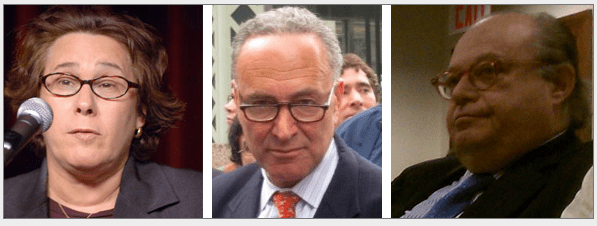
Image via Streetsblog
The Post editors are worried that a hypothetically serious lawsuit against the city could cost taxpayers millions, but they so far have expressed zero concern about the costs accruing to taxpayers from a real-life, frivolous lawsuit filed by millionaires.
Question #2:
Any guesses what happens if a bike-renting tourist gets squashed by a bus?

There’s a difference between an accident that could potentially occur with a city bike share program and an accident that’s the responsibility of a private company or individual, but it’s not as if tourists aren’t already getting “squashed” in this city. If a tourist is killed by a bus, chances are it will be the either driver’s fault or the cyclist’s, not the bike share program’s. I’ve been in two bike accidents in my life and neither one resulted in me suing Bianchi.
Question #3:
Or a rental cyclist flattens a gaggle of pedestrians?

The article doesn’t mention if the car involved in this accident — which flattened a gaggle of people inside a bodega — was a rental.
“Unless you try, you won’t know.”
Here’s then-DOT Commisioner Iris Weinshall in 2007 on the subject of countdown clocks for pedestrians.
A pilot project costing $186,000 was launched, even as Weinshall conceded publicly: “We have been against it for a while. Maybe the engineers are incorrect. Maybe this thing will work. But unless you try, you won’t know.”
Don’t Be a Jerk – Initial Thoughts
DOT’s “Don’t Be a Jerk” campaign debuted today with spots making the rounds online. I must admit that the videos are far more benign so far than I had anticipated, although it remains to be seen what the Post or CBS2 will do with them if the chance arises.
I stand behind my original belief that using the language of the backlash to advance cycling as a legitimate mode of transportation is counterproductive. Imagine if DOT had kept everything under the umbrella of its “Bike Smart” campaign. Very little about these ads would have had to change: the department still would have been able to show Mario Batali going the wrong way down Broadway, Paulina Porizkova cutting off a group of pedestrians, or John Leguizamo riding on the sidewalk without linking the word jerk to cycling.
That being said, here’s what I like about the spots:
- Like Ben, I like that the criticism comes, for the most part, from other cyclists. Having drivers yell at cyclists would have been a big mistake.
- They paint a nice picture of New York as a place with bike lanes, pedestrian plazas, and parks, bucking the more typical concrete jungle imagery. Don’t tell Heather Haddon, but the Mario Batali spot, with its accordion-flavored soundtrack and people sitting at outdoor tables, makes riding near Madison Square Park seem positively European.
- Sadik-Khan’s cameo in the Leguizamo spot is like an Easter egg for transportation nerds.
- The little dinging bell at the end of the ads is a nice touch, adding an extra touch of friendliness to the series.
Then there’s the stuff that doesn’t work so well:
- If you don’t know who they are, Batali comes off as a clueless Crocs-wearing tourist and Porizkova as a Beautiful Godzilla; neither one is really a jerk. Only Leguizamo shows some good old fashioned New York ‘tude befitting the series’ tag line.
- Speaking of clueless, who shoots a PSA about bike safety and then forgets to tell the ad’s star to buckle his helmet?
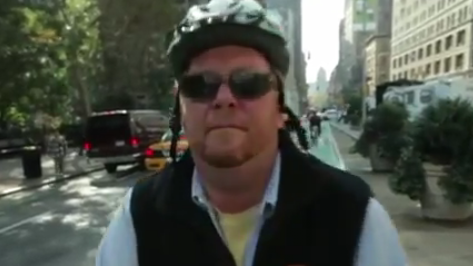
- In the Porizkova spot, it’s not exactly clear who’s at fault, the pedestrians or the supermodel. The sequencing seems off and the message is dulled as a result. The relationship between cyclists and pedestrians crossing the street is perhaps the source of most of the animus in Great Bike Lane War of 2011, and this ad feels like a missed opportunity.
- Porizkova’s spot makes a subliminal case for separated bike lanes. Check out this screen shot and ask yourself what would have happened had Mrs. Ric Ocasek been run over by a white van during the filming:

Some of this is filtered through my critical eye as a TV producer, so take it all with a grain of salt. I think with slightly better editing, a clearer message, and a more positive tag line that fit the overall tone of the spots, this campaign would have accomoplished all DOT intended it to do and made a more lasting impression on New Yorkers. Entertainment Weekly style, I give the entire series a B.
UPDATE, 5/11/11: As predicted, the Post uses the DOT’s words and takes them one step further in describing the DBAJ campaign:
One of the city’s top bike backers yesterday painted cyclists as a bunch of lawbreaking idiots.
It’s almost as if the Post received a DOT stamp of approval to continue waging its campaign against cyclists. Instead of marginalizing naysayers in the tabloids, the DOT is enabling them.
And here’s DNAinfo on the PSAs:
New York City does not want you to be a jerk – when it comes to riding your bicycle.
Bike lanes have come under attack from some critics who say they block parking, hamper pedestrians and are unnecessary because of the small number of people who commute via two wheels.
 Brooklyn Spoke