Bike Month Came Early

Look who I bumped into on my way into work this morning: Transportation Alternatives volunteers giving out coffee, cookies, applies, and new bike maps on the Manhattan side of the Manhattan Bridge. I had completely forgotten that this was happening, so when I came around the bend of the bike path and saw them it made an already fantastic morning commute even better. It got me very excited for Bike Month, which officially begins on Sunday.
By the way, if there’s a coffee cup index for ridership levels in New York, someone needs to alert the news media. There were so many riders using the Manhattan Bridge today that I think the volunteers ran out of cups shortly after I left.
Chuck Schumer, Scofflaw Cyclist
From the New York Times, 10/3/2004.
Despite his enthusiasm for cycling, Mr. Schumer has not necessarily mastered all the rules. He tends to follow his gut, not traffic patterns. As we crossed Pitkin Avenue, he drifted in front of an ice truck, eliciting a honk. The driver recognized Mr. Schumer despite the helmet.
”I’d expect that from a kid, not a senator,” the driver shouted.
“We all know that is a flagrant lie.”
Streetsblog is starting to reveal some of the documents it received as part of a FOIL request from the major players in the lawsuit to remove the highly popular Prospect Park West bike lane.
One document is an October 2010 email correspondence between Luke DePalma, who’s the Transportation Policy Analyst in Marty Markowitz’ office, and some people named Susan, Gail, and James. In it, DePalma cast a net for area residents “affected by the PPW bike lanes” and willing to be interviewed about it by someone from the media. (Who needs a PR firm when you have the borough president’s office shilling for you?)

Click to enlarge
There’s some rich irony in a city employee whose email signature includes a graphic from a city-sponsored bike safety organization trying to broker a newspaper article or TV segment with the overall goal of killing a vital bike safety project. I wonder if that jibes with the Bicycle Safety Coalition’s mission?
The New York City Bicycle Safety Coalition was formed in 2006 in response to a 40% increase in cyclist fatalities over the prior year in the five boroughs. The Coalition is comprised of a range of parties who have one goal in mind: to make the streets safer for everyone.
There’s some even richer irony to be found in DePalma’s comment that “This would be a good opportunity to keep the story alive,” and in the response, presumably from Susan, that bemoans the “carnival like atmosphere that has been created on PPW.” If you want the carnival to leave town, don’t request a conference call someone who want to “keep the story alive,” especially if that person works for someone who turned his State of the Borough speech into an anti-bike lane carnival.
And what to make of this quote? “It is incomprehensible that the only complaint is a few cars in the islands. We all know that is a flagrant lie. Besides, the only time I noticed a few cars parked in those islands were in the beginning days.” The old NBBL confirmation bias rears its head again.
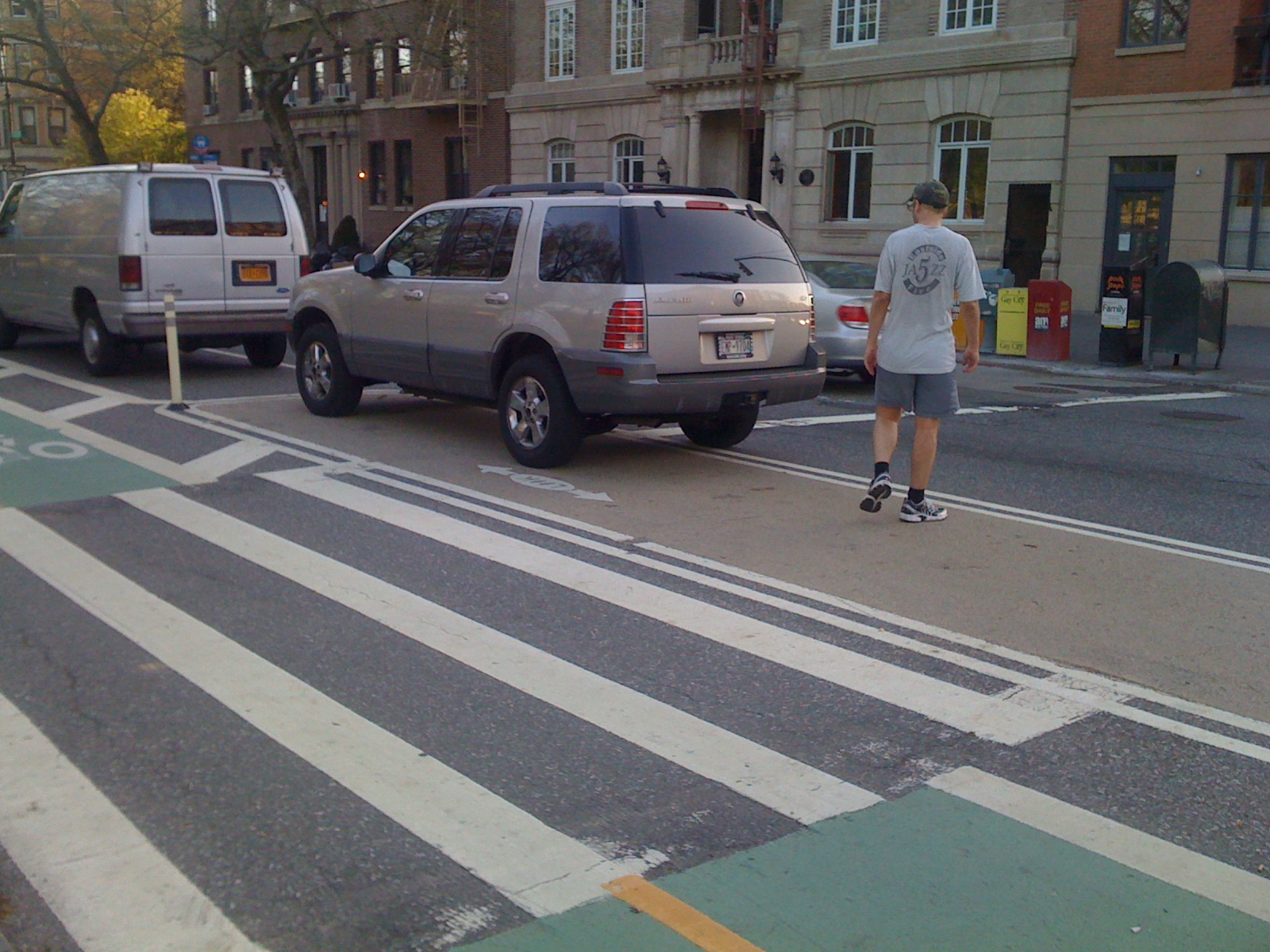
Well, it’s been nearly a year since the bike lane went in. We’re well past its “beginning days” so we must not need “toys” and “expensive granite barriers*” to keep the pedestrian areas free from double parked cars, right?
April 26, 2011
*See the comments for the difference between the “expensive granite barriers” mentioned in the email and the inexpensive concrete islands that will be installed soon.
Community Board 8 Meeting Tonight
There’s a meeting of the transportation committee of Brooklyn’s Community Board 8 tonight at 7 PM that you may want to attend. The DOT is presenting plans for the Washington Avenue safety project which will include traffic calming, shorter pedestrian crossings, and more. The meeting takes place at the Haitian American Day Care Center, at 1491 Bedford Ave.
Prospect Heights Patch has more on the meeting.
The NYC Department of Transportation will be presenting their plans for changes to Washington Avenue and Grand Army Plaza at Community Board 8’s transportation committee meeting tonight, including plans for bike lanes at both locations and a new traffic light at Grand Army Plaza.
The board will vote on these proposals, but the vote is advisory: the DOT will take the community’s concerns into account, but can still go forward with the plan.
Cuozzo Bait
One more thought on DOT’s “Don’t be a Jerk” campaign: the tabloids will make hay with it. Nothing could possibly win over the Post, of course, but the Steve Cuozzo column practically writes itself:
With calls for her to take the Cathy Black road to resignation, Bicycling Commissioner Janette Sadik-Khan is finally telling her two-wheeled worshippers to shape up or ship out. After decades of terrorizing real New Yorkers, cyclists are being told — with taxpayer dollars, no less — to stop being jerks. Not that they’ll listen; they’re too busy listening to music on their iPods as they run red lights the wrong way on Broadway. Sadik-Khan, who’s been a jerk to every community board this side of New Jersey, is perpetrating her biggest “Khan” job yet.
Want proof of this? Read this editorial in yesterday’s Post. It’s not a far leap from “boors” to “jerks.”
I shudder to think of the pictures that will appear in the Post the minute riders are photographed around town in front of “Don’t be a Jerk” bus shelter ads and billboards. And if one is photographed cutting off a pedestrian? Get ready for the word “jerk” to appear in every caption of every bike picture that makes it into the tabloids.
DBAJ is seriously misguided. Does anyone really think that the Post‘s biggest gripe with cycling is that too many cyclists act like jerks? Would Marty Markowitz ditch his driver and SUV and start riding his senior trike to Borough Hall if only more riders stopped at red lights? Will Iris, Norman, and Louise learn to stop suing and love the Prospect Park West bike lane on the day that every cyclist begins yielding for pedestrians?
Yes, some cyclists need to get their acts together. But not because it will make people really, really like them. Some people just hate bikes and bike lanes. Period.
Brooklyn Bridge, 1910

Think it’s hard to bike across the Brooklyn Bridge with all of the tourists meandering across the narrow path? Imagine what it was like in 1910 when there were stairs to navigate. Click through to see the full image at at Shorpy, a veritable treasure trove of vintage NYC bridge pictures.
Hard-Core
Today’s Wall Street Journal enlisted “hard-core, regular cyclists” to frame a debate about the city’s investment in separated bike lanes. (I’m a regular cyclist, but am fairly certain that my upright Dutch-style bike and baby seat immediately disqualify me from being “hard-core.”) Without explicitly using the term, the story echoes past arguments about vehicular cycling, focusing on riders who prefer the free-for-all nature of open streets over separated bike lanes that one rider describes with the kind of hyperbole typically used by members of Seniors for Safety.
“They’re death traps and they’re very poorly designed,” said Mr. Durller. He said he got tired of dodging pedestrians, turning cars, slower cyclists and trucks loading and unloading.
As Howard Wolfson tweeted today, the number of cyclists killed in protected bike lanes remains at zero – I don’t know what the threshold is for calling something a deathtrap, but I think it has to be higher than one. I can’t deny anyone their opinion of riding in separated bike lanes versus open streets, but my experience is that no matter where you ride you still have to dodge pedestrians, turning cars, and trucks. Maybe the only advantage the street has is that a veteran rider never has to worry about getting stuck behind this jerk.
Still, I can’t fault the riders quoted in the piece that much – it’s the writer, Andrew Grossman, who sets up one of the article’s more baffling pieces of logic:
But a cadre of regular cyclists say that while they like City Hall’s pro-bike bent, its efforts to separate them from traffic can backfire.
Christopher Baker, a triathlete who lives on the Upper East Side, said he got stopped by police a year ago after hopping onto the sidewalk to try to avoid a pedestrian in the Ninth Avenue bike lane. A few months later, Mr. Baker was stopped on Second Avenue for riding outside of the lane there.
Are Baker’s understandably frustrating experiences the fault of bad bike lane design and the DOT or the fault of, say, NYPD officers who are unfamiliar with the law, unwilling to use due discretion, and ordered to crackdown on cyclists no matter how benign the offense?
Interestingly, the article focuses on conflicts and frustrations with “lanes in denser parts of Manhattan,” but is illustrated with a rather serene picture of a lone rider on the Prospect Park West bike lane, perhaps confirming Dmitry Gudkov’s theory that PPW is only as “controversial” as the media’s search engine optimization needs it to be.
Don’t Be a Jerk
I have an opinion piece up on Streetsblog today on the DOT’s upcoming Don’t Be a Jerk campaign and Bike Smart Pledge. Please take a read and let me know what you think.
Brooklyn’s Bike Shop Boom

I’ll have more on this later, but Here’s Park Slope has news of a new bike shop coming to 476 Fifth Avenue between 10th and 11th Streets. If you’re counting, it will bring the total number of bike shops in Park Slope to seven, if I’m using a real estate agent’s definition of the neighborhood.
In addition to this newcomer, you’ll find:
- Ride Brooklyn on Bergen Street between Flatbush and 5th Avenues
- R&A Cycles on 5th Avenue between Park Place and Sterling Place
- Dixon’s Bicyle Shop on Union Street between 6th and 7th Avenues
- 9th Street Bikes on 9th Street and 6th Avenue
- On the Move on 7th Avenue between 12th and 13th Streets
- 718 Cyclery on Seventh Avenue between 16th Street and Windsor Place
If I’m missing any, please let me know. I’m not even including bike shops within walking and riding distance of these in other neighborhoods, such as Rolling Orange in Carroll Gardens, Bicycle Station and Bespoke Bicycles in Fort Greene, Brooklyn Bike and Board in Prospect Heights, and other off-the-radar stores in the area.
Many of the above-mentioned shops opened only within the last three years during a recession. So, while critics claim that no one is riding in bike lanes, or that the census shows that the DOT is overestimating bike commuters, or even that the DOT has cooked the books on ridership, Brooklyn, the epicenter of the city’s bikelash, is in the middle of a bike shop boom. Of course, the opening of another bike shop is no more definitive a measure of biking’s popularity right now than the opening of a mortgage broker’s office was a measure of a healthy housing market in 2008, but it may be a positive sign that small business owners are willing to bet big on biking’s future.
Now Even Kids’ Play Spaces are Controversial
There’s something fundamentally wrong with our media when even a plan to provide more safe play space for children on a dead-end street inspires the kind of lazy reporting and search for controversy on display in this article in the Brooklyn Paper.
Despite what reporter Natalie O’Neill seems to want to stir up in her piece in the BP’s “Mean Streets” series, the plan to close 4th Street from traffic during weekdays this fall is far from controversial. It has the support of CB6 and Middle School 51. It’s hard to even say that the plan includes closing 4th Street to traffic, as O’Neill writes, since it’s not a through-street and is already closed during the week – the new plan merely extends the car-free hours starting this fall. A truer statement would be that the city and community have decided that 4th Street would work better as a place for hundreds of children to play safely, rather than as a place where only twenty people can store their private vehicles for free.
But, never mind. O’Neill manages to inject a little controversy where there is none. She interviews David Ma, “who rents apartments and space to businesses like the nearby Stone Park Café.” Not surprisingly, he feels it’s bad for the neighborhood. A journalist could ask Ma how many of his tenants drive or how many of the restaurant’s customers arrive by car, but that information is not found here.
No reporter can possibly write a story about eliminating even one parking space without making the most tenuous connection to bikes and bike lanes, and O’Neill doesn’t miss her chance:
The city’s plan for Fourth Street will likely be seen as another blow to motorists, who increasingly complain that roadway space is being taken for cyclists and park users.
Two weeks ago, Councilwoman Gale Brewer (D–Manhattan) called for a ban on cars in Prospect Park, saying, “New Yorkers should be able to go to the park without worrying about motor vehicle traffic.”
As Streetsblog has reported, the amount of road space “being taken for cyclists” is infinitesimally small. And the idea that roadway space is also being taken for park users, and that it’s a “blow to motorists,” is laughable. If anything, space has been taken from park users and given to motorists in spaces which were created before anyone could have imagined cars speeding through them at 40 miles per hour.
Reading O’Neill’s reporting, you can almost see the sign over her desk reminding her how many pro-car articles she has left to write before she earns a parking placard and a lunch with Steve Cuozzo.
 Brooklyn Spoke
