Write to Community Board 6
Community Board 6 is scheduled to convene this Thursday, March 17 at 6:30 PM to formulate “a recommendation to the Department of Transportation on their proposed modifications to the Prospect Park West bike lanes.” Theoretically, they’ll suggest the DOT follow many of the recommendations outlined in the Lander/Levin survey such as installing raised pedestrian refuges, adjusting signaling and signage, and making minor aesthetic improvements. Other minor changes may also be suggested.
To build on the immense support on display at last week’s public hearing, tt couldn’t hurt to write voicing your enthusiasm for traffic calming project and bike lane. You can write to Community Board 6 at 250 Baltic Street, Brooklyn, NY 11201-6401. Email is Info@BrooklynCB6.org.
Bike Lane Sightlines
One of the common complaints coming from critics of the PPW bike lane is that it is hard for pedestrians to see around parked cars before they cross to the sidewalk. Streetsblog has a great picture of the view from First Street showing just how clear it is, but I shot these two videos on a trip up to the park on Saturday to show how clear the sightlines are as you look both ways.
Here’s Carrol Street, about two blocks from Grand Army Plaza.
The view is very clear in both directions, mainly due to the width of the buffer between the parked cars and the bike lane. (This is the buffer that may be narrowed in order to smooth the flow of traffic off of Grand Army Plaza and onto PPW.)
As you can also see, car drivers aren’t having too much of a problem speeding down the street now that there are two lanes instead of three. And before someone comments that the bike lane isn’t necessary because no one is riding in it, all I can say is that the bike traffic came in waves, much like the car traffic did.
Here’s another crossing, further south on PPW. (Sorry, but I forgot which crossing this is. Help a guy out in the comments if you can.)
The buffer is narrower here, but the views are still quite lengthy.
I’m not a tall guy, about 5’8″, and I shot these videos by holding a Flip camera at chin level. So even someone shorter than me wouldn’t have much of a problem seeing up and down the bike lane for some distance.
Despite this, I do not want to minimize that some people may feel unsafe crossing the bike lane. I can’t argue with anyone’s perception. But what I can say is that such fears could be solved by removing one or two spots near crossings so that tall SUVs or vans can’t limit views. Raised cement pedestrian refuges will help, as they’ll prevent cars from parking in current flat, tan pedestrian areas. I also think the mounted “Look Both Ways Before Crossing” signs could be lowered so that they’re at the eye level of the average person. I can’t wait to see these kinds of tweaks this spring.
Rationalizing Irrationality
John Cassidy’s rants on the subject of bike lanes may not have demonstrated his bona fides as an economics reporter, but they have proved his worth as a reliable page view generator for the New Yorker website. Thanks to the three irrational screeds Cassidy has written in as many days, the subject, at least for now, warrants an entire tab on the website’s banner.

It’s such a page-view generator for them that the tab abuts to the two things that make the New Yorker the New Yorker: urbane cartoons and high-minded news analysis:

Cassidy’s blog on the New Yorker site is titled Rational Irrationality, but given the hole he continues to dig for himself–a hole he has so far not filled in with facts–I suggest a new title: Rationalizing Irrationality.
The subject has even pitted neighbor versus neighbor at the Condé Nast. Hendrik Hertzberg has joined the Cassidy smackdown parade:
I was interested to note that John currently gets around in “an old Jaguar XJ6.” The last time I saw him behind the wheel, he was piloting a vintage Cadillac Sedan de Ville, a car whose fuel economy is best calculated in gallons per mile. Apparently he is “going green.” At this rate he’ll be driving a Prius by 2050.
But that’s Hertzberg for you. Just another member of the radical bicycle lobby.
Break Free
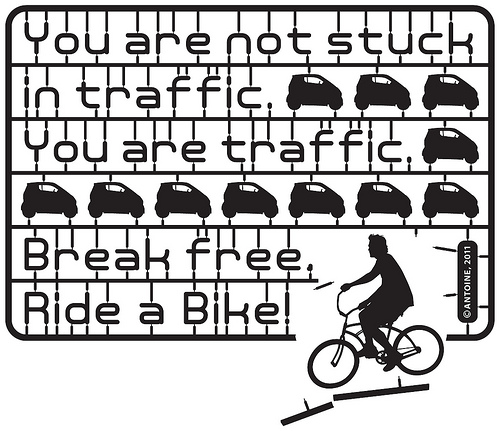
Some good advice, via Copenhagenize.
Quick Hits from the CB6 Public Hearing*
Thursday night marked the third Community Board Six meeting I’ve attended on the subject of the Prospect Park West bike lane and let me offer this quick assessment: members of Neighbors for Better Bike Lanes, Seniors for Safety, and other unaffiliated critics of this vital traffic calming project were given an amount of time at the microphone disproportionate to their attendance.
By trying to achieve the semblance of balance at the meeting, CB6’s decision to alternate between small groups of “pro” speakers, small groups of “con” speakers, and speakers designated with the ambiguous category of “other” left me somewhat dismayed. It gave the early impression that there is some sort of split on this issue, which there is not. Not according to the Brad Lander/Stephen Levin survey which showed around 70% approval for the project, and not tonight; my guess is that the room was split 80/20 into supporters and opponents. As a barometer, Transportation Alternatives says it handed out 350 green and pink pro-cycling and pro-pedestrian stickers in a room of about 450 people, and many supporters were not wearing them. But because of this seeming need for balance, a reporter who covered only the first thirty minutes of public testimony might have gotten the impression that the community was evenly divided. It is not and it never was.
On the TV series Lost, we never really learned if the Others were good, bad, or somewhere in between, but what ended up happening with the “other” category at the public hearing tonight was that, for the most part, it was co-opted by opponents. To be fair, some may have thought that their position was in the middle somewhere, but there were far more examples of people who were clearly against this project who could not honestly claim agnosticism on the subject. One woman, who at the December meeting complained that all of the pollution on PPW was making it hard for her to sustain speech, spoke as an “other.” CB6 should have come down harder on people like her, as this happened around six times during the night. Other after other would get up only to very quickly reveal himself or herself as more or less against the new PPW.
After the first hour, CB6 did loosen up on its pro-con-other order a bit, allowing multiple pros to go speak. When some bike lane opponents complained that the other side was getting too much speaking time, the chair did say that if he allowed the cons to speak with the same frequency, “your side would run out of speakers.” Eventually they did run out of speakers towards the end of the meeting. In fact, in a minor breach of protocol, the CB6 chair solicited someone from the audience, asking if there were any people on the con side who wanted to speak. One woman volunteered but began her speech by saying, “I wasn’t prepared” and then proceeded to ramble on for far more than the allotted two minutes. By the time the meeting ended shortly before 9 PM, around 90 people were still left to speak, all of them supporters of the new Prospect Park West. In a way, it’s really good news that support for this project surpasses the amount of time available to speak about it. The support is there and hopefully the written testimony submitted follows a similar pro-con breakdown.
There’s more good news, too. On a cold, rainy night, over 350 people packed a stuffy and hot high school auditorium to stand up for safer streets. People care about this and I believe that further legal maneuverings will only stir this pot even more.
The tone stayed civil, for the most part. There were disparaging remarks here and there, of course, but not so much to shift the tone all that much. When one man from Carroll Gardens was booed by opponents for not being from the neighborhood, the chairman upbraided them, saying, “We are one community.” NBBLers were heckled a few times, but such moments on both sides were rare.
A few of my favorite moments:
- Brad Lander spoke first and I can’t stress this enough: I believe he has exhibited real courage on this issue, considering the power and influence of some members of NBBL. It seems silly to say that courage is necessary to defend a bike lane, but that doesn’t make it not true. Lander said, “The Prospect Park West bike lane is working. Fears it would be constantly gridlocked are untrue.” (I think he meant the car traffic and not the political process.)
- After Council Member Brad Lander, the next two speakers were 2nd grade girls June and Ava, who both spoke about riding their bikes with their families and being safe. Both were adorable.
- A man who identified himself as a “registered Republican…in Park Slope” and who admitted to voting for both Bushes and McCain, said “Even I am pro bike lane. Cyclists need a safe and legal place to ride and I want more bike lanes.” Citing the economic and health benefits, He said he was “pro-business, pro-family and pro-bike lane.” He fairly chastised cyclists for breaking laws, but made the point that more bike lanes means more legal behavior.
- One of my favorite quotes came from a man who said the bike lane had made riding with his kids safe: “Slower traffic speeds is a better aesthetic than a floating parking lane.”
- A woman who was left disabled after an accident, with a limp that meant walks to Celebrate Brooklyn would take her a long time, said that biking was an efficient mode of transportation for her but that given how riding in traffic felt to her before, she felt compelled to ride on the sidewalk: “Obeying the law would have been suicide for me.
On the con side, there were few surprises. We heard conflicting testimony, often from the same person, about how the bike lane is empty, but that seniors are afraid to cross or exit their cars because there are too many bikes. Yogi Berra couldn’t come up with that if he tried. Some people blamed the lack of bus service on the bike lane and not, say, budget cuts. Others complained of double parking, which is an issue of enforcement by police and not my concern when I go by on my bike.
Mostly, we heard this issue reduced to bikers versus everyone else, even though pedestrians and drivers have, in many ways, been even bigger beneficiaries of the safety improvements than bikers. It was illustrative to me to see how many NBBLers and other opponents honestly believe that everyone who opposes them must be a cyclist. This is bigger than that.
Many opponents repeated the request that the bike lane be removed, and that a one-way Class II bike lane be installed with a two-way bike lane put into the Park. I’ll write more on the subject in the future — and have in the past — but that solution does nothing to calm traffic. Paint alone can not stop a truck. It’s becoming a major talking point for NBBL, so stay tuned.
I Tweeted much of the meeting and highlighted some of the NBBL, SFS, and others opponents comments. Here are some notable ones.
- Louise Hainline of NBBL repeated the “experimental bike lane” language and said, “We are not your enemy.” But from where I see it, she was one of only a few people in the room whose name and signature is on a lawsuit to take away something that over 70% of the community loves. I don’t know if that makes her an enemy, exactly, but she’s not likely to earn any friends after it’s all over.
- She listed four bike lanes, all installed in recent years, and said, “we can not keep this up.” No word on how many streets she can name and whether or not New York can keep up with them.
- Lois Carswell also repeated the call for a Class II bike lane and another in the park. I’ll give CB6 credit. When it came up later, a CB6 member raised the point that riding in the park late at night is not safe.
- Carswell said that on every other street in New York traffic is “controlled,” which elicited howls from the audience. She suggested that one way to control speeding on PPW would be to put up speed limit signs and install radar guns. Right. Because those 30 mph signs you see around the city are doing a great job.
- One man said he had contributed money to the litigation fund and that it was sad that this thing would go higher and higher and be appealed. He said, “Let’s go back to the status quo,” which I am suggesting NBBL put on a bumper sticker.
- Another man said cycling was a religion and what he saw was zealotry, again reducing the issue to cars versus bikes.
- Jasmine Melzer testified of crossing the street and having to watch out for bikes because you don’t know which way they’re coming from. Someone in the audience yelled, “Both!” Melzer is from the UK, I believe, and I did enjoy the irony of a British person moving to America, presumably learning a new street-crossing behavior when she came across the pond, but now, decades later, complaining that she might have to look both ways before crossing the street.
All in all, it was a home run for everyone involved who supports livable streets. We had a great turnout, an upbeat attitude, and proved that outside of the pages of the tabloids there is real and growing support for this kind of positive change in Brooklyn. There is still a full Community Board vote on the subject to come, so keep letters coming and don’t be shy about calling or writing your local City Council member.
The fight is not over, but we’re getting close.
*I wrote this post thinking it would be short. It was not. I am sorry. And sorry for any typos or sloppy grammar. I wrote this bleary-eyed at midnight last night.
One Last Reminder
Stay positive, be cheerful, and stress safety for all. That’s what it’s about.
John Jay High School at 6:30. 237 7th Ave in Park Slope. F train to Seventh Avenue.
See you tonight.
What is a Class II Bike Lane?
Just in case there is any confusion, this is a Class II bike lane. It’s also the “compromise” that Jim Walden, Louise Hainline, and others speaking on behalf of Neighbors for Better Bike Lanes have proposed.

Would you want your kids riding in that bike lane? Come to the CB6 hearing tonight to make sure the street stays safe.
Which Historic Charm? Pt. 6
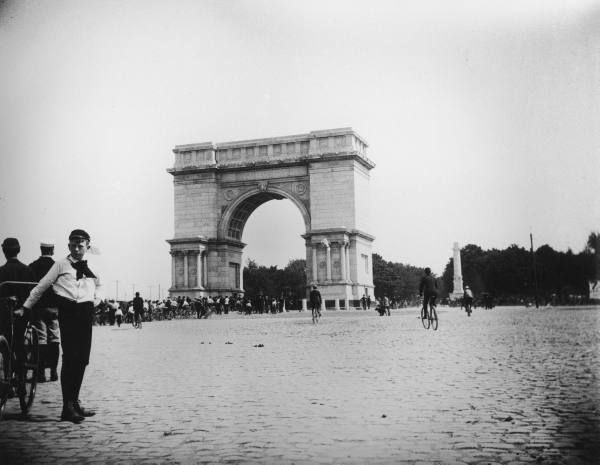
More Brooklyn bikes and cobblestones for you, this time from June, 1895. As with the last photo I found, there’s no statue atop the arch yet, and one gets the sense that walking from where this photo was taken to the monument would be easy, not at all like doing it today.
If he were alive today, aside from being freakishly old, the boy in the foreground would be shocked to see what has happened Grand Army Plaza. But turning it back into this, while romantic for some, is no more the answer than turning PPW back into the speedway it was before last June. Progress requires forward movement and new ways of looking at modern living. How people use streets evolves over time and we would no more want to be stuck in the 1890s than in the 1990s.
Which Historic Charm? Pt. 5

Nope, it’s not the Big Apple Tweed Ride, but a historic picture of Grand Army Plaza. My guess is that this is from the very late 1800s. I love the cobblestones around the arch and, of course, the bikes. You can also see four people standing on top of the arch. It’s too bad that this kind of visit is generally impossible these days, and that so much of Olmsted & Vaux’s vision for what was originally called Prospect Park Plaza, has been chipped away at over the years by traffic. It makes it the kind of place that few people visit, even though it’s right across the street from the main entrance to Prospect Park. Hopefully that will change as the city makes improvements to the plaza over the coming years.
Cars seem to be part of the ether now, but there was a time when cars were considered the interlopers on city streets, as rare seeing a baby pigeon. Years later, when the first automobile went around Grand Army Plaza, I’m sure the people in this picture and people like them would have felt much the same as many people today do about bikes. Not that they were a panacea, but it took new road designs, signs, and traffic signals to bring some order to the chaos imposed on city streets by automobiles. The same will hold true for bikes, and we’re starting to see it all over New York. With a lot of work, but at a fraction of the cost of installing a century’s worth of roadways, bike infrastructure will be a part of that ether, too.
First Class Bike Lanes
I bumped into Clarence from Streetfilms while he was shooting this interview with Gary Toth on Prospect Park West on a particularly sunny, beautiful day. (If that makes us part of the “radical” biking cabal, so be it.) The bike lane was filled with commuters, kids riding home from school with their parents, and lots of other people using Prospect Park West to get where they were going. Car traffic was moving smoothly. It was amazing and a great sign of what’s in store come spring.
This video’s release before Thursday’s CB6 meeting is perfect. With the NBBL lawsuit filed and their continued calls for a Class 2 bike lane, which is really just two lines of paint on the street, this video is a great demonstration of why separated bike lanes are so important, not only to cyclists but to pedestrians, drivers, and everyone who lives in and visits a neighborhood. NBBL complains in their lawsuit that these types of bike lanes never existed in New York before the DOT installed them on PPW and Kent Avenue, but so what? Since when is New York shy about innovation?
Toth points out in this video that change takes some getting used to, but that if we allow history and the lessons of other cultures to be our guides, then the future may not seem as scary and that we may even look back on these changes as visionary. A lot of the things we now take for granted were once new themselves, and met much of the same skepticism and, in some cases, opposition. Who knows? Perhaps there once existed a group called Neighbors For Better Car Lanes.
 Brooklyn Spoke