NBBL Waves the White Flag?

I took this short article in today’s Post as a sign that the story of the Prospect Park West bike lane is reaching its denouement:
Opponents of a controversial bike lane along Prospect Park West are offering a one-way compromise, suggesting the two-lane path be chopped in half.
“The entire community favors a regular one-way bike lane, which would neither place pedestrians in danger nor create the kind of choking traffic we see day in and day out,” Neighbors for Better Bike Lanes said in a statement yesterday.
The 130-member group has powerful backing — its leaders include former Transportation Commissioner Iris Weinshall, who is married to Sen. Chuck Schumer, and former Sanitation Commissioner Norman Steisel.
It says the city DOT is overstating the number of cyclists using the path since its installation.
The city says the lane has reduced motorist speeding and curbed accidents.
On one hand, it’s another example of NBBL’s brilliant PR strategy, although this time they didn’t need Marcia Kramer’s help. By offering a “compromise” they can position themselves as the only side willing to give even an inch, as opposed to that stubborn DOT, which is often portrayed in the tabloids as shoving bike lanes down community residents’ throats.
On the other hand, it’s a sign that NBBL has zero confidence in their lawsuit. Settlements are common in all types of legal battles, but it’s not the most Sun-Tzu-like move to offer this drastic a concession so early. It’s also a sign that NBBL’s PR strategy isn’t always that brilliant; the threat to sue may have been a huge overreach, especially considering the negative publicity that comes when wealthy people get pro bono representation.
If anyone believes that NBBL would have been in favor of this bike lane from the beginning had it only been one-way and taken up three fewer feet of road space, then I have a bike lane over the Brooklyn Bridge I’d like to sell them. And is NBBL’s biggest problem with the lane really that pedestrians have to look both ways before crossing it? It’s fine to offer compromise, but given how far back the PPW traffic calming project goes I wonder where NBBL has been for the past five years.
Still, you have to hand it to NBBL for pretending to speak for the “entire community.” Of the 65,000+ people who live in Park Slope, and of the thousands more who use PPW, NBBL can claim only 130 members. NBBL’s Facebook group has only 310 members, while the one supporting the new PPW has over 1,900. Perhaps 50 to 75 NBBL supporters came to the October rally, while over 300 safe street supporters turned out on the same day. I have no idea how NBBL tallies its membership, but perhaps they use the standard multiplying effect of 50:1 for constituent support.
You also have to hand it to the Post for not including a response from the DOT, TA, Park Slope Neighbors, Community Board 6, or Brad Lander, whose office found that an overwhelming majority of the community favors the two-way bike lane more or less the way it is.* Lander’s survey asked respondents, “If Kept, How Should the Design Be Modified?” The top recommendation was “Clearer yield” followed by many other design and aesthetic improvements. “Make the lane one way” didn’t even make the cut.
Note, too, the subtle framing in NBBL’s statement: a “regular one-way bike lane.” There’s no such thing as a regular bike lane, just as there’s no such thing as a regular street. Some are one-way, some are two-way.
There is another positive sign in the Post’s reporting of this development. Once again, the paper has made a clear connection between Senator Chuck Schumer and Neighbors for Better Bike Lanes, and news of the Schumer-to-NBBL connection continues to build. Getting him involved may be a bigger overreach than NBBL’s legal threats.
This will all be over soon. I can’t wait for spring.
*UPDATE: Eric McClure of Park Slope Neighbors points out in the comments that he was contacted by the Post’s Bill Sanderson but he had filed the story by the time Eric returned his call.
Chuck Schumer Bike Lane Appreciation Day, Continued!

Iris & Chuck celebrate CSBLAD
Don’t forget that Chuck Schumer Bike Lane Appreciation Day continues today! If you haven’t already posted a message on the senator’s Facebook page, as many celebrants already have, please do so.
If you’re on the Twitter, you can always follow and mention @ChuckSchumer. The good news is that if you follow him there you may gain a new follower since it says under his bio that “New York’s Senator Office tries to follow all followers.”
There are plenty of other tips for celebrating in the post below, so please join in the festivities!
Chuck Schumer Bike Lane Appreciation Day

Chuck celebrating with Marcia Kramer
I am declaring today, Tuesday, February 15th, “Chuck Schumer Bike Lane Appreciation Day.” Here are some tips for celebrating:
- “Like” and then post a comment on Senator Chuck Schumer’s Facebook Wall telling him how you feel about his involvement with Neighbors for Better Bike Lanes and their efforts to remove the Prospect Park West Bike Lane. Don’t just comment on or like someone else’s post. Post your own.
- Send Senator Schumer an email.
- Call his New York City office at 212-486-4430.
- Write him a good, old fashioned, pen-and-paper letter. His NYC office address: 757 Third Avenue, Suite 17-02, New York, NY 10017
In any communication, be polite and focus on the positive elements of the PPW traffic calming project. For a quick how-to in effective letter writing, I suggest watching this TED video from Omar Ahmad.
Like the Jewish holidays, this one will be celebrated for two days. You can continue your observance into Wednesday, February 16th.
If this takes off, I hope we can hold the first big CSBL Day celebration event on the Prospect Park West Bike Lane itself. Chuck is sure to attend, since we know how much he and Iris love biking!
UPDATE: In observance of Chuck Schumer Bike Lane Appreciation Day The Brooklyn Paper has an excellent rundown of the connections between Senator Schumer and Neighbors for Better Bike Lanes’ pro-bono attorney Jim Walden.
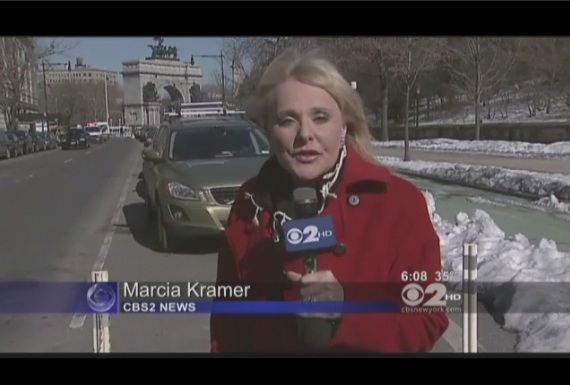
Something’s Wrong with This Picture
Why is it that whenever Marcia Kramer tells CBS2 viewers that bike lanes cause traffic congestion she never stands on a congested street?
If You See Something, Say Something
The Daily News continues its coverage of the great bicycling crisis of 2011 with an article by Adam Lisberg in yesterday’s paper. It’s titled “In the city’s bike wars, the downside of cycling isn’t counted as rigorously as the upside,” although there may have been an earlier or different title for the story, as the URL ending indicates:
getting_city_to_rein_in_rogue_bikers_is__a_vicious_cycle_for_311_callers
Maybe it was changed because it would reveal just how much better the Post is at this whole bike wars thing than the Daily News. You can’t out-fox a fox (or Fox) and I sometimes wonder why the Daily News hasn’t tried to position itself as the anti-Post instead of competing for the same dwindling audience.
Lisberg’s article centers on 311 and the fact that right now there is no effective way for the system to log complaints against dangerous riders. There are efforts underfoot to reform how 311 tracks this info, but you won’t learn very much about if you read the Daily News.
While Lisberg may dismiss my criticism as merely coming from a cranky bicycling advocate, he’s missing the point. My issue is not with his bike reporting but simply with his reporting. In fact, if there’s a way to give bicycling its own category in 311 then I’m all for it. Unfortunately, Lisberg’s story is not the journalism you deserve if you are trying to figure out the extent of the problem, its context, and how changing 311 might work.
Lisberg’s article begins with the story of Nancy Linday, a Manhattan resident who was so fed up with “out-of-control cyclists” that she decided to do something about it.
…she took careful note of every lawbreaking cyclist she saw near her office. A day later, she said, she dialed 311, demanded the operator take notes and dictated them for more than an hour. It got a response: A sergeant from the Midtown North Police Precinct called her within days, gave her his direct line and told her to call him anytime with bike problems.
Linday’s experience with led her to realize that the city doesn’t have an effective way to log bike-related complaints, because 311 currently lumps bicycling complaints into a general category of “bikes, skateboards, Rollerblades and motorized scooters.” That provides the jumping off point for Lisberg to dive into the problem in more detail.
Or at least it should. Lisberg boils down Linday’s story to this conclusion: “In other words, in the city’s bike wars, the downside of cycling isn’t counted as rigorously as the upside.”
Well, not exactly. I’m open to the possibility that cycling’s disadvantages may outweigh its advantages, but it is also possible that some things simply have a much bigger upside than downside, to the point that counting its downside is difficult or not worth it. Although it makes for nice copy, it’s not a foregone conclusion that because something isn’t counted it’s therefore being ignored by those with the spreadsheets.
Then again, the city does have a way, however imperfect, of counting bicycle complaints. For the sake of argument, assume that 100% of 311’s recorded complaints about “bikes, skateboards, Rollerblades and motorized scooters” are only about bikes. How many calls did it log in 2009?
The city’s 311 operators recorded 426 calls last year about chronic problems with bikes, skateboards, Rollerbladers, and motorized scooters. The upper East Side topped the list with 48; the upper West Side followed with 38. An additional 198 callers called with hazardous biking-skating-scooting complaints, which were transferred to 911. City records don’t break them down by location.
That’s 626 total bike-related complaints. (The article doesn’t mention how many of them were from Nancy Linday’s hour-long 311 call.) Even assuming that some people called 311 only to hang up out of frustration with the system’s inability to properly log their complaint, 626 hardly seems like a huge number when you consider that 311 fields 50,000 calls per day. The fact that the upper West Side accounted for 38 of these calls should be its own statistical standard deviation. Zabar’s probably gets twice as many complaints about the its checkout lines on Sundays.
Even if the point of the article is to show that the category is so broad as to be ineffective, are there not other 311 categories that are similarly broad and ineffective? How does 311 tally other chronic complaints that don’t fit neatly into one category? And where do these 626 bike complaints compare to those related to graffiti, overgrown branches, or consumer complaints? There’s no context to the data.
Even if the city could track bike-related 311 calls more reliably, it’s hardly the panacea some may be looking for. It’s not that hard to report reckless driving to 311, but how many people spend 10 minutes–or an hour–on the phone every time they are almost run over by a car? As a commenter on Gothamist’s post about the story noted, “The city needs to start a new system, maybe 211, for people who feel the need to report things that almost happened.”
Serious accidents involving injury, death or even property damage already have their own data collection method: 911 and NYPD incident reports. Of course, there are probably many accidents of all kinds that go unreported, but the city can’t be responsible for calls they don’t receive and it can’t be expected to respond to hearsay, although I do hear it’s the perfect basis for a lawsuit.
It’s entirely possible that, NYPD crackdown aside, a bicycle-friendly administration has unleashed an unprecedented wave of rogue cyclists upon a vulnerable population and that city residents are only just now realizing the deficiencies in 311’s reporting methods. Cycling may have grown so much in the past few years that it caught the Department of Information Technology by surprise.
If that’s true, then Lisberg leaves some very important questions unanswered: How do the 626 bike-related complaints compare to previous years? Has there been a sudden uptick that’s risen with the addition of bike lanes? And if changing 311 is a good solution, how much will it cost to retrofit the system so that the bicycle category stands on its own? Is it as as simple as rewriting a few lines of code and reprinting a page of the 311 handbook or will it be a huge, laborious undertaking?
My issue with Lisberg’s article is not that it’s negative or that he quotes people with whom I disagree. My problem is that if I was a totally uninformed Daily News reader, this story would not help me make sense of the problem and its potential solutions. Journalism’s job is to not only report the news, but to put the news in context for readers. That’s why I think Lisberg’s article fails.
Lisberg’s excuse is that he doesn’t have “endless space like Streetsblog does.” Two points for the clever dig, but it’s not exactly as his story had to be written exactly the way it was written in the space his editors provided. Then again, given how many stories and editorials his paper has devoted to rogue cyclists this year alone, it seems as if the Daily News actually does have plenty of space to devote to biking.
The Case for Red Light Cameras
This has been posted on Streetsblog, but should be seen by everyone everywhere. It’s a very hard video to watch, but it’s one of the most effective arguments for speed and red light cameras I can imagine. It’s telling that most of the angry talking heads in this video probably don’t object to the kinds of cameras that are used to manage traffic. I visited the Massachusetts Turnpike Authority’s control room in Boston and can tell you that they can easily track your every move through the Big Dig tunnels in order to effective manage traffic and respond to accidents. It would make Big Brother proud. But use cameras to capture people doing something illegal and people go nuts.
I live on 4th Avenue and can’t possibly count the number of times I see cars run lights long after they’ve turned red or even stop at a red only to ignore it and keep going. The rule I have for myself, especially when I’m walking with my daughter, is to never cross 4th Avenue until I’ve actually seen the cars stop and have a sense that they’ve seen me about to cross. If something could be done to reign in the rampant speeding and red light running on 4th Avenue, I’m all for it. This video makes the case with great power.
Chuck & Iris on a Bicycle Built for Two

It’s amazing how much of a fan Senator Chuck Schumer and his wife, Iris Weinshall, are of livable, walkable cities and even bikes and bike lanes. In fact, Weinshall has basically said that walking, not driving, is the primary transportation mode for her fellow New Yorkers:
”It’s not uncommon for New Yorkers to walk a mile a day.”
This is from an article that ran in the Times following the 2005 transit strike. Also interesting to me, while not a direct quote, was this thought on bicycle use from the former DOT head and current Neighbors for Better Bike Lanes member:
The city has far more bicycle lanes and paths than it did in 1980, but Ms. Weinshall said bicycling was a less-attractive option because of the cold weather. The 1980 strike began on April 1 and lasted 11 days.
There you have it: Iris more or less admitting that people will choose biking as transportation if weather and other conditions, such as the availability of transit, allow.
Then there’s this 2002 article from the Times, Chuck’s Place, about the contrast between Senator Schumer’s “dorm-like” existence in Washington and his more comfortable home with his wife and family on Prospect Park West:
Despite casual family décor like the plastic yellow PreSkool table in the den and the pack of bikes parked in the living room, the Schumers’ three-bedroom apartment is still downright luxurious compared with the D Street house. Mr. Schumer sleeps in a real bedroom and even has chests of drawers.
See? Iris and Chuck like bikes so much that, like many New Yorkers with a lack of good storage space, they keep their bikes in their apartment, or at least they keep them around to give off a just-folks image to Times reporters.
Chuck understands the power of bikes so much that he uses his as a means of identifying with his younger constituents, no easy feat for someone very closely identified more with Wall Street tycoons than Bedford Avenue hipsters. Here’s Chuck Schumer in 2009, in support of the Jelly concerts in Williamsburg:
“I happened to pass by the Jelly concerts when I was riding my bike through Williamsburg and was amazed at the thousands of people who lined the streets to come to the concerts.”
This is from a written statement, so it’s no accident that Chuck chose to reference his bike here — it’s political calculation. He can’t exactly go on Meet the Press wearing skinny jeans, but he can say that he rides a bike to make sure everyone knows he’s just a hipster at heart.
In other political contexts Schumer knows that a bicycle can humanize the kinds of political figures who are too often seen as detached from regular citizens. Here he is using biking as a litmus test for fellow New Yorker Sonia Sotomayor in 2009 before she was confirmed to the Supreme Court:
“She’s a bicycle rider. I’m a bicycle rider. We talked a little bit about our favorite routes. She’s a very human person of great legal mind. And I think that’s the right person to be on the Supreme Court.”
I’m happy to add more examples of Chuck’s love for bicycles and Iris’ acknowledgment that New York is, for the most part, a walking city. Please add what you can in comments or send me an email and I’ll update the post.
One other thing you can hopefully help me with is this: how can Chuck Schumer square his love of biking–to to mention his love of the bicycle as a political prop–with his work behind the scenes to get the bike lane that thousands of his neighbors love removed?
Pedestrian Accident
On my walk home from daycare pickup yesterday evening, two members of the Auxiliary Police were handing out these fliers on the corner of 5th Avenue and 5th Street. (I’ll upload an image later.)
Attention Parks [sic] Slope Community
Please be advised that we had a pedestrian accident on
Jan 5th at 5 Ave & 5th St at 3:20 PM.
Please exercise caution at this intersection. Remember to Cross
with signal and not in between cars.
I asked one of the officers what happened and he said that a pedestrian had been struck by a car. He didn’t know much more than that, or even if it involved a student from Middle School 51 across the avenue. My fear is that because it happened at 3:20 PM, it did. If you received one of these fliers or have more information, please let me know.
I refrained from saying anything other than thanks to the officers, since it’s not their call on who to flier or what message to send out, but this flier is pretty indicative of the blame-the-victim approach to traffic safety that many of us have experienced from the NYPD. It’s telling that one of the only times I’ve seen cops on foot this winter was on an occasion when they were telling pedestrians to be more careful around cars.
On the one hand, you can’t exactly blame a driver if a kid appears out of nowhere from between two parked cars. Even if you’re doing nothing wrong, bad things happen.
On the other hand, kids are more or less stupid when it comes to traffic safety, so I’d hope the 78th Precinct would recognize this and do more to keep them safe. An environment where hundreds of pre-teens and teenagers pour onto the sidewalks and into streets where cars speed by is a recipe for disaster. Instead of passing out fliers, the 78th could hand out tickets to all the illegally double-parked drivers. It would take the same amount of effort, actually do something to make the street safer, and generate revenue in the process.
There’s so much more the 78th Precinct could have done. It could have parked one or two cruisers on the street or posted signs telling drivers to slow down and “exercise caution at this intersection.” They could have handed out fliers to drivers stopped red lights. They could ticket car service drivers for making illegal u-turns. In general, they could devote more resources to ticketing reckless drivers and less to the tiny threat posed by bikes. Instead, the 78th Precinct focused solely on pedestrian behavior, using a herding cats strategy of getting hormonal middle high schoolers to be more rational about their safety.
Good luck with that.
Trash Talk
My morning walk to the train from Daniel Sieradski on Vimeo.
Here’s a tour of 4th Avenue that’ more or less covers the same route I take to get to the subway station entrance at Pacific Street. As you can see in the (shaky) video, it’s not just the snow that’s the problem. There’s an abandoned motorcycle at the corner of Pacific and 4th Avenue that’s swirling with garbage.
This tiny corner is home to an entrance to one of the city’s busiest subway stations and the starting point for the growing number of people who call this area of Boerum Hill, Gowanus, and Park Slope home. At prime rush hours, it’s hard to find space on the sidewalk to wait to go down into the station. Crossing the street from any direction means competing with fast-moving 4th Avenue traffic. Add mounds of trash to the sidewalks and there’s even less room for pedestrians.
As City Council member Stephen Levin gets his Traffic Task Force going, I hope he targets areas like this, a prime candidate for raised crosswalks, neck downs, and other pedestrian friendly improvements. He could also get someone out there with a very large broom.
New and Old v. Fair and Balanced
The Daily, the iPad news app, has a story today about a study from the Harvard School of Public Health. Riding in separated bike lanes–wait for it, wait for it–is safer than riding with traffic. From The Daily:
…pedal-pushers are 28 times less likely to be injured if they ride on a separated two-way lane, instead of cruising amid cars in traffic.
This is obvious to just about anyone, akin to saying people who fly kites on days when there are no electrical storms are 98% less likely to get struck by lightning. What is more notable about the study is that it runs counter to the common standards used to design streets just about everywhere.
This is contrary to American Association of of State Highway and Transportation Officials guidelines, used by most American cities to design roadway, which advise against building bike lanes that are separated from the street.
Then again, this isn’t surprising at all. If the focus is to move cars, not people, then it’s no shock to learn that an organization wouldn’t want bike lanes to be much more than lines of paint. Ask Iris Weinshall.
What is most interesting, at least to me, is not the story, but the reporting on the story and what it says about new media versus old. First, read these two paragraphs in The Daily story, written by Sarah Ryley. As a result of official opposition to separated bike lanes, she writes…
…people just didn’t ride. Less than 1 percent of American commuters ride to work, and only 24 percent of adult cyclists are women, according to the study. In contrast, in the Netherlands, where separated bike tracks are commonplace, 27 pecent of commuters ride to work and 55 percent of adult cyclists are women.
But that’s changing as cities across America buck the transportation officials’ standards in favor of the European model…
Now, compare that to this story in the Post by Matt Harvey, “Attack of the Killer Bike Lanes,” which uses a common line of attack, Europe bashing, introduced by a quote from a Queens native and West Village business owner:
“Bikes are great for the environment, but New York isn’t Holland or Poland. It can’t handle more bikes.”
Like it or not, that’s what the city wants. Two hundred miles of bike lanes have been added since 2008, part of an ambitious plan, modeled on Copenhagen, to build 1,800 miles of lanes before 2030. In 2008 alone, the city spent $8 million on them. Starting this month, so-called “protected” lanes — which run between the curb and parked cars — have hit the East Village, with more slated for Union Square, Columbus Avenue and Prospect Park.
This would seem a lot of effort for the only 50,000 daily cyclists in New York the US census records.
New media: more people would ride, but the needed infrastructure isn’t there. Old media: few people ride, so there’s no need for the infrastructure. New media: Americans can learn from Copenhagen. Old media: Americans have nothing to learn from Copenhagen. (Or Amsterdam, or, oddly, Poland.)
Copenhagen-bashing is even more rampant on old-media editorial pages. Here’s the New York Post’s Steve Cuozzo about dedicated bus lanes:
The DOT’s rationale seems to be that the existing lanes don’t work well because some motorists ignore the rules by driving and even parking in them. Of course, there’s a solution that would cost a lot less than $30 million: build a fence. But that elegantly simple remedy would get in the way of Sadik-Khan’s campaign to transform throbbing Manhattan into a Copenhagen-like lolling ground.
You know, because no one works in Copenhagen! Instead, they just ride their bikes for fun, loll around, and pose for pretty Cycle Chic pictures. If you install a bike lane on Broadway Wall Street traders will ditch their Thomas Pink shirts American Apparel tees and the entire American way of life will collapse!
The irony here is that Sarah Ryley has written for the Post. I don’t know her, and I don’t know if she ever wrote about bike lanes or transit for the paper, but she’s not some hipster upstart who came out of nowhere, only to land a writing gig at some newfangled news app in order to push an anti-car agenda. She’s a reporter.
The bigger irony is that The Daily is owned by Rupert Murdoch’s News Corp, the same company that publishes the Post. Clearly, the editors of each news outlet know their audiences. Dead-tree media, its circulation shrinking and its readership more uniformly older, suburban, and car-dependent, remains defiantly anti-bike lane and anti-transit. A new media outlet, with a younger, more metropolitan, information-hungry audience, is able to report a story that’s fair and balanced.
 Brooklyn Spoke