The State of Our Borough President is Questionable
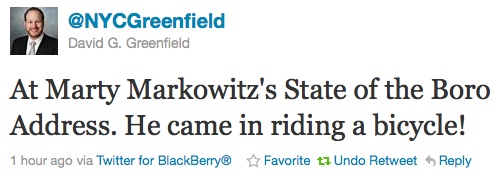
As I’m sure you noticed, I made my entrance tonight on what I like to my senior cycle [sic], so I hope you understand that I am not against bicycles. I’m not even against bike lanes. I’ve supported their creation around Brooklyn, including 9th street near Prospect Park and the Brooklyn Greenway that runs from Greenpoint to Sunset Park.
But for the majority of New Yorkers, it is simply not feasible to make bicycles their primary mode of transport, and unfortunately that’s the direction I believe the City’s policy is heading. They are trying to stigmatize car owners and get them to abandon their cars, when the fact is, even many bicyclists also own cars!
Cycling is no substitute for mass transit, and there are still tens of thousands of Brooklynites who live far from public transportation and who rely on a car to reach their jobs and live their lives. But of course, we must have a comprehensive plan that insures the safety of drivers, walkers and cyclists.
We already have “a comprehensive plan that insures the safety of drivers, walkers and cyclists.” It’s called the Prospect Park West Bicycle Lane and Traffic Calming Project.
The BP is one hundred percent correct that tens of thousands of borough residents live far from good transit options, especially in this time of service cuts and MTA budget raids. At least a few affected people could, conceivably, bike to a subway or bus stop before continuing on their journey. It happens–and has happened now that there’s a bike lane on PPW, for example–but I wouldn’t want Marty to accuse me of advocating that for all Brooklynites so I won’t dwell on it.
Instead, let’s dwell on the fact that Marty’s speech didn’t include even the slightest hint of compassion for those transit-starved Brooklynites, unless they own a car. Marty’s only mention of a subway had to do with the rehabilitation of the 4th Avenue-9th Street subway station and only then in the context of a revitalized, presumably condo-lined 4th Avenue, which won’t really help people in the outer parts of Brooklyn under-served by transit. And unless he deviated from the text I read, he mentioned buses zero times.
And we should all remember to show respect to one another—drivers, cyclists and pedestrians, everybody who uses our streets. I have been a vocal critic of the Prospect Park West bike lane because I think it is a perfect example of how not to install a bike lane. It has disrupted the aesthetics of one of Brooklyn’s most beautiful thoroughfares and made it more dangerous to cross the street safely, especially for seniors, young children and parents with strollers.
As I’ve written before, the aesthetic argument is a tricky one. Should we run a trolley down PPW again? Get rid of the cars? Even if we didn’t, there’s nothing stopping me from parking a graffiti-ridden junk heap on PPW, so long as it meets inspection and registration requirements and I move it for alternate side parking. Would that meet his aesthetic criteria? My guess is that Marty only cares about the aesthetics as one sees them from within a moving car. The rest of Marty’s claim is, of course, not true and he offers no statistics to back up his claims because there are none. There’s simply nothing about shorter crossing distances and slower car speeds that’s more dangerous for seniors, kids and, speaking as one, parents with strollers. I won’t even link to the DOT studies, as I’m getting carpal tunnel syndrome from doing it over and over again.
As Marty reminds us to show respect and play nice, maybe he should apologize to the Janette Sadik-Khan for calling her a zealot and to her department, which he accused of organizing a conspiracy. But, you know, poor Marty. He’s really asking for respect from those disrespectful cyclists.
Marty’s speech would be fine if he stuck to the rah-rah-sis-boom-bah cheer leading tone for which he’s known. I’m all for the BP’s office being filled by someone who wants to cut ribbons and eat cheesecake. But his detour into the Prospect Park West bike lane, especially when there are so many other serious issues facing Brooklyn residents these days, speaks to his paranoia, misplaced priorities, and utter lack of seriousness about safe streets or really any matter of policy. But what would anyone expect from such an unserious man?
Quote for the Day
To all of these challenges, bike lanes are not the only solution – but they are a solution, and make up one of the more public attempts at changing NYC for the better. We need to support and defend those efforts. – Charles McCorkell, Founder and Owner, Bicycle Habitat
Simplify, Simplify, Simplify
There’s a lot to like in Benjamin Shepard’s piece in the Huffington Post on the “Bike Backlash” in New York. Ben is a smart, tireless advocate for cycling and safe streets, and I think he nails it with this passage:
“In a pluralistic democracy, what one enjoys, others inevitably find offensive. This is part of democratic living. We have to learn to live with each other, not stir up hostilities or calls for more police crack downs, particularly for something as innocuous as cycling.”
I couldn’t agree more. One addendum would be that in an Internet-enabled, conflict-motivated media age, anyone can easily find a small group of cranks who are offended by what others enjoy and offer them a big platform and a loud megaphone. That’s really what stirs up hostilities these days.
One thing that I disagree with in an otherwise excellent piece is how Shepard frames cycling as a boon to personal health, especially when compared to driving. He writes, “Most everyone wants transportation to be healthy — for pedestrians, cyclists, and cars.” Actually, I don’t think that’s true, nor do I think it’s an argument that will gain a lot of traction. Most people want transportation to be efficient, convenient, and inexpensive. Health concerns are a distant fourth, and the fact that Americans have long made peace with losing over 30,000 fellow citizens to automobile accidents each year is evidence of that.
Most people don’t see driving as unhealthy, but rather they see traffic as the problem. The Onion put it best over ten years ago: “Report: 98 Percent of U.S. Commuters Favor Public Transportation for Others.” On a surface level, there’s nothing inherently unhealthy about driving especially if you don’t have to spend a lot of time doing it.
This is why claims of superior health have not yet been enough to turn the tide of opinion and in fact only provoke defensive responses from drivers who don’t like being berated by stereotypical holier-than-thou cyclists. You see this in the (untrue) claims that bike lanes increase CO2 emissions from congested car traffic. “Oh, yeah?” drivers essentially say, “If you’re going to tell me my choice is unhealthy, I’m going to tell you it’s your fault!” To top it off, in much of the country, and even in most neighborhoods in New York, cycling is not a viable option for even a large minority of the population. If the message sounds like, “Just ride a bike, it’s easy, healthy, and fun!” we can’t be surprised when people react defensively.
There’s no one PR trick to getting drivers to learn to stop worrying and love bicyclists, but simplifying the message will help. For a growing number of people, cycling is an efficient, convenient, and inexpensive way to get to work, to school, or just about anywhere. These people should be free to make the same choice as someone who chooses to drive, and local governments should do what they can to provide people with the proper infrastructure–along with the proper enforcement of that infrastructure’s use–so that those choices can be made safely.
Right now, if I want to ride my bike to work on weekdays but take my giant SUV (that I do not own) to my palatial vacation home (that I also do not own) on the weekends, I should have the freedom to do that. The key to cycling’s acceptance, if there is one, is making it about personal choice and moving people efficiently, not saving the world. Sometimes riding a bike is just about riding a bike.
Bike Commuters, They’re Just Like Us
Please don’t miss this short post over at AMNY, Identity of Commuters Broadens, by Max J. Dickstein. It highlights the work of BicyclesOnly, who has been documenting bicycling commuters with pictures he posts to Flickr. It’s a refreshing change from most of the media out there and a reminder that most people on bikes are just trying to get to work.
Eyes on the Road!
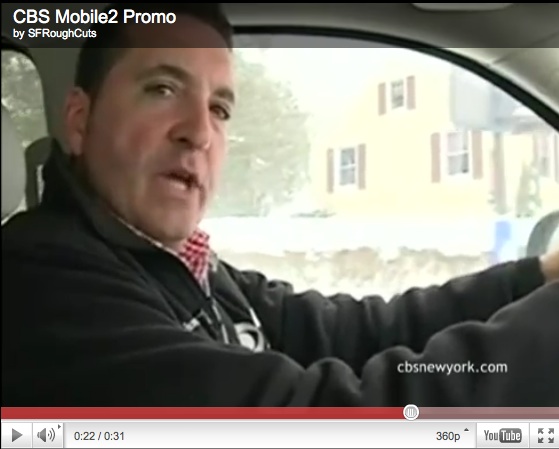
This covers some of the same ground as this excellent Streetsblog post but since the issue of distracted driving is so important, I think it’s worth adding my meager two cents to the discussion. I’m by no means an expert on the subject, but I’ve done my homework. I wish I could say that CBS2 had done the same.
For a TV project I worked on this summer about the brain, I did a lot of reading on the science of attention. As part of my research I spoke to a number of experts in the field of neurology and cognitive science, including Professor Dan Simons, the man behind this experiment, which you may have already seen:
The big question this test prompts us to ask is why we can have something cross right in front of our field of vision but still fail to notice it? That’s because we don’t see with our eyes. We see with our brains. Anyone who’s ever driven and snapped out of a momentary funk, not able to remember exactly how you stayed on the road, knows this feeling very well, no cellphone required. Your eyes never left the road, but your brain did. It’s called inattentional blindness.
In essence, there is no such thing as multi-tasking, only doing a lot of things at once not very well. That’s why laws mandating hands-free cellphone use miss the mark. To oversimplify the research, it’s not the act of holding a phone up to your ear and talking into it that makes you distracted, it’s the distraction and inattentional blindness caused by having a conversation with someone who is not in the car.
One of the reasons talking on even a hands-free cellphone may be different from having a conversation with a passenger is that the passenger is more likely to immediately understand why you have to stop talking. He can see the car that just cut your off or the obstruction in the road you have to navigate around quickly. When we talk on the phone, we may, even subconsciously, feel less able to stop a conversation and let safety take a priority. In the case of Tony Aiello, Lou Young, or any reporter who does a “drive-and-file,” there’s even less of a likelihood that he’d be able to drive with his full attention, since the primary goal is to produce a good story. The normal outbursts one has in a car, even when there’s a passenger–“Oh, fuck, did you just see that?” “Hold that thought for a sec, I gotta get around this guy.”–would have to be tamped down even further in order to make a segment that works on live TV.
No one’s brain is capable of “seeing” the road completely and doing some other sort of mental processing, such as reporting the news. And I’m not even trying to be snarky. The Kent Brockman or Anchorman jokes may write themselves for some of these guys’ stories, but you wouldn’t want the world’s best heart surgeon talking on the phone while he’s doing his job either. There is little to no correlation between intelligence or skill and an ability to overcome this phenomenon, as Professor Simons writes about in his book in a thrilling story about airline pilots, who presumably are a lot smarter than the average TV reporter.
When you do two tasks at once both suffer from a lack of attention. If one of those tasks involves driving a vehicle, that’s a recipe for trouble since the consequences of crashing a vehicle are far more serious than dropping the F bomb on live TV. Driving a news van through a busy city street or on a snowy suburban neighborhood while talking to camera, paying attention to your segment’s timing and pacing, and then throwing it back to the studio is a tragedy, and possibly a crime, waiting to happen. If it’s any comfort to whomever is unfortunate enough to be on the receiving end of Mobile 2 when it causes an accident, it’s that it will all be caught on tape.
Ratings gimmicks like these, especially ones that trivialize the real problem of distracted driving, are one reason television news is mostly seen as a joke. You don’t typically see reputable news outlets touting the technology they use to collect the news; no one expects the Economist to run a full-page ad showing off its new high-powered computers and I have yet to see a BBC World promo showing me their amazing new cameras. Those outlets typically focus on the story, the news, that they’re reporting. But when your news gathering skills are so thin perhaps all that’s left it to run promos about your tricked out van, never mind the danger. Edward R. Murrow, wherever he is, is probably listening to NPR.
Le Freak & Cycle Chic
I received an email notification this morning that @nyccyclechic was now following me on Twitter. Lo and behold, I checked it out and there is now an official New York Cycle Chic blog, just up and running. If you’re hungry for a daily dose of stylish people on bikes, I’m sure it the site will find itself bookmarked in your browser soon.
 Cycle Chic was coined by Mikael Colville-Andersen, founder of the popular website Copenhagenize, one of my regular reads. When Mikael isn’t stirring up a hornet’s nest by talking about bike helmets, he’s a fierce advocate for the normalization of cycling. His perspective on cycling has informed my own, at least on days when I’m not writing polemical take-downs of bike lane foes.
On the one hand, it’s surprising that it took this long for New York to get the Cycle Chic treatment. (Although there are other great blogs in the city that document fashionable cyclists and bike culture, Cycle Chic is a trademarked term owned by Colville-Andersen.) There are thirty-three other official Cycle Chic blogs, and it might seem strange to center-of-the-universe New Yorkers that Sacramento and Atlanta–LA without the beach, as I call it–got the official CC stamp of approval before the Big Apple.
On the other hand, it’s not at all surprising that New York has been low on the Cycle Chic totem pole. While we are a city known for our style-wise pedestrians, our biking culture has, historically, tended to be more Mad Max than Max Mara. Outside of delivery people, messengers, and the Lycra crowd, biking in New York has long had a reputation of something undertaken only by the militant, politically active, or suicidal.
This began to change a bit with Janette Sadik-Khan’s appointment and a renewed focus on adding bike lanes and cycling infrastructure to the city. Stores such as Adeline Adeline, which opened in Tribeca last year, heralded a small shift from the Lycra set to a more stylish, yet utilitarian type of rider, and similar stores have opened elsewhere. Even at my local bike shop I noticed that upright steel bike brands such as Linus and Electra were crowding out the Colnagos and Canondales this summer. Stories such as this one in the New York Times Styles section in September seemed like the icing on the cake. (Although it depends on how you regard the Styles section; it’s almost an unspoken rule that by the time a trend is covered there, it’s either already been established for months or is totally made up.)
But then the snow started. Despite massive gains in new bike lanes, growing ridership, booming business for bike shops, and a general shift in public space away from cars and towards people, transit, and bicycles, it seemed as if cycling in New York ground to a halt.
If it isn’t the weather–the grey skies and soot-covered snow that makes even the most die-hard New Yorker raise the white flag of surrender to Los Angeles–it’s the draconian bike crackdown that has seen the NYPD issuing tickets to cyclists in Central Park while drunk car drivers run over bicycle deliverymen in Midtown. Even without these news-worthy events, there’s the simple fact that it’s cold outside, leaving only the most die-hard cyclists on the road. The fact that ridership is down right now is about as surprising as the fact that fewer people are going for strolls on the beach at Coney Island.
Into this void stepped the editors and reporters of the New York Post such as John Doyle and Sally Goldenberg as well as TV reporters such as Tony Aiello and Marcia Kramer. Using empty bike lanes as a backdrop, they have been on a months-long campaign to portray the DOT as bending over backwards to “brazen” cyclists at the expense of senior citizens and local businesses. Even the New York Times got into the act, with a thoroughly unscientific study of the Columbus Avenue bike lane on a 33-degree day during a time when most people were at work.

Note the temperature.
CBS2 is one of the prime offenders in this regard. Marcia Kramer may be biased, but she’s not stupid, and she had a very good reason for reporting from Prospect Park West when it was 26 degrees outside and the bike lane had not been plowed. (Picture, left)
It’s not merely that she was covering a recent DOT presentation or Community Board 6 meeting. If that had been the sole reason, she might have interviewed someone from the community board or sent a camera to the meeting itself. Kramer, it seems, has a narrative to push: bike lanes are bad.
One way to push that narrative is to prove that no one is using bike lanes, and if you’re going to do that you better act fast. If Marcia Kramer comes back to Prospect Park West in April she can’t very well air a claim from a woman who “rarely [sees] people in the bike lane. Maybe one or two now and then.” Not with dozens and dozens of bike commuters whizzing by her at 5:35 PM. And if Tony Aiello drives Mobile 2 down Columbus Avenue on a summer night, he’ll have a hard time reconciling his narrative that bike lanes are bad for business while the camera picks up shots of people locking up their bikes before running into a store.
This reporting also speaks to a general laziness in local media these days. If 60 Minutes took on the subject of bike lanes–you know, because that’s so much more important than Egypt or health care right now–I’m sure Steve Kroft would ask business owners if he could review their books before allowing them to complain that the bike lane and not, say, seasonal fluctuations or the recession hurt their profits. Unfortunately, all CBS2 shares with 60 Minutes is a set of call letters.
There’s also a reason why the NY Post seems to publish an article a week on cycling. If they can push the cyclist-as-other narrative now, when the only bike riders out there are the ones who fit the stereotypes then it’s going to be much easier to control the narrative in the spring when women worthy of a two-page spread in the Styles section get on bikes, when men in suits ride to work, or when parents start biking their kids to soccer practice. Right now cyclists aren’t fathers, mothers, businesspeople, students, or style-mavens. They’re this menacing guy.
To mix metaphors, in this winter of the New York cycling community’s discontent, I’ve been searching for signs of light on the horizon. With snow from the last three storms not yet melted and another storm on the way, it may seem hard to believe that spring will be here soon. Negative voices have gained steam in recent weeks, whether they come from within Brooklyn’s Borough Hall or the editorial offices of our tabloid media, and it may seem as if they are winning. But they’re playing on an icy, snowy playing field as the referees call a lot more fouls on the underdogs, to mangle yet another metaphor. They’re doing the reverse of running out the clock. They’re trying to front-load the “biking is bad” narrative so early into the winter season that they’ll have an advantage come spring.
It’s into this mix that I welcomed the email notification about New York Cycle Chic this morning. Just two-posts old, it’s hard to claim that this little blog signifies anything big in the march towards making New York more friendly to cyclists, but it is a welcome sign. Come spring, when the bike lanes go back to only being blocked by double-parked cars and people feel more comfortable getting out on the road for work, for school, for errands, and for pleasure, you’ll see the city streets fill with an unprecedented amount of bikes. If Cycle Chic blogs and sites like it are any barometer, it’s going to be a lot harder for the Marcia Kramers of the world to push their anti-cycling narrative very soon.
Hang in there.
Where is the Car Crackdown?

An 85-year-old woman was hit and injured by a cab at this intersection this morning. From DNAinfo:
The cabbie of the SUV taxi said he had just turned right on East Broadway from Pike Street when he hit the woman…
I’m assuming the woman was in the crosswalk and had the light when she was hit. The story is sparse on details, if ever there was a case for traffic calming, this is it. There’s a median [UPDATE: and bike lane] in the middle of Pike Street, but there are still two wide traffic lanes on either side. It’s no panacea, but curb extensions or neckdowns and, yes, a separated bike lane on East Broadway would help slow cars down and force drivers to pay more attention so they don’t plow into senior citizens crossing the street.
Never mind the recent spate of traffic deaths and injuries less than four weeks into the New Year. You won’t see Tony Aiello or Marcia Kramer in Mobile 2 covering this story and you won’t read anything in the Post or the Daily News calling for a ticket blitz on taxis. They speak for millionaires on Prospect Park West but not for 85-year-old ladies crossing the street in Chinatown.
This is the measurement by which the NYPD can judge the success of its crackdown: pedestrians might get injured or killed on New York City streets, but at least it won’t be because of a bike.
Snow Parking Zone
Any time a new bike lane goes in, you’re guaranteed to hear this question: What will we do when it snows?
BicyclesOnly answered this question rather well after the last blizzard, since it was cars, buses, taxis, trucks, and delivery vehicles that were stranded on city streets, and not bikes. This question, like so much of the criticism of bike lanes, is nothing more than a distraction, designed to sow doubt about traffic calming projects that, bikes or not, make things safer for everyone. It also takes away from the real problem during snow events: cars.
So, now that we’ve had another blizzard, what will we do with cars when it snows? The only incentive a driver has to shovel out his car early is so that it doesn’t get iced over. While crosswalks and intersections remain snow-covered with just foot-wide troughs in the snow for walking, car owners get their own huge parking space in which to let their private vehicles linger for as long as the city keeps alternate side parking suspended. The convenience of the few outweighs the slow walking and wet feet of the many.
So, while critics might bemoan that bike riders are getting an expensive service for free and aren’t even using it–as if anyone could be expected to use a bike lane that’s not plowed for three days–it’s car ownership that truly proves the ways in which the needs of a privileged minority are given priority over the majority. The entire cost of the bike lane network in New York City does not even come close to adding up to the amount of money the city could receive it charged people for the privilege of leaving their cars like this for days and days on end.
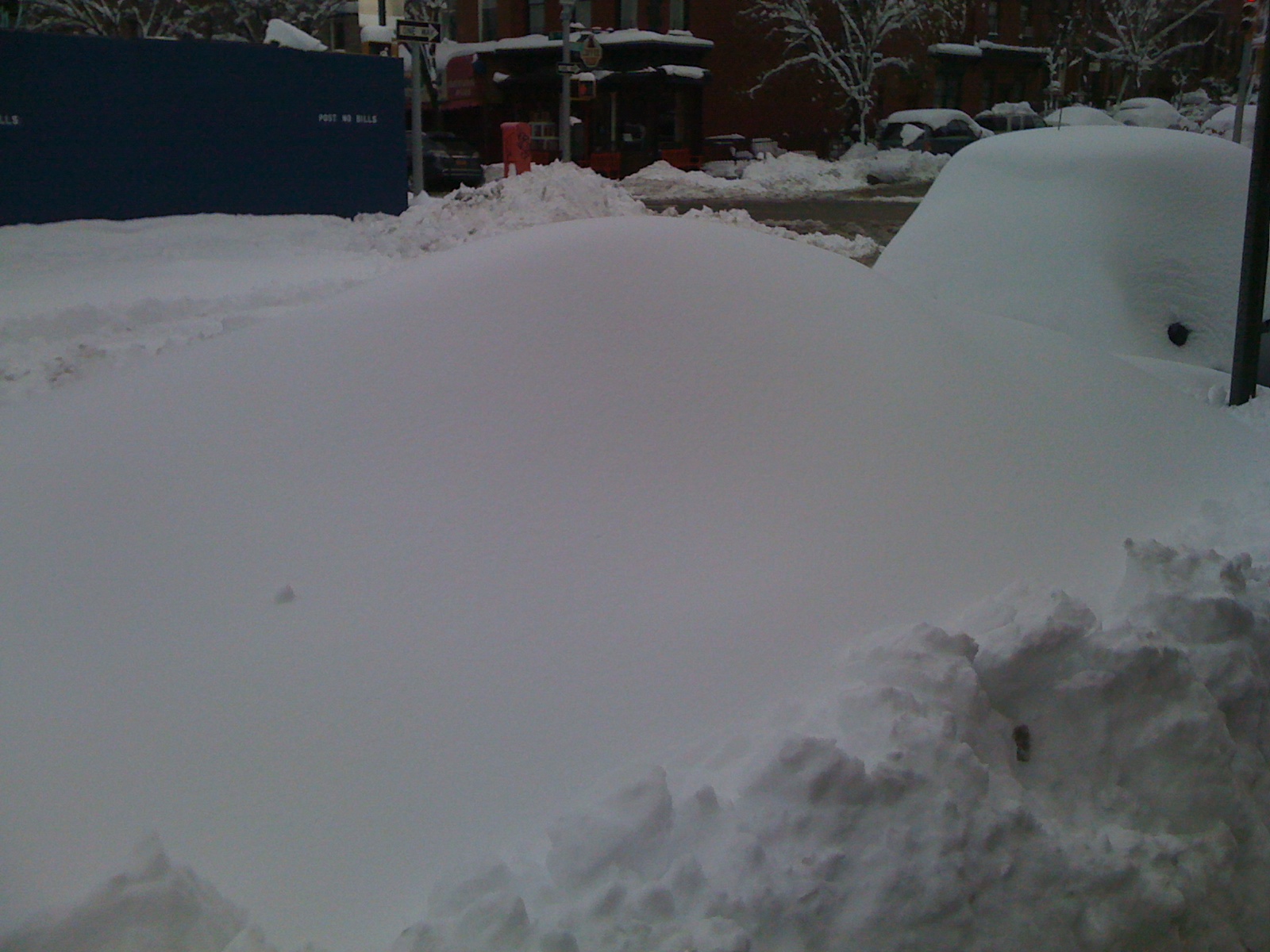
There's a car under there.
Marty Markowitz Eating
I don’t know if drinking counts, but I did find this image to add to the collection.

Quote for the Day
“You need to write about something else. You’re going to get pigeonholed as someone who only cares about Prospect Park West.” – My wife
Soon enough, sweetheart. Soon enough.
 Brooklyn Spoke