CB6/DOT Presentation Impressions
Last night’s CB6 meeting was largely civil, and much credit should be given to Ryan Russo and other representatives from the DOT for their grace under pressure and to the members of the community board for keeping the tone in check and allowing a broad range of questions from all sides without preference or prejudice. The City Council’s Transportation Committee could learn a thing or two from CB6.
There were probably around 200 people in attendance and by my estimates 75% to 80% were supporters of the traffic calming project. Much like at the October rally, they represented a larger cross section of the neighborhood, from people with kids to seniors. Maybe the biggest surprise of the evening was the simplest: a sixty-ish woman who rose to speak and then effused glowingly about how, in her opinion, the new PPW made the neighborhood more lovely and safe. It’s a lesson to a media all too quick to stereotype one side as “organized and well-financed bike riders.” It’s actually the other side that fits into a much more narrow stereotype.
If I took anything away from the meeting it’s that this fight is not over. There will be another hearing sometime in the near future at which people will be able to voice their opinions. Ryan Russo, in perhaps his most subtle moment of pushback against NBBL, said in a response to a question about the cost of their research that perhaps the biggest was the “opportunity cost.” Doing subsequent studies and attending meetings about a project that has already proven to be successful means that the department can not devote itself studying worthy projects in other areas. I’m sure members of CB6 would also like to take up other matters of pressing concern. You want to be angry at NBBL? Don’t be angry at them for fighting this traffic calming project. Be angry at them for tying up future ones with their incessant demands for more data, more studies, and more hearings.
There were two moments that I felt neatly illustrated the NBBL state of mind, now that the evidence for the efficacy of the traffic calming project is overwhelming.
One woman asked how average citizens could contact the DOT with their suggestions for changing the street design. Without friends in high places, such as CM Lander or people on the community board, how could people like her have their voices heard to get this project changed? (Translation: eliminated.) I don’t remember her exact question, since like many of the speakers last night her question was more of a statement punctuated with a question mark. (She had a British accent, if that helps attendees remember her.) What she was accusing the DOT of was clear: the department is closed off to outsiders.
Never mind that the DOT has made itself available at numerous open-to-the-public CB6 meetings. Never mind that Russo said that the department is reachable through 311, online contact forms, through city council members’ offices, and more, and that they respond to any and all complaints and suggestions. Never mind any of it. At that moment I wanted to jump out of my seat and scream, “Lady, you’re talking to the Department of Transportation RIGHT NOW!” The sheer cognitive dissonance it takes to complain that you aren’t able to talk to the DOT while you are talking to the DOT speaks volumes about the NBBLers perceived victimhood.
(On a related note, somehow I doubt this woman cared very much about leveling the playing field when Norman Steisel and Marty Markowitz skipped the line and testified beyond their allotted two minutes on her behalf at the City Council Transportation Committee hearing in December.)
The most illustrative moment came towards the end of the evening, when PPW resident and NBBLer Lois Carswell rose to ask a question, or, rather, rose to question the DOT’s bike count data. (Read Mike Epstein’s explanation of the difference between the DOT counting methods and NBBL’s.) After Russo presented his calm, clear description the Department’s methodology and how NBBL’s counting at Grand Army Plaza failed to include riders who exited PPW at various connecting bike lanes further south, Carswell responded that she didn’t agree with his line of reasoning.
(UPDATE: Streetsblog quotes Carswell as saying, “I disagree with your logic.”)
And that is all you need to know. In NBBL’s world, there’s no such thing as a fact, just a line of reasoning.
Sigh. As exhausted as we all are over writing letters, attending meetings and rallies, and remaining active, we’ll have to tap our activist reserves at least one more time. NBBL doesn’t care about data, lies when making up their own, and is ready to keep fighting this for as long as possible. The only way we can counter this is to keep showing up. See you again.
Unfrozen Caveman Lawyer Argument, Part 2
Not much to add to Mike Epstein’s brilliant take down of the utterly bogus NBBL “Case Statement and Neighborhood Accident Summary.” Smarter minds than I have already provided sufficient rebukes to the mental gymnastics demonstrated by the the authors of this “report,” but a few things caught my eye.
First, a note on their observational accident reports. Here are their descriptions.
Late June-Early July (Fri or Sat nite, after Celebrate Bklyn concert): PPW & 4th St: SUV sideswiped parked sedan (low speed, lane so narrow van swerved into sedan)…
If there was an NYPD report of this accident, I have a feeling that in the space marked “DATE,” an officer would not write, “Late June-Early July, Fri or Sat nite.” There’s no reason to believe the bike lane was the cause of this accident. Plenty of cars pass through PPW without sideswiping parked cars, so perhaps the SUV’s swerving had something to do with this? This is an argument for slower, more careful driving, not an argument against bike lanes.
Date uncertain: a car swerved across 2 lanes, causing an accident…
Right. I guess we’ll trust you on this one. There was an accident, but no police report? Does the NYPD know that NBBL does not trust their data? Can we all just make up whatever we want?
Week of Oct 4: 40-44 PPW, 5:30 pm: van back-ended by a sedan…low speed collision (less than 25 mph)
Thank goodness that with the redesign of PPW fewer cars are exceeding the speed limit, otherwise this would have been a far more serious collision.
And that’s just a small sampling of the anecdotal, please-trust-us-when-we-say-they-happened accident reports collected not by the NYPD, the DOT or even the Parks Department, but by, you know, some people.
They then call into question the DOT data, which bears no repeating. But I did find this analysis curious.
The other interesting point is the profile of counts across the day…on weekdays…the profile shows a double peak with a small morning peak about 8-9 am, followed by a mid-day trough, with a slow rise to a second wider and higher peak in the afternoon.
Quick: are they describing car traffic or bike traffic? If you guessed bike traffic, you’re right! How strange that people who commute to work do so during morning and afternoon peak hours. Guess all those bikers aren’t hipsters and drug addicts after all. Best of all is what this observation and analysis must mean to NBBL:
We surmise that the morning and some of the afternoon peak is due to commuters combined with baseline recreational bikers…biking in the middle of the day is quite low, less than a biker every 2 minutes. Our counts…are consistent with what many observers of the bike lane have reported: long intervals with no biking activity, particularly during the week.
As someone who works from home, I often take mid-day rides to Prospect Park. Guess what? I don’t see a lot of cars on PPW at 1 PM or so either, less than a driver every 2 minutes by my observation. Roll up the pavement!
This one was by far my favorite stretch of logic. It’s truly astounding.
We were not able to surmise from our videos exactly how many “round trips” were happening, but it is likely that a substantial number of bikers were traversing the bike lane more than once, which would reduce the total number of distinct bikers to an unknown fraction of the total count recorded. As many as half the trips, or more, may be second passes on the lane.
Given that so much of the traffic in Park Slope consists of drivers cruising for parking, can we surmise that many of the cars trips may be second passes on the street? As for “round trips,” I’m fairly certain that most people who go to work, run an errand, go to the library, or drop off the kids at school come home after they are done. I’m guessing that the people who drive back into a neighborhood at the end of a work day are, for the most part, the same people who left it in the morning.
To give some context, the larger MTA subway cars carry over 250 passengers when fully loaded…It’s not clear how much positive”green” impact this lane has had on NYC…
And how many car drivers are able to travel through PPW? According to the DOT study, at the peak PM hour (4-5 PM) measured at Carroll Street, 1,010 vehicles travel PPW. By NBBL’s measurements, the same volume of people could be carried by four MTA subway cars. Good thing there are multiple lines at either end of PPW for all of the members of NBBL so concerned with the “green” impact of their transportation choice. (By the way, I’m clearly no survey expert but I’m not too sure that most contain words with quotes around them that aren’t, you know, actual quotes said by real people.)
They summarize:
This leads to the very real question of whether the PPW bike lane is simply duplicating the adjacent Prospect Park which is more appropriately a venue for recreational biking than a heavily traveled public street.
Again the NBBL exhibits a prejudice for one type of riding over another when they do not apply the same standard to driving. Shorter NBBL: if you drive to your spin class, drive wherever you want. If you bike to work, or for any other reason, stick to the park.
I could go on. We all could. It’s endlessly infuriating and entertaining. Best thing to do is show up tonight. See you there.
Quote for the Day
The core issue here is that NBBL represents about 25 or 30 very wealthy, very politically connected people (former DOT Commissioner Iris Weinshall, former First Deputy Mayor Norman Steisel, and several of their friends and relatives) who are throwing a highly visible tantrum because they didn’t get their way. No more and no less. – Mike Epstein, Streetsblog
Lies, Damned Lies, and Neighbors For Better Bike Lanes
You’re probably as exhausted reading about the Prospect Park West bike lane and traffic calming project as I am writing about it. Still, there’s good news to share. Hopefully it will be the last news we need so we can all get on with our lives and just ride. (Or shovel out our cars, as some may need to do this weekend.)
The Brooklyn Paper has a preview of tonight’s DOT Presentation on the Prospect Park West Bike Lane. Unsurprisingly, the effects are positive.
Some highlights, straight from the BP article:
- Crashes are down from an average of 30 in six months to 25, or 16 percent.
- Crashes that cause injuries are down from 5.3 in six months to two, a whopping 63-percent drop.
- Before the project, a crash was twice as likely to include an injury.
- Injuries to all street users dropped 21 percent.
Not too shabby. And here’s a very important nugget:
The data also found that since the lane was installed last June, there have been no reported pedestrian injuries and no pedestrian or cyclist injuries from pedestrian-bike crashes.
Emphasis mine. Zero bike-on-ped accidents. Zero. That’s not to say one might not happen in the future, but if it does it won’t be the bike lane’s fault, but a question of odds and bad luck. The bike lane is working and, best of all, it’s making pedestrians safer from cars.
This is not a case where, to use a cliche, reasonable people can disagree. Not in the least. Reasonable people can look at the facts, at data, and at study after study and only conclude one thing: the redesign of PPW is a success and you and your neighbors are safer as a result. Only unreasonable people disagree with that.
Unfortunately, that’s not how our local media sees things. You see it everywhere, no matter the debate. “Does the health care debate contain a provision for ‘death panels’? We’ll let both sides have at it after the break.” No. There are not two sides to every story. Balanced, objective journalism looks at facts first, opinions last. But unfortunately, that’s not how our local media works. Take this screen shot from a January 6 CBS2 report by Tony Aiello on pedestrian islands in Borough Park:

“…Could wind up causing serious injuries or fatalities…” Except that it hasn’t. Not once. When redesigning streets to enhance pedestrian safety, the DOT looks at data and conducts before-and-after comparisons, as it did on PPW. But studies and facts don’t matter to opponents of pedestrian safety. All that matters is repeating the same fear-based mantra enough times so that a lazy local media creates a visual like the one above, lending it the kind of credence that only TV can. All that matters is more cars, more cars, more cars. I don’t know if any media will be there tonight, but if they are, don’t let them give a megaphone to a few scared but politically connected NIMBYs.
The data also found that since the lane was installed last June, there have been no reported pedestrian injuries and no pedestrian or cyclist injuries from pedestrian-bike crashes.
New emphasis mine. As Mark Twain did not say, “There are three kinds of lies: lies, damned lies, and Neighbors for Better Bike Lanes.”
Tonight: Defend Safety on Prospect Park West
Via Transporation Alternatives comes this plea to attend tonight’s CB6 meeting. Please be there.
—
This Thursday evening, the Department of Transportation will present its safety findings regarding the Prospect Park West bicycle lanes and traffic calming project to Community Board 6. Join Transportation Alternatives at this critical meeting as we call upon the Department of Transportation to “POUR THE CONCRETE” and make the safer Prospect Park West permanent. Bring your neighbors and be prepared to speak up.
Transportation Alternatives has gotten word that a NIMBY group, day lighting as “Neighbors for Better Bike Lanes,” is using their political connections to try and get the Prospect Park West bike lane removed. They will be the only voice at this meeting if you do not attend.
Don’t let a small but well-connected group of NIMBYs steal a safer Prospect Park West from Park Slope residents.
Where: Old First Reformed Church, 729 Carroll Street at 7th Avenue (Q/B to 7th Avenue)
When: Thursday, January 20th, 6:30pm
Let’s not let “Neighbors for Better Bike Lanes” tell anymore lies. Here are the facts about the new design of Prospect Park West:
It improves safety – Park Slope Neighbors’ before and after speed surveys showed that the new design reduced average speeds by 25%, increased compliance with the speed limit five-fold and reduced the proportion of cars speeding 40 mph or faster from 30% to just 1.4%. This is all the result of replacing one of Prospect Park West’s travel lanes with a protected, two-way bike path and pedestrian refuge islands. The street carries the same volume of cars as it did before, they just aren’t speeding.
The community asked for it – The new Prospect Park West was born out of community concern with unsafe driving and speeding on the corridor. The project’s development and implementation has been supported consistently over several years by Community Board 6, local elected officials, civic organizations and thousands of Park Slope residents and users of Prospect Park.
Councilman Brad Lander’s recent survey speaks to the broad-based community support: http://bradlander.com/ppwsurvey
- Among the 3,150 respondents: 78% support the new Prospect Park West
- Among the 2,210 respondents living in Park Slope: 71% support the new Prospect Park West
- 85% of survey respondents feel that the project has very much or somewhat met the goal of reducing speeding
- 91% feel it has very much or somewhat met the goal of creating a safer space for biking
- 70% also feel that the project has very much or somewhat made Prospect Park West easier to cross
The small group of opponents, who cannot handle change, are simply out of touch with what the majority of the neighborhood wants and needs to be safe.
The War on Pedestrians
If you’re visiting this blog you’ve probably already read Streetsblog editor Ben Fried’s excellent post calling out the Post and members of the City Council for their juvenile and vehement rhetoric against Janette Sadik-Khan. Fried writes:
The Post refers to Sadik-Khan as “Deputy Mayor for Bicycles” and, a few paragraphs later, “Bicycle Lady.” As astute observers will know, if the writers had been paying attention the past three years, they would have come up with a more accurate nickname, like “Pedestrian, Bicycle, and Bus Lady.” Or, to really cover the full extent of what’s been going on, “Safer, More Efficient Transportation Lady.”
Ben is spot on. The Post editors know they won’t get much traction if they rail against faster bus service or a Times Square where thousands of pedestrians, once crushed into narrow sidewalk space, now get to enjoy open vistas, cafe seating, easier walking, and fresher air. (Nor will they find much success among area business owners and landlords, who are enjoying higher revenues and rents since the street-to-pedestrian-plaza switch was made.)
If I could add or change one thing about Ben’s post it’s that he, too, falls a bit into the trap laid for him by the Post. The headline should not be an admonition for New Yorkers to speak up about “Bike Policy,” but for New Yorkers to speak up about “Pedestrian Policy.” Why? Because every single one of the projects instituted by Khan and the DOT has had a larger benefit to pedestrians than to cyclists.
The Prospect Park West bike lane is one example. Lower car speeds, shorter crossing times…these benefits would accrue to pedestrians even if the bike lane was filled in with dirt and turned into a mile-long community garden. It’s one of the reasons NBBL opposition rings so hollow: even if one could prove that cyclists weren’t using the lane in big numbers, reducing PPW from three lanes of traffic to two has had an immensely positive effect pedestrian health and safety. Going back to the way it was before might get rid of the bikes, but it’s not going to help protect pedestrians.
I’ve walked through Times Square and down Broadway to Herald Square and, in my mind, the bike lane is the least useful part of the thoroughfare’s redesign. In many places, the bike lane is between the curb and a pedestrian seating area, rendering the bike lane almost useless as a transportation route, especially on matinee days or during Times Square’s busier periods. Cyclists may be safer separated from cars, but they hardly have a smooth route through the city if they take Broadway. While that may be an argument for getting rid of or redesigning the bike lane, it’s not an argument for getting rid of the pedestrian plazas and turning everything back over to cars, which is what the Post and many elected officials want.
Everywhere you look, the “Extreme Makeover: DOT Edition” treatment has benefited pedestrians more than cyclists. Madison Square Park and Union Square are two other areas where pedestrians now have fewer lanes of traffic to cross and more open space in which to enjoy the city. Should the thousands of people who enjoy these areas every hour have this taken away so that a few hundred car drivers have more asphalt?
That’s why I think that pedestrians need to start paying attention. Because the shorter version of all of this criticism of the DOT and cyclists boils down to this: more cars, more cars, more cars. A person who wants the PPW bike lane taken out wants more cars. An editorial writer who argues that the Times Square redesign needs to go wants more cars. A City Council member who complains of bike lanes being plowed before streets or who advocates for smaller fire hydrant zones wants more cars.
More cars! More cars! More cars!
Pedestrians ought to be up in arms about this, but instead they are focusing their energy on an easy scapegoat: bikes.
The current bike crackdown and slew of anti-bike editorials and media reports is having a far greater effect than a few $270 tickets or silly legislative proposals to license bikes. What it’s doing is pitting cyclists versus pedestrians. Every story about a cyclist running a red light that generates a rash of defensive comments or letters plays right into the narrative the media is pushing. The cycling community, if one exists, has to stop doing this. Stop being defensive about bad cyclist behavior. Yes, let’s all speak up against egregious abuses of power, disproportionate appropriation of enforcement resources, and gross misunderstandings of traffic law, but a person who runs a red light deserves a ticket even if we can all come up with a million justifications for why that person did it. A person who rides on the sidewalk deserves a ticket. A person who rides without lights at night deserves a ticket. A person who salmons deserves a ticket. Own that behavior, admit it’s wrong, and stop arguing. By defending it, by rationalizing it, all you do is cement the impression that cyclists don’t care about anyone but themselves.
The only way to diffuse the argument is to own it. Someone who argues that cyclists are all bad is looking for you to rationalize why you simply had to run that red light. But if you say, “You know what, it is wrong,” they have nothing left to argue and they then have to confront the truth. (I found Paul Steely White’s opinion piece in the Brooklyn Patch very effective in this regard.)
By doing this, we can then turn the spotlight back where it belongs: on cars and our non-sensical–and seemingly non-existent–traffic enforcement policies. We’ll also find that we’ll get more pedestrians on our side. It’s not exactly the same as asking someone, “Tell me, when did you stop beating your wife?” but making the pro-car people own their philosophy and behavior is the best way to re-frame the debate. So, to the editors of the Post, James Vacca, Neighbors for Better Bike Lanes, Marty Markowitz, David Greenfield, Andrea Peyser and company, I have one question: Why are you in favor of more pedestrians getting hit by cars?
Mr. Walker v. Mr. Wheeler
Via Veritas et Venutsas, it’s good to know so much has changed in 60 years. Perhaps the biggest change is that if this cartoon were made today, most of the sympathies would lie with Mr. Wheeler, and not Mr. Walker.
Rorschach Test

Take a look at this screen shot from a WABC-TV report on proposed bicycle registration and licensing in New York. It’s as good a Rorshach test for how you see the current state of affairs on our city’s streets. Do you see a plague of renegade cyclists? An endless stream of automobiles? Or do you, like me, see this and think that a little perspective is in order?
The proposal to require bikes to register is fraught with problems, many of which I’ve addressed before. Considering that a similar plan died in New Jersey less than 24 hours before this report was broadcast, this is little more than a media-grab by the New York City council member who proposed it. (No need to mention him by name, since who needs to contribute to his 15 minutes of fame?)
Licensing bikes would do nothing more than create another level of bureaucracy in a cash-strapped city, and solve nothing. Right now, if a police officer pulls over a cyclist for running a red light, riding on the sidewalk, or going 31 mph, the officer can ask to see the cyclist’s ID. (Despite the council member’s claim, carrying an ID in a shirt pocket or tucked into your Lycra shorts is very simple. Some of us don’t need two ton metal boxes in which to carry our identification.) If the cyclist is not carrying any, the officer can detain–not arrest, but detain–the cyclist until his name and address can be identified. Making cyclists carry ID or place a decal on their bikes won’t help expedite that process, especially since old bikes are sold and swapped all the time.
Another small issue: Since teenagers have as much of a right to ride on city streets as adults, only requiring this of people over 18 years of age accomplishes very little other than adding one additional barrier to getting people on bikes.
There’s also the straw man argument of the rogue cyclist who mows down a pedestrian and then rides off, identity unknown. In what way would a license plate or sticker help? The next time you see a cyclist pass you at an intersection, try to read the word printed on the back of his saddle. (Usually it’s a brand or model name.) Impossible, no? I doubt most people would even be able to read the bike brand printed on the top tube or a word printed on the back of a t-shirt. So what levels of attentiveness and eyepower would a dazed pedestrian have to possess in order to reliably get a cyclist’s registration number? Or how big would the license plate have to be to render it visible from a distance? This big?
This is nothing more than an attention grab by a young city council member who saw the growing backlash against bikes, along with a local news industry too lazy to report on the real dangers on city streets and too ready to exploit hysterics for ratings, and used them both to boost his political fortunes and get his 15 minutes of fame. Considering that New Jersey backed down from a bike licensing scheme, he might not even make it to 5 minutes.
Pants on Fire
Since I like to give most people the benefit of the doubt, I hesitate to call anyone a liar and instead prefer to understand someone who spreads misinformation in other ways. But every once in a while I question that doubt. Take this editorial in The Brooklyn Paper from Leslie Lewis, president of the 84th Precinct Community Council.
I’m not anti-bike, but I follow police statistics: About 90 percent of the bicyclists killed in this city died, in part, because they were not following the rules of the road. Obviously, these deaths were tragedies and they never should have happened. But in many of these cases the bicyclists were violating the rules in some way. They were either on roads without bike lanes, going through a red light or riding the wrong way down the street. The “ghost bikes” you see in the different neighborhoods that honor these fallen bicyclists only tell half the story.
Any statement that begins with defining what you are not stinks a tad, methinks, of protesting too much. The Times did it in their 12/16/10 editorial–“Let’s be clear. We like bicycles.”–and Lewis does it here. I don’t hate bikes, I’m just reporting what the police tell me! Don’t shoot the messenger!
If only staking a defensive posture was Lewis’ biggest offense, we could dismiss his opinion piece as a mere trifle. But Lewis has a direct relationship with the police and as such should have a modicum of responsibility to report reliable, verifiable figures. Lewis’ 90% figure is dubious–what’s the source?–and his understanding of the rules of the road is lacking. “They were either on roads without bike lanes,” he writes. Sorry, no. Cyclists do not have to stick to streets with bike lanes. Even if I give Lewis the benefit of the doubt and imagine that he meant that cyclists would be safer on streets with bike lanes, that does not mean they deserve to die for riding on streets without them.
Aside from printing information that is demonstrably false, and probably easy to look up if you have a direct line to One Police Plaza, Lewis maligns a lot of very innocent people whose tragic deaths were no fault of their own, getting in a swipe in at the Ghost Bikes project in the process. Jasmine Herron, whose ghost bike is the most recent addition to the city streetscape, was not violating any rules when she was doored by a driver opening her car door and subsequently crushed by a bus in September of last year. By all reports she was riding lawfully: she biking with traffic down Atlantic Avenue and did not run a red light. Not that it matters all that much, but she was wearing a helmet.
For Lewis’ sake, allow me to “tell the other half of the story.” You know, the story of those poor drivers who, through zero fault of their own suddenly find themselves besieged by renegade cyclists. Better yet, perhaps Lewis could read The Brooklyn Paper to learn more about the sad tale of the poor driver who doored Herron:
Crystal Francis, the driver, attempted to leave the scene, claiming she had nothing to do with the accident. But police officers dragged her back, and she was charged with driving on a suspended license, police said.
So, a driver who had no business behind the wheel of a car, which I’m assuming she had to drive in order to get it into the parking space, knocks down a cyclist and it’s the cyclist’s fault? And lest I be accused of cherry picking one example, other Ghost Bikes tell similar tales. Meg Charlop, killed in March, was riding legally when she was killed. The list goes on. There are, of course, tragic cases in which cyclists engaged in behavior that contributed to their deaths, but Lewis ought to be more careful when disparaging dead people.
Leslie Lewis ought to be asked if he really wants the “other half of the story” told. It might lead to people questioning whether or not he really needs to drive to Borough Hall from a neighborhood rich with transit and bike lanes.
UPDATE:
Paul Steely White comments over at Streetsblog: “Leslie Lewis derives his 90% from the city bike safety report that found over 90% of fatally struck bikers were not wearing helmets.” Never mind that no helmet is going to protect you if you are riding lawfully and run over by a bus, just as no bullet proof vest will protect you if you are shot at with a rocket launcher. Also, since there is no mandatory helmet law in NYC, not wearing one does not mean that you are “not following the rules of the road.”
School Crossing, Part 2
Just to demonstrate that Tuesday’s scene in front of Middle School 51 on 5th Avenue was not a fluke, here are a couple more pictures, taken yesterday evening at about 5 PM. This is long after school is over for the day, but many students must still have extra-curricular activities that keep them there until this hour. Just like in the morning, these cars are inconveniencing pedestrians, other drivers, bus riders, cyclists, and everyone else trying to move around during rush hour.
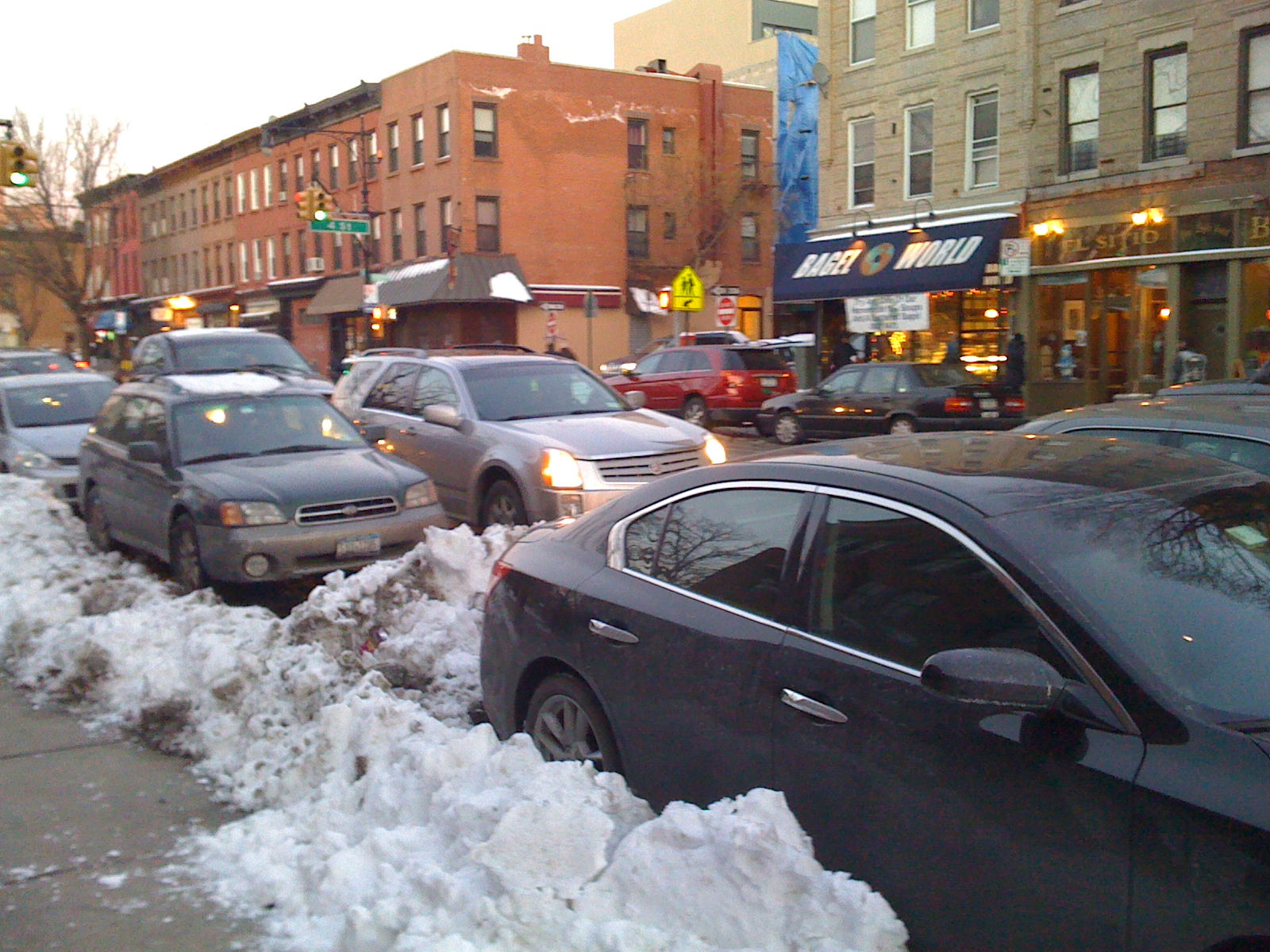
If you look carefully you can count four double-parked cars in the picture. The camera on my phone does not have a wide enough angle to take in the whole street, but if it did you’d see that the entire side of this bit of 5th Avenue between 4th and 5th Street was lined with double-parked cars.

This driver decided to wait in crosswalk. Drivers exiting 4th Street and turning right onto 5th Avenue–and there weren’t that many since 4th is a dead end–had to make an awkward turn around her. Drivers turning left from across the street had to squeeze between her car and cars waiting at the light going the other direction. The bus that came by had barely enough room to pass.
To top it off, pedestrians, including the kid in the green backpack, had to go around her car and out of the crosswalk in order to get across the street. (There is no crossing guard stationed at this time of the evening.) If you were the driver of the dark-colored Jeep about to turn onto 5th seen in the background of the picture, would you be able to see the kid about to come out from behind the silver SUV?
 Brooklyn Spoke