Mark Your Calendars…Again
Just when you thought it was safe to go back in the bike lane…
On Thursday, January 20 representatives from the Department of Transportation will be in Park Slope to present “findings and recommendations regarding the Prospect Park West bicycle lanes and traffic calming project installed in Summer 2010.”
On paper, there seems to be little question that the bike lane is here to stay. The before-and-after safety data is unambiguous. And the cherry on top? It’s a huge hit in the neighborhood.
Still at the last CB6 meeting, Neighbors for Better Bike Lanes members outnumbered livable streets supporters by too great a margin, a huge disappointment considering the overwhelming turnout in favor of the bike lane at October’s rally. I know that activism fatigue can set in. Even my first thought upon getting the confirmation about the DOT presentation was, “Here we go again.” God Himself could ride His bike down Prospect Park West and NBBL would want to hold a hearing about it.
But even though nothing, absolutely nothing, will convince NBBL that the bike lane makes the neighborhood safer and more livable, you need to be there. Come not to shout down your misguided neighbors, but to show the DOT and the mayor’s office that there is broad support for this vital traffic calming project.
The details:
DATE: Thursday, January 20, 2011
TIME: 6:30 PM
PLACE: Old First Reformed Church, 729 Carol Street (Corner of 7th Avenue), Park Slope
So please come. For fun, please let me know what baseless claims you think NBBL will make at this meeting. Make your predictions in the comments section below.
E for Effort
I’ve followed the growing debate over electric bikes with great interest. It doesn’t take a scientific survey to see that many of the people who operate them often do so in an illegal fashion, riding against traffic or the wrong way in bike lanes and cruising onto sidewalks. I don’t think this happens at a higher rate than with other vehicles, such as cars and foot-powered bikes, but as with anything new it’s sometimes more noticeable.
My take on e-bikes is that they are not bikes. They’re not exactly motorcycles or mopeds either, but on a spectrum that runs from a Hummer on one end to a tricycle on the other, they’re closer to the Hummer.
For starters, e-bikes have top speeds of around 20 miles per hour. Sure, there are plenty of bike messengers and racers who travel faster than that, but it’s unlikely that the average bike commuter could sustain that pace for very long or that a delivery person would have much left in him after an hour or two of biking around the city at that speed. There’s also the issue of acceleration; even Lance probably can’t speed up to 20 mph as fast as a delivery guy on an e-bike.
Additionally, e-bikes allow riders to be less connected to riding, since all they have to do, even after a quick pedal-assist, is steer. That gives them more in common with cars than with bicycles, since one of the biggest problems with cars is that they make it too easy for drivers to not think about and work on the task of driving — it’s as easy to tap the accelerator to go fifteen mph as it is to go sixty. If you are pedaling, you are working, and if you are working, you are thinking. So if an e-bike rider doesn’t have to think about the energy he’s expending or how he, on his own, will stop or turn, it’s all too easy for him to stop thinking about other people on the road. That’s how accidents happen.
I think of it another way. Is our problem with cars merely that they are powered by gas or do other factors come into play, such as their size and weight and their ability to accelerate quickly? Or still another: would you rather be hit by a small gas-powered car going 20 mph or a small electric-powered car going 20 mph? Which is heavier, a pound of gold or a pound of feathers?
I’m certainly for a New York City in which more e-bikes replace cars and gas-powered scooters and motorcycles. The city would be quieter and cleaner and you can park at least five of them in the space it takes to store one car. Just keep them out of the bike lanes.
And Knowing is Half the Battle
There’s a lot of misinformation out there about cyclist’s rights, and with the ongoing biking crackdown it’s important to know the truth. Take this news item from the Manhattan Times, a paper covering upper Manhattan.
Some of the laws that the police are reminding cyclists to obey include: no riding bikes on sidewalks except where signage permits or when the bike’s wheels are less than 26 inches in diameter and the rider is twelve years or younger; bicycle riders must use bike lane if provided, except for safety turns;
(Italics mine.)
The wording of this piece may make casual readers think that cyclists may only exit the bike lane if they want to make a safe turn onto another street. What’s a safety turn?
Thankfully, the actual law is much more clear. Here’s it is, via Biking Rules.
RCNY § 4-12 (p) Bicyclists should ride in usable bike lanes, unless they are blocked or unsafe for any reason.
You should ride in a bike lane, but you do not have to and it’s up to the individual rider to determine his or her own personal definition of “unsafe.” In fact, with many bike lanes snowed over right now, you’d be hard-pressed to find a bike lane to ride in safely. Even in warm weather, it may be unsafe to ride in bike lanes since most painted lanes are within an unsafe distance of the door zone. And you don’t need to wait until a bike lane is blocked by a car. If you see a stray plastic shopping bag or tiny divot in the bike lane, move over to avoid it.
So, ride safely, ride legally, and know your rights. This doesn’t mean you should weave all over the place, but it does mean that you can not receive a ticket for not biking in a bike lane.
School Crossing
Every morning on my walk to take my daughter to daycare, I pass Junior High School 51 on 5th Avenue in Park Slope. The sidewalks in front of the school are typically packed with kids waiting for their school day to start. The fact that schools are as much a piece of the fabric of the city as any business, home, or office is one of the things that I love about the neighborhood.
I’ve also biked down 5th Avenue and hope to do so with my daughter in a seat on the back of my bike when the weather gets warmer. But the chaotic scene on the streets in front of William Alexander Junior High School would make me think twice.
JH 51 has no drop-off zone for parents who need to drive their kids to school, so parents stop their cars in the bike lane instead. This practice forces people commuting by bike down 5th Avenue into traffic and in some ways makes cyclists less visible to car drivers and pedestrians, since they have to weave in and out of backed up traffic or wait behind or between stopped cars. With so many kids darting out from between double parked cars, it’s only a matter of time before a kid is hit by a bike or worse, a car.

This driver didn’t just stop and drop his child off, he actually hung out for a bit and read the paper. Maybe he was waiting for his kid to bring him back something from inside the school.
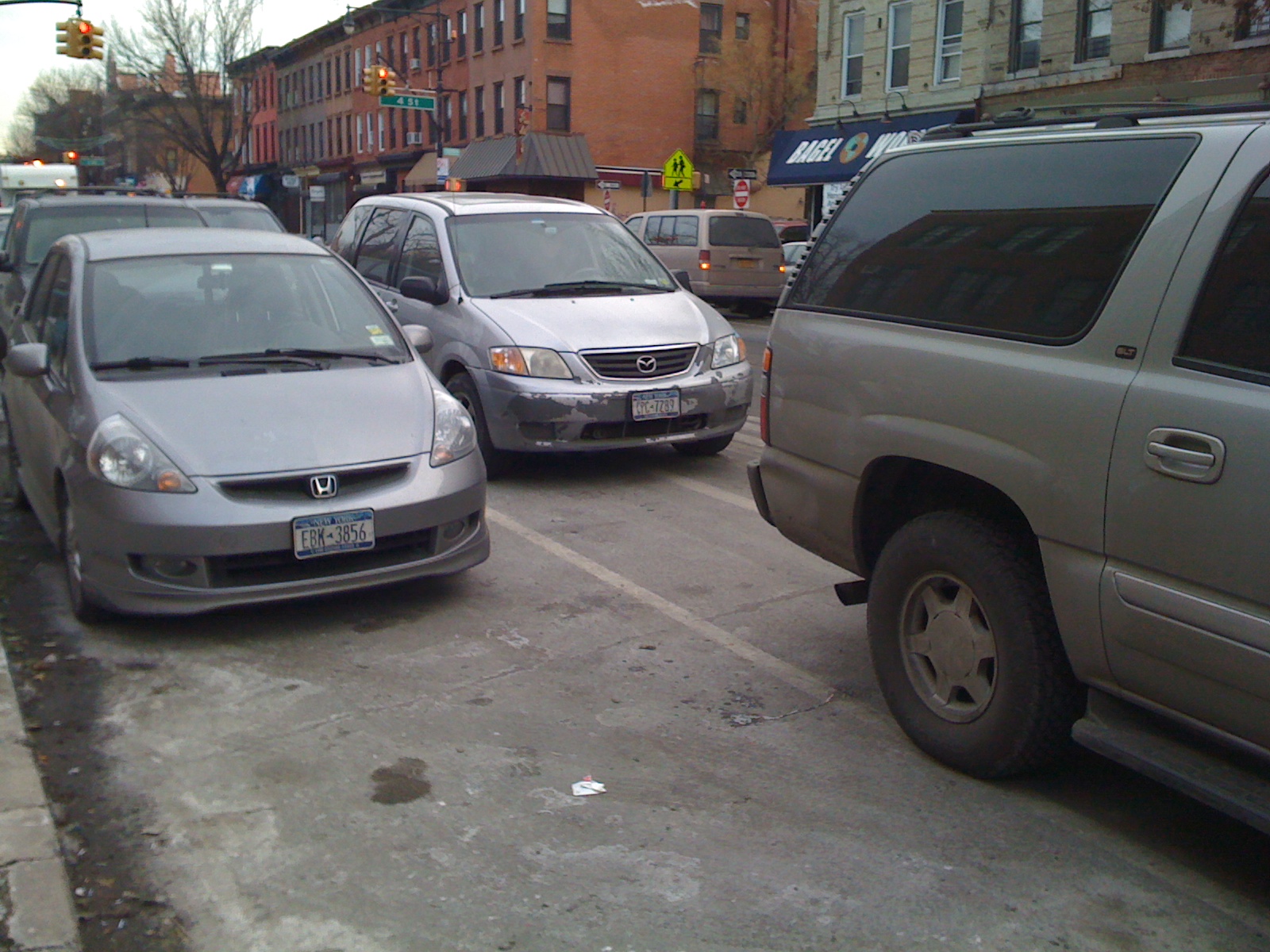
The SUV driver actually could have pulled into this empty space, but perhaps he didn’t want to get blocked in by a double-parked car. If the issue was simply that parents were pulling into the bike lane, dropping their kids off, and then leaving, perhaps I could get my head around just dealing with it. That’s city life, no? But these two cars idled in the bike lane for a while, too. In fact, with no traffic officer or school safety official directing cars, many feel free to linger as long as they want. The scene is sometimes worse in the afternoon when parents arrive early, double park, and then wait for their kids to come out at the end of the school day.
If you look between these two cars across the street, you’ll see a brown minivan with its blinkers on, parked in the other bike lane.

From the opposite side of the street, you’ll see that the driver of the maroon car has just pulled out from where she had been idling, slowing down the B63 bus. The driver of the Ford minivan was sitting there long enough that I was able to go into a Bagel shop on the corner, wait in line, get some coffee, and come back out to find him still sitting there.
Bike lane or not, this practice of double-parking is bad for everybody. Cars heading up or down 5th Avenue have to squeeze through a narrow space that can make it hard for two cars to pass in opposite directions at the same time. Bus passengers, which includes lots of kids going to this very school, are inconvenienced, made to wait until the bus can get to the nearby stop. Pedestrians are rendered invisible by double-parked cars, and even the two crossing guards on either side of the school can’t guarantee complete safety. And of course, you know, the bikes. The bikes.
The silly part about this is that there is non-metered parking on this stretch of 5th Avenue, about seven spots on each side. So, instead of having a loading zone right in front of the school so that parents can pull in and out of traffic, a grand total of seven people–fourteen if I apply a very generous carpooling rate of 100%–get the great privilege of parking their cars for hours at a time all the while inconveniencing hundreds of people each weekday morning and afternoon. (I know that some of these cars may belong to teachers, but there is a small parking lot behind the school. Fourth Street, which dead-ends next to JH-51 also has parking.)
Where is the NYPD enforcement on this? Will they spend their time giving out tickets in Central Park, or do something about a truly dangerous, or at least hugely inconvenient, situation?
The solution is easy: eliminate the parking in front of the school, turn it into a loading zone, and have a traffic officer direct cars in and out of the curb space. The city wouldn’t even have to eliminate the parking all the time; it could simply enact no parking hours in the time immediately before and immediately after school.
UPDATE 1/12/10: I checked this morning and there is a sign on the school side of 5th Avenue indicating that there is no parking on part of the block from 7 AM to 4 PM on school days, but this does not seem to be enforced at all.
One of These Things Is Not Like the Other

This is a shot of bike parking in my building’s garage. There are approximately fourteen vehicles in space number one and only one in space number two. (Not seen are another fifteen or so bikes locked up along the reverse wall.) Even if the car is used by a family of four or shared by two families, which is a more efficient use of space?
This is not Big Brother
In light of the recent announcement about a crackdown on bicyclists that commit traffic violations, I found this article in the Post on the DOT’s proposal–and a local community board’s request–to install speed cameras in the city very enlightening. Once again, the media presents the afflicted, persecuted motorist and gives him the last word on this important story. Actually, they present two of them.
“The mayor is squeezing all of the drivers by the throat. There are too many regulations and obstacles already,” said Henry Nina, 50, of Jackson Heights, a driver for a car service.
Colon Cantos, 25, a cabdriver from Queens, said, “This is just another way for them to nickel-and-dime the working people to death and take money out of their pockets.”
How is enforcing the law an example of overzealous “regulations and obstacles” or “nickle-and-dime” budget balancing? Rich or poor, it’s my understanding of the law that unless you break it you are not subject to its consequences. Fines should not be excessively punitive, but this is not an example of an oppressive regime stripping citizens of their civil rights and telling them, “As long as you follow our rules, you have nothing to fear.”
When the cycling crackdown was announced, many reporters, editorial writers, and others said, “Good, make bikers follow the law like everyone else.” But when drivers are told that there may be an effort underfoot to make them follow the law they bemoan high prices and play the “working people” card. Working people who stop at red lights have nothing to worry about.
I’d be open to a discussion on civil rights and fears of a Big Brother government, but that’s not what typically rankles drivers. (They typically don’t complain that the government makes them get their picture taken and placed on an ID card before getting permission to drive.) It’s being caught doing something that they know is illegal and paying the financial price for it that’s their real objection.
Fair and Balanced
The news can not control what people say, but it can control who gets a platform and how information is presented. Take today’s story in the Daily News about the tragic death of an 82-year-old rabbi in Midwood. Rabbi Moshe Adler, visiting from Israel, was hit while crossing a street in a crosswalk. (Whether he was crossing with or against the light is not stated, only that he “crossed quickly.”) The driver of the car, 27-year-old Yosef Luban, was arrested. Here’s where I think the Daily News story should end:
Luban, who lives blocks away from the deadly crash, was later arrested and charged with driving without a license.
The guy shouldn’t have been on the road. Period. Elderly people get mowed down by perfectly licensed drivers all the time, but there’s a different category of legal responsibility for someone who gets behind the wheel without the state-sanctioned authority to do so. Game over, right?
Nope. Here’s how the Daily News ends their story:
Still, Adler’s friends expressed sympathy for Luban.
“I feel terrible for the driver,” Lowy said. “The driver probably didn’t see him and \[Adler\] couldn’t move quickly.
And scene.
Look, I’m not naive enough to think that even the worst drunk driver doesn’t have friends and family who would be distraught should he be thrown in jail. I can put myself in Luban’s shoes for a moment. Regardless of what happens to him in a criminal sense, he will have to live with the guilt of killing an esteemed rabbi–and Holocaust survivor no less–visiting his community.
But the minute an unlicensed person makes a choice to get behind the wheel of a car, then the time for editorializing, sympathy or “balance” on the part of the news is over. This is not the case of an innocent and lawful driver not seeing an old man emerge from between two parked cars and having no chance, even at a safe speed, of avoiding an accident. In such a scenario I think it would be right for a fleshed-out report on the subject to explore the guilt and feelings of people involved. But Luban is not an innocent victim who drove down the wrong street at the wrong time. He had zero legal right to drive a car and that’s where the story should end.
I’m not saying that his friends and family [revised: of all parties] can’t be distraught; that’s an emotional burden they must sort out themselves. What I’m saying is that the News ought not to quote them on the subject, such that it fuels the “blame-the-victim” mentality that seems to follow reports of such tragedies.
19th Century Crackdown

The archives of Brooklyn Daily Eagle, which are hosted by the Brooklyn Public Library, are a treasure trove of historical snapshots into the history of cycling in the borough. After reading a few articles–and there are hundreds to comb through–my big impression was that the more things change, the more they stay the same.
Take this article from August 19, 1892 on a crackdown against “wheelmen” riding without lights at night. Some highlights:
The police have grown tired of complaints from non wheeling citizens who allege that the silent steed is a menace to the comfort, health and bones of innocent and peace loving pedestrians. Within the last two weeks a dozen letters have been received at police headquarters from indignant persons who represented that of late wheelmen were indiscretely riding at night through the main thoroughfares at a rapid rate without the warning lamp, and instances were given where men, women and children had been mowed down on Flatbush and Bedford avenues by the noiseless two wheeler.
“A dozen letters…from indignant persons…” Why, that’s almost as many people who belong to Neighbors for Better Bike Lanes! In all seriousness, as a bike blogger I am no more in favor of bikes riding without lights at night in 2011 as I would have been as a pamphleteer in 1892. But it is interesting to see an old paper using terms such as menace and mowed down in a story on cycling. It’s as if reporters have been pulling from the same filled-in Mad Libs style guide for nearly 120 years.
On November 6, 1890 a general order was sent out from police headquarters calling attention to the ordinance…and demanding enforcement. Several arrests were made, and for a time wheelmen obeyed the law. They became careless again, and so did the police. On June 13, 1891, the superintendent again asked the force to see that the law was obeyed, and again there was some show of attention on the part of wheelmen. The craze for bicycle riding has recently become pronounced and of late the practice of tearing through the streets at racing speed has been entirely too common. Yesterday afternoon Inspector MacKellar again sent out a warning to his men to enforce the ordinance, and details were sent from the Fourth, Tenth, Sixteenth, and Twenty-second precincts to make arrests for violations.
Change 1890 and 1891 with 2010 and 2011 and this article could be written today, since the most recent police “crackdown” on cycling was in October and another one is set to begin any day now. If history is any guide, the behavior will change for a bit, until it goes back to the way it was, giving us a lot of evidence that ticket blitzes and crackdowns alone are not enough to engender change. From a 21st century perspective, only infrastructure can do the job.
Quote for the Day
Being a cyclist in New York City is a lot like being a child character in a Dickens novel–most of the time, we’re neglected and forced to fend for ourselves, but every so often the authority figures remember that we exist and decide to beat the crap out of us. – Bike Snob NYC.
NYPD Challenges Cyclists to Go 31 MPH
The NYPD is set to do another crackdown against scofflaw cyclists, according to the Brooklyn Paper.
The NYPD has been ordered to begin a borough-wide crackdown that will hit renegade riders for often-overlooked “vehicular offenses” like failing to obey traffic signals and signs, breaking the speed limit, tailgating, and even failure to signal before turning.
The crackdown is set to “begin in a matter of weeks,” which means the NYPD will be out ticketing cyclists in January and/or February, months when cycling rates are at their lowest. That’s a big investment of manpower for what’s likely to be a small return. This reminds me of the joke about the bald man who goes to the barber for a haircut. He’s charged twice as much as a customer with a full head of hair. When he asks the barber why, the barber replies, “It’s five dollars for the cut and five dollars for the searching.” Glad to know the NYPD will be using our tax dollars for the searching.
Also, we should all be on the lookout for cyclists going more than the city-wide speed limit of 30 miles per hour. Anyone who does that doesn’t belong in jail, they belong in the Tour de France!
Of course, there’s this chestnut from the Brooklyn Paper:
It also comes as some Park Slopers are lashing out against the city’s bicycle lane program, most recently with protests on Prospect Park West, where the bike lane remains a lightning rod, with opponents complaining that it has made the boulevard less safe for pedestrians.
I should make it clear that I fully support calls for cyclists to obey the law and ride safely. As a pedestrian, I was hit by a cyclist who ran a red light and it was very scary, especially since I was carrying my then eight-month-old daughter at the time. (We were all fine.) As a cyclist, I’m constantly pushed into traffic by salmoning cyclists and lately have had some close calls with red-light-running bikers at red lights. As a driver, I’ve narrowly avoided hitting cyclists as they ran lights at intersections through which I had the right of way. Overall, I think cyclists need to stop posting justifications for why they break the law. “Cars do it, too” is not a good excuse, and running red lights may create as many safety issues as cyclists purport such a riding strategy solves. We do not have to be ambassadors for cycling every time we get on our bikes, or even at all, but we should realize that our behavior is magnified beyond proportion.
Proportion is the operative word here, and I do think it is fair for cyclists to complain about the balance of enforcement. The new year is barely five days old and we already have tragic news of a three-year-old on death’s door after being hit by a van driver on Tuesday and young mother and her twins injured when a livery cab crashed into their parked car on Monday. If a bike had caused even one accident like these this early into 2011, every media outlet and City Council member would be standing on the steps of City Hall calling for Mayor Bloomberg to rip up every last inch of bike lane in all five boroughs.
Cyclists break the law, but they typically do so in a handful of definable ways: running red lights, going the wrong way, riding on sidewalks, and not having lights at night. (Failing to signal has to be balanced with the expectation that cyclists should keep both hands on their handlebars at all times.) Car drivers break the law, but do so hundreds of seen and unseen ways: speeding, making illegal U-Turns or turns from the wrong lane, driving with the wrong type of license or even unlicensed, operating cars with broken headlights, operating under the influence or while texting, failing to signal…the list could go on forever. Even honking except for danger is supposed to be illegal. And, as far as I have experienced, no one has ever been kept up all night by a bike alarm going off for hours.
What the quiet majority of law-abiding cyclists want is not a free pass for riders who flout the law, but a sense of proportion on the part of the NYPD and drivers. Please don’t tell us to keep our house in order when your entire neighborhood is a mess.
 Brooklyn Spoke