The Only Thing We Have to Fear is Change Itself.
 Turning a city into a bike city, or at least a city in which you can get around safely by bike, inspires a lot of passion both for and against. Those of us on the pro side seem to have facts and popular opinion on our side.
It can take some stunning mental gymnastics to be against bike lanes, pedestrian plazas, and other traffic calming measures that make a city of pedestrians safe from cars. How else to explain someone who thinks that shorter crossing times and slower cars in some way makes crossing more dangerous, especially when the only new wrinkle it puts into one’s routine is to look both ways before crossing the street?
Bicycling has much in common with other progressive movements. And, despite the many conservative reasons to support cycling, I mean “progressive” in both the liberal and and gradual, forward-moving sense. Change takes activists, and those activists often tend to be liberal, but it also takes time.
I read this post from Jason Kuznicki at The League of Ordinary Gentlemen on the subject of gay marriage and the “slippery slope” argument that it could lead to social or legal acceptance of incest. While gay marriage is certainly a more pressing issue than a bike lane here or there, it seemed to apply to any movement that challenges the status quo.
The fear of slippery slopes is not the fear of a legislative or judicial process leading by its own wicked logic to the abandonment of common sense. It’s the fear of cultural change. Or rather, the fear that the future will not always agree with you. Less charitably, it’s the fear that you might just be plumb wrong on a lot of things that you would find highly embarrassing to reconsider.
Many of those who oppose bike lanes think that it will lead to a city where cars are banned. This is not the case. In fact, even in cities that most activists think of as biking paradises such as Amsterdam and Copenhagen, you’ll find cars. You just won’t find a lot of people using them all of the time, especially for short trips. Bike lanes give some people, even a lot of people, the option of using bikes as transportation. But it does not mandate that they do. So that slippery slope is not what bike lane opponents fear. What they fear is change.
Many of the more pressing issues in this country, such as gay marriage, DADT, and health care boil down to a fear of change. The world may not always be as it was, and that, to some, is scary. So it is with less pressing matters, such as bike lanes. Some of the seniors who make up a disproportionate number of bike lane opponents are so inured to the threat of cars, that they see bikes as an affront. The city is dangerous, yes, but what makes it dangerous? It can’t possibly be the thing that’s dominated streets for 50 years, can it? It’s easier to blame it on bikes.
I believe that some of the biggest bike lane opponents, such as Marty Markowitz and those who live on Prospect Park West, have that fear. This is not the Brooklyn they know, the Brooklyn they have lived in for the past many decades. To them, the city has always been a city of cars, the roads have always been designed to accommodate them, and what looks like a sudden change–even if it is the result of multi-year conversations with community boards and intense, data-driven studies–is a shock to the system. Carol Linn, of Neighbors For Better Bike Lanes (which is actually against the PPW bike lane) testified to this very point during the City Council hearing on bikes. She mentioned going away last summer only to come back to see that the street had been radically changed. Years of requests from the local community board and conversations with the DOT were invisible as far as she was concerned; all that mattered was that the street had changed without her knowing it.
There is also another fear that comes with change: the fear of being wrong and having to admit it. John McCain may be the best example of that in our country right now. Once someone stakes a position on something, it becomes very hard for them to do a one-eighty, even if the facts are staring them right in the face. Study after study has proven that bike lanes and street narrowings do what no amount of police presence can: slow traffic. But if that’s true, then everything people believe in about cars and the streets they have grown used to would have to change. And that’s a lot to take in.
Brooklyn Spoke’s Law
Any of the big blogs can post something about bikes, no matter how innocent, and it is all but certain that the comments will quickly start railing against bikes, bike lanes, and rogue cyclists. It’s almost a rule of the Internet, akin to Godwin’s law. Call it Brooklyn Spoke’s Law: If a website posts something about bikes, the probability of comments complaining about rogue cyclists is one.
Take this article from the New York Daily News on Sunday about Marcus Woolen, 36, who switched from riding the E train to riding his bike to work and lost thirty pounds in the process. It’s a positive story on the benefits of giving up a sedentary lifestyle and not an advocacy or opinion piece on the merits–or evils–of bike lanes.
So how long does it take for the comments to turn sour?
Validating Brooklyn Spoke’s Law: one. “Is it possible to find out what Mr. Woollen has to say about riding on sidewalks, wrong way on streets and stopping (or not) at stop signs and traffic lights? Does he “call out” to rogue cyclists, as Janice Sadik-Kahn wants done, when they break the law? Thank you.” Thankfully, the Daily News site doesn’t seem to get a lot of traffic, as the story generated fewer than a dozen comments overall.
That’s why I was ready for the worst when I read this headline over at The Awl yesterday: If People Are Going to Ride Bicycles in New York in this Weather, We Can’t Win. The piece seems designed to provoke angry comments, even if the author has a sense of humor about his opinion and admits its shortcomings.
But here’s the thing: The comments are actually thoughtful. They pick apart the author’s tongue-in-cheek suggestion to have a recorded message on bikes rather than allowing cyclists to shout “Move!” or blow whistles at pedestrians. They decry assholes of all stripes, not just on bikes. They debate cycling in the cold. All in all, it’s very civil.
Of course, readers of the Awl are probably more literate than Post or Daily News readers and have a younger sensibility than stodgy Times readers. There’s an ironic tone to many of the comments, something you won’t find on Gothamist, where the comments tend to be angrier and meant to provoke.
So there you have it. Brooklyn Spoke’s Law proved and disproved within the span of three days.
License Bikes?
At Thursday’s City Council hearing on bicycles, Council Member David Greenfield asked DOT head Janette Sadik-Khan if she had considered requiring bicyclists to get licenses. Greenfield said that this is commonplace in California. Gothamist mentioned the idea in a headline on their site on Friday. (Although John Del Signore’s tongue-in-cheek posts are hardly anti-bike.)
So, is bike licensing commonplace in California, as Greenfield suggested?
It is not. In fact, it is becoming increasingly uncommon.
First, here’s VC section 39002(a) of the California State DMV code.
A city or county, which adopts a bicycle licensing ordinance or resolution, may provide in the ordinance or resolution that no resident shall operate any bicycle, as specified in the ordinance, on any street, road, highway, or other public property within the jurisdiction of the city or county, as the case may be, unless the bicycle is licensed in accordance with this division.
Yes, California cities and counties may require bicyclists to be licensed, and other parts of the DMV code say that it’s the job of the state DMV to “procure and distribute bicycle license indicia and registration forms to all counties and cities which have adopted a bicycle licensing ordinance or resolution.” But there is no statewide mandate, just help from Sacramento if a local government decides to enact a bike registration law.
So how are bike licensing programs working out, especially in California’s big cities? Here’s the San Jose Mercury News from November 29:
San Jose has required bike registration since 1974. But a city audit earlier this year found the mandate is seldom observed today. The program doesn’t make enough in fees to cover the cost for busy cops and firefighters to create and maintain a useful license database.
“I think the last time I licensed my bike was third grade,” said Councilman Sam Liccardo, an avid cyclist. “Given the fact that nobody seems to know much about the license requirement, it made sense to get rid of it.”
The City Council on Tuesday is expected to repeal the bicycle license requirement from the municipal code, a move recommended in the February audit that said the provision should either be enforced or dropped.
In San Jose, a one-year license cost $2. Going all in for three years only cost $3. So how much money did San Jose collect?
But with an estimated 22,000 bicycles sold each year in San Jose, the city in the 2008-2009 budget year collected just $636 in bike license fees. The auditors surveyed two fire stations, where the licenses are distributed, and found that only nine licenses had been issued that year.
Not only that, but the two stations didn’t keep locked cash boxes to store receipts. Plus, the police weren’t too helpful because it seems they had more pressing matters: “Although police were supposed to establish a license database where the information could be accessed to aid in recovering stolen bikes, they had not done so, telling the auditors they were too short-staffed.”
Then there’s the issue of enforcement. Even if the police could devote resources to pulling over bikes–“License and bike registration please.”–how much revenue could they generate to cover enforcement costs? Here’s San Mateo’s city code, which still requires that bikes be licensed:
Any person violating the licensing, registering or reporting provisions…shall be guilty of an infraction for which the fine to be imposed shall not exceed five dollars for each violation.
LA, San Francisco and other California towns tell similar tales. Not enough revenue, not enough participation, no cost-efficient way to enforce ordinances. San Mateo, Berkeley, Oakland and other cities still require bikes to be licensed, but I’m sure the ratio of bikes sold to licensed riders is not very good in those locations either. Plus, many of the cities that require bike registration use it mainly as a tool to aid in theft recovery, not in enforcing traffic laws.
Licensing opens up a whole host of administrative and logistical questions. If you license bikes, what’s the age requirement? Sixteen and up? Thirteen and up? Would police arrest or ticket a ten-year-old for riding on the street with his parents? Many people have more than one bicycle; do you license the rider or the bike? The list of questions can grow so large that it soon becomes clear that no amount of money could possibly cover the answers.
As Noah Budnick said during his testimony on Thursday, licensing bikes is another barrier to entry that has a negative effect on the Safety in Numbers phenomenon of cycling. The more cyclists there are, the safer cycling becomes and the more cycling behavior falls in line. Even pedestrians benefit.
Time and time again, the lessons are clear. The cheapest and easiest way to make the city safer for cyclists is to enable more cyclists to get on the road. Does Greenfield really think that netting $636 dollars is worth creating another level of red tape for the DMV, DOT, and NYPD? His remark may have been casual and off-the-cuff, but these things gain traction in the hands of our hysterical local media.
Update 10:32 AM:
Peter Walker at the Guardian’s bike blog has a post on the same subject. He brings up some of the same points, notably that licensing would discourage cycling and be hard to enforce. But he also adds this important piece of information:
There’s a reason why third party insurance costs hundreds of pounds if you drive a car while for cyclists it can be tacked on to the modest membership charge for a cycling organisation, or added to your home insurance as a freebie. We cyclists very, very rarely kill people. There are some very real problems on the UK’s roads – six people dying a day on average, 60-plus more badly hurt – but we’re really not it.
Like anything, it’s about perspective. Those who say that bike licensing is necessary are simply ignoring larger facts about cycling.
Which Historic Charm?
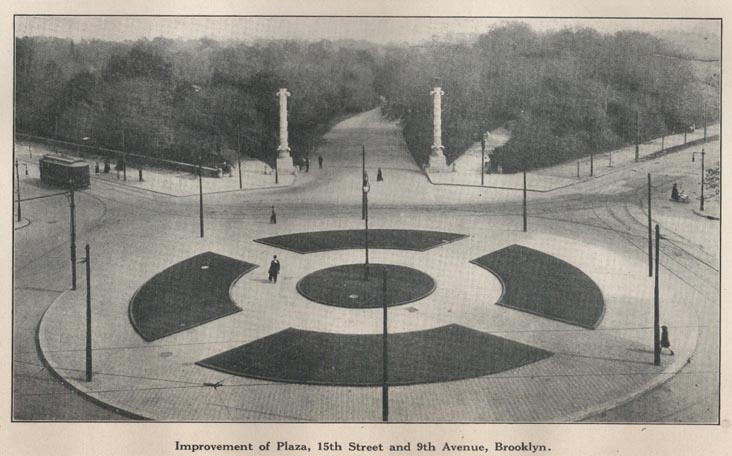
One of the most common arguments against the Prospect Park West bike lane is that it clashes with the historic charm of the grand boulevard. Carol Linn and Lois Carswell, two Prospect Park West residents, testified to this aesthetic desecration at Thursday’s City Council hearing on bicycles. It comes up in almost any news item about the subject.
Via Eric McClure of Prospect Park Neighbors, comes this picture of Bartel Pritchard Square from 1915. There is a trolley line running along Prospect Park West and no car parking on at least the one side of the streets visible in this picture. To be fair, there are no bikes in the picture either, but I’d be willing to sacrifice the current bike lane if Linn, Carswell, and Normal Steisel would back up their belief in historic charm by eliminating cars and returning a streetcar to Prospect Park West. What could be more historic than that?
Marty Markowitz’ Vision of Utopia
Marty Markowitz just doesn’t know how to make a point. And for a guy who has more than a little borscht in his belt, he doesn’t really know how to make a joke either.
Here’s the borough president’s 2010 holiday card, which makes fun of the growth of bike lanes, most notably along Prospect Park West. (You may remember that at a hearing where some people testified that their loved ones had been killed or hurt in car and bike accidents, Marty gave a jolly singing performance of the card’s lyrics at last week’s City Council hearing.)

Look, I get it. It’s supposed to be a joke, a lighthearted take on a so-called controversial issue. I just don’t think it’s funny, nor do I think it effectively illustrates the point he’s trying to make.
To my eye, that looks not like a nightmare that’s “getting insane,” as the lyrics inside the card say, but a hyper-idealized childrens book fantasy version of a neighborhood scene a lot of people would like to see. Disney could buy up all of Red Hook to build a Brooklyn-themed attraction and people would pay $67 a day for the privilege of walking down such a simulacra.
Only a real Grinch would commission an illustration of a boulevard populated by kissing couples, bicyclists, roller skaters, joggers, people enjoying drinks, parents pushing strollers, dog walkers, and a holiday parade, and think its an effective editorial, no matter how lighthearted, on the growth of bike lanes. A Prospect Park where people can sit at cafe tables and drink wine in the middle of the street? Oh, the horror!
But that’s what you get when you use holiday cheer as a chance to editorialize one’s political beliefs. (Instead of promoting Brooklyn; the card’s illustrator is based in Oregon.)
But let’s be fair. Am I and other livable streets activists–not to mention the huge number of Brooklynites who favor bike lanes–just Scrooges who can’t take a little gentle ribbing from Tiny Tim?
The Brooklyn Paper editorializes:
[Transportation Alternatives] may be taking the Beep’s holiday card out of context. The colorful annual greeting is always filled with coded messages and timely commentary, the Beep’s holiday well-wishes have long been a source of media attention and fun.
I’m sorry, but there’s a big difference between using last year’s card to promote pro volleyball at Coney Island, which generated no protests nor spawned any group called “Neighbors for Better Volleyball Courts,” and using an official communications device from the beep’s office to denounce something that makes cars obey the speed limit, saves lives, and has been widely endorsed by an overwhelming majority of the local community.
So, thanks, Marty. I’d rather see the vision of Brooklyn sent out by your office than what I hope will be your 2011 card, should your back-to-the-past, auto-centric ideology become a reality:

I Want to Be a Part of it, SF, SF
One thing you often hear in the “war on bike lanes” in New York is that in a city as crowded and congested as the Big Apple, we simply can’t add biking into the mix. To me, this is the talk of a society so inured to the dangers and congestion caused by cars that it has developed a sort of Stockholm Syndrome. Being held hostage to cars and seeing no alternative, some make excuses for why there’s no way the situation will ever improve.
But look at San Francisco, where cycling is up 58% since 2006.
Now, San Francisco is a different beast from New York City in many ways. It’s smaller, of course, and in some ways its a more transit-friendly city. (Despite a pokey bus system that finds few fans among locals and the fact that the BART is far more limited than the New York City subway.)
But there are a lot of similarities. Traffic-snarled bridges and expressways. A diverse population with distinct neighborhoods. Huge, sprawling auto-centric suburbs. Unpredictable weather.
Plus, for years San Francisco faced a huge bureaucratic obstacle to building bike lanes, as the Gate reports:
…13 months ago…a San Francisco Superior Court judge partially lifted a 3-year-old injunction that prevented the city from adding bike lanes until a state-required environmental review of parking and traffic changes necessitated by the plan was completed and certified.
“The public opinion used to be that San Francisco never could be a bicycle city because of the topography,” said Mayor Gavin Newsom. “But now we’re seeing that view change as more people are biking to work and school and to get around the city.”
A Picture’s Worth

Would you ride a blocked bike lane?
One of the big things I took away from yesterday’s City Council hearing on bicycles was the difference between “noticing” something and “studying” something. Every bike lane skeptic or opponent would offer testimony that he or she “noticed” how few bikers were using a particular bike lane. Council Members Koo and Vacca repeated their observational findings over and over again; each time they went outside, they rarely saw anyone using the bike lanes.
What was discouraging to me yesterday was the level to which many members on the Transportation Committee chose to rely on what they noticed rather than what the DOT has studied. Many of them willfully ignored data that is available to anyone with an Internet connection. (I’d imagine it’s even more available to City Council members who have both Internet connections and the phone numbers of DOT staffers.) Obviously, this is a factor of ideology and politics more than intelligence.
That’s why stories like this one from the New York Times City Room blog are so disappointing. One expects that a news media organization as intelligent as the Times would rely less on what its reporters notice and more on what they study, or, for a better word, report. Here’s the scientific findings of Jospeh Berger, who observed the bike lane earlier this week:
A reporter standing Monday morning between 82nd and 83rd Streets counted just six bicycles using the lane in the half-hour period between 9:23 and 9:53, and three of those were local deliverymen.
Some softballs here.
– Thirty minutes of observation is all it took for this reporter to determine that, “so far, few bike commuters and other cyclists seem to be using the Columbus Avenue lanes.” Thirty minutes. Thankfully, the DOT and other city agencies base their decisions on weeks if not months or years worth of data.
– It was 33 degrees on Monday, as Berger notes. (Did he guess or did he, you know, look that information up?) I wonder if during that same thirty minutes of freezing temperatures the reporter didn’t also determine global warming to be a hoax.
– The reporter began his scientific study at 9:23 AM. Wouldn’t the average office-working person already be at work by 9 AM? Traffic on the West Side Highway is surely worse at 8:30 AM than it is at 9:30 AM. It’s probably non-existent by seven minutes before ten. Bike riders are subject to the same time sensitivities as car drivers.
– What difference does it make if three of the cyclists were deliverymen? Do only yuppies on Dutch bikes deserve bike lanes? What’s funny to me is that if this were a story on hundreds of cyclists breaking the law, running red lights, or salmoning, I doubt that the Times would break this behavior down by type of cyclist.
And then there’s the picture. Surely it was picked because it illustrates Berger’s theory that the bike lane is under-used. But look closer. There’s a van parked in the bike lane. On top of that, there’s an empty parking space. Using Berger’s own standards of scientific theory, can I safely say that there is no shortage of parking on Columbus Avenue?
Singing for His Supper
This video from yesterday’s City Council Oversight Hearing on Bicycling. Brooklyn Borough President Marty Markowitz, who complained that Sadik-Khan and the DOT were pushing an ant-car ideology, sang a song set to the tune of My Favorite Things suggesting that Brooklyn is becoming the “borough of lanes.” The lyrics will be printed and mailed in the BP’s annual holiday card to who knows how many thousands of Brooklynites.
Marty, one quick question. If it’s not okay for the DOT to push an ideology, then why are you using taxpayer money to push yours?
Be There Or…
…don’t complain when they start taking bike lanes away.
New York has made amazing strides when it comes to safer streets in just the last few years, with hundreds of bike lanes and other traffic calming measures put in place by a very forward-thinking DOT. The city could be world-class when it comes to transportation, but there’s still a lot of work to be done.
Tomorrow the New York City Council will hold a hearing on Bicycling. If you bike in New York as a commuter, to run errands, for fun, or for exercise, it is imperative that you come. If you don’t bike, it is imperative that you come, as the improvements that are happening across the city have made streets safer for all users, as study after study has proven. When cars can be calmed by a simple redesign of the street and suddenly go from breaking the speed limit 3 out of 4 times to only 1 in six, that’s a benefit that can be enjoyed by anyone who crosses a street in New York. Meaning everyone.
I’ll be speaking up on behalf of my one-year-old daughter. Should she grow up in a city that continues the destructive legacy of planning only for cars, or should she enjoy the safety and convenience of streets designed for a variety of users? Perhaps more importantly, I’ll be speaking up on behalf of sane, rational thinking. We can not let those who are afraid of change, or those who simply don’t wish to see it on streets in front of their apartment buildings, dictate what’s best for all New Yorkers. Opponents of bike lanes need to do better than to say, “No.” They need to offer alternatives. How would they make the city safer for the majority of people who live here? Because that majority does not drive.
Here are the details. Please RSVP with Transportation Alternatives.
What: City Council Oversight Hearing on Bicycling
When: December 9th, 9:30am
Where: 250 Broadway, Committee Room, 14th Floor (the location might be changed to 16th floor because of crowds, so please confirm at the security desk)
The hearing is scheduled to start at 10 AM, but TA is suggesting people to get there by 9:30. I’ll be there by 9:15.
Apart from the obvious facts and statistics about how safe bike lanes and pedestrian islands make everyone, I believe the biggest message the diverse New York City biking community should present is that we are not “other.” We are citizens and taxpayers who deserve as much of a place at the table, if not more, than as anyone else. The other side will likely skew to an older demographic who would like to believe we’re all a bunch of unemployed hipsters who have nothing better to do than tool around town on our toys with a flagrant disregard for the law and safety. If you are there tomorrow you are there because they are wrong.
You Want Scientific?
Click to enlarge
Critics who dismissed New York City council member Brad Lander’s survey on the Prospect Park bike lane as unscientific just can’t catch a break. On the heels of that overwhelmingly positive–if you consider bike lanes positive–survey, comes highly scientific report from the New York City DOT. It confirms what previous studies have already discovered: the redesign of Prospect Park West has made the boulevard safer for everyone.
Some highlights, courtesy of Transportation Nation (TN) and my own reading.
- Weekday cycling has just about tripled.
- Weekend cycling has more than doubled.
- The number of people riding on the sidewalk has fallen from 20 percent to 4 percent. (TN puts this as a drop from 46% to 3%, the DOT report has the 20% to 4% figures.)
This is really amazing. Weekday cycling tripling means that it’s commuters, not recreational cyclists, who are using this bike lane in big numbers, since people riding for fun and exercise would simply go into the park and do laps. Also, anyone who complains that cyclists don’t follow the rules should be shown this report. You want to stop the threat of “scofflaw” cyclists terrorizing helpless pedestrians? Install a bike lane and more cyclists will fall in line.
About that last stat. Of the 4% of people who are still riding on the sidewalk, almost half are children twelve and under who are legally allowed to ride on the sidewalk anyway. If you are against this bike lane, you are against kids and you probably murder puppies on your brownstone’s front stoop.
Here’s another nugget from TN:
What’s especially interesting—and a little unexpected—is the impact on total usage. Commuter volume on the street has increased in both morning and afternoon rush hours. In the morning, there are both more cyclist commuters and more car commuters, though in the afternoon car commuting has dropped while bike commuting has spiked.
That’s big. Very big. Although it’s fairly obvious to ascribe causality to the presence of a bike lane and the observed result of increased bike commuting, it’s hard to say if the bike lane has caused more car commuters to take to the streets in the morning. That could simply be caused by the price of gas, the result of less frequent transit service or bus line cuts, or any other such unrelated factor. However, if it can be proved that the bike lane has caused more people to drive in the morning, that deserves to be addressed.
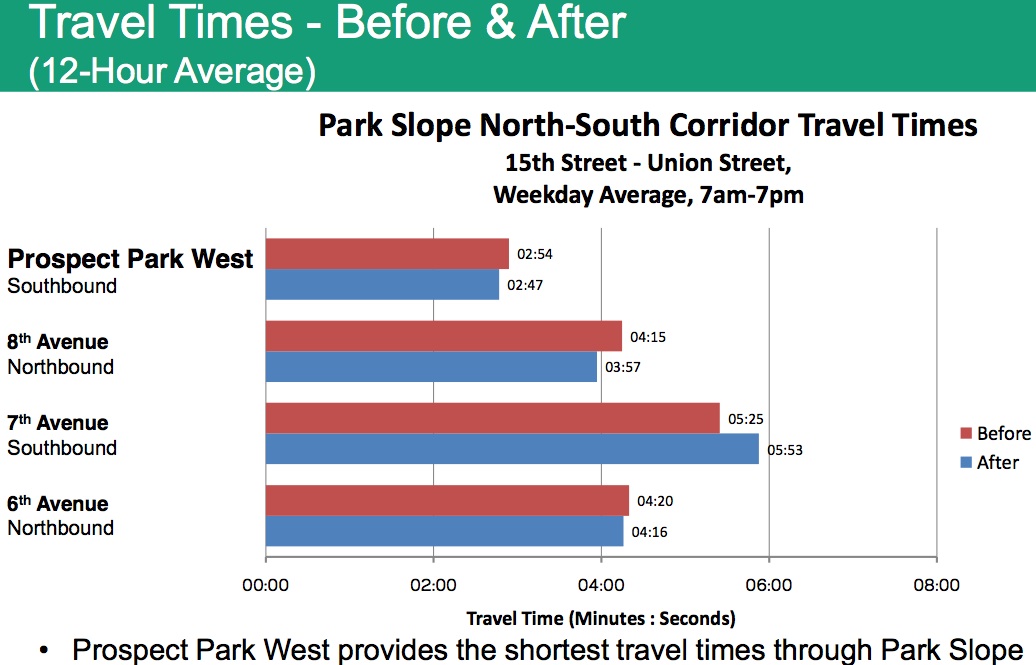
But here’s the thing I found the most interesting. Lost in this entire debate, hidden under hysterical claims that PPW is now a parking lot or that residents of the area are subjected to horrendous traffic jams and honking, are the stats shown in the graphic at the top of this post:
- Before the redesign, weekday travel on PPW from Union Street to 15th Street took an average 2 minutes, 54 seconds. After, it took an average of 2 minutes, 47 seconds. That’s seven seconds less than before.
- On 8th Avenue, average weekday travel times are now eighteen seconds less. On 6th avenue, four seconds have been shaved from travel times.
- Only on the busy and commercial 7th Avenue have times increased. Southbound travel now takes 28 seconds longer than it did before.
As Alex Goldmark at TN writes, “Overall though, the DOT data show motor vehicle traffic has not been negatively affected while biking has increased dramatically.”
Remember, overall traffic speeds have decreased along the park, yet it now takes less time to travel the length of Prospect Park West than it did before. So, the small majority of drivers along PPW have actually benefited from getting an extra seven seconds a day returned to their lives! (Pity the poor 7th Avenue drivers who lose THIRTY WHOLE SECONDS in traffic.)
How many more benefits need to be proven and how much more scientific do we need studies to get before we write off bike lane critics as selfish practitioners of NIMBYism at its worst?
 Brooklyn Spoke