Some Assembly Required
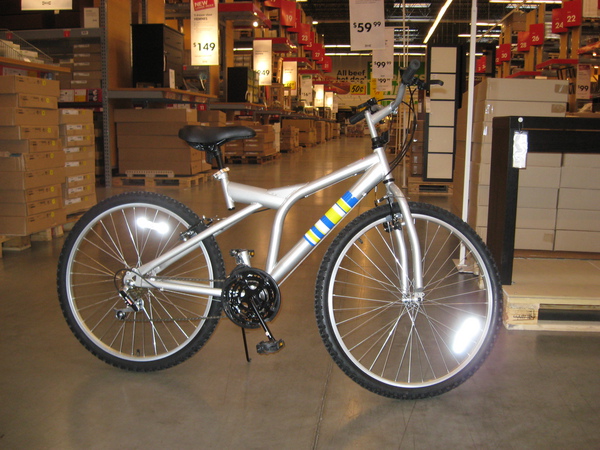 Seems even IKEA employees have a hard time assembling IKEA products. Here’s one of the bikes given to employees as a year-end gift. Can you spot what’s wrong with this picture?
Spin Control
It’s interesting to see how some of New York’s local media have chosen to represent a survey that, to any reasonable person, should but the nail in the coffin of any “debate” over the Prospect Park Bike Lane. Over 3,000 bike lane fans can’t be wrong, or so you’d think.
- The Brooklyn Paper: Survey Says! Prospect Park West bike lane is a hit!
- WNYC.org: Survey Shows Support for Park Slope Bike Lane
- The New York Times City Room: Survey Finds Support, but Debate Continues
Thanks, New York Times, for a headline that does not represent the overwhelming support for the bike lane. The debate could one day be held only between one Prospect Park West resident and his cat, but as long as it’s online–or as long as the person talking to his cat is a former deputy mayor–the media can claim that the debate “continues.”
The debate is over. The bike lane is here to stay. Only fine tuning remains.
Brooklyn Spoke
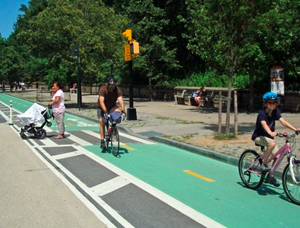
The results of city council member Brad Lander’s survey about the Prospect Park West bike lane are in and the result is not surprising to anyone who attended the rally in October: Brooklynites want the bike lane.
A few things to point out:
- Along PPW there is still overwhelming support for the bike lane. 57% of people on PPW and side streets are in favor of it. Put another way, if a presidential candidate was elected with 57% of the vote that would be considered a mandate.
- Elsewhere in Park Slope, support soars to 81%. Expanding outward to include more of Brooklyn brings support to an astronomical 90%.
- The survey is not scientific; it was online and open to anyone with the motivation to participate. But if there really was greater opposition to the bike lane, the numbers might be in the sixty to seventy percent approval range, not eighty to ninety.
I can already hear opponents dismissing the survey out of hand because the survey is not scientific. But there have already been scientific studies by both Park Slope Neighbors and the DOT and those results were clear: the bike lane has reduced speeding and made the street safer for pedestrians. Never mind the facts, however:
James Bernard, a community board member and resident of Prospect Park West, said his opposition was undiminished.
 Here’s a better version of Bernard’s statement: “Yes, the study shows that the bike lane has cured cancer, resulted in the surrender of Osama Bin Laden, stopped global warming, and God Himself has released His own scientific study, but such facts are of no consequence to me.” Some people will be opposed to the bike lane or any measures to make PPW safer, and no amount of scientific studies will change their minds. When such people dismiss facts and data, they, too, deserve to be dismissed.
The other side will claim that the survey was hijacked by a group of well-organized online activists. But remember that the Internet is open to anyone; Streetsblog and web-savvy neighborhood activists do not have to play with a handicap just because those who live on PPW may not be on Twitter and Facebook in huge numbers. Even with a lopsided online presence, you don’t get 90% approval on anything in Brooklyn if the support isn’t actually there. (Credit must be given to Lander’s office, who “emailed, leafleted, and canvassed residents door-to-door to get a sampling of opinion” included in the survey.)
The anti side has tried over and over again to galvanize support to remove the bike lane. Such support has failed. Period. It is time to start looking forward to a Prospect Park West where a bike lane is a permanent part of the streetscape. Whether it was at the October bike lane rally at which the anti crowd was outnumbered four or five to one by the pro side or again in this survey, the message is loud and clear: Brooklyn wants its bike lane.
By the Numbers
The Daily News publishes back-to-back editorials on bike lanes, the first by Paul Steely White of Transportation Alternatives and the second by the paper’s editorial board.
Here’s the Daily News:
This is Bloomberg’s data-driven administration, the government that measures and calculates to figure out whether something works. At this late date, Sadik-Khan should have at her fingertips facts and figures that tell the tale of what she hath wrought.
- In the last four years, the city has added 250 miles of new bike lanes. This unprecedented boom has sparked a surge in riders: The number of bike commuters grew 79% during this time.
- Streets with bike lanes see 40% fewer crashes ending in death or serious injury by slowing down cars and encouraging drivers to look twice. Last year was the safest for traffic since the city began keeping records 100 years ago.
- On Ninth Ave., with a protected bike lane from 16th to 31st Sts., injuries have been cut by 56% for all road users – including a 29% reduction in injuries to pedestrians, according to the Transportation Department.
The commissioner’s office has little of this information, opening her to understandable suspicion that she – an avid cyclist – just wants to impose her own preferences (and dreams of easing global warming) on an entire city.
That may be music to her ears, but it’s blaring noise to New Yorkers who have to drive into Manhattan from Brooklyn, Queens or the Bronx.
Toronto Streetcars
I love this. Change a few nouns and exchanges and you could have the typical livable streets advocate’s conversation with the No Bike Lane crowd. This is a good primer for the upcoming New York City Council Hearing on Bikes.
Quote for the Day
Newspapers are unable, seemingly to discriminate between a bicycle accident and the collapse of civilization. – George Bernard Shaw
Long Rides, Longing to Ride

Can you get homesick for a place that’s not your home? Four years after spending an amazing month there, I always get a little wistful for New Zealand at this time of year. Maybe it’s because just as winter is starting to settle in here in New York, summer is in full effect over there, and my brain and body could use long days of sunlight right about now.
I went to NZ one week ahead of my wife, who would join me on the South Island for three weeks. During one memorable day by myself, I took a ferry from Auckland to Waiheke Island and rented this bike for less than ten dollars. I can still feel the sun and smell the ocean.
Quote for the Day
When man invented the bicycle he reached the peak of his attainments. Here was a machine of precision and balance for the convenience of man. And (unlike subsequent inventions for man’s convenience) the more he used it, the fitter his body became. Here, for once, was a product of man’s brain that was entirely beneficial to those who used it, and of no harm or irritation to others. Progress should have stopped when man invented the bicycle. – Elizabeth West, Hovel in the Hills
Boris Bikes
My friend Jason Cochran provides this great video guide to London’s Boris Bikes over at WalletPop. My favorite stat? In a city known for high prices, annual membership works out to just 19 cents per day. Take that, Oyster Card!
Mike Bike Predictions

Paris Velibe Bikes
We’ll have to wait and see what happens, but count me as one person who can’t wait for 2012 when New York City’s bike sharing program is predicted to begin. (And, just to get it out there one more time, I’ll repeat my wish to nickname the program Mike Bikes.)
While some may debate the finer points of bike sharing in New York–What will the bikes look like? How many gears will they have? Where will the stations be located? How much will it cost?–I prefer to spend my time imagining how newspapers and TV news stations will report on the scheme when it finally debuts. Why? Because sometimes the outright predictability of this city’s media is one of the best things about living here. The Times’ Spokes blog could simply post the words “bikers,” “pedestrians,” and “bike lanes” and such a post would generate over 100 comments in a matter of hours.
When the Mike Bikes program is finally rolled out, expect the Times, Post, Daily News, Marcia Kramer, and other hysterics of the media world to pepper their stories with anecdotes about minor accidents, thefts, and other incidents all the while putting a very negative spin on a program that will ultimately prove to be very successful and popular. I’m willing to bet my bike on it.
So, New York media, allow me to do your job for you. Look into my crystal ball as I present the Top Bike Sharing Stories of 2012!
- Theft and vandalism prove that bike sharing doesn’t work in New York.
According to Streetsblog, over 8,000 bikes in the Paris Velibe program were stolen and another 8,000 were “rendered unrideable and irreparable,” by being vandalized or, in some cases, dumped into the Seine. In a city that has its own Kryptonite lock named for it, theft and vandalism are real concerns for anyone hoping to leave upwards of 10,000 bikes out on the streets. It’s also something the Department of City Planning addressed in its 2009 Bike Share Opportunities Study.

Barcelona Bicing Bikes
The company that runs the bike sharing program will have to do all it can to ensure a minimal amount of theft by designing a good locking mechanism or making program-specific parts that won’t work with other bicycles. But one fact remains: bikes will get stolen. That’s life. Any car rental or insurance company builds theft, accidents, and vandalism into its budget projections and the bike sharing program will do the same.
The question should not be whether or not bikes will get stolen–they will–or whether or not bikes will be dumped into the Hudson–they will–but whether or not the rate of theft and vandalism is within the acceptable levels projected by those running the scheme.
Prediction: Within six months of the bike sharing program the Times will report on a stolen Mike Bike that has turned up in Africa, China, or on eBay.
- Accidents and fatalities prove that bike sharing doesn’t work in New York.
In the most hopeful of situations, the Mike Bikes program will introduce hundreds, then thousands of newbie riders onto New York City streets. Accidents will be an inevitable, if unfortunate, result of flooding the streets with a new form of transportation.
But just like theft and vandalism rates, the city and bike sharing company will probably build accident and fatality projections into the program. They’ll have to. The city has insurance to cover accidents involving people who trip on sidewalk cracks, so you better be sure they’ll have it for this. I’d bet that membership payment forms will be accompanied by a contract that puts all the risk of usage on the rider.
Never mind that the bike sharing program may offer a huge opportunity for promoting safe, legal cycling in New York. The threat of losing one’s membership or being fined if caught “salmoning” or running red lights while on a Mike Bike may be enough to change a lot of cyclist behavior. No bike sharing program has been able to require helmet use so far, but signage at bike stations can be used to promote basic safety. And it goes without saying that getting people out of cars and onto bikes will slim waistlines and promote cardiovascular health at a rate higher than the occasional accident.
Even a biker who follows all the rules gets in an accident now and then, and so far, no helmet has been invented that can save someone from being struck by a truck at 50 miles per hour. It is a certainty: Someone will get in a bad accident. The media will seize on the tragedy–and subsequent lawsuit–as proof that they city can’t afford bike sharing. (Never mind that if the accident is caused by a car, no one in the media will cite it as proof that car ownership in the city is a failure.)
Prediction: The Post will profile a Midwestern tourist who goes home with a broken arm, leg, and/or jaw after taking a Mike Bike out for a sightseeing jaunt. The segment will end with this line: “Despite facing terror on the street, [tourist] plans to return to New York. Only next time he’ll take a taxi.”
- A newspaper will interview a bike shop owner who claims that his sales have dropped due to the Mike Bikes program.
Mike Bikes will be a ripe target for any disgruntled bike shop owner already on his way to closing his shop, with or without such a bike sharing program. On the verge of going out of business anyway? Pin it on Mike Bikes and call CBS 2!
Even though bike sharing programs are designed to encourage casual, no-lyrcra-required riding, Mike Bikes will do to cycling accessories what a new iPhone release does to carrying case sales. Bike stores will be champing at the bit to sell their products to the thousands of new riders whizzing by their stores.
The smart shops in town will ride the wave that the Mike Bikes program generates, marketing fashionable cycling clothing, bags, helmets, and other basic accessories to users. Shops will offer discounts to program members. Since you’ll only be able to lock your bikes safely at stations in the program, some bike shops will offer secure Mike Bike parking for customers if no station is located nearby. I’d wager that restaurants will get in on the action as well; how long before we see the first Mike Bike valet station at some trendy Village bistro?
Prediction: Within weeks of each other, the Times will feature two stories. One will appear in the Sunday Styles section: “Top Five Fashion Picks for the Mike Bikes Rider.” Another will appear in the Sunday Metropolitan Section: “Mike Bikes a Blow to Local Bike Shop Sales.”
- A TV reporter will broadcast live from a bike station that’s completely full.
This will be used as evidence that the city grossly overestimated interest in a bike sharing program.
Prediction: See next prediction.
- A TV reporter will broadcast live from a bike station that’s completely empty.
This will serve as evidence that the city grossly underestimated interest in a bike sharing program.
Prediction: See previous prediction.
What are your predictions for Mike Bikes? Write your own headlines and stories in the comments.
 Brooklyn Spoke