Quote for the day
The bicycle is the most civilized conveyance known to man. Other forms of transport grow daily more nightmarish. Only the bicycle remains pure in heart. – Iris Murdoch, The Red and the Green
Get On Your Bike and Ride
 I really loved this short post from Amsterdamize in which he quotes Michael Bauch, director of the bike documentary Riding Bikes With the Dutch: “We don’t need more cyclists. What me need are more people that ride bikes.” Truer words have never been spoken.
Imagine if drivers acted like cyclists. While a car driver spends an enormous amount of time deciding what kind of car to buy, once he has his car, he just drives. He doesn’t have to buy special driving shoes, socks, or pants, and the days of driving gloves are long gone. He doesn’t worry about his seat belt wrinkling his shirt. He doesn’t buy special driving food or electrolyte-filled beverages to fuel himself through his journey. If he did all of these things, he might never get in his car.
We need to treat biking more like driving. By all means, spend some time thinking about what kind of bike works best for you, what features you’d like, or what color you want your bike to be. (Car drivers sometimes spend more time counting cup holders than horsepower, and I see no reason why someone who rides a bike can’t be as frivolous.) But once you have a bike, just get on it and ride. Sure, you might need a more comfortable pair of underwear if you’re going on a long ride, but that’s about it. If you want to get out and experience your city, I have one word for you: ride.
You can obsess over lights, jackets, lycra, bells, helmets, messenger bags, baskets, and more, but every minute you spend doing that is a minute you won’t be on your bike. Plus, as Amsterdamize notes, you’ll wind up spending money on stuff you don’t really need. I think there are great pieces of clothing and gear that anyone who commutes by bike should have, and I’ll list some of them in a coming post–it is the holidays, after all–but remember, put the word “biking” before the words “shirt,” “pants,” “gloves,” or anything else, and those same items will cost about 25% more than they would without it.
The more I’ve moved from biking like Lance to just getting around by bike the less gear I’ve needed. But the less gear I’ve needed to bike the more of New York I’ve experienced. I have the time and ability to make those impulse stops along my ride that I never would take if I were in a car and had to look for parking or on the subway and had to think about where it stops. Plus, as I’ve become less of a gear-head the less I’ve had to worry about walking into a store in spandex shorts.
If you do all of this, if you act more like a driver, you’ll find the true benefits of cycling without feeling like a cyclist. Plus, unlike a driver, you’ll never waste time cruising for parking and you’ll save a ton of money on gas and maintenance. Just ride.
Happy Thanksgiving!
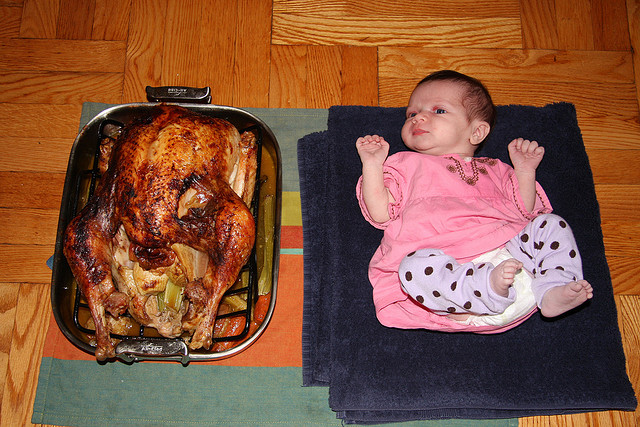
Have a great holiday!
Precious Cargo

Three bikes. A million differences.
This was taken on my trip to Amsterdam in 2008. I love bikes like this. Sometimes they are just for transporting cargo and sometimes they are used for transporting precious cargo.
These three people sum up a lot about Amsterdam biking. A stylish woman in jeans and heeled boots. A dad in casual clothes with his child in a big basket. An older woman in a heavy, leopard-print coat. Big, sturdy bikes. And not a helmet or piece of spandex on any of them. Cycling is something different in Amsterdam. It’s not exercise, it’s not a political statement, it’s not a lifestyle. It’s just life.
Mike Bikes
If the city does institute a bike sharing program, can we call the bikes Mike Bikes?
The Illusion of Causality
And then there were three. Gothamist adds its voice to today’s pileup on cycling with this story: With Cycling Deaths on Rise, NYPD Cracks Down on Cyclists. Nineteen cyclists died in 2010 through the month of October, seven more than in all of 2009, although whether this rate outpaces the increase in cycling is never said.
Lest you think the NYPD suddenly grew an extra chamber in its heart that pumps compassion for cyclists, take a look at how the NYPD, according to Gothamist, is responding:
In response, the NYPD has gone on a ticketing blitz targeting cyclists, issuing summonses for such infractions as talking on a cellphone while biking and cycling without lights. Sources tell the Post that NYPD officers in the Midtown North precinct are cracking down on cyclists who pedal on sidewalks…
As far as I know, none of these behaviors were a factor in any of the fatalities this year, so the idea that the NYPD is protecting cyclists from themselves is laughable. Jasmine Herron died because she was hit by a bus after getting doored, but the NYPD is not mounting a campaign to get drivers to look before they open their doors. Riding on sidewalks is illegal, but has not resulted in any pedestrian deaths, unless you count the 4-year-old kid who knocked over an 87-year-old woman and is now being sued for it.
Sometimes the simplest explanation is the most likely: the NYPD is cracking down on cyclists because it wants to and can.
This is lazy reporting on the part of Gothamist, if you can call what Gothamist does reporting. (Note: I used to write for the site.) There is zero causal relation between cycling deaths and stepped up enforcement. If anything, cycling is far safer than it has ever been, yet ticketing blitzes against bikers have made the news a lot lately. That doesn’t jibe with Gothamist’s logic.
I believe, more and more, that the media is our worst enemy. Sensationalism and pitting us versus them, no matter who “us” and “them” are, is more important than digging just a tad deeper for the truth.
The Tom Wolfe Novel Writes Itself
On top of the Wall Street Journal piece comes a story in today’s New York Times titled, Expansion of Bike Lanes Brings Backlash. I think the article stinks a bit of cable news style debate with equal weight given to the DOT’s statistics and a vocal minority of cranksters. One great example is Leslie Sicklick who “grew up driving with her father around the Lower East Side, where she still lives.” It takes a special kind of auto-centric thinking to look at Union Square, teeming with pedestrians, NYU students, farmers market vendors, artists, and street performers and say that it’s “one of the worst areas created by the new bike lanes.”
Later in the story, check out who is quoted as a representative of the”well-connected neighbors” on Prospect Park West who “are fighting to eliminate the 1.8-mile, two-way strip of green paint.”
“Things have come to a critical pass,” said Lois Carswell, one of the organizers of an Oct. 21 protest by several dozen opponents of the lane.
Carswell. You can not make stories like this up.
One other thing to point out in the story that speaks to a larger problem in the news of all opinions being weighted equally with actual facts. The Bedford Avenue bike lane was removed because of objections by the local Hasidic community. Their objections weren’t that it caused more accidents (it didn’t) or created more traffic (it didn’t) or that it was ugly (who can argue?) but that it allowed scantily clad bikers, mainly women, to ride through “their” neighborhood and offend their religious sensibilities. But the Times doesn’t mention that.
Who Shouldn’t Be a Jerk?
Today, Tom Perotta of the Wall Street Journal takes a look at Cycling’s New Rules of the Road. Sure, there’s a quote from a taxi driver making a complaint about rogue cyclists, but this article must represent a media first, with not a single Frankenstein’s monster-like quote–Bike lanes baaaaaddd–from a politician or community board leader. In fact, it’s a very positive, forward-looking take on the state of New York City cycling.
A couple of things to point out. First, this bit about life on the Upper East Side:
In the 19th Precinct, on the Upper East Side, dangerous cycling is the chief quality of life complaint among residents, according to the NYPD.
Think about that for a second. There are neighborhoods in New York where the number one quality of life complaint is that you can’t go outside without getting shot. There are neighborhoods located next to factories and highways where just the simple act of breathing can lessen one’s lifespan. There are housing complexes where the rats outnumber the residents three to one. Some areas of New York draw hordes of Jersey Shore wannabes who use sidewalks for toilets after they’ve been thrown out of their last club. And yet Upper East Siders, at least those who call into 311 or talk to local community boards, are most upset about…bicycles. Congratulations, Upper East Side, you’ve won life’s lottery!
Then there was this sequence of paragraphs, which I found a tad confusing.
Biking in New York is safer today than during any time in the city’s history. As daily ridership has increased (some estimates claim it has almost doubled since 2005 to more than 200,000 daily riders), the yearly number of cycling fatalities and injuries has remained flat or declined, and the percentage of riders who are injured while riding has fallen dramatically.
This year, however, the city will see a slight increase in the number of cycling fatalities and accidents in its year-over-year numbers, according to a Wall Street Journal analysis of data from the New York City Police Department.
There were 19 cyclist fatalities in the city through October 31, seven more than in all of 2009. In the same period, 3,505 bikers were injured in crashes with motor vehicles, more than last year’s total and up 20% compared to the first 10 months of last year. If the current rate of injuries continues, the percentage of daily riders who sustain injuries in 2010 will rise slightly.
On the one hand, as cycling has gone up injury and fatality rates have gone down. On the other hand, cyclist fatalities and accidents are up slightly over last year. But is that because there are more bikes on the road or because enforcement against cars has grown more lax? Also worth noting is that the article cites statistics for bikers injured in crashes with motor vehicles, but there are no statistics for pedestrians or bikers injured by bikers, just one unfortunate story of a child hit in Park Slope. Sounds more like a case of a jerk being a jerk, and not evidence of a city-wide plague.
Which brings me to the DOT’s Don’t Be a Jerk campaign. On the one hand, I agree that there are a lot of jerks on bikes. It’s hard not to notice when a biker does something idiotic or illegal as he rides. But noticing such behavior and focusing on it are two very different things. Why is there so much of a focus on bad biking?
Reckless bikers stand out precisely because they are not cars. Fifteen drivers could clog an intersection blocking the box trying to make an illegal left turn as they talk on their cellphones, but what would little old ladies on the Upper East Side notice? The bike messenger weaving in between the cars.
It is a sad state of affairs, but we have so accepted that cars are part of the ether that we tend not to notice or the ways in which drivers act like jerks, or, more accurately, break the law. They speed, run red lights, stop in crosswalks, make illegal U-turns, back up down one-way streets, fail to signal, cut across lanes to make turns, park on the sidewalk, double park, and stop in no standing zones. And those are just the violations one can observe. Add in unlicensed drivers, distracted drivers, and drunk drivers and you’re still just at the tip of the iceberg.
When people complain about jerky cyclists, they are typically talking about a handful of violations: Riding on the sidewalk, riding against traffic, and running red lights. It’s not hard to find other examples of stupid behavior, but these three are guaranteed to be the chief complaints you’ll see on blogs and in newspaper editorials. But the thing is they are easy to fix: Build infrastructure that encourages compliance. On Prospect Park West, 46% of bikers rode on the sidewalk before the bike lane was installed. After? Four percent.
Is the threat posed by bikes so big it warrants a celebrity-filled PSA campaign? My feeling is no. Every dollar spent on a PSA telling cyclists to not be a jerk is a dollar that isn’t spent on bike lanes or other infrastructure that will actually change behavior and encourage more people to ride, allowing polite, law abiding cyclists to start outnumbering the jerks. It’s also a dollar that isn’t spent on enforcing laws that prevent the far more deadly consequences of illegal and dangerous driving; while I can’t discount the fact that some cyclists are just assholes, there are a lot of bikers out there who break laws because it is sometimes safer for them to do so.
The people sitting on the sidelines right now debating whether or not to get on a bike and ride are not the messengers or Williamsburg hipsters who may be more inclined to salmon or break the law than others. They are women, moms, kids, and older people who would bike if it just seemed safer out there. Which is going to protect them more when they ride and help them follow the law? A separated bike lane or a finger-waving Mario Batali? NYC DOT, given the cost of an ad in the New York Times or on Channel 4, why don’t you build a bike lane instead? The people inclined to break the law aren’t reading the Times or watching network TV anyway.
#BikeNYC
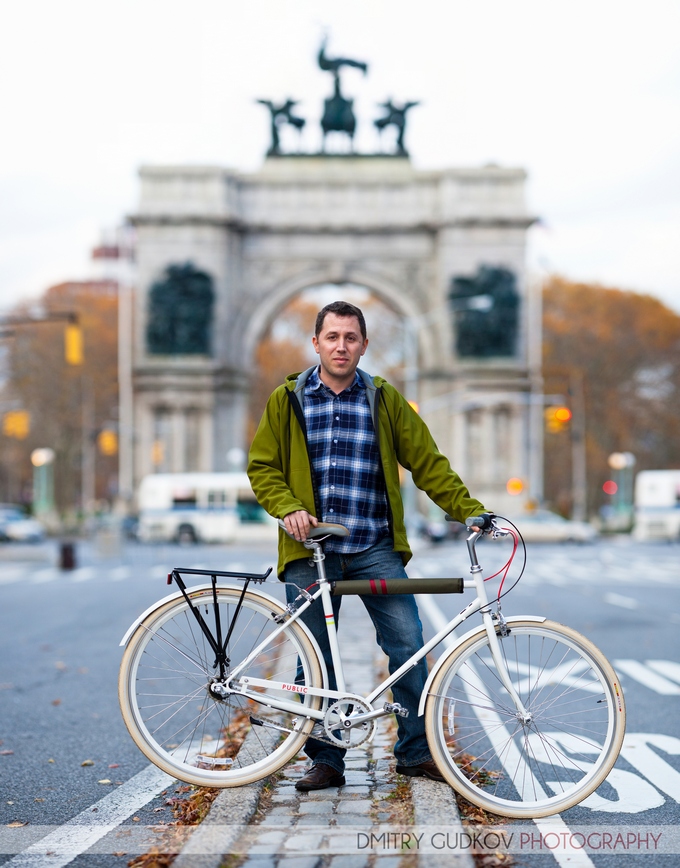
Credit: Gudphoto.com
I had the great fortune of meeting Dmitry Gudkov, a talented photographer who recently began a series of portraits of people and their bikes. He’s calling his series #BikeNYC after the Twitter hashtag used by cycling commuters and enthusiasts. Dmitry took this amazing picture of me with my PUBLIC D3 in one of my favorite spots in Brooklyn near Grand Army Plaza.
He’s a great guy and a very talented photographer. Check out his site for pictures of other cyclists, far more attractive than I.
Letter of the Law, Spirit of the Law
 The story of the unicyclist ticketed for riding on the sidewalk is making the rounds today now that the unicyclist in question, Kyle Peterson, has filed a $3 million lawsuit against the NYPD for violations of his constitutional rights. Peterson used the wording of the New York City administrative code as a loophole to get his summons dismissed and is now pointing to it as the basis for his lawsuit.
The code defines a bicycle as a “two- or three-wheeled device” propelled by human power – that’s at least one wheel more than a unicycle has, the suit says.
If the backlash against cyclists these days is a battle of perception, we must consider that only those enmeshed in the world of cycling would really distinguish a unicycle from a bicycle or tricycle. There’s only one reaction to this silly story if you live in the non-cycling world: bikes, defined as anything with wheels and pedals, don’t belong on the sidewalk. If the cycle in question had four wheels instead of one, would anyone argue that Peterson was within his rights to pedal on the sidewalk or that he should not have been ticketed because of the narrow definition of the law?
 Brooklyn Spoke