Nieuwmarkt
 I recently went through my collection of photos from 2008 trip to Amsterdam, reminding myself that I need to find the next and earliest opportunity to return.
I sorted through dozens of pictures of bikes. Bikes at cafes. Bikes on bridges. Bikes parked by the hundreds at the rail station. People on bikes. Kids on bikes. Old people on bikes. Everywhere bikes. I have so many to choose from, and that’s on top of the pictures of Amsterdam’s wonderful canals and buildings.
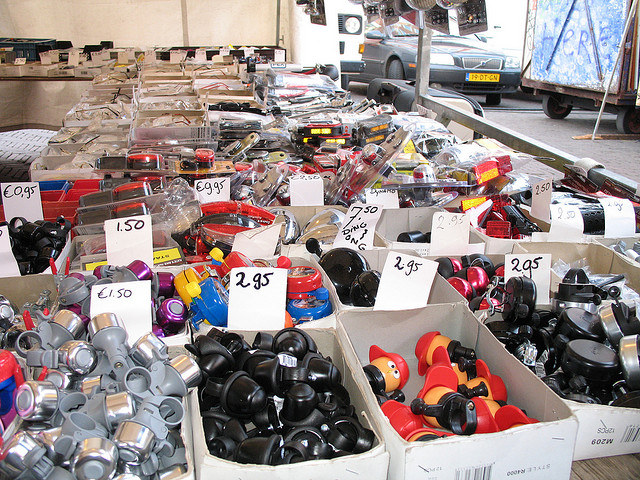
But one of my favorite pictures is this one. There’s no bike in it, but it’s all about the bike, to be sure. It’s from Amsterdam’s Nieuwmarkt and, in case it’s not clear in the picture, is from a large stall at the market that sold bike supplies, from lights and bells to tires and pedals. I bought a bell there which I affixed to my commuter bike when I returned to my job in Boston.
You’ll know New York has come a long way in terms of its biking culture when supplies such as these are available at the street fairs that tend to shut down random avenues each summer. Instead of grilled corn, ten-packs of socks, and huge bottles of spices, perhaps we’ll see some industrious person set up a stall such as this in the near future.
Light & Easy
Here’s a great post from velojoy with some tips for staying visible now that it’s time to set your clocks back. As Yogi Berra said, “It gets late early out there,” so your evening commutes–and even a few morning ones–will find you riding in darkness.
There’s really no need to be afraid of riding at night, so long as you stay safe and make yourself visible with reflectors, lights, and a light-colored jacket or vest. As velojoy points out, front and back lights and reflectors are required by law. They’re cheap, too, so there’s no reason not to have them.
In addition to front and rear lights, I find that it’s also helpful to clip a light onto my messenger bag and helmet. This helps me stay even more visible than 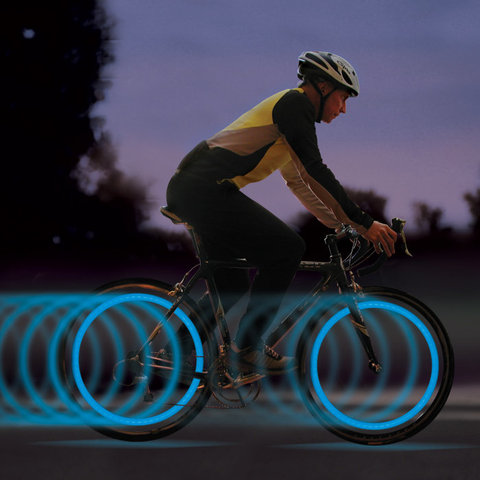 bike-mounted lights alone. Plus, the lights don’t get stolen if I forget to put them away.
If you really want to go for it, check out the SpokeLit. (Pictured left.) I have a red version of this on my rear wheel and it helps you be seen by cars approaching you perpendicularly. If you’re going to run red lights, which I don’t advise you to do under any circumstances but especially not at night, you should make sure you can be seen from all sides.
There are more extravagant versions, including Hokeyspokes, that can have you lit up like the Vegas strip, but maybe there’s such a thing as attracting too much attention.
Some of my favorite riding experiences have been at night. The temperature is perfect, the city is a little quieter, and there’s a great feeling of freedom. Stay safe, stay visible, and have fun.
Car Lane

I love this poster from Tatsuro Kiuchi.
Contextual Cycling
Responding to the Wall Street Journal article on why the Dutch don’t wear helmets, Bikes Can Work nails it. The Dutch don’t wear helmets because, he writes, “they have the world’s safest streets.” The incidence of injuries and fatalities is so low there that the benefit of adding helmets into the mix would be hard to measure. It’s one place, in fact, where requiring helmet use might actually cause people to bike less.
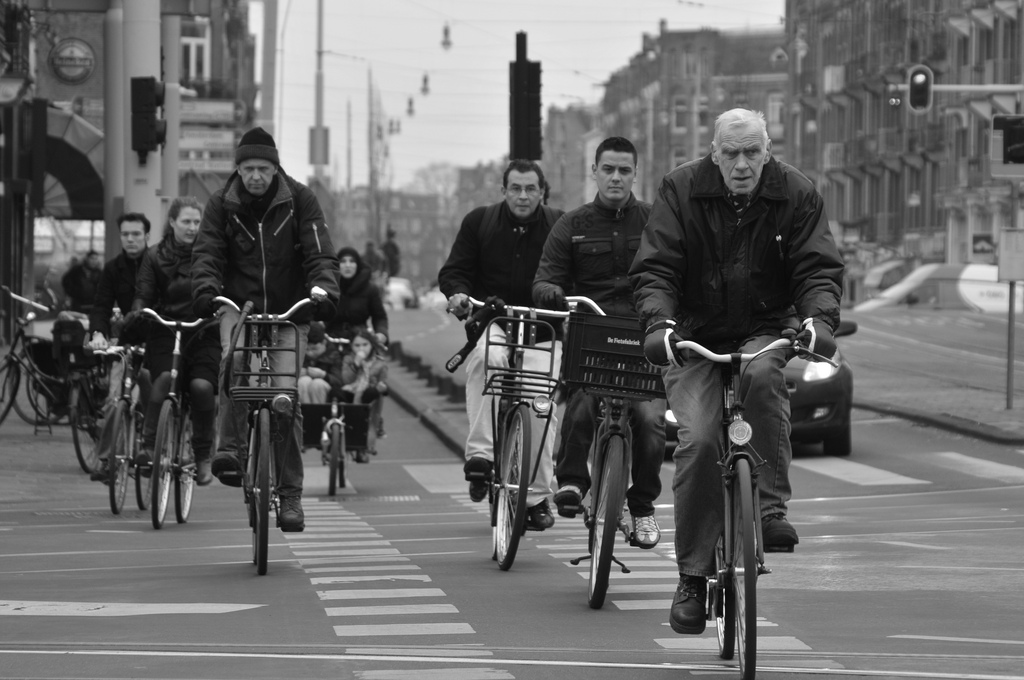
Photo credit: Amsterdamize.com
BCW’s insightful post is an example of what I call contextual cycling. Most of the typical arguments for and against helmet use–which you’ll find perfect examples of in the comments under the WSJ’s story–rely on either a misunderstanding of facts or personal anecdotes as a substitute for true evidence. Context is rarely a factor.
Take this comment from beneath the WSJ story:
Even motorcycle helmets only reduce the risk of head injury by about 20%, according to US statistics. Now compare a motorcycle helmet to a bicycle helmet. Bit of a difference, huh? Nonetheless, the bicycle helmet mongers often claim an 85% reduction. Maybe motorcyclists should start wearing bicycle helmets…or maybe the helmet mongers are blowing smoke.
If bicycle helmets reduce the risk of serious injury by 85%, it’s probably because most biking happens at such slow speeds that the risk of injury is low relative to motorcycles use. Motorcycle accidents most likely happen at speeds of at least 55 miles per hour, and even the best helmet may not be enough to prevent serious head trauma at such high speeds. (I’ve worn a motorcycle helmet, but I still don’t think I’d want Juan Uribe swinging a bat against my head.) Plus, bike riding occurs in a variety of locations–city streets, but also parks, bike paths, sidewalks, and quiet cul de sacs–that are safer, generally, than where motorcycles can be found almost exclusively: on streets and highways. Again, it’s all about context.
Then there’s this comment, a perfect example of confusing one’s personal experience with facts:
In 200,000 miles I’ve hit my head twice, neither time serious although I needed stitches once. This is all the proof I need that helmets are not necessary.
One could probably point to lifelong smokers who never develop lung cancer, but you’d be hard pressed to find doctors who would trot out such people as an example of why smoking is okay. We all know terrible drivers who never get into an accident. Comments like this represent a terrible misunderstanding of black swan theory. Just because the probability of some event is low, or, more importantly, perceived to be low, that is not a reason for it not to happen. (You hear this reasoning when it comes to driving and talking on a cellphone: how can it be dangerous if I can do it just fine?) This commenter may live somewhere where traffic is light or drivers expect to see bikes on the road, but he also may live in New York and just be lucky. There’s no way of knowing.
What I loved about BCW’s post–and Amsterdamize’s tweets on the subject–is that it takes in the full context of where the cycling occurs as a basis for whether or not helmet use matters. Imagine having a discussion about jacket use that failed to consider where a jacket wearer lives. Yeah, jackets keep you warm, but in Miami you might not need one for more than one or two days a year. Context, more than any single study or personal example, is the best way to talk about cycling.
I Do What Google Maps Tells Me To Do
I live near the nine subway lines (N, R, Q, B, D, 2, 3, 4, and 5) that all stop at the Atlantic-Pacific station near my apartment, so when I had to meet a friend for an early morning breakfast today at the Clinton Street Bakery on the Lower East Side, I thought it would make more sense to take the train rather than ride.
But Google maps told me that it would take 31 minutes to take the subway, including the walk from the station to the restaurant on the other end. (And that’s if the trains weren’t delayed.) Biking, on the other hand, would only be 23 minutes. So I rode.
Remind me again why more people aren’t giving up their MetroCards for bikes?
To Helmet or Not to Helmet? That Is the Question
This article in the Wall Street Journal on helmet use in the Netherlands struck me as really fascinating. It highlights the helmet debate in a country where just 0.1% of bicyclists wear one. Like many cycling-related debates, some of the arguments made on both sides are based on a lot of research and facts while others are based solely on feelings and passion. While I tend to fall more on the side of logic and statistics, I like to understand both sides. It’s worth a read.
I’ll post more on this later, breaking down some of the common arguments in the helmet debate, but I wanted to reflect a bit on my experience with helmets here in New York, across the U.S., and across the globe.
My experience overseas and at home speaks a lot to the contextual reasons for wearing, or not wearing, a helmet. On a visit to Barcelona last year I took out a bike from our hotel but didn’t wear a helmet, only because the hotel didn’t have any to let. Barcelona had introduced the Bicing program two years before and there were a few separated bike paths along some of the city’s main boulevards, including the Passeig de Gracia, so I felt reasonably safe. Plus, my desire to photograph the Sagrada Familia early one morning outweighed my safety concerns. Even this very logical bike rider can sometimes let his emotions get the best of him.
In New Zealand, I took a ferry from Auckland to Waiheke Island, and rented a bike for $8 at a shack near the ferry slip. Cable locks were included, but the tiny rental service didn’t stock helmets. Still, I rode. While I saw few other bikes during ride, I also saw few cars, and there were lots of stretches of the island where there were nothing but vineyards or coastline. Imagine a subtropical Nantucket or Martha’s Vineyard, but decades before those islands were overrun by cars. I could hear cars coming from very far away and took the islands steep downhills slowly and carefully. With such beautiful scenery and my only deadline a very late ferry back to Auckland, I was in no rush anyway.
I rode in Amsterdam on a work trip the year before that and, no surprise, did not wear a helmet. It’s hardly worth expounding on my reasons for not wearing one, since so few Dutch riders wear helmets or anything that could even be labeled as biking gear. I don’t even remember if the bike rental shop had helmets available, although since it catered to so many American and British tourists, I’m sure it must have. Nevertheless, I didn’t wear a helmet. When in Rome, right?
When I’m home in Brooklyn and ride anywhere in New York, I wear a helmet. Always. The same holds true when I get on a bike in Boston, despite that city’s huge measures to improve cycling conditions. In San Francisco, a biking town if there ever was one, my last ride took me over the Golden Gate Bridge, to Tiburon and, after a ferry ride back, to the Mission for lunch. I wore my helmet for every mile of that ride and might have forgotten to take it off had the chin strap not allowed me to open my mouth up wide enough to eat my burrito.
I think much of the debate on helmet use, at least when that debate happens online and is available to cyclists from all over the world, fails to consider local context. Riders in Amsterdam and Copenhagen post to message boards in the U.S. and say that there’s no need to wear a helmet ever. New Yorkers or Chicagoans tell their European counterparts that a flagrant disregard for safety will leave them dead or in a vegetative state if they so much as ride over a bottle cap or twig. And then there are those all over the map who see helmets, or at least calls for helmet laws, as an infringement on their rights as freethinking adults. Fair enough. (For the record, I’m against laws mandating helmet use for adults, but am in favor of widespread, voluntary helmet use.)
Forgive this heavy-handed analogy, but I think it applies.
During the uber-PC days in which I went to college, I once argued with a girlfriend about the philosophy that women should be able to wear what they want, when they want, where they want. Yes, I agreed, a woman should be able to put on any item of clothing and go wherever she wants without fear of being assaulted. In theory that’s a fine world to work towards, but in practice it’s not a great idea. That’s simply not the reality of the world in which we live. My girlfriend, who was saw sexism in so many things that she stopped using third-person pronouns, would not have it and kept insisting that it didn’t matter what a woman wore. I teased out what I still see as the more nuanced position: no woman is ever asking to be assaulted, of course, but there are common-sense measures she can take to lessen the odds that she will be. There may be neighborhoods where a woman can wear whatever she wants without so much as a cat call or whistle directed her way, but there are certainly places where a woman shouldn’t walk no matter what she’s wearing.
Here’s a shorter, lighter example: stealing is wrong, so I should be able to count wads of cash while waiting for the subway. But it’s not something too many people would advise I actually do. I can stand on the Biblical and legally supported principle against theft, but my principled stand may result in me getting home a few dollars poorer.
I think the same idea holds true with helmets. No rider is asking to be killed if he doesn’t wear a helmet, but he should understand that it’s a real risk in New York. In principle the streets should be safe enough so helmet use is not necessary, but that’s not the reality of biking in New York right now.
Anyone who tells me that in Amsterdam they don’t wear helmets has to understand that I don’t ride in Amsterdam. I ride in New York. And New York, despite all of the safety improvements, new bike lanes, and the growth of cycling overall, is still a dangerous place in which to ride. Drivers are not used to seeing bikes and few are trained to look for them. Cars speed on every available surface, sometimes going twice the limit on the city’s wider avenues. Pedestrians step out between cars and cross against lights. Roads, and especially bike lanes, are horribly maintained. Most bike lanes are set too close to cars, making being doored a significant risk. Even bike lanes set against the curb instead of along parked cars are often blocked by taxis and delivery trucks. Bike riders themselves don’t understand the rules of the road, contributing their own brand of danger by riding the wrong way in bike lanes or without lights at night. Amsterdam isn’t perfect either–I had to dodge my fair share of pedestrians and be mindful of not getting my front tire caught in streetcar rails–but it’s much closer to perfect than New York is.
Perhaps a scientist has measured the exact point at which a city’s rate of helmet use reaches its apex and begins to decrease as ridership goes up, lending credence to the argument that helmets send the wrong message about safety, but New York is a long way from that point. My friends who don’t ride rarely mention helmets as a barrier to entry. They are afraid of cars. Helmets don’t remind them that cycling is dangerous. Cars do. (Also, most surveys in the city show that the lack of a secure place to park a bike outweighs most safety concerns. It’s the number one reason given when people are asked they don’t commute to work by bike.)
Like that late night college argument or my imagined bankroll on the subway, the helmet argument in New York is one of balancing principles with practicality. Context is everything. I will work towards the city I want to ride in and, for now, ride in the city I live in. Unfortunately, that means it’s a good idea to wear a helmet, except for when I’m in Amsterdam.
Vote
Don’t forget to vote today! A lot more than livable streets and transit is on the line today. I actually thought about not voting, since I forgot to change my registration to my new apartment and getting over to the old polling location is a bit of a schlep, even on the bike. But then I remembered all the hateful and hurtful things Paladino has said about minorities, women, and gay people and I realized that it doesn’t matter if I think someone is likely to win or lose with or without my vote. Voting isn’t just about making sure the right person gets elected, it’s also about sending a message. And remember: you can’t spell Paladino without “no.”
Until You Bike a Mile in My Shoes
I rarely ride my road bike anymore. I take it out when I feel like I’ve fallen behind in the exercise department and need to push myself a little harder. It has clipless pedals, so I have to dig out the shoes that work with the bike. Once I dig out the shoes I then feel the need to wear bike shorts, a lycra shirt, gloves, and even the sunglasses with the interchangeable lenses I bought for long rides, races, and lap sessions.
The problem is that when I think of what getting ready to ride that road bike entails–suiting up in a special uniform–the motivation to ride starts to fade very quickly. Imagine if every time you went for a walk you had to put on a specific walking outfit: special shoes, shorts cut just so, a shirt to wick away sweat, and more. You’d never leave the house.
I thought about this today when I took my D3 out for a ride down to the grocery store to pick up a few things for dinner. I wore jeans, a sweater, and Camper shoes, their bubbly soles all I needed to grip the pedals, no cleats required. I wore gloves, but only because it was cold, not because I needed them to take some of the pressure off my hands. (Another benefit of riding upright.) The only bike-specific items I wore were a helmet and a green Swrve Milwaukee hoodie, a remnant of my Boston bike commuting days. But even that jacket hardly qualifies since it’s warm and stylish enough to wear whenever.
So all I needed to do to ride today was grab my helmet, unlock my bike from its parking spot in our building’s garage, and roll it outside. One, two three. I didn’t even have to change my shoes.
The next time you’re out for a ride and want to see the changing face of New York City riding, don’t look at the type of bike a person rides. Look at his or her shoes instead. When biking is seen as something as simple as one, two, three and not something one has to suit up for, you’ll know how far city cycling has truly come.
A Very Long, Roundabout Means of Making an Introduction
I’ve been riding in New York City for as long as I’ve been living here, thirteen years. During that time, my riding has evolved in a way that has, in many ways, reflected the changes in the city itself. When I first moved to the city, I came with a GT Timberline mountain bike, complete with front suspension, bar ends, and tires with deep treads. It was a heavy and loud bike, able to take on potholes and the (then) completely unforgiving and unfriendly Manhattan streets.
After I completed a charity bike ride on this tank of a bike, I upgraded to a Bianchi Velochi and joined the ranks of the city’s spandex-clad warriors, doing the requisite Central Park laps and taking day trips across the George Washington Bridge to Piermont, Nyack, and Harriman State Park. The occasional road rash and near-permanent farmer’s tan were proof of my passion, as was one cracked helmet and a hospital trip, the result of a driver who tried to race around me to make a right turn as I went–legally–through an intersection in New Jersey.
Even though I’ve ridden bikes for a long time, I didn’t become that more modern of biking creatures, a commuter, until a work assignment had me up in Boston during most weekdays for the better part of two years. Now, I grew up a colonial Massachusetts town, went to Tufts University, and truly love Boston, but there’s a reason I left. Compared to New York, it’s more of a small town with a few big buildings. So when I found myself away from my wife and home in Brooklyn working long hours and spending the equivalent of a full day on the Bolt Bus or on Amtrak getting to and from Boston, I knew I needed something to help me stay sane and healthy. I tried a gym membership, but all that meant was that at the end of the day I would still have a long T ride to get back to where I was staying, only to eat dinner and go to sleep, without time for much else.
A bike, of course, was a natural solution. I could commute and get exercise, killing two birds with one stone, and still have time to catch a movie or meet a friend. Plus, I could do those things in places where the T didn’t run, without having to worry how I was getting there or getting back.
Still, I had my doubts. The thought of biking in and around Boston never would have occurred to me as a kid or college student. Boston has long had a reputation for being a traffic nightmare, with roads that follow the former grazing paths of cattle, terrible drivers, and potholes that can swallow a Volkswagen. Layer on top of this weather that, for most of the year, ranges from wet and cold to wetter and colder, and the words Boston and biking don’t seem like a natural fit.
But in the time I had been away from Boston the city had taken a more friendly approach to accommodating bicycle traffic, with bike lanes, parking facilities, and sensible policies that made biking more attractive every day. Everywhere I went and at all hours of the day and night, I saw people on bikes and bikes locked up to every available surface. The idea of biking in Boston, not solely for exercise, but to get from point A to point B, seemed not only attractive, but possible.
So, I bought a bike.
Since I was only in Boston on weekdays, I didn’t want to deal with a bike with gears or a derailleur that might require multi-day stays in the bike shop for a repair. Walking on Beacon Street one day, I saw a used (read: cheap) single-speed SE Draft with a for sale sign on it locked up in front of a bike shop. It was probably a size or two too small for me, but the price was right. I bought it, along with a sturdy lock and a helmet, and rode to work the next day. I rarely took the T again.
Looking back on it, and despite the weather, Boston and biking are a natural fit. The city is compact, and the adjacent cities and suburbs of Cambridge, Somerville, Brookline, and Newton are all within a few miles of downtown. A huge percentage of the population, nearly 25% by some estimates, are students, a group that doesn’t tend to own or need cars to get around. Boston continues to add miles and miles of bike lanes, and on one stretch of my commute through Cambridge and Somerville, I would pass work crews painting lanes. Each day they were a few blocks further down Mass Ave until, after a few weeks, they were gone and a freshly painted bike lane was left behind.
I was also lucky in that my office was very bike-friendly. In the time I worked there, the company was in one building and then moved to another. In one, there was a set of bike racks in an outdoor parking lot and a small gym on the ground floor with a locker room. Once we moved to Davis Square in Somerville, I could park my bike on a rack in the building’s underground parking lot and clean up in a bathroom with a shower stall. However, even though my commute was seven miles, I typically kept my pace slow enough that I didn’t break too much of a sweat on the way in. I saved the fast ride for the way home.
The job in Boston ended, and the bike came back to Brooklyn with me, as did my new perspective on biking, commuting, and the simple act of getting around. New York changed in the time I was gone, too, with bike lanes on more streets, new parks along the Brooklyn waterfront, and a higher number of bike everywhere I turned. It was impossible to not notice the amount of people now on bikes when I got back, much in the way that I now notice the sheer number of kids in Brooklyn in a way that I never did before I had one of my own.
Settled in at home, I started running more errands by bike. I found myself doing fewer laps in Prospect Park and more grocery runs and trips to the farmers market on my bicycle. Recently, I traded in my SE Draft for something sturdier, an upright, Dutch style Public D3. Exercise became an ancillary benefit to biking, not its primary purpose. In that way, my experience has reflected the changes in New York over the past few years. Bike messengers and Lance wannabes will be an indelible part of the New York biking experience, but it’s increasingly common to see women in skirts, men in dress pants, or people in clothes that, when they are not on their bike, give no hint as to how they arrived at their destination.
In addition to the vast improvements I’ve witnessed when it comes to city biking, I’ve also noticed a related and growing trend. Animosity towards bikes and bikers is at an all-time high and getting more intense by the day. From protests against bike lanes to angry editorials in the city’s tabloid papers, the negative stereotypes of bikers as aggressive jerks intent on flouting every conceivable traffic law while mowing down innocent pedestrians, is becoming harder and harder to counter. Partly, that’s because the stereotype is largely based in truth. Many cyclists are jerks. Any bike rider who is being honest has to admit that it’s not just the messengers and delivery guys who are giving bike riding a bad name in this city.
Those on the pro-bike left, if one can put this issue on a political spectrum, often come across as holier-than-thou, revolutionary hippies and tattoo-covered hipsters with no tolerance for those who don’t see bikes as the Savior Of All Humanity. Those on the right, from the Andrea Peysers and Marty Markowitzes to the reflexively angry commenters on blogs who would post to an item about the Tour de France about the danger posed by bike, come across as holding a religiously intolerant windshield perspective, unable to see why anyone wouldn’t choose a car for any and all transportation needs. Many blogs could simply post a one-word entry, “Bike,” and find that they’ve raked up more than 100 comments in less than a few hours. Heck, I wouldn’t be surprised if a post about Pee-Wee’s Big Adventure resulted in a comment about someone almost being hit by a biker.
I started this blog because I’ve become increasingly involved in and aware of what has been called this city’s “biking culture.” That’s not a term I tend to endorse, since it’s loaded with meaning both good and bad, and obscures some of the real issues at stake on all sides. Much of what passes for discussion in this country at this moment is dominated by the extremes of both sides, leaving the sane, reasonable middle with no room to participate. Being able to make judgments based on fact while still seeing things from the other side are become rare commodities on the Internet these days.
Much like the ideas put forth at this past weekend’s Stewart/Colbert rally, there is a silent middle majority on the subject of livable streets that just wants to live their lives free from labels. I have stated before that making a political statement every time one gets on a bike just seems so very exhausting. Most of the time, I simply want to get from point A to point B and I want to do it in the safest, most efficient way possible. Many times, but not every time, this means riding a bike.
If all of this sounds self-important or like it’s giving great gravitas to a silly subject, well, it is. My goal with this blog is, one the one hand, to simply write and post about the bike-related things that I enjoy. There will be a fair amount of posts and links to bikes and bike products I enjoy or covet, articles that are plain good reads, and other random thoughts of no great significance.
On the other hand, I hope to inject some sanity into what is becoming an increasingly insane debate. This blog will, at times, come across as smug, pedantic, sanctimonious, wonky, and boring. I will take that criticism head-on. Yes, reasonable people can disagree, but disagreement that results in paralysis, or one side steam-rolling over another, is no way to solve anything. I hope to use this blog to sort out my own thoughts on the subject of biking, and hopefully contribute my voice to a reasonable discussion on how to make New York City a bit safer for everyone, no matter how they get around.
Thanks for indulging me.
Coming soon
I expect this blog to be up and running by the first week of November. Thanks for your patience!
 Brooklyn Spoke