Shovel Ready

Deputy Inspector Michael Ameri shovels the Bergen Street bikelane. (Picture via N Wayne Bailey)
Deputy Inspector Michael Ameri of the 78th Precinct has long been a friend to the many people who cycle through the community. He’s always welcomed safe streets advocates at Community Council meetings, frequently attends safe streets meetings in Park Slope, and he famously allowed the so-called guerilla bike lane on the short stretch of Bergen Street between 6th Avenue and Flatbush Avenue to become a more or less permanent part of the street, earning him some much deserved praise last year.
Well, Deputy Inspector Ameri has outdone himself, taking to the street to shovel out the bike lane after this week’s big storm. Sanitation snow removal efforts meant that the French barriers had to be moved to the curb, and when the plows came down Bergen they pushed a lot of snow into the bike lane. N Wayne Bailey shot these pictures of officers of the 78th Precinct clearing the bike lane to fix that problem.
It’s not every day you seen NYPD officers taking a literal hands-on approach to bike safety. If you are so inclined, you can call the precinct to thank them for this kind action.

Picture via N Wayne Bailey

Picture via N Wayne Bailey
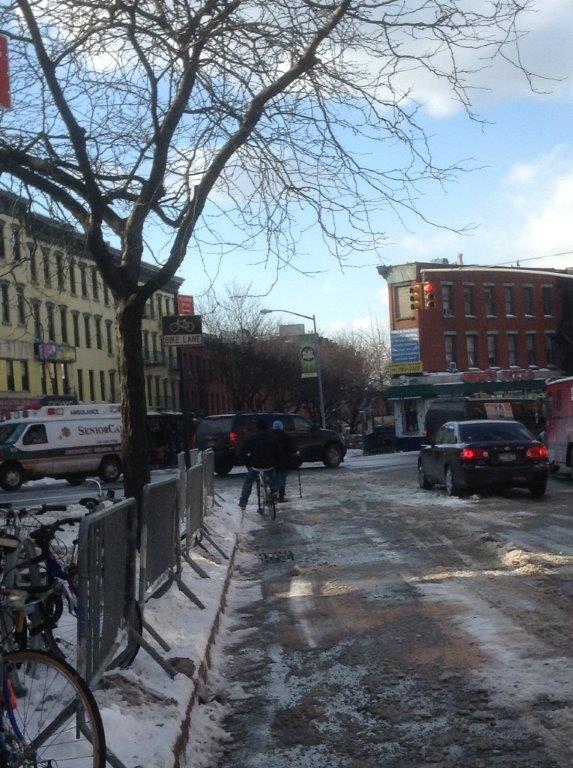
Picture via N Wayne Bailey
New speed limit on Prospect Park West

Prospect Park West & President Street. Photo via Park Slope Neighbors.
Earlier today, Eric McClure of Park Slope Neighbors tweeted this picture of a new 25 mph speed limit sign above Prospect Park West. My sincerest thanks and gratitude for the concerned community members who advocated for this change and to the DOT for responding. This is a great step toward an eventual 20 mph speed limit throughout the neighborhood and, hopefully, the city.
Drive Like Your Kids Live Here

Fourth Avenue and Baltic Street.
A couple of months ago, after stumbling upon the website for Drive Like Your Kids Live Here, I purchased two of their signs. I wasn’t sure what I would do with them, and then I read about the advocacy group Right of Way’s installation of 20 mph speed limit signs along Prospect Park West. Inspired by their guerrilla activism, I took my two signs and affixed them to posts on the Fourth Avenue median.
Despite a fantastic traffic calming project along most of Fourth Avenue through Park Slope, drivers still treat the boulevard like a highway. The particular stretch where I live, which happens to include the new PS 133 building, received some curb extensions and left-turn bans, but still retains three northbound traffic lanes. This was meant to prevent traffic from backing up to 9th Street and beyond during the morning rush, but it has had the effect of allowing drivers to continue speeding during the 22 other hours of the day. Even when the traffic is congested, drivers constantly block crosswalks, make dangerous u-turns, and otherwise show a general disregard for the people who live on or near Fourth and must cross it on foot.
Signs won’t change much — and these signs might not last long now that I’ve finally posted about them — but in the absence of meaningful police enforcement and with conditions that threaten your children and neighbors every day, what would you do to tell drivers who are just passing through to be more careful?

Fourth Avenue and Butler Street, with PS 133 in the background.
Quote of the Day
“Further, the NYPD has been cracking down more on cyclists than motorists, even though no pedestrians have been killed by cyclists in New York City in nearly 5 years.” – Richard Robbins, Huffington Post.
“I’m cool with the bike lane now.”

Another reason why the future looks bright for biking in Brooklyn: my daughter yields to pedestrians on the Prospect Park West bike lane.
This quick mention on FIPS of the latest chapter in the ongoing saga that is the Prospect Park West bike lane lawsuit is as good a representation as any when it comes to New York City’s matured relationship with complete streets in a post-bikelash, après-Marty era:
I went back to check through all of our PAST PPW BIKE LANE COVERAGE to try and remind myself what the lawsuit actually hopes to accomplish, but then I realized I just don’t give a fuck. I’ll admit, I was not entirely pro-bike lane when it was first happening. Why have a bike lane when people can ride freely on the road inside the park? Go bike inside the park! But, you know what? I’m cool with the bike lane now. I think it does serve to slow down traffic on PPW, and I don’t think it makes it any harder to cross the street, which seemed to be the main concern of the Seniors for Safety. In fact, you actually have a shorter walk from the median than you would if there was no bike lane.
Jerry Seinfeld did an AMA. What happened next will amaze you…
Jerry Seinfeld did a Reddit AMA today. The man who has a garage full of Porches is also an — please excuse the term — avid cyclist. (And walker.)
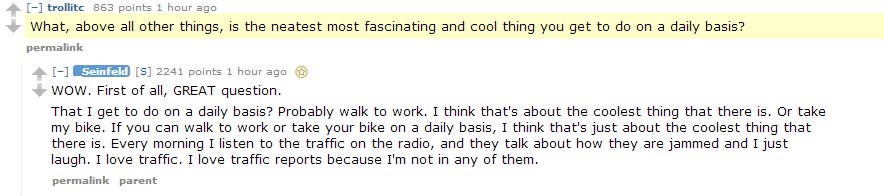
Click to enlarge.
“I love traffic reports because I’m not in any of them.” It turns out Seinfeld is one of those smug, entitled cyclists people are always whining about.
An [old] interview with Polly Trottenberg
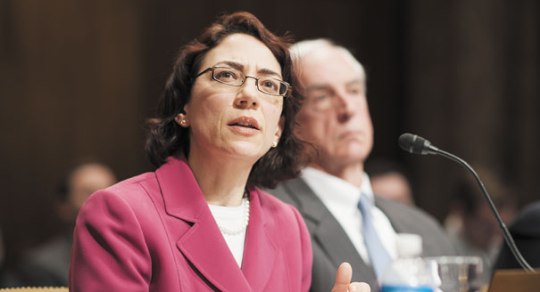
Image via Politico.
While waiting for the first sit-down interview with new NYC DOT commissioner Polly Trottenberg to be published, many people, myself included, have spent the last day or so reading the tea leaves for signs that she will be as dedicated to the cause of safe streets as Janette Sadik-Khan. As Ben Kabak writes, Trottenberg “will have big shoes to fill.”
The initial signs are nothing if not encouraging. The official announcement of Trottenberg’s appointment on the de Blasio transition website says that she will be charged with “executing Mayor-Elect de Blasio’s ambitious agenda to expand Bus Rapid Transit in the outer boroughs, reduce traffic fatalities, increase bicycling, and boost the efficiency of city streets.” It’s statement that shows that the new mayor isn’t shying away from bikes, buses, and Vision Zero as he makes the move to Gracie Mansion. And Trottenberg herself appeared at an Inauguration Day Vision Zero rally, taking the time to talk to livable streets advocates and family members who have lost loved ones to traffic violence.
But for a better sense of how Trottenberg may think about bike and pedestrian projects while at NYC DOT, this 2011 interview with BikePortland.org’s Jonathan Maus and the then-Assistant Secretary for Transportation Policy at the U.S. Department of Transportation offers a bit of a preview.
Particularly, in a lot of big cities there is no more place for capacity, you can only better utilize the capacity you have… And you may not have a lot of money to do it, so of course you’re going to look to more buses, more bike lanes etc…
On the power and enthusiasm of bike and pedestrian advocates and overcoming the bikelash:
One thing that’s been so interesting for us at DOT for the past few years is, we travel around the country and find that so much of the political energy and enthusiasm is coming out of bike advocacy. It’s amazing. We went to LA for this re-authorization visit. This is LA, which people think of as the car city, and 300 bicycle activists showed up and took over the meeting. I just see that’s where the political energy is in transportation right now.
We’re going to have some tough fights ahead I think. On the one hand, as you point out, economically constrained times may make people think creatively but there’s also the backlash: ‘We can’t do frivolous things like bikes!’ There are competing tensions that come out of having constrained resources. I think we need continued political energy on bike and pedestrian projects in how important they are and talking about their benefits and showing, particularly, that it’s not just the product for the elites but that there’s widespread support for these projects.
On why bike advocates are so passionate:
You have a mode of transportation that’s inexpensive to build and inexpensive to operate in which you burn no oil and you emit no carbon. It helps reduce obesity, people who engage in it reconnect with their communities and they loove it! It’s a really unique form of transportation. So it’s not surprising, since we’ve started to re-accommodate it once again in our streets, of course people are taking to it…
On safety in numbers and the positive feedback loop created by more bicycling:
It’s just strength in numbers. It’s a nice synergy: As cities have grown more accommodating of bikes, the number of people riding increases; and as the number of people riding increases, they love it and they become passionate and engaged and that political energy is genuine and important.
Trottenberg’s responses to Maus strike me as more than just the political calculations of someone who knows her audience. At a fundamental level, she gets it.
Still, there are reasons to remain skeptical of how her philosophy will mesh with the political reality of New York City, where NIMBYs — and the nontroversy-driven media that feeds off of them — are willing to scream about every lost parking space, narrowed traffic lane, or other perceived inconvenience. As Ben Fried writes at Streetsblog, “A transportation commissioner like Janette Sadik-Khan needed a mayor like Bloomberg, who gave his deputies relatively free rein and always had their backs.” So will Mayor de Blasio have Polly Trottenberg’s back? The jury is out. It will surprise no one if de Blasio is more influenced by polling and donors than his corporate-minded billionaire predecessor, and the man who once answered the phone for NBBL may not be willing to tell New York’s placarded class to take a hike when the going gets tough. It also remains to be seen who in the de Blasio administration will take up the NIMBY-flyswatter mantle of Howard Wolfson, who was willing to go to bat for Sadik-Khan at a time when a different political strategist might have advised his boss to drop the “psycho bike lady” like a ton of bricks.
But there are reasons to be encouraged beyond Trottenberg’s positive statements about bike and pedestrian projects. Whereas the Bloomberg years were seen, largely incorrectly, as an era of top-down redistribution of public real estate, each new street design brought with it a different kind of change, one that others, including Janette Sadik-Khan herself, have noted in the past week. Today, New Yorkers of all stripes are fluent in the vernacular of safe streets. And that’s something that no transition from one administration to the next can undo. There’s a growing community-driven demand for everything from additional Citi Bike stations and Slow Zones to the expansion of pedestrian plazas and play streets. There’s also a growing political constituency that votes based on how the issues of safe streets affect them personally. Trottenberg — and, more importantly, Mayor de Blasio — will have no choice but to listen.
Happy Holidays!
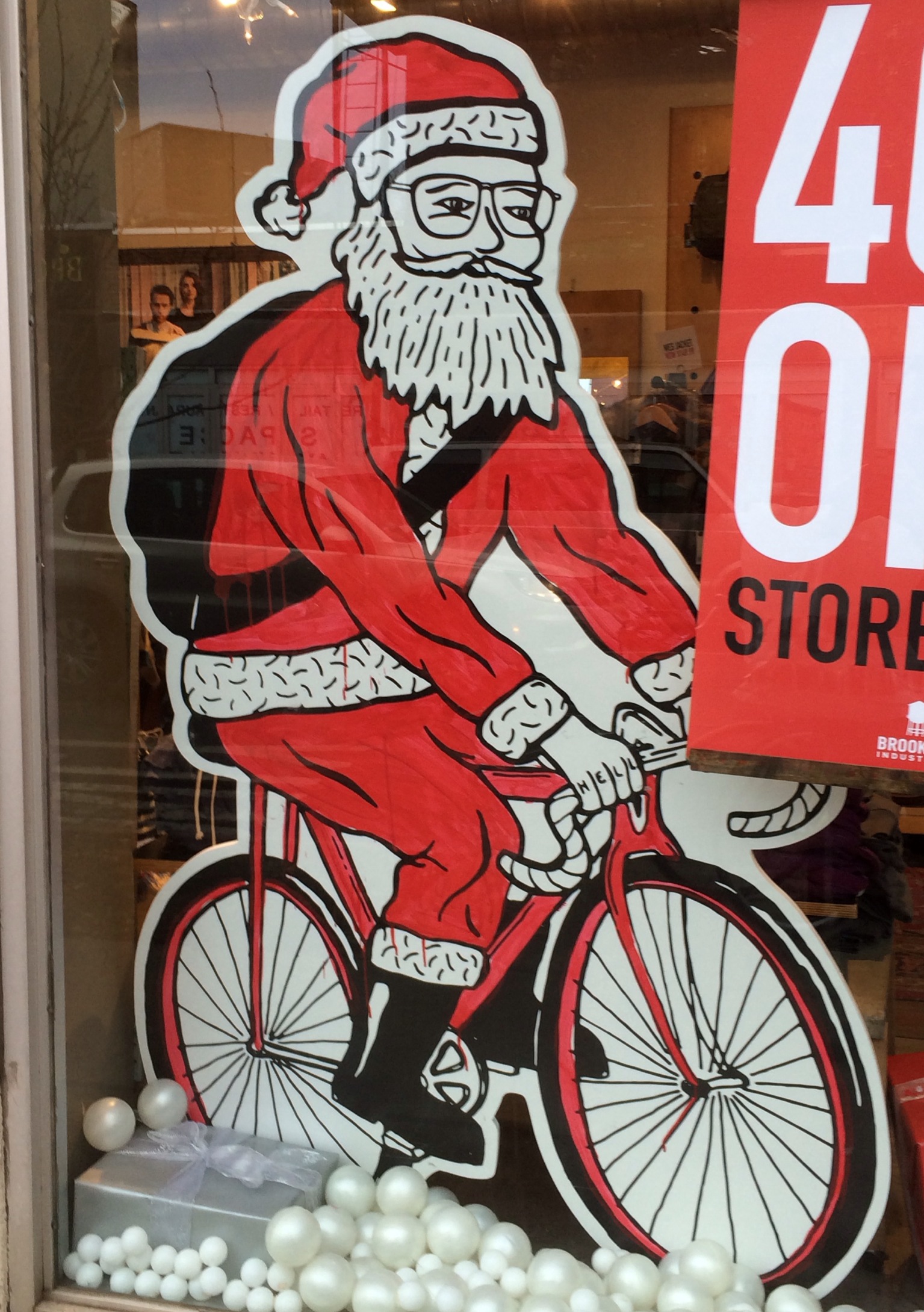
Bikey Santa Claus, as seen at Brooklyn Industries
Thank you to everyone who’s read this space over the past year. This blog has long been a work in progress, a place for me to not only advance the cause of safe streets, but to get educated about a subject that’s of great importance to me. I truly appreciate your comments, emails, tweets, and general support.
See you all back here in 2014!
In the meantime, please consider a year-end donation to Transportation Alternatives and Streetsblog to keep the cause of safe streets for cyclists and pedestrians going forward.
Saturday: Make Music NY
This sounds like a fun event and it’s right in Prospect Park! Via Make Music New York:
Blink gathers the city’s seasoned and casual cyclists to perform a new piece for bicycle bells by composer Merche Blasco. Riders travel through Prospect Park, following a score transmitted from the lead bike via a special helmet pre-programmed with lights that cue bicycle bells of different pitches. Through the piece, riders will collaborate with each other and generate music that interacts with the soundscape of the area.
Bicycle bells will be distributed to participants at the beginning of the parade.
If you want to participate, meet at Grand Army Plaza at 4:30 PM on Saturday. Bring your bicycle, of course.
“This is a fallacy.”
David Hembrow of A view from the cycle path takes on the myth that one of the pillars of the “Three E’s,” education, makes a meaningful contribution to safety on the road:
“It is imagined that given enough advice, people won’t make mistakes. This is a fallacy. People will always make mistakes. This almost defines us as being human. Not only will no amount of training prevent either child cyclists or adult drivers from making mistakes, but law changes or punishment for mistakes will also not remove the possibility of mistakes occurring.”
He continues:
“What makes Dutch roads and cycle-paths safe is not training orstrict liability but Sustainable Safety (Duurzaam Veilig). Sustainable Safety is a policy of reducing the opportunity for mistakes to become injuries by reducing the consequences of making such mistakes. Roads should be self-explanatory and forgiving.”
 Brooklyn Spoke