Marty Markowitz: Fuhgeddaboudhim
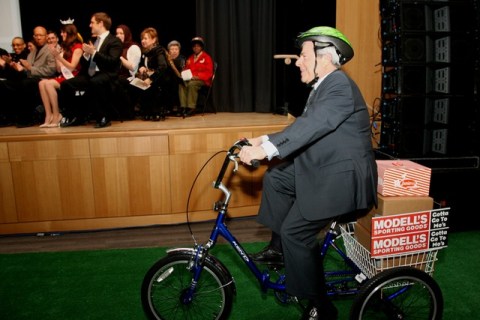
Photo via Gothamist.
From his paranoid claim that DOT tipped off cyclists to inflate ridership counts on Prospect Park West to his entrance on a tricycle at the State of the Borough address in 2011, no one made a bigger mockery of the fight for safe streets in New York City over the past twelve years than Brooklyn Borough President Marty Markowitz. So vociferous — and, some might say, delusional — were his claims and antics that if one were to write a screenplay for “Bikelash: The Movie,” studio executives might kick back the script with a note saying, “Love it, but can you tone down that Marty character?”
With just weeks to go before his final term in office expires, Marty has been the subject of a valedictory story in the Times and earlier this week took to the airwaves for a look back. In an interview on WNYC’s “The Brian Lehrer Show” about the changes in Brooklyn during Marty’s twelve years in office, host Brian Lehrer pointed out that many of the show’s web commenters tagged the borough president as “a prime critic of bike lanes.” And while most of the city has learned to stop worrying and love bicycles, here’s how Marty, with characteristic stubbornness, responded:
Brian Lehrer: Have you warmed to the mayor’s approach on [bicycle lanes] at all?
Marty Markowitz: Listen. First off, I’m not against bicycles, my wife and I have a bicycle, but I have [an] absolute right to raise a question as to whether or not bicycle lanes should be emphasized as a viable alternative transportation mode. And I have serious questions about that. I really do. If you’re in your twenties and early thirties and you live in Williamsburg and you work in DUMBO, absolutely I can make sense, I don’t oppose that at all. But if you live in Sheepshead Bay and Manhattan Beach and you work in Midtown Manhattan, and you’re in your fifties and sixties, come on. You know, the bottom line is, you know, this has to be approached rationally and the one thing I learned in all my years in public service, when you’re a zealot, you’re a zealot. If you’re not with them a hundred percent no matter what they want you are an enemy to them. So I’ve gotten used to this already and it’s okay. So have I warmed to it? Not really. I mean I recognize that certain bicycle lanes are wonderful. For instance, in Manhattan, on the west side, I love that bi—I love it. If you want to build a bicycle lane on the Verrazano Bridge, magnificent, I think it’s wonderful.
Brian Lehrer: And Citi Bike, a good thing?
Marty Markowitz: From what I can see so far it doesn’t seem, you know, except the placement of some of those bikes somewhere, but I, it looks like it’s had a positive impact by and large. I don’t see any opposition to it.
In a two-minute near-soliloquy, Marty neatly encapsulates his entire relationship with bicycles over the past decade, covering everything I’ve come to know — and truly appreciate — about how people who really hate bike lanes talk about bike lanes:
- The obligatory “Some of my best friends are bike lanes” assertion. Marty excels at this tactic like no other person. And there it is, right in his first breath: “Listen. First off, I’m not against bicycles, my wife and I have a bicycle…”
- One statement that directly contradicts the next. Marty believes that bicycles shouldn’t be emphasized as a “viable alternative transportation mode,” but also believes they are a perfectly viable transportation mode for young people commuting from Williamsburg to DUMBO. (By the way, why is it that no one questions whether or not bicycles are a viable mode for men of all ages transporting Chinese food?)
- Framing the slight reallocation of road space in terms of a culture war. Marty not only symbolizes Brooklyn’s mostly false divide between young newcomers to the borough and “real New Yorkers, he also epitomizes the tactic of using this dichotomy to fight progressive change. (Go to any community board meeting on bike lanes and listen to people establish their bona fides by first stating how long they’ve lived in the neighborhood and you’ll know exactly what I mean.) But remember, it was bike-lane-opponents Neighbors for Better Bike lanes, not Transportation Alternatives, that felt that starting a spin-off group called “Seniors for Safety” would help their cause. Seniors who bike for transportation and recreation — and there are many — should be insulted by the way people like Marty cynically think so little of their physical ability.
- The straw man. Very few advocates or transportation planners believe bike lanes will result in large numbers of two-wheeled commuters heading from Sheepshead Bay to Manhattan. Rather, they think that giving New Yorkers safe and more convenient access to jobs, schools, parks, shopping, and transit hubs in their communities is simply a smart approach to a sustainable future. Of course, it would be great if the end result of patching together those smaller networks is that one could safely ride seventeen miles from Columbus Circle to Manhattan Beach, but that’s not the immediate objective. But, man, the way Marty puts it, it sure sounds like those crazy TA hipsters are pretty far out of the mainstream if they think real New Yorkers will pedal their way from one end of the city to the other! Put down the Gatorade, bike crazies!
- The plea for common sense. When Marty says, “This has to be approached rationally,” he sounds like Internet commenters who use the anonymous handle, “Voice of Reason.” Typically the comments that follow are anything but.
- The paranoid invocation of an all-powerful bicycle lobby. With his use of the words “they” and “them,” but without going the full Rabinowitz, Marty implies that he’s been the target of an uncompromising and unnamed opposition who sees him as the “enemy.” Never mind that many of the traffic-calming projects Marty opposed outright, including Prospect Park West and Plaza Street, involved a lot of fine tuning and tweaking to satisfy bike lane opponents’ criticisms. And it also helps to ignore that a group of people sued to have a popular bike lane not just changed, but removed entirely. In Marty’s world, it’s the bike people who are rigidly unreasonable.
- The demeaning personal insult… For NBBL member Louise Hainline, it was the condescending comment that people who ride bikes for transportation are holier-than-thou hippies. (“Bikers really think they’re doing work for the environment if, instead of taking the car a block, they take the bike to the food co-op. That’s touching. But it’s silly.”) For Marty, it’s saying that anyone who subscribes to the radical belief that one fifth of a roadway along a park should be devoted to bicycles must be a zealot.
- …followed by the claim of persecution and martyrdom. Despite the name calling, Marty does not believe he’s done anything to deserve the scorn heaped upon him for his positions. He’s “gotten used to this.”
- “Am I getting too beligerent? Here, let me once again remind you that I love bicycle lanes.” “I mean I recognize that certain bicycle lanes are wonderful,” says Marty, rattling off a couple that are just dandy. One happens to be a mostly recreational path on the far edge of Manhattan and the other doesn’t exist yet, but, man oh man, does Marty Markowitz adore bicycle lanes… so long as they don’t take space from cars.
When Lehrer asks Marty if Citi Bike is “a good thing,” Marty’s characteristic belligerence gives way to an almost confused resignation. This is where you really must listen to the interview since you can almost hear the air come out of his tires as he stammers and trips over words in an attempt to reconcile the fact that Citi Bike is undeniably popular with his belief that there’s still some debate about the future of bicycles as transportation. Citi Bike, in this way, is the bike hater’s Kryptonite.
So there you have it: an exit interview of sorts with the man who was the face of the bikelash, at least while it lasted. Will I miss Marty Markowitz? In some ways, yes. I will miss his love and enthusiasm for Brooklyn, even if it was a love for a kind of egg-creams-and-Dodgers-games simulacrum that was probably never as ideal as he made it out to be. And I will certainly miss the material he gave me for this blog, especially in its early days. But I will not miss his opposition to safety for all Brooklynites, nor his apparent lack of compassion for people who can’t afford to drive everywhere.
As a livable streets advocate who sees nothing but opportunities ahead now that one of the biggest obstacles in the fight for safer streets motors off into the sunset, perhaps my feelings about Marty Markowitz can best be summed up by one of the funniest moments from “Fiddler on the Roof,” in which a rabbi is asked by a young villager if there’s a blessing for the tsar. “Of course,” replies the rabbi. “May God bless and keep the tsar…far away from us.”
Recreation Centers
Remember when Neighbors for Better Bike Lanes litigant Norman Steisel dismissed the DOT’s counts of cyclists on the Prospect Park West bike lane in part because many were perceived to be going somewhere other than work?
Furthermore, the D.O.T. data’s lack of credibility is reinforced by our own videotapes. These show that the Prospect Park West bike lanes are used by half the number of riders the D.O.T. says, and that cyclists are not riding to commute as originally contemplated but are recreational users who could be better served by enhancing the existing lane 100 yards away in Prospect Park.
This argument was, and remains, absurd, since NBBL would often cite the fact that people drive to the park for concerts, Little League games, working out, and other non-work purposes as an argument for preserving the parking and three-lane configuration.
Todd Litman, writing for Planetzien, tackles this and other anti-bike arguments in a great post entitled, “Mythbusting: Exposing Half-Truths That Support Automobile Dependency.”
Critics sometimes argue that walking and cycling primarily provide recreational travel, with the implication that this frivolous. For example, Poole asks, “Why should I—either as a highway user-tax payer or a general taxpayer—have to pay for someone else’s hobby?” But a significant portion of all travel is recreational: travel for vacations, to sport and cultural events, or to shop for recreational goods. Critics assume that automobile trips that serve recreational purposes are important but walking and bicycling trips that serve the same purposes are not. For example, they value a car carrying passengers to walk or ride on a trail, or to a gym to pedal a stationary bike, but not people who walk or bike directly from their home. This is arbitrary, inefficient and unfair, reflecting a bias against non-motorized travel.
The Poole to which Litman refers is the Reason Foundation’s Robert Poole, who, writing in Surface Transportation Innovations #121, tries to soften his argument against funding for a U.S. Bicycle Route System by saying, “I have nothing against bike riders or bike paths. Several of my family members are avid bike riders.”
“It Should Be Like Sidewalks”

Here’s Jan Gehl, speaking on safe cycling for people of all ages:
“It is my opinion that to have a substantive bicycle culture it is not only for the extreme sport enthusiasts, the freaks who think, ‘It’s a good day if I survive’. If, like in Copenhagen, you have a bicycle system that’s a real system, it should be city-wide in the major streets. It should be like sidewalks – it goes from one entrance door to another entrance door.”
Neighborhood Forum on Street Safety, Tuesday, December 3
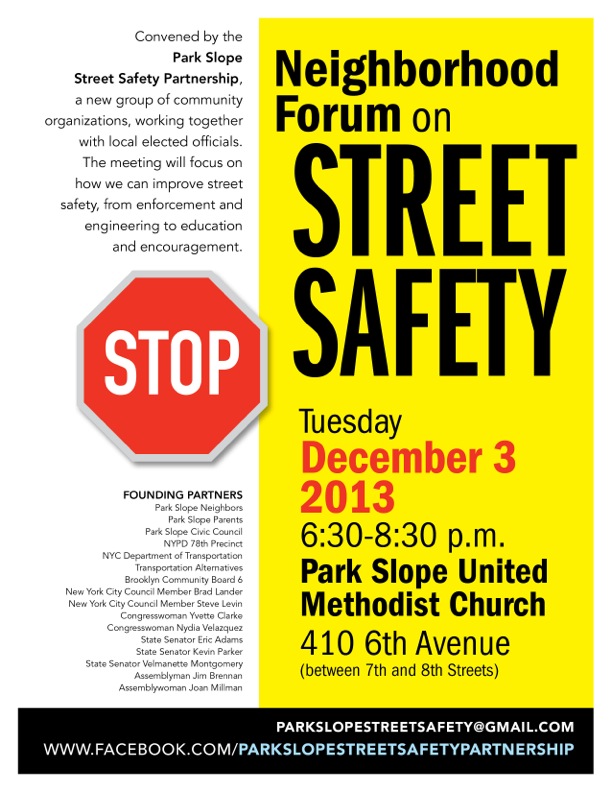
The Brooklyn Paper has more on this upcoming forum on traffic safety. One of the topics that’s sure to come up for discussion is a neighborhood-wide speed limit of 20 mph:
Forum organizers also include the groups Park Slope Parents and Park Slope Neighbors, the latter of which tried and failed to convince the city to make the neighborhood a so-called “Slow Zone” in 2011. Now it thinks there might be more momentum behind such measures.
“There seems to be a city-wide interest, not only in Park Slope, in doing something about making the streets safer,” said organization co-founder Eric McClure.
Tuesday’s meeting comes on the heels of a well-attended march and rally in Fort Greene last month and high turnout at the most recent meeting of the 78th Precinct Community Council.
Keeping Up Appearances
Does wearing reflective clothing matter that much when riding a bicycle? Perhaps not as much as wearing a jacket that says “Police.” (Which I’m not at all suggesting you do.)
This study looked at whether drivers overtaking a bicyclist changed the proximities of their passes in response to the level of experience and skill signalled by the bicyclist’s appearance. Five outfits were tested, ranging from a stereotypical sport rider’s outfit, portraying high experience and skill, to a vest with ‘novice cyclist’ printed on the back, portraying low experience. A high-visibility bicycling jacket was also used, as were two commercially available safety vests, one featuring a prominent mention of the word ‘police’ and a warning that the rider was video-recording their journey, and one modelled after a police officer’s jacket but with a letter changed so it read ‘POLITE’. An ultrasonic distance sensor recorded the space left by vehicles passing the bicyclist on a regular commuting route. 5690 data points fulfilled the criteria for the study and were included in the analyses. The only outfit associated with a significant change in mean passing proximities was the police/video-recording jacket. Contrary to predictions, drivers treated the sports outfit and the ‘novice cyclist’ outfit equivalently, suggesting they do not adjust overtaking proximity as a function of a rider’s perceived experience. Notably, whilst some outfits seemed to discourage motorists from passing within 1 metre of the rider, approximately 1-2% of overtakes came within 50 cm no matter what outfit was worn. This suggests there is little riders can do, by altering their appearance, to prevent the very closest overtakes; it is suggested that infrastructural, educational or legal measures are more promising for preventing drivers from passing extremely close to bicyclists.
“Just yield to me.”

Photo by Dmitry Gudkov
Eleven-year-old Esme Brauer, the wonderful daughter of my friends and fellow activists Hilda Cohen and Nathan Brauer, delivered a speech at the March for Pedestrian Safety in Fort Greene that was about as eloquent as any I’ve ever heard from livable streets advocates three or four times her age:
“I’m growing up in Brooklyn. And when you’re living in Brooklyn, you learn the rules of the street. And you follow them,” she said, loudly and clearly. “But no matter how much you follow them, when you are on the street, your life is in someone else’s hands. Everyone else’s hands. And most of these hands are on the steering wheel of a car. So it matters if I follow the rules of the street. But it also matters if you follow the rules of the street. And you can do this easily. Just yield to me. Stop at red lights. Go the right way. Just drive safely. For me and for everyone who walks the streets of Brooklyn.”
You can read more about this week’s rally in this excellent post from the New York Times’ Motherlode blog by Hope Reeves.
Tonight: Community Traffic Safety Meeting
Concerned community members will gather tonight at Congregation Beth Elohim in Park Slope to discuss traffic safety:
In the wake of the deaths of local children, Sammy Eckstein and Lucien Merryweather, we must come together to make our streets safer. We will discuss what actions the city is already taking, and then brainstorm our own list of safety measures that we think are necessary. We will begin strategizing around initiatives that we can start ourselves, and ways to put pressure on city leaders. Hosted by community members Daniel Hurewitz and Adam White.
For more information, contact saferstreetsNYC@gmail.com.
Leslie Albrecht at DNAInfo has more on tonight’s meeting:
“My hope is that…we’ll gather our energy in a way that will create pressure to really make these changes happen and really see results,” Hurewitz said.
Hurewitz said he doesn’t consider himself a traffic activist, but felt compelled to take action after the death of Cohen Eckstein, who was hit by a van at Prospect Park West and Third Street.
The father of two, who lives around the corner from where Cohen Eckstein was killed, said he was disappointed by the seemingly lukewarm response from city officials after Sammy’s mother pleaded for lower speed limits.
Hurewitz is hoping the Thursday meeting will mobilize more people to pressure lawmakers for changes.
“I want this to be a chance to brainstorm ideas so we can turn to our officials and articulate to them, ‘Hey here’s what we want,'” Hurewitz said. “I didn’t know Sammy, but I feel like he was one of our kids. I just feel like his story could be any of our stories.”
And here are two other dates you should put on your calendar if you’d like to get involved:
- Tuesday, November 26th, 7:30 PM, 78th Precinct Community Council meeting.
- Tuesday, December 3rd, 6:30 PM, Park Slope Street Safety Partnership’s Neighborhood Forum on Street Safety, Park Slope United Methodist Church.
Tonight: March for Pedestrian Safety in Fort Greene
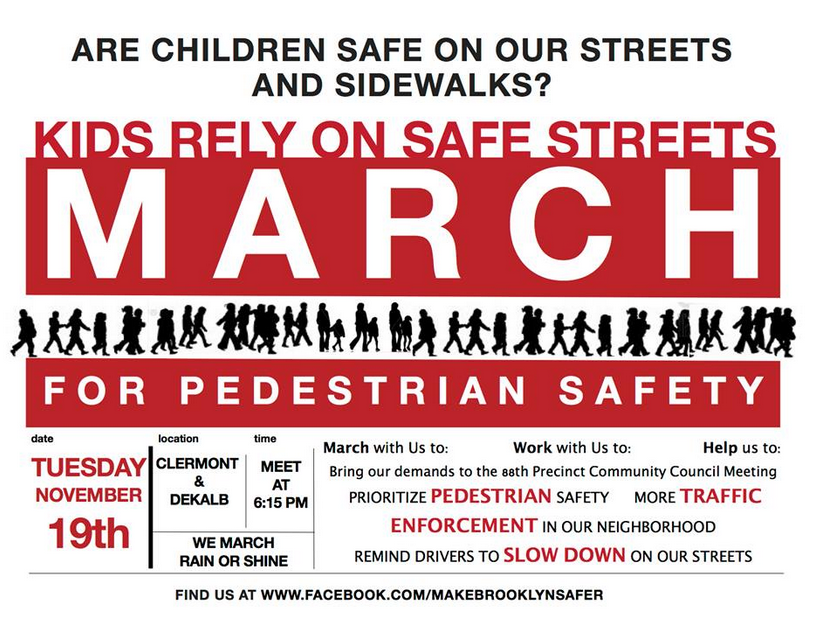
Parents, kids, and concerned citizens of all stripes will stage a march for pedestrian safety before tonight’s meeting of the 88th Precinct’s Community Council. I plan to be there with my daughter and hope you can come, too.
Please note that the meeting location has changed to the corner of Cumberland & Dekalb at the entrance to Fort Greene Park.
Learn more at the Make Brooklyn Safer Facebook page.
Bike War Is Over! If You Want It
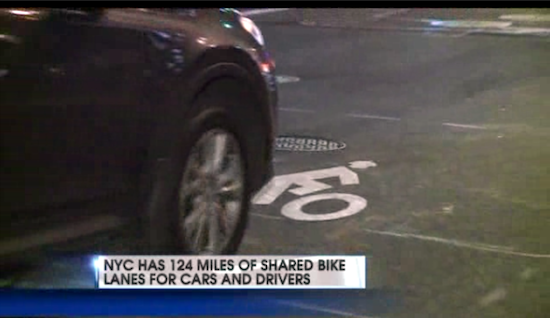
Truth in chyrons: NYC’s “Shared Bike Lanes” are actually “For Cars and Drivers.”
What is it with TV reporters who fail to remember that TV is a visual medium? To CBS 2’s Marica Kramer and Lou Young, we can now add Greg Mocker of WPIX, who, over the image above, indignantly exclaimed, “The bike markings appear to leave no room for cars!”
The overall theme of this piece, which aired over the weekend, is that “with weeks left to go” the Bloomberg administration is desperately cramming as many bike lanes and plazas into the streetscape as possible, most notably by expanding the Times Square pedestrian plaza. Now if you happen to get up to go to the bathroom in the first thirty seconds of Mocker’s report that’s about all you’ll take away, but this suggestion is immediately refuted by Mocker himself, who clarifies that the city is not asking to enhance or enlarge the Times Square pedestrian plaza, but rather seeks to “expand the area that can host concessions.” But this is after setting up the classic community-board-David-versus-DOT-Goliath meme, so, well, you know.
About halfway through the piece, Mocker brings up the bike stencil, shown in the image above. Never mind that the stencil is part of a bike box, yet to be fully striped, that allows cyclists transitioning from the left-side bike lane to wait safely in front of cars before making a right turn on Sixth Avenue. Mocker sets this up as some sort of mystery design, giving a cursory explanation for how it will really work — a graphic would help! — before waving his microphone and saying, “Well I don’t understand because the bike is there, the bike is there… so where do the cars go? They don’t line up.” To which a woman, who I will assume is not a traffic engineer, says, “The bike is in the middle of the road.” No it’s not! That guy who you’re talking to just explained it to the audience two seconds ago!
Toward the end of his field piece, Mocker sarcastically says, “They can’t be rushing to get this all in before the new mayor or something? It’s interesting.” It’s a telling comment. While it’s hard to take anything on the PIX11 News too seriously — its frenetic camera style makes CBS 2 look like “The MacNeil/Lehrer NewsHour” — Mocker’s report illustrates something I’ve noticed in the last few weeks. For as long as I’ve been following it, the bikelash tends to flare up as soon as the clocks fall back and the temperatures drop, but this year the TV networks and newspapers have filed what seems like a larger number of anti-bike pieces than I’ve seen in quite some time. “Not since PPW,” as the saying does not go.
So what’s happening? Reporters can’t be rushing to get all these bikelash pieces filed before the new mayor or something. It’s interesting. Is the tabloid media trying its darndest to set the stage for a full-blown reversal of the Bloomberg bike lane and pedestrian plaza program as soon as Bill de Blasio takes the oath of office? If they are there’s one huge problem with this strategy. And that’s because bike lanes and pedestrian plazas have escaped the orbit of any one political personality’s gravitational pull to become more community-driven than ever. Perhaps Janette Sadik-Khan’s real genius was not in telling New Yorkers “You need this,” but in unlocking something in New Yorkers that allowed them to say, “We want this.”
Of course, idiotic editorials and news stories against livable streets and traffic calming projects aren’t about to end anytime soon; too many page views are at stake. And I’m sure we’ll have more than our share of fights over parking spaces on the road to make our streets safer. But starting January 1st, opposing bike lanes and pedestrian plazas won’t be a convenient proxy for being against a billionaire mayor anymore. For some, it will exposed for what it really is: being against a better New York City.
Correction of the Day
Via New York Magazine:
*The sentence “Few motorists would dare blow through a red light, even if it appeared safe to do so” has been removed from the second paragraph. A 2000 report indicates that drivers in New York City run 1.23 million red lights each day, which is more than a few.
 Brooklyn Spoke