Wednesday Night: Citi Bike Panel
I’m moderating a panel hosted by Women in Housing and Finance, “A Closer Look at the Planning, Implementation, and Financing of Citi Bike.” It takes place on Wednesday, November 13th from 6:30 to 8:30 PM at Nixon Peabody, 437 Madison Avenue in Manhattan.
As the title suggests, we’ll be talking about how bike sharing in New York City went from an idea to a functioning system, the finer points of financing, and what the future has in store for this hugely successful program.
In May 2013, the much-anticipated New York City bike share program, known as Citi Bike, was launched with 6,000 bicycles and 330 docking stations Midtown, Lower Manhattan and West Brooklyn. Citi Bike was born as a public-private partnership, operated by NYC Bike Share LLC, a wholly-owned subsidiary of Alta Bicycle Share, Inc., which is a Portland-based company focused solely on operating large-scale bike share systems, including bike share locations in Washington DC, Boston, Melbourne and Toronto.
In the six months since its launch, Citi Bike has already become the largest bike share program in the county with more than 80,000 annual members, over 3.5 million cumulative trips and 7 million miles traveled to date. In its first year of operation, the program is expected to generate approximately $36 million in economic activity and create 170 new jobs.
Panelists include:
- Justin Ginsburgh, General Manager, New York City Bike Share
- Kate Fillin-Yeh, Department of Transportation
- Caroline Samponaro, Senior Director of Campaigns & Organizing, Transportation Alternatives
- Margaret Anadu, Vice President, Goldman Sachs Urban Investment Group
The cost is $25 ($15 for students) and RSVP is required at whfnyc@gmail.com. Hope you can make it.
The Invisible Made Visible
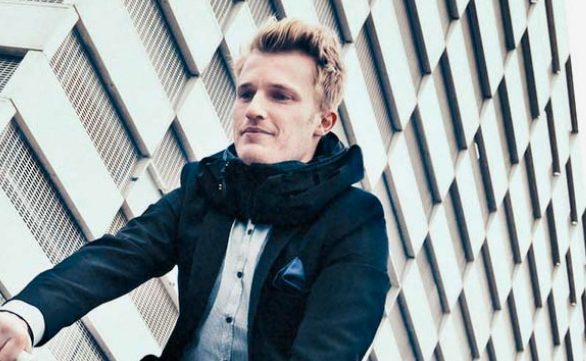
Looks cool, but what about in July?
After making the rounds about one year ago, the “Invisible Bike Helmet” began popping up in my social media feeds again after Jalopnik featured it late last week:
You know what kind of sucks about riding a bike? Other than all that pedaling? Bike helmets. Sure, they keep that overrated “brain” from getting splattered, but they take a lot of the open-air-joy out of things, and they’re not comfortable. A pair of Swedish women have developed a remarkable solution: the invisible bike helmet.
I was skeptical of this “helmet” and its chances for success for a variety of reasons when I first heard about it last year, and the fact that it doesn’t seem to have penetrated the market for protective head gear very much since then confirms my initial skepticism. Here’s why:
1. It still looks uncomfortable. It’s true that bike helmets, even well-ventilated ones, can be hot to wear and that people often forego the helmet for that wind-through-the-hair feeling. So imagine going helmet-less but instead wearing the equivalent of a heavy winter scarf every time you ride. Now imagine it in New York. In July.
2. It doesn’t allow for spontaneity. If one feels the need to always wear a helmet while riding, then one needs to always carry a helmet in case one wants to ride. (This is why bike share systems in cities with mandatory helmet laws tend to see low ridership.) The invisible bike helmet may pack in to a bag more easily than a plastic helmet, but it still must be carried, rendering it useless the moment it is accidentally left at home or at the office.
3. It’s expensive. It costs about $600. As Todd Edelman wrote, “If you really think a helmet can help, then buy five 60 dollar helmets for friends and give 300 dollars to your local bicycle coalition or another org. fighting desperately to keep streets safe and collisions from happening in the first place.”
4. It’s single-use. Much like the car airbag from which it was clearly derived, the invisible helmet must be reset after it deploys, adding a significant cost to an already significant cost. Regular helmets must be replaced after any type of collision, but at a much lower expense to the consumer. (See #3, above.)
5. It’s battery-powered. According to Fast Company, “The whole setup runs off an on-board battery, and charging is taken care of via a micro USB port.” Sounds cool. But what if the charge runs out? And what if you don’t realize it?
6. It distracts from the real danger. The fact that so many of my non-cycling friends sent me this link speaks to the opportunity cost of focusing on this arguably cool invention. It sends a message that cycling is inherently dangerous and that only technology and consumerism can save cyclists from distracted or reckless drivers.
Design, of course, is inarguably important in the ongoing quest to improve cyclist safety, but design should be focused on roads, not fancy gadgets. As the Dutch and the Danes learned a long time ago, the goal is to build a city where no one feels that a helmet is necessary.
When A Kid Owns the Road

Today, this is my street.
Fourth Avenue is one of Brooklyn’s most dangerous streets for pedestrians, and despite a slew of recent safety improvements it still largely functions as a highway, funneling drivers back and forth between Bay Ridge and downtown Brooklyn. It is, to say the least, not a particularly inviting place for walking, biking, or just plain being.
It also happens to be where my family lives. So perhaps that’s one reason why Marathon Sunday is one of my favorite days in New York City all year. On the first Sunday of November, this busy and unpleasant thoroughfare becomes the focal point of the community, if not the world. Crowds line each side of the boulevard, bands perform music on every other street corner, vendors roam the sidewalks hawking cotton candy, and cheers echo off of the growing number of glass condos towering over the avenue.
But hours before the race begins, Fourth Avenue, for those who are awake to experience it, becomes one of Brooklyn’s quietest streets. Motorists are instructed to move their cars by 10 PM the night before, and any vehicles not relocated by then are towed by the NYPD under the cover of darkness. Street sweepers come through in the middle of the night to rid the road surface of any detritus that could twist a runner’s ankle. All car traffic, including cross traffic, is banned well in advance of the race’s start. When the sun rises, you can almost hear the sound of the traffic lights continuing to change at every intersection from inside your apartment.
This past Sunday the end of Daylight Saving Time meant that my daughter was up at 5:30 AM. But it also meant that I had the opportunity to let my daughter do something I’d never otherwise let her do in a million years: bike on Fourth Avenue.

“Come on, Papa! Let’s go!”
My daughter, who was just two days away from turning four when I shot these pictures, recently switched from a balance bike to her first pedal bike and loves any chance she can get to ride. For the past month that’s meant a lot of trips to a local playground a few blocks away, an easy walk for a grownup but a somewhat challenging bike ride for a little kid who has to contend with Park Slope’s rather uneven sidewalks. So I don’t think she’s ever experienced pavement as smooth as this since she’s been on anything with wheels, including her stroller.

The thrill of the open road.
Like many city parents, I’ve come to realize that it’s rare for me to be more than twenty to thirty feet away from my child. From our 900-square-foot apartment to crowded sidewalks on the walk to school, there just aren’t that many opportunities for her to roam free. Sure, there’s Prospect Park, but trips to the top of the Slope tend to require a tad more advance planning than just waking up and stepping outside our front door.

Now you see her…
So when my daughter started pedaling, I just let her go…

To the tower!
…and go…

Hey, wait! Come back!
…and go.
It was an interesting feeling, even if it lasted for just a moment, and made me think about how much freedom and independence is taken away from children everywhere, not only in cities, due to the constant threat of fast-moving automobile traffic. Imagine how much more fun our kids might have on the way to school or while running an errand with mom or dad if we prioritized the safe movement of children over motor-vehicle travel Level of Service and the free storage of private cars?
As I mentioned above, even the side streets along Fourth Ave are more or less closed down, since no traffic is allowed to cross the marathon route. This makes Marathon Sunday different from even Summer Streets, where people on bikes and on foot have to stop at major cross streets to allow for buses and drivers to get across Manhattan.
Taking advantage of this kind of tamed street, my daughter, with me running behind her, rode up Baltic Street toward Fifth Avenue. This is a trip we make every day, but we’d normally be on the sidewalk to the right in the picture below. She so far has mostly ridden loops in the playground, I can only imagine how a full block of open road ahead of her must have looked.

Taking the lane.
Fifth Avenue, of course, was still open to moving traffic, but since Baltic runs toward it from Fourth, I didn’t have to worry about a driver turning onto this side street like a car exiting a highway, as is often the case.
We took a quick break at Gorilla Coffee, grabbing a latte for me and a chocolate croissant for her, and then headed back home via Baltic. My daughter, as the child of a dedicated livable streets advocate who frequently transports her on the back of his bike, knows a thing or two about the rules, but she didn’t bat an eye about going the “wrong” way on this one-way street.

Just another New York City cyclist.
For the entire length of Baltic, the only thing I had to look out for was a motorist pulling out of a parking spot, which is rare even in the middle of the day in “No Park Slope.” It was a far cry from the constant vigilance parents must feel when they bike with their children — or even walk with them in a crosswalk — and was about as relaxing as riding on a quiet street in Amsterdam.

Contra-flow.
When we got back to Fourth Avenue my daughter took a few more spins up and down the street, not quite wanting to go back inside to warm up for a bit before the race began.
Doing this with my daughter felt like we were sharing some sort of secret about Brooklyn. And her constant exclamations — “Whee! Look how fast I’m going!” — were a delight to hear. So watching my daughter enjoy herself like this, all I could do was wonder in amazement. Why does it take a marathon for us to make a street for people? Why aren’t we doing this in every neighborhood every weekend? It wouldn’t have to be the entire length of Fourth Avenue from the bridge to the Barclays Center, but if we closed short stretches of streets on a regular basis for more than just summer fairs and left them wide open and clear of cars, how many parents would let their kids just roam? And how many kids would get to experience the same independence, empowerment, and just plain fun that my daughter did for a brief moment this past Sunday morning?
So happy birthday to my daughter, who turns four today. She is, without a doubt, my inspiration for all that I do and my favorite livable streets advocate.
Vigil for Lucian Merryweather, Tuesday, 11/5, 7 PM
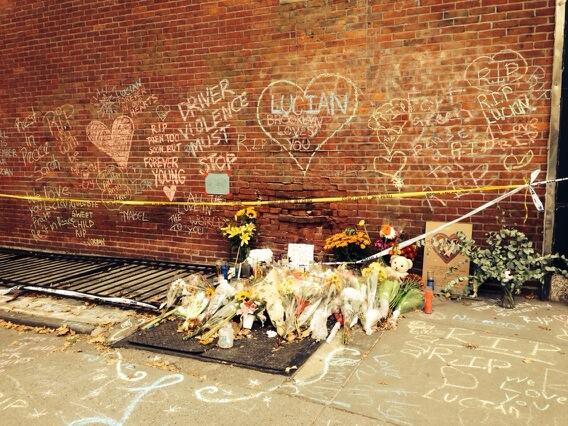
Image via Hilda Cohen.
I just received word from Tish James’ office that there will be a vigil tomorrow in memory of Lucian Merryweather:
The Office of Council Member Letitia James is organizing a vigil tomorrow to offer support to the Merryweather family and those affected by Saturday’s tragic vehicular incident that claimed the life of a local 9-year-old Lucian. We invite local faith leaders, safe-street advocates, and community members to join us—
WHEN: Tuesday, November 5, 2013, 7:00 PM
WHERE: Corner of Clermont Avenue and De Kalb Avenue
Here’s the press release from James’ office:
**FOR IMMEDIATE RELEASE**
November 2, 2013
Contact: Aja Worthy-Davis (212) 788-7081
9-Year-Old Boy Killed In Fort Greene Vehicular Incident
(Brooklyn, NY)– Around 12:45PM on Saturday, November 2, 2013, a man driving a red SUV Ford Expedition west along Fort Greene’s DeKalb Avenue, moved to turn left onto Clermont Avenue and collided with another vehicle.
According to reports, the driver of the SUV then lost control of his brakes, mounted the sidewalk, and crashed into a nearby building.
The tragic accident caused pedestrian injuries, and killed a 9-year-old boy. Witnesses state that the 9-year-old boy, his sibling (a 5-year-old boy), their 47-year-old mother, and another 28-year-old woman were among those injured. The 9-year-old boy was pronounced dead at the scene of the incident, while the other victims suffered non-life-threatening injuries.
“My heart goes out to the victims and loved ones affected by the tragic vehicular incident that took place in Fort Greene today,” said Council Member Letitia James. “I will be working with the Department of Transportation to review the details of the incident, and specifically determine what measures can be taken to increase driver and pedestrian safety along De Kalb Avenue.”
163 < 1,644
Which benefits a city more? 163 parking spaces for cars or 1,644 parking spaces for bikes? Via Streetfilms and Treehugger:
Why are bike corrals so great? Because in a dense urban environment, the are very space-efficient; where 1 or 2 cars could park, dozens of bikes might fit. The Portland Bureau of Transportation (PBOT) said that their bike corral program “has helped Portland businesses increase on-street customer parking ten-fold.”
It’s simple math. No one is arguing for eliminating automobile parking, but the smallest of shifts can bring about a very big change not only in safety and convenience, but in the fortunes of local businesses.
The city of Portland is a tad more enlightened on these issues than we are here in New York. If you’ll recall, the DOT’s safety plan for Fourth Avenue was initially rejected by Community Board Six for, among other reasons, the potential inclusion of bike corrals. It’s a pro-car-parking bias the board has demonstrated in the past:
Kummer also says the board opposed the plan because it includes potential locations for bike corrals. Even though the plan does not call for the installation of any corrals, each of which would go before the community board for future consideration, Kummer used it as a reason for the board to reject the safety plan entirely. The board “has a strong preference for proposals that are parking-neutral wherever possible,” he said. Last month, the board rejected a bike corral on Columbia Street because it would have removed one car parking space.
In a future post, I’ll explore how a “parking-neutral” approach to bike corrals is problematic, not only in the obvious phrasing issues it brings up, but in actual practice.
“In Defense of the Law-Breaking Cyclist”
Jake Blumgart, writing in Pacific Standard, has a nuanced take on the reasons why he, as a regular bike commuter, breaks the law:
Because bikes belong on the road, they have to contend with laws and infrastructure that were not made for them. Most of Philly’s bike lanes are not separated from traffic, so people park and idle in them, taxis swoop over to pick up fares, and on the big boulevards—which you have to cross to get to many neighborhoods—cars are going up to 50 miles an hour.
He continues:
In such an environment, it’s not a level playing field for bikers. I have to take my advantages where I can to avoid one of those awkward outbound hospital calls that mothers are so loathe to receive.
Like Blumgart, I experience this need to “take my advantages where I can” every day. Take, for example, a situation where I’m stopped at a red next to a line of drivers and scan ahead to see cars parked in the bike lane just beyond the intersection. In such a scenario I have three choices:
- Stay to the right of the driver at the front of the queue. When the light turns green, attempt a dangerous merge with a steady stream of moving traffic, since cars can accelerate from a dead stop faster than a person on a bike. If it’s an intersection where drivers can turn right, run the additional risk of a right hook.
- Pull in front of the first driver in the queue. When the light turns green, take the lane until I pass the double parked cars and can re-enter the bike lane. This choice yields additional choices: pedal as fast as I can when the light turns green or pedal at a normal pace and risk an angry honk from the driver behind me. (Note: sometimes pedaling fast also yields an angry honk.)
- If there’s no cross traffic nor pedestrians in the crosswalk, go through the light, cycle at a relaxed pace around the double-parked cars, and re-enter the bike lane long before light behind me turns green and the drivers can catch up.
Ninety-nine percent of the time, I opt for choice three. In the absence of a clear bike box that’s respected by drivers, a cycling-specific traffic signal or leading interval, and a general culture of civility, it is one of many situations I and many other people on bikes face in which the technically illegal choice is by far the safer one.
Open and Shut
While the news processes the candidates’ comments on the Times Square pedestrian plaza at last night’s mayoral debate, I thought the language used by the moderator, CBS 2’s Maurice DuBois, was perhaps more telling when it comes to how livable streets are discussed not only in politics, but in the media.
Note how DuBois asked the about one of the Bloomberg adminstration’s signature achievements, as related by Dana Rubinstein in Capital New York:
Last night, at the second-to-last debate before the mayoral election, CBS reporter Maurice DuBois asked de Blasio if he would “take out the tables and chairs from Times and Herald squares and reopen Broadway.”
Emphasis mine. If you’re a pedestrian enjoying a safer walk through Times Square or sitting at a table drinking a coffee after having spent a lot of money in a nearby store, Broadway probably feels pretty “open” right now. Any effort to “reopen” the street to cars would essentially close it to people on foot, making Times Square feel about as spacious as a cattle car. This kind of language demonstrates the pro-car bias of local TV news and shows how anchors and reporters typically experience the city: from the backseat of a town car or riding shotgun in a news van.
So what can advocates and progressive transportation wonks do to change the language? One great way is to stop using it themselves. Here’s an old Cap’N Transit post on one thing that irks him about DOT’s otherwise excellent Summer Streets program.
Several times I heard and read reference to the street being “closed,” and at 1:00 I heard repeated announcements that they were going to “open it up again.”
To someone like me, who rarely takes taxis and drives even less, when cars are allowed it doesn’t feel “open” to me. It’s open to me for three mornings a year, and pretty unavailable the rest of the time. Repeating over and over again that Park Avenue will be “opened up again” emphasizes that we don’t belong.
A few times I’ve stayed on one of the streets and been directly addressed by the staff, who don’t seem to be aware that bicycles are allowed on the streets even when Summer Streets is over. Last week a bunch of us were traveling the right direction in the Centre Street bike lane and got yelled at.
A more neutral framing would be to simply say, “Cars will be allowed on the street again. Be careful of the cars; they can kill you. Pedestrians move to the sidewalk, and bicycles move to the right.”
Reminder to CBS 2 Reporters: TV is a Visual Medium

“…in places there’s only one clear lane of traffic.”
Kind of Blue: Delia Ephron and the Art of Anti-Bike Illogic
One of the old chestnuts of anti-bike-lane rhetoric is the argument that bike lanes are on the one hand empty and therefore not necessary, and on the other dangerous for pedestrians to cross because of all the cyclists whizzing by. To this absurd entry into the Encyclopedia of NIMBY Logic, writer and producer Delia Ephron, in an opinion piece that appeared in the New York Times, added her own.
Ephron — who with her sister Nora adapted a 1940 black-and-white film starring James Stewart and Margaret Sullivan into a 1998 color movie starring Tom Hanks and Meg Ryan — says that the bright blue bicycles of the Citi Bike program distract the eye from the “browns, grays, greens and brick red” of New York City’s natural color palette. But she also suggests that they’re invisible, so apt to appear out of nowhere that they could mow down innocent pedestrians at any time.
If you read Ephron’s piece, you probably noticed that she opens with a Cuozzoian anecdote about scofflaw cyclists:
It’s this bike program. The other day I stepped off a curb and a bike coming the wrong way down a one-way street passed so close I could feel its breeze on my back. It seems as though, every day, I’m almost hit by a bike.
But late in her piece, Ephron claims that the blue bikes are simply impossible to not notice.
Almost all directors and cinematographers know that, in a movie, the color blue pulls focus. If you place a love scene in front of, say, a blue bench, the audience will look at the bench and not the actors. Our city, if you look around, isn’t a blue city, or wasn’t until the bikes arrived.
If Ephron sat and thought about it for even a second, she should probably write another opinion piece thanking Citibank for choosing a shade of blue that announces a bicycle’s presence long before one almost hits her.
Of course, Ephron’s gripe isn’t really about her fear of getting hit by a bicycle. (“That’s a problem, but it’s not the problem.”) Given the statistics, that would be insane. “The problem” is the fact that at least 8 children have been killed by automobile drivers in 2013 so far bike share bicycles ruin movie shoots.
Forget for a moment that bike share stations are easily removable and unlikely to mar any period pieces set in pre-2013 New York City. As a TV producer and film fan, I can honestly say I was fascinated by this cinematography factoid, previously unknown to me:
Odds are, in your favorite romantic Manhattan movie, you’ll see barely any blue.
Come to think of it, Ephron is right. Here’s a shot from one of my favorite romantic Manhattan movies:
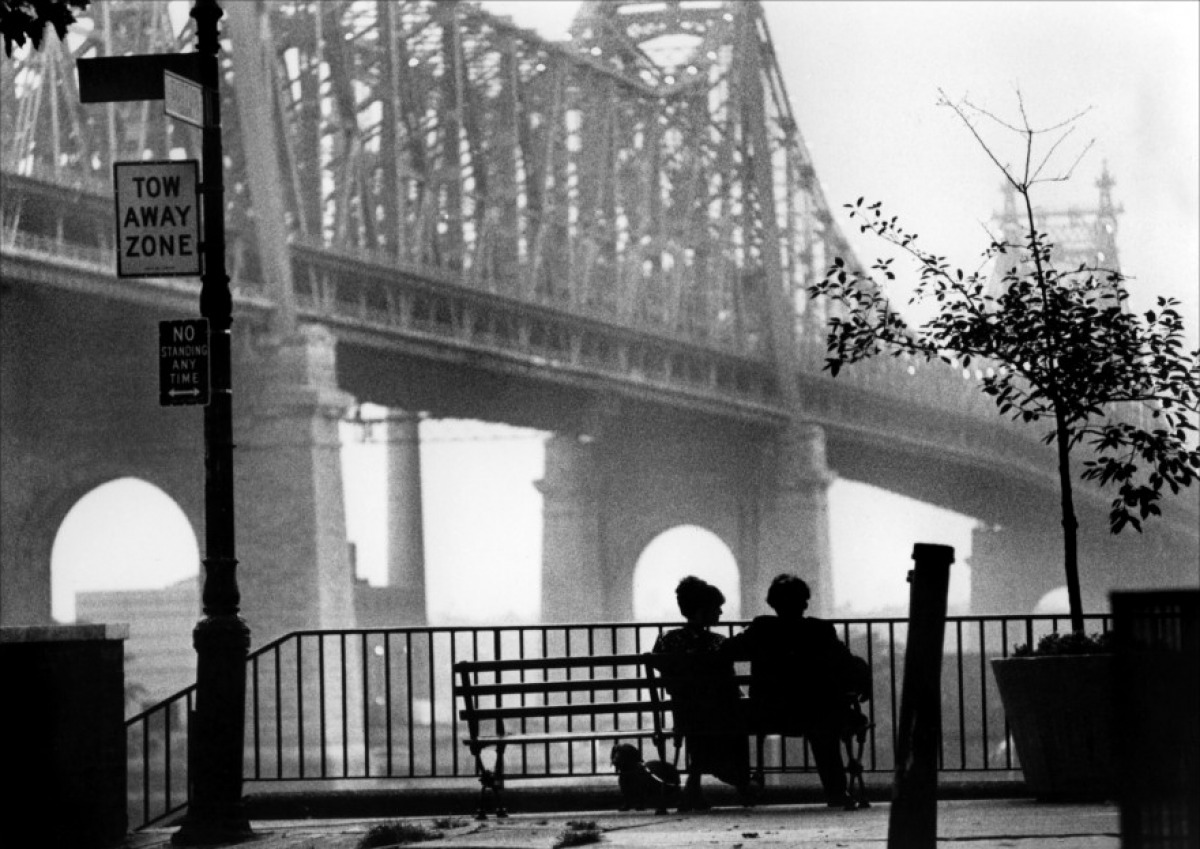
Thank goodness the bench isn’t blue.
Of course, Ephron, as the writer/producer of some of the most successful romantic comedies of the nineties knows a thing or two about shot composition. Take the following scene from “You’ve Got Mail.” There’s absolutely nothing blue to pull the audience’s focus. You know what else you won’t find pulling the audience’s focus? Cars!

(By the way, the fact that there’s an available parking spot in front of an Upper West Side store in this shot caused Blockbuster to accidentally shelve “You’ve Got Mail” in the Sci-Fi/Fantasy section for years.)
Like John Cassidy, who once infamously claimed there was a bike lane causing congestion on Brooklyn’s Fourth Avenue, Ephron — and by extension, the Times fact-checking department — does not let the truth get in the way of a good anti-bike-lane swipe. Here’s her take on the changes that came to the intersection of 9th Avenue and 18th Street, or “Bloomberg corner” as she likes to call it:
Where there used to be four lanes for cars traveling down Ninth, there are now two. A long triangular concrete island has been installed to guide drivers making left turns even though drivers have been making left turns since they got licenses.
Emphasis mine. Here’s the Google Street View of 9th Ave and 18th Street:
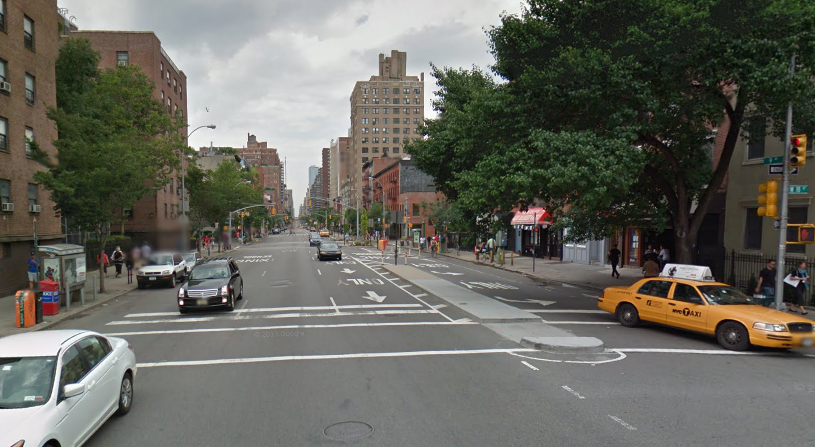
Don’t try to explain channelization to Delia Ephron.
So not including the lane dedicated to car parking and another devoted to vehicles making left turns, there are three lanes for cars traveling down Ninth, not two. And just in case you’re wondering if the lanes go down from three to two south of 18th Street, they don’t.
Then there’s the question of those ads. Ephron is none too pleased that the bikes are mobile billboards for a bank:
To make certain you don’t forget this fact, a Citi Bike sign hangs in front of the handlebars, Citi Bike is printed twice on the frame, and a Citi Bike billboard drapes the rear wheel on both sides. The font is the familiar Citibank font and the Citibank signature decoration floats over the “t.” There is no way to see a Citi Bike without thinking Citibank.
Is it great that a public transit service is festooned with ads for a corporation? Perhaps not. But in my imaginary socialist utopia where brown, gray, green or brick red taxpayer-funded “City Bikes” lined the streets, we’d still be reading anti-bike jeremiads by the Delia Ephrons of New York. Because the biggest problem the guardians of the status quo have with bicycle sharing is that the shared bicycles are not private automobiles.
Oh, and about those ads. Did you know that there’s no way to see another form of public transportation without thinking “lap dance”?
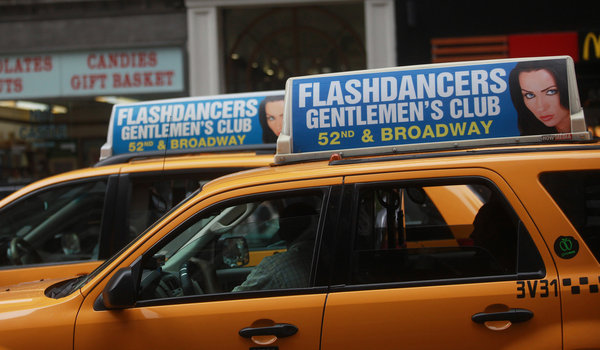
Say what you will about Citi, but I’ve never felt uncomfortable explaining what a checking account is to my daughter.
Zero pedestrians have been killed by cyclists since before 2010, but over 600 pedestrians and cyclists have been killed by drivers. The uncomfortable truth about pieces such as Ephron’s — and, to a greater extent, the Times editors’ decision to print them — is that they completely ignore the real hazard on our city’s streets. So much so that they have to include fictions such as this:
Then the snow will melt and freeze, and someone on a blue bike will skid right into you. Finally spring. Your broken leg is almost healed. The surgery to insert pins went well. You have completed four weeks of physical therapy, and at last can limp around outside without crutches. As you spy a cherry tree lush with blossoms, a you-know-what will zip by. Suddenly that beautiful day will get so much uglier.
Ephron ought to speak to Sian Green, whose dream of a beautiful day in New York City was forever sullied by the reality of an ugly encounter with the wrong end of a curb-jumping taxi.
That cab, of course, was yellow.
“I don’t want to lose any more friends.”
Leslie Albrecht at DNAinfo has a nice write-up on the efforts of 13-year-old Allison Collard de Beaufort to memorialize her classmate Sammy Cohen-Eckstein and turn her grief into action.
The eighth-grader, who had a class with Sammy and lives two doors down from the Cohen-Ecksteins on Prospect Park West, decided that drivers on the busy straightaway needed a stark reminder that Park Slope is teeming with kids.
To make her point, she went to Ikea, bought 40 teddy bears, and spent the next two days tying them to lampposts and street signs along Prospect Park West. Now they line the busy boulevard, looking down on drivers whizzing past.
Collard de Beaufort is hoping people who see the stuffed animals will think of children, and press their foot on the brake as they cruise down the street, which kids routinely cross on their way to and from Prospect Park.
“I don’t want anybody else getting hurt,” Collard de Beaufort said. “I don’t want to lose any more friends.”
The city would be a better place if we listened to kids like Allison a little more.
 Brooklyn Spoke