Forth on Fourth
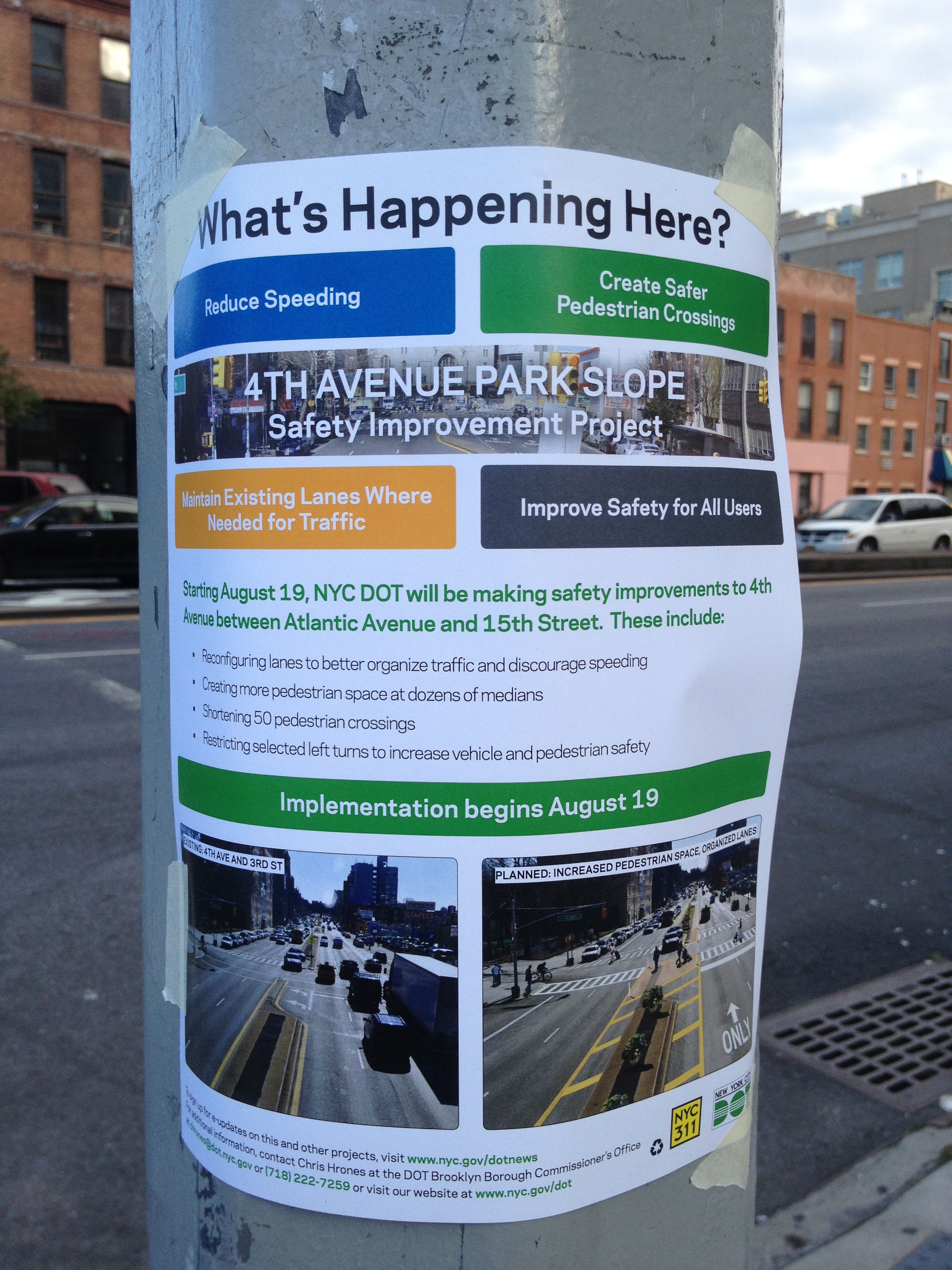
These signs appeared around the neighborhood this week, and they bear some great news. The Fourth Avenue Safety Improvement project, which had somewhat of a tortured birth, will be implemented on August 19th. Congratulations to Forth on Fourth, Transportation Alternatives, and the great team at DOT that saw the successful passage of this plan through to the end.
“I love bicycles.”
Gibson Dunn attorney Jim Walden, who is attached to two bike-related lawsuits and has been accused of trolling for a third, wants you know that some of his best friends are bikes. Via The American Lawyer:
Walden is well aware of the reputation the cases have bestowed on him (and says he looked at the Twitter account once and “had a good laugh”) but refuses to let that steer him and the firm from doing what they think is right: “I love bicycles,” he says, noting that, after winning one in a recent charity event, he owns three. “What I hate is terrible government decisions that cut out the community.”
Emphasis mine. And about that whole “cut out the community” thing? It’s not true.
Art Crank

Art museums are starting to capitalize on Americans’ newfound love of bicycles in ways that go beyond exhibition spaces:
But time, society, and environmental trends are on the bicycle’s side. Surrounded by ever-growing communities of bike lovers and bike sharers, art museums are finally beginning to explore the exquisite mix of engineering, craftsmanship, and style, that moves us forward on two finely calibrated wheels. The change is happening across the institution, from the curatorial and programming departments to the decision to get more bike racks (for visitors as well as staff) and to post bike directions on websites.
MoMA doesn’t post bike directions or nearby Citi Bike station locations on its website, but it has enthusiastically promoted Citi Bike on its Twitter feed. The American Museum of Natural History website doesn’t include anything about bike directions or bike parking either. Neither does the Met. The only major museum that lists bike parking information? The Brooklyn Museum, of course.
“I love my car.”
Wall Street Journal columnist Jason Gay takes the whole “Some of my best friends are bike lanes” rhetoric and turns it on its head:
I say all of this as a driver. I love my car. When I moved to New York, everyone said one of the best parts about New York City was that you didn’t need a car, and that was true. But having a car also kind of rules. It’s fun to drive places. It simplifies a lot of experiences. Carrying groceries home from the supermarket isn’t as complicated as docking a space station. (But I loathe parking. I truly do. I park on the street and sometimes it takes nine days to find a space as I roll sad laps around the block.)
But city streets do not belong exclusively to cars. You meet people sometimes who believe that New York streets were made only for cars, and that sidewalks are for bikes. These people would be really surprised by what New York looked like before the car arrived. It was not New Yorkers riding horses on the sidewalks. (Especially not those blue CitiHorse horses.)
Of course, Gay isn’t using his love of cars as a predicate for trashing them, as Cuozzo and company tend to do with bikes. He’s merely injecting a much needed bit of nuance into the ever-diminishing nontroversy surrounding a safer, more equitable New York City.
Rebalancing Act
One of the most remarkable aspects of Citi Bike’s debut is how quickly people worked bike sharing into their rush-hour transportation routines. That’s a good thing insofar as it provides strong evidence of a pent-up demand for better bike lanes and quiets the critics who predicted that New Yorkers would never choose cycling as anything more than a recreational pursuit. But it obviously presents a challenge for rebalancing crews, who can’t keep up with the throngs of commuters who arrive at two of the world’s busiest transportation hubs hoping to hop on bikes to complete their journeys.
When Citi Bike launched in May, I wrote that it would be “as convenient (and frustrating) as everything else” and quoted liberally from this great post by David Alpert at Greater Greater Washington. Now that the biggest complaint about Citi Bike seems to be that there aren’t enough bikes, Alpert’s post seems worth revisiting:
Bike sharing is, in many ways, more like transit: it transports you from fixed stations to other fixed stations. However, it’s also different from transit. Transit has more capacity at peak times when there are more vehicles. It costs money to run a vehicle, so you run it when there’s demand. Therefore, bus lines in particular are far more useful at times when there are a lot of buses. At some times of day, they don’t run at all.
Bike sharing is the opposite. It has a fixed capacity that fills up quickly, but is always available. Bike sharing is most useful off-peak, when the stations aren’t filling up or emptying out so fast. It’s always available at night.
Citi Bike should, of course, do everything it can to keep up with peak demand at the city’s major transit hubs. That includes rebalancing, but it also will have to include a higher concentration of bikes and stations near Grand Central and Penn Station as well as additional stations within the existing service area so people have place to dock when they ride those bikes to their destinations.
But it may just be a fact that as Citi Bike becomes more of an entrenched part of New York City, the definition of what it is used for evolves along with people’s expectations. Personally, I happen to find Citi Bike perfect for mid-day meetings or on those nights when a deadline keeps me at the office after 8 PM and I don’t have my own bicycle to ride home. But I do know that if I absolutely need to be somewhere at the height of the rush hour, I might want to give myself extra time to find a station with an empty dock.
It’s no different than the many calculations New Yorkers make when they choose the best means of getting around. Take getting to JFK. If my flight leaves at 6 AM, I typically take a car service and sail along traffic-free streets before the sun rises. But if the only flight available requires me to get to the airport in the midst of a busy rush hour, you better believe I opt for the LIRR to the Air Train.
One other thought. Given the clear demand for biking among people who commute into the city from Connecticut, Westchester, and New Jersey, it may also be the case that the desire for people to have a reliable connection from transit hubs to their offices and back again will require the repurposing of additional street space for the parking of personal bikes which can be left overnight. Though we wouldn’t want to turn into Amsterdam, would we?
“Lady, you just don’t shut up do you!”
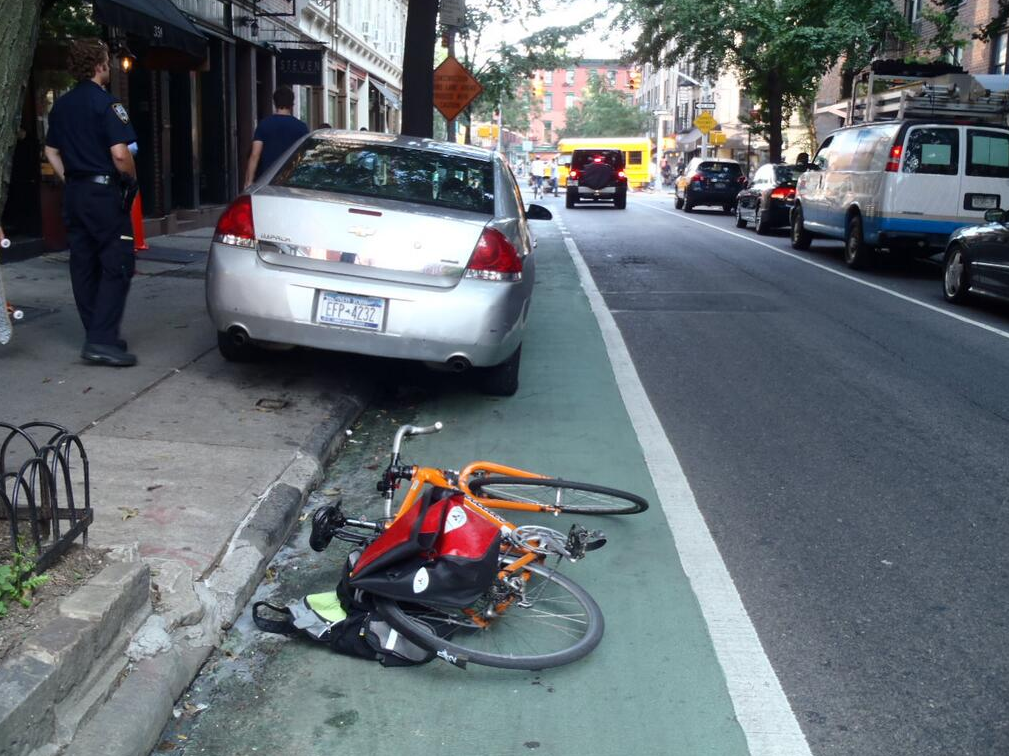
A typical scene: ticketing cyclists while blocking a bike lane.
It’s well known that the NYPD’s crackdown on cyclists has done little to make anyone safer, seeing as how it’s largely focused on people who run red lights at T intersections or ride on empty sidewalks when the design of the street gives them no other option. Now there’s another example of what can only be described as a campaign of harassment against New Yorkers who ride bikes for transportation. Hilda Cohen, a dedicated livable streets advocate and StreetsPAC board member, was ticketed on Friday for running a yellow light. Her story, below.
I was traveling east on Bleeker at 5:20pm in Manhattan. Had on my StreetsPAC t-shirt, so I was going an intentionally respectable speed in the painted green bike lane on Bleeker.
Heading towards the intersection of Charles Street, I notice that the T&LC next to me is speeding up for a fare ahead. There is also a car parked in the bike lane past the intersection. So I let the car pass, and then come out of the bike lane to avoid the car ahead. I typically react about 20-30 feet ahead of obstacles in my way if I can. I pass through the intersection with a yellow light.
I get stopped by the guy standing next to the car, NYPD in uniform.
“You just ran a red light.”
“The light was yellow when I went through the intersection.”
“No, it was red”, he said. “I saw it.”
“I am actually 100% positive that it was yellow. I looked for it, I saw it, and I don’t run red lights,” I said. “Why do you say it was red?”
“We saw the pedestrian crossing sign change from a flashing hand to a solid hand when you entered the intersection.” These police officers could not even see the light that they were referring to, they were about 30 feet past the intersection on a one way street. “That means that it was a red light.”
“Actually that proves that it was yellow. That is when the light changes from green to yellow.”
“Well you can’t go through yellow lights.”
To this I did say, “you’re not serious.”
“A yellow light means put on your brakes” he continued, “and you can’t go through a yellow light. You must have been going too fast to stop in time. I’ll give you a ticket for running a yellow and speeding. The speed limit is 25 mph, you were going faster than that.”
The above is an accurate telling of what he told me, and literally my jaw dropped. I realize now, at this point I should have just shut up because this was ridiculous. I should have just let him lie, and keep lying to me, and should have just kept my mouth shut, right?
But, in as even a tone as I could muster said, “you can enter the intersection when the light is yellow.”
“Then I’ll give you a ticket for being outside of the bike lane, and for speeding.”
I responded, “I could not stay in the bike lane as you are parked in the bike lane, and the speed limit is 30, and there is no way I was going 30 mph.”“Lady, you just don’t shut up do you!”
So my resulting tickets are for “Reckless Operation of a Bicycle” (19-176-C) and “Obstructing Vehicle Traffic” (240-20-5) which I have been informed are code for disorderly conduct for a bicyclist. These are criminal offenses, and I have to show up to court whether I plead guilty or not.
I was stopped for running a yellow light, and then given two tickets for knowing my rights, and the law. These are the people that are looking out for our safety and well being, right?
For context, the NYPD’s 6th Precinct, where this incident occurred, issued three speeding tickets in June for a total of thirty in 2013.
School Parking
A new bike corral was recently installed in front of the Brooklyn Heights Montessori School on Bergen Street near the corner of Court Street. When I rode by this morning, a couple of people were in the process of locking up.

The corral has space for ten bikes, and the wide gap between two of the hoops seems ideal for a cargo bike or two. While it was quiet this morning, the corral is bound to see some heavy action once school starts up again in the fall. Parents pedaling cargo bikes or longtails with children are an increasingly common sight on my morning ride to work.
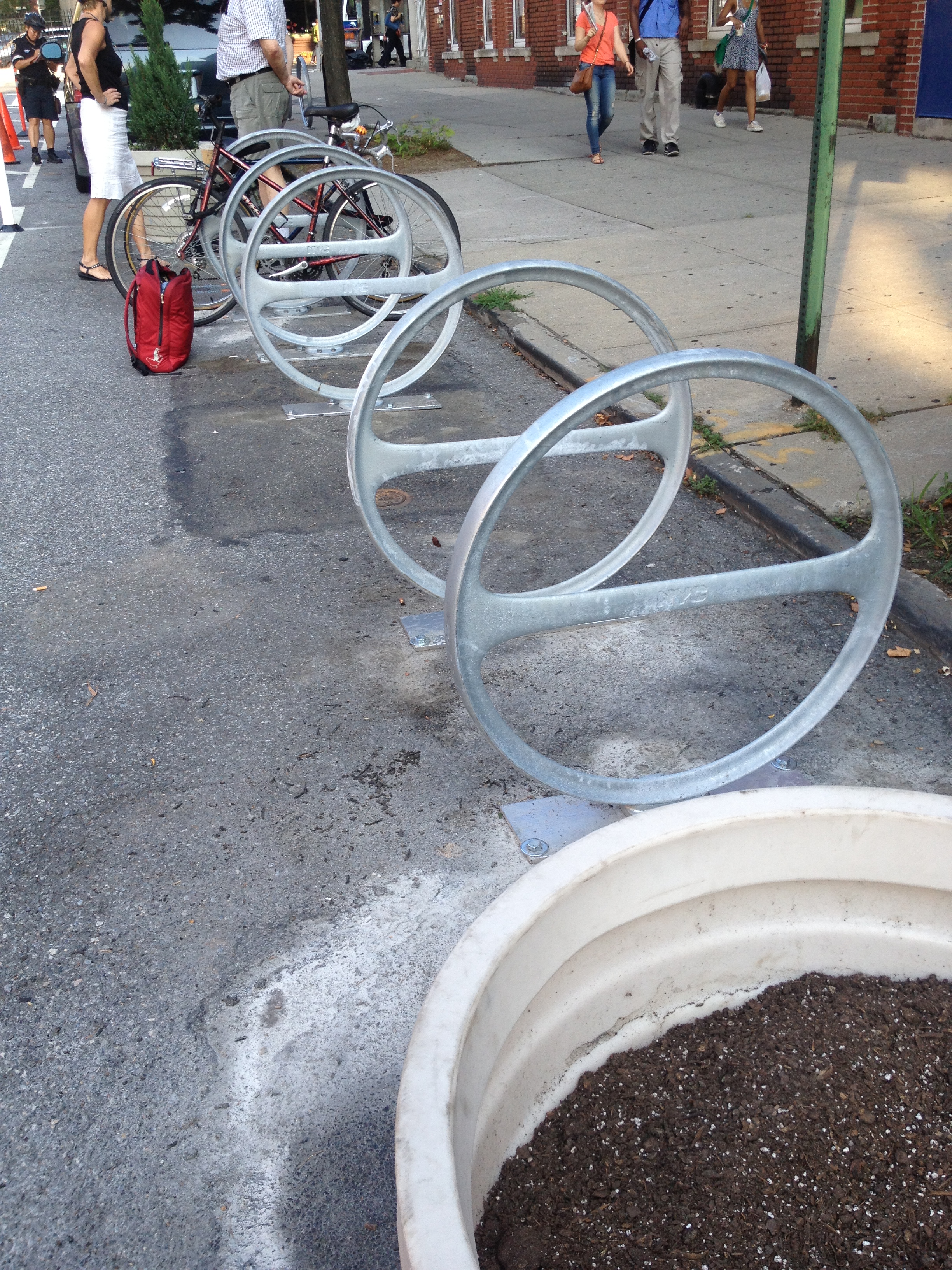
As you can see in this photo, the planter in the background is already filled in. The near one seems to be waiting for its plant. Plus the space opens up the street enough that the two people pictured seem comfortable hanging out and having a conversation. Try that between two parked cars.
It seems the arms race over bike parking between Chicago and New York City is not over yet.
Design Matters
James D. Schwartz, a Toronto blogger who writes The Urban Country, uses a recent trip to illustrate how, as he puts it, “Bad Design Leads to Bad (Scofflaw) Behavior.”
While the protected bike lanes were wonderful and comfortable, the traffic signal design, which was designed for motor vehicles, made it awfully tempting to break the law and run red lights.
For example, while riding down the 9th Ave protected bike lane at a relatively slow pace, we hit red lights at almost every intersection.
Obeying the law would put bicycling on par with walking pace, since a bicyclist would need to wait for a full 3-phase signal cycle to complete at almost every block.
Thus, it was no surprise to me that most bicyclists safely passed through a red light when the intersection was clear.
Other bicyclists rode fast enough that they could hit most green lights, which are timed for motor vehicles traveling at about 50 km/hour.
In the eyes of onlookers, red light jumpers are “scofflaw” cyclists. But it is bad design that creates incentives for bicyclists to jump red lights.
Even as a tourist in New York, I surely wasn’t going to sit at red lights all the way down 9th avenue, so I safely and courteously jumped my fair share of reds over the weekend.
More on Fourth Ave
Here’s my favorite part of an excellent “open letter to Brooklyn Community Board 6” from Keith Williams of The Weekly Nabe:
We rarely question a doctor’s medical advice, even if it runs counter to our gut instincts. Why would we do so with respect to the flow of traffic? The professionals in the Department of Transportation have spent years studying and applying the principles of urban design and movement. There is little reason to believe they overlooked anything here – particularly after the host of public meetings that have been held on this topic.
The comparison to a doctor’s advice is great. Sadly, sometimes community boards act a bit too much like insurance companies, denying life-saving treatment. Let’s hope that’s not the case tonight.
Wednesday: Fix Fourth Avenue
I’ll be on a light posting schedule this weekend, but wanted to call attention to what I feel is the most important livable streets advocacy issue of the summer, the effort to fix Fourth Avenue. A public hearing is being held on Wednesday, July 10th, at 6:30 PM.
Community Board 6, which last month voted against a Department of Transportation plan to calm traffic on Brooklyn’s 4th Avenue between Atlantic Avenue and 15th Street, will hold a public hearing and special meeting at which it may reconsider the proposal. DOT has accepted an invitation to appear and may offer modifications. The DOT proposal, which is supported by local City Councilmembers Brad Lander and Steve Levin, arose from a multi-year public outreach effort aimed at improving safety on one of New York City’s most dangerous roads. Members of the public will be allocated two minutes each to speak on the proposed plan; having a large group of respectful but resolute plan supporters present will help immensely. The hearing will take place at the 78th Precinct station house, 65 6th Avenue, at the corner of Bergen Street. If you’re unable to attend the hearing, you can submit written testimony in advance of the meeting to info@brooklyncb6.org.
Summer schedules may mean that many of the people who poured their blood, sweat, and tears into the community process over the past few years may not be in town for this hearing. We’ll need smart, sane voices in the room to express their support for a sensible plan to fix one of the borough’s most dangerous streets for pedestrians and drivers. I encourage you to attend if you’re so able.
 Brooklyn Spoke