A Different Kind of Barclays Bikes

Customers check their bikes in to the T.A. Bike Valet at the Barclays Center
I live not too far from the Barclays Center and on occasion have ridden by the arena’s bike parking while an event was in progress. And on most of those occasions the arena’s many bike racks were empty.
There are a mix of reasons why the bike parking hasn’t be utilized to its fullest, but foremost among them would be the fact that it’s not secure or guarded. Leaving one’s bike locked up outside while attending a basketball game or concert is pretty much an advertisement that tells a thief, “No one will try to stop you, so have fun trying to saw through my u-lock for the next two hours.”
[UPDATE: A rep from the Barclays Center tells me that the bike parking is monitored 24 hours a day by the arena’s security team.]
Wednesday night was the first attempt to change that with the debut of a secure bicycle valet service for people attending the National concert at the Barclays Center. Operated by Transportation Alternatives, the bike valet was free of charge. It also attracted a fair amount of press, with Mayor Bloomberg and DOT Commissioner Janette Sadik-Khan on hand to give interviews. To top it all off, two members of the National rode their bikes to the arena and checked them at the valet.
But the real test is how many people use it. So how did it go? I checked in with the bike valet at about 10:30, a little before The National show wrapped up and snapped a few pictures.

A secure valet meant people could leave helmets with their bikes instead of carrying them inside.
TA tells me that around 100 people checked bikes on Wednesday, and while that’s a drop in the bucket when compared with approximately 18,000 seats inside the Barclays Center, it’s a start. I have a feeling that the location of the bike parking doesn’t help drive traffic, since it’s behind the arena on the corner of Dean and 6th and largely invisible to the majority of people who get off of the subway and head straight into the center’s main entrance. More signage is one way to help let people know that this service exists, as is heavy promotion inside the arena itself.

I spotted more than a few child seats among the checked bikes last week.
But even though the bike valet received a fair amount of press before and after the concert, it won’t be press that drives its growth. Only by offering it as a regular service will it become more popular. Dean Street gets a lot of bike traffic, so offering a regular bike valet may create a positive feedback loop; as more people see the bike valet in use, more people will use it. I hope the Barclays Center figures out which events are most likely to attract bicycle riders and offers the service when appropriate. If it does it enough times, it may find that there’s demand year round.
As I poked around the bike valet toward the end of the evening, one bike stood out for me as indicative of what happens when an organization or company offers secure bicycle parking.

A WorkCycles Fr8
Above is a fully loaded WorkCycles Fr8, set up to transport two children. It’s also a somewhat expensive bike. This just isn’t the kind of bicycle you leave on an unsupervised Brooklyn bike rack for two or three hours while you attend a concert. To me, this bike showed what a difference offering secure bicycle parking can make. You want slow and considerate cyclists to ride on city streets? Offer them a safe place to park.
Of course, this being Brooklyn there has been some griping about the attention paid in the media to the bike valet. Here’s writer Ellen Freudenheim:
Imagine my surprise at reading in the hyper local news outlet DNA that Mayor Mike will show up tonight in Brooklyn to tout urban biking….but where? At Barclays Center to make a fuss over the mega-million dollar stadium’s embrace of valet bike parking.
Well, how about Mayor Mike on a bike showing up at some of other Brooklyn cultural institutions that have had valet biking for years— before, say Barclays even broke ground?
Look, I get it. The wounds from the “Battle for Brooklyn” are still fresh. But it is, in fact, remarkable that a mega-million dollar stadium is attempting to embrace valet bicycle parking, even if you think their motivations are suspect or count as little more than greenwashing. But here we are in 2013, after years of angry tabloid columns, lawsuits about bike lanes, and last-gasp hysteria about the danger of bicycles, and our billionaire mayor thought it was worth his while to come out to Brooklyn to stand behind a giant arena to answer questions for the press… about bike parking.
I’ll take it.
Where are the Grownups in Brooklyn Heights?
I’ve been appalled at the childish behavior of the residents of 150 Joralemon, who have taken to having their building’s maintenance staff pile bags of trash on the Citi Bike station outside their building.
As Kim Velsey says in this outstanding piece in the Observer, this is not how civilized city dwellers should act:
Co-op resident Nina Hackler told The Post: “There just isn’t enough room. Something has to give—and this time, it’s the bikes.”
Anyone with that attitude doesn’t belong in New York City. Comprising, accommodating other people and things, handling disputes without resorting to throwing garbage at things you don’t like—those are essential requirements for being able to live in this or any other city. Anyone who can’t deal with the inconveniences of sharing space with 8 million other people in a civilized way should seriously consider leaving.
There seems to be one thing the wealthy NIMBYs of Brooklyn Heights–and PPW–do not understand. You may own your apartment or your building, but you don’t own the shared sidewalk and street outside. That belongs to everyone.
The Real Totalitarianism
Answering Dorothy Rabinowitz’ hyperbolic screed against the totalitarians seeking to reallocate a small amount of space away from cars and to bicycles, Slate’s Matt Yglesias writes that the “systematic over-allocation of public space in urban areas to cars” is the real “transportation authoritarianism.”
But without even knowing it, he’s answering Josh Greenman as much as he’s answering the Wall Street Journal. Greenman, you may recall, chastised bicycle advocates for essentially demonizing the car, and used this statement to make his point: “God forbid anyone in power should try to make life easier for those who dominate the roads.”
Here’s Yglesias:
Perhaps the view is that automobile driving is associated with positive social externalities such that at the margin we want to encourage people to drive more and walk less. Or perhaps the view is that the goal of urban policy is not to maxmize the welfare of city dwellers but instead to maximize the wealth of downtown landowners by facilitating suburbanites’ commutes. But there’s no explicit articulation of this view.
Instead, the idea seems to be that since private automobiles are a highly space-inefficient way of transporting people through an urban area, they therefore deserve massive subsidy in the form of additional space-allocation. After all, if private automobiles were made to get by with the same amount of space dedicated to pedestrians, they’d be impractical for many uses. But would that be a bad outcome? Why? And bad for whom?
The Straw Man
Josh Greenman, writing in the Daily News, wants to broker a truce in the war on cars. Except that he doesn’t. What he really wants to do is offer a defense of the poor, put-upon New York City motorist. And he does so by assigning beliefs to a Rabinowitz-style “bicycle lobby” that it does not have.
Here are my thoughts on Greenman’s massive straw man of an argument.
I’m a Citi Bike founding member, and I’m happy to flaunt my membership fob. The bike share racks don’t bother me, and neither do the riders.
Some of my best friends are bikes!
Knee-jerk anti-bicyclism is a curious thing in this city, a convenient, mostly evidence-free outlet for pent-up reactionary thinking. I am sure that a third street-level mode of transportation can happily coexist alongside pedestrians and motor vehicles. I regularly cross paths with a dog-walking unicyclist, whose bravery and skill I hereby commend.
But there’s one thing I can’t countenance about the bicycle evangelists at Transportation Alternatives, Streetsblog and the like, and that’s their ingrained, reflexive disdain for the automobile.
To distinguish one’s self from “knee-jerk anti-bicyclism,” it’s probably not a good idea to describe TA supporters, Streetsblog writers and readers, “and the like” as evangelicals.
Poke around online or on Twitter and you will find that the bicycle is the greatest thing since the invention of the wheel, while gas-powered, four-wheeled vehicles are practically the embodiment of evil. They’ve ruined our neighborhoods; they’re destroying the environment; they kill pedestrians and bicyclists, practically with glee.
The fact that one has to “poke around online” undermines the idea that anti-car zealotry is a mainstream position among the above-mentioned “evangelicals.” And drivers may not kill pedestrians and cyclists with glee, but they do it largely without consequence.
The zero-sum vision of some pro-bicycle advocates is a tacit assertion that in some parts of the city, cars, those corporate tools, have no claim to the road. They must be managed in the way an incurable disease is managed. God forbid anyone in power should try to make life easier for those who dominate the roads.
Cars have plenty of of “claim to the road” where bicycles and pedestrians have none. Highways come to mind. And while 274 deaths per year is not an incurable disease, it is a public health crisis.
Josh’s use of the word “dominate” is as curious as it is meaningless. Cars dominate the road because decades of policy has allowed them to do so, not because they are fundamentally better than other forms of transportation. Dominance, therefore, does not entitle one to privilege. But never mind that we do, in fact, provide plenty of privileges to drivers. The city offers free on-street parking on some of the most expensive real estate in the world. Drivers have a host of free bridges from which to choose if they want to enter Manhattan. Many police precincts turn a blind eye to speeding. As I mentioned above, few drivers who kill pedestrians face any real legal penalty. Maybe Greenman needs to provide specifics: how much easier should life be for drivers in New York City?
I’d like to offer words in defense of the car, and its cousins, the truck and bus.
Cars take elderly people to the doctor, help cops to chase criminals and bring people to work, including teachers and nurses who travel early or late to areas that lack convenient public transportation.
Yes, cars do all of these noble things. But imagine how many fewer people would have to go to the doctor if they didn’t spend so much time in cars. Imagine how many criminals the NYPD could chase if they weren’t serving as de facto investigators for the auto insurance industry.
Cars give families the freedom to escape the city for a weekend. Cars enable middle- and working-class people who live well beyond the bounds of Manhattan to participate in the life of the city. And don’t forget those suburbs: Sometimes a New Jersey or Long Island family, whose chosen a life of quiet streets and backyards, wants to brave the tolls and traffic to pay a visit.
Yep. Cars are great for all of this stuff, too. But rental cars and Zipcar memberships also offer families–including mine–the same freedom of escape without cluttering the streets with automobiles that are only used two times per week. Again, the position of livable streets advocates is far more nuanced than Greenman will allow himself to admit.
A 13,000-strong fleet of yellow cars, and a parallel fleet of black cars, provide a living to thousands of immigrants. Summoned by our fingertips, they take us just about anyplace we need to go. They have helped many a drunk get home at the end of a long night.
Nowhere in Greenman’s statement can an argument for the status quo be found. That an industry employs a lot of hard-working immigrants is a wholly separate idea from that industry being good for the city. Strip clubs and adult video stores provided a lot of employment in the Times Square area for decades until Giuliani decided it might be good for public safety and the economy if the area wasn’t so dominated by them.
And, yes, it’s wonderful to live in a city where you can get drunk and not ever have to worry about getting home. But cars, it should also be pointed out, are often driven by drunk people who kill people, including sober people in cars.
And trucks?
Trucks bring bananas to the supermarket, stock every store on my vibrant Park Slope strip and serve ice cream to kids. Trucks deliver packages, so many packages. I’m glad mom got her birthday gift on time.
Who can argue against mothers, kids and ice cream? Everyone knows that the people of Chelsea have not tasted the sweet, sugary taste of ice cream ever since the 8th and 9th Avenue bike lanes were installed. And if you have a mother who lives on Prospect Park West, I have some bad news for you: she hasn’t received your birthday gift to her since sometime before June 2010.
Trucks take away our garbage and recycling, my old cat litter, your spoiled cottage cheese, your neighbor’s broken bookshelf. Trucks enable construction workers to build this dense city and allow plumbers and electricians to make repairs. Outfitted with sirens, trucks speed heart attack victims to emergency rooms.
Greenman gets really lazy here. No one I know–NO ONE–thinks there shouldn’t be garbage trucks, service vans, or ambulances. They have all of those things and more in some of the world’s most livable cities. It’s just that the glut of cars on our streets makes it really hard for heart attack victims to reach emergency rooms, among other problems. Livable streets advocates think that sensible solutions like congestion pricing, parking maximums, or competitive rates for curbside parking could go a long way toward reducing congestion, allowing garbage trucks to pick up trash faster and help that plumber get to more clients in a day and make a lot more money in the process.
Now, bicycle advocates will tell you they’ve got nothing against cars and trucks. The only point, they say, is that they’ve had free rein, and reign, for far too long. They’ve pumped nasty emissions into the air and hit pedestrians and hit bicyclists. They’ve ruined the waterfront and torn up our human-scale streets, no thanks to the horrid ambitions of Robert Moses.
These advocates say they only want to rebalance things a bit. What they fail to grasp is that New York City, unlike, say, Miami, where I grew up, is already pretty damn balanced. It’s a really tough place for drivers to drive. The signage sucks. The “highways” are mottled. The streets are narrow. Other forms of transit do as they please, and that makes driving more tension-filled than in car-dominated cities.
Meanwhile, in most respects, we’re already living in the highly walkable city of new urbanists’ dreams, despite the car supposedly having run amok.
As we respect and even expand the territories of pedestrians and bicyclists, the question is: Do we do the same for the many who drive?
Again, New York is highly walkable in comparison to almost every other American city. But even here, Greenman is experiencing a limited New York, that of Manhattan, brownstone Brooklyn, Williamsburg, and other “gentrified” parts of the city. For many pedestrians in Brownsville, Upper Manhattan, and much of Queens, the car has, in fact, run amok, leaving those communities disproportionately burdened by asthma and long bus commutes.
If you see cars as always the tool of the oppressor, and if you see bikes as always the weapon of the oppressed, then, naturally, you will try to make life harder for vehicles with engines, and thus harder for the people who rely on them.
Those aren’t Wall Street millionaires taking the wrong off-ramp and getting lost in the Bronx. They’re real people doing their level best to hack it in the city.
Citi Bike 101: Dock-Surfing
Now that Citi Bike is open to 24-hour and 7-day pass holders, confusion about certain elements of the program are bound to rise. And one of the most common questions I’ve heard has to do with the time limits:
If you only have 30 minutes before overage fees kick in, how on earth are you supposed to get somewhere that’s 35 minutes away?
The 30-minute time limit applies only to 24-hour and 7-day pass holders. Annual members, the people with the blue keys, have a 45 minute limit, but many of them have asked a similar question. If your destination is farther away than time allows, aren’t late fees inevitable?
Fear not, New York. There’s one trick that’s sure to become second nature in short order, like swiping a MetroCard or folding a slice of pizza. And to explain it, I asked Brian McEntee from the blog Tales from the Sharrows to write a guest post. Brian writes about commuting by bike in Washington, D.C., and is a member of Capital Bikeshare.
Take it away, Brian:

The Capital Bikeshare system in DC/Arlington/Alexandria is very diffuse. It’s over 12 miles between the southernmost stations in Old Town Alexandria and the northernmost stations in Petworth in NW DC. It’s a 14 mile ride from the westernmost stations in Arlington to the easternmost stations across the Anacostia river. How the hell is someone supposed to get a 45-pound bike 12 miles uphill in a half hour or less? (Even annual CaBi members only get 30 minutes.) Is Capital Bikeshare just trying to rip people off by making them accrue late fees with these long trips?
It’s easy. It’s called dock-surfing. Others call it daisy chaining. It’s common practice in D.C., and the good news is that it works with Citi Bike, too. Need to get from 57th and Broadway to Fort Greene but all you have is a 24-hour pass and its 30-minute limit? With dock-surfing it’s easy to get there without paying a penny in late charges.
The steps are as follows:
- Start your ride. Be sure to look at your watch or phone. Think about your end destination and whether you’ll be able to make it there in under a half hour. The bikes aren’t designed for speed, so be conservative.
- Think of some Citi Bike stations you might pass along the way. In fact, plan your route ahead of time with the intention of passing some intermediate stations. In the course of the ride from one end of the system to the other, you might pass one or two stations every few blocks. You can use the Citi Bike app or Spotcycle to get a sense of nearby stations.
- As your time limit approaches, ride up to one of these intermediates stations and dock your bike. Note the green light. At this point, your “trip” is over. As far as Citi Bike is concerned, your ride is done and your time is stopped.
- If you’re a 24-hour or 7-day pass member, you’ll need to leave the bike, swipe your credit card, get a new code and enter that code to release the bike again. If you’re an annual member, you don’t even need to leave your seat. Put your key in the slot, wait for the green light and remove the bike. It can even be the same bike, which means you don’t have to remove your bag. You’ll have to wait two minutes between docking a bike and taking one out again, but that’s the perfect amount of time to check your phone for directions or to see how many open docks there are at your next stop.
- Citi Bike considers this to be is a new trip and your time starts afresh. Go on your merry way, safe in the knowledge that you’ll reach your final destination well within your new time limit.
Here’s the best thing about dock-surfing: you can string together as many intermediate stops as is your want. Just ride until you’re close to your time limit, dock the bike, undock the same bike or a new one, ride on, and repeat as necessary. So long as you know the stations along your route and keep an eye on your time, you’ll never incur any late charges. By adopting this very simple strategy, there’s never a need to rush and there’s never a need to pay extra if you’re just smart about it.
Thanks, Brian! If you’re a bike-share pro from another city and have some insider tips about how to get the most out of the system, drop me a line at brooklynspoke at gmail dot com and I’ll feature your advice in a future post.
Sunday: We Ride The Lanes – NEW START LOCATION
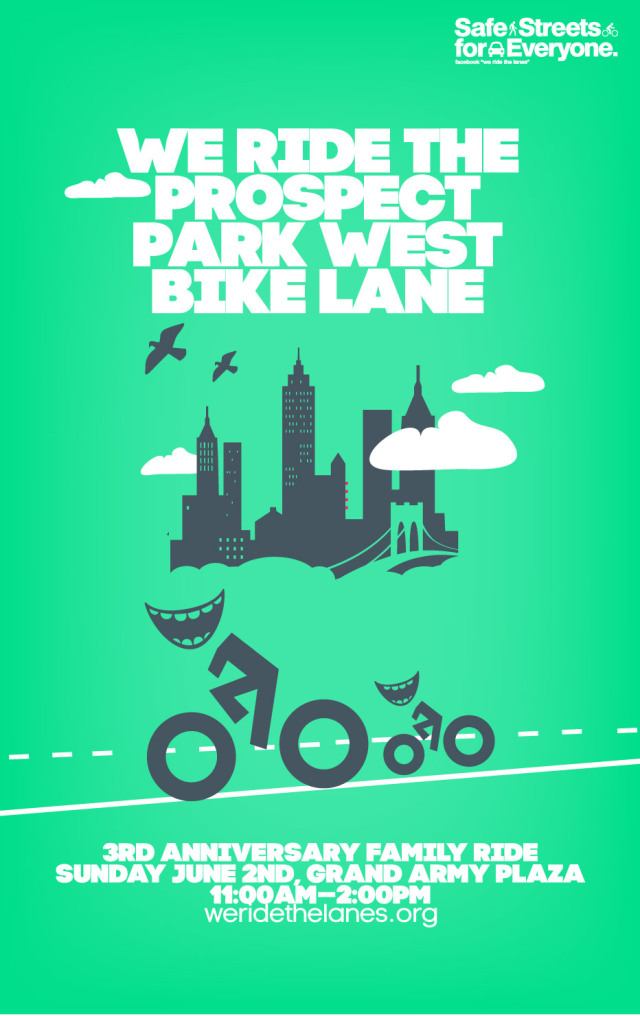
Just a quick reminder that this Sunday, June 2nd, you can join lots of your fellow Brooklynites and their kids at the second “We Ride the Lanes” ride on Prospect Park West. We’ll have t-shirts and a raffle for lots of great prizes, including a Tern Bike, gift certificates from Public Bikes, and more.
See you Sunday!
UPDATE: The ride will now begin at PPW and 3rd Street, not Grand Army Plaza.
Citi Bike Launch Photos

I’m too excited and exhausted to write a lengthy post about today’s events. It was just one of those days you had to experience to understand. And anyway, Janette’s smile probably says it all.

Mayor Bloomberg gave a masterful performance at the press conference, pretty much owning the media’s desperate search for controversy on the subject of everything from stolen bikes and safety to docking stations taking up too much space: “Bike racks do take up space. But the parked cars that they replaced took up a lot more space.”
Oh, and I had my picture taken with one of the city’s best bicycle advocates. I hear he writes music, too.

Many congratulations to Jon Orcutt, Kate Fillin-Yeh, Dani Simons, and the many tireless officials, advocates, and allies who helped bring New York City to this day.
More photos can be found in this Flickr set. I’ll add a few more here and there as time permits.
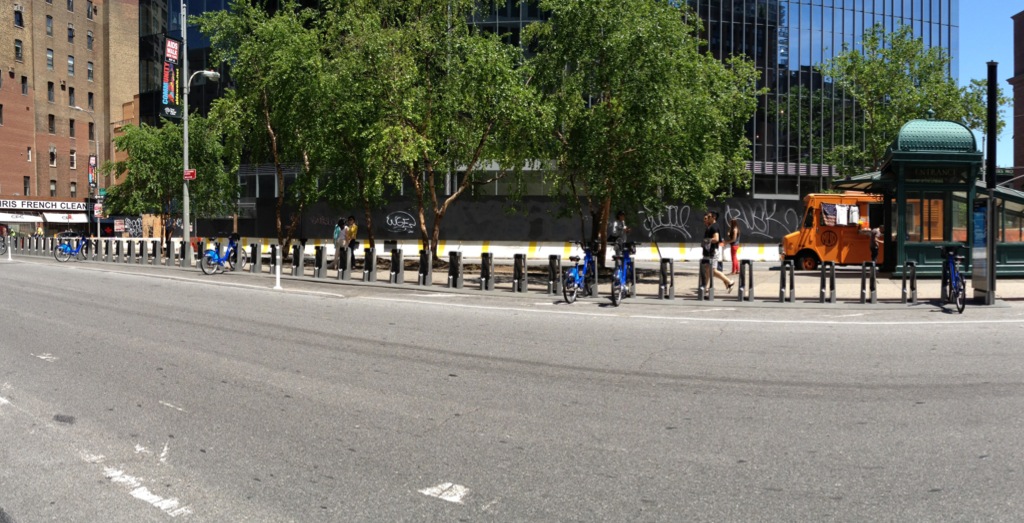
A few hours after the launch, there were only six bikes at Astor Place. (Click to enlarge.)

It was the same story at the so-called “controversial” Citi Bike station at 99 Bank Street. Just three bicycles remained when I arrived there today.
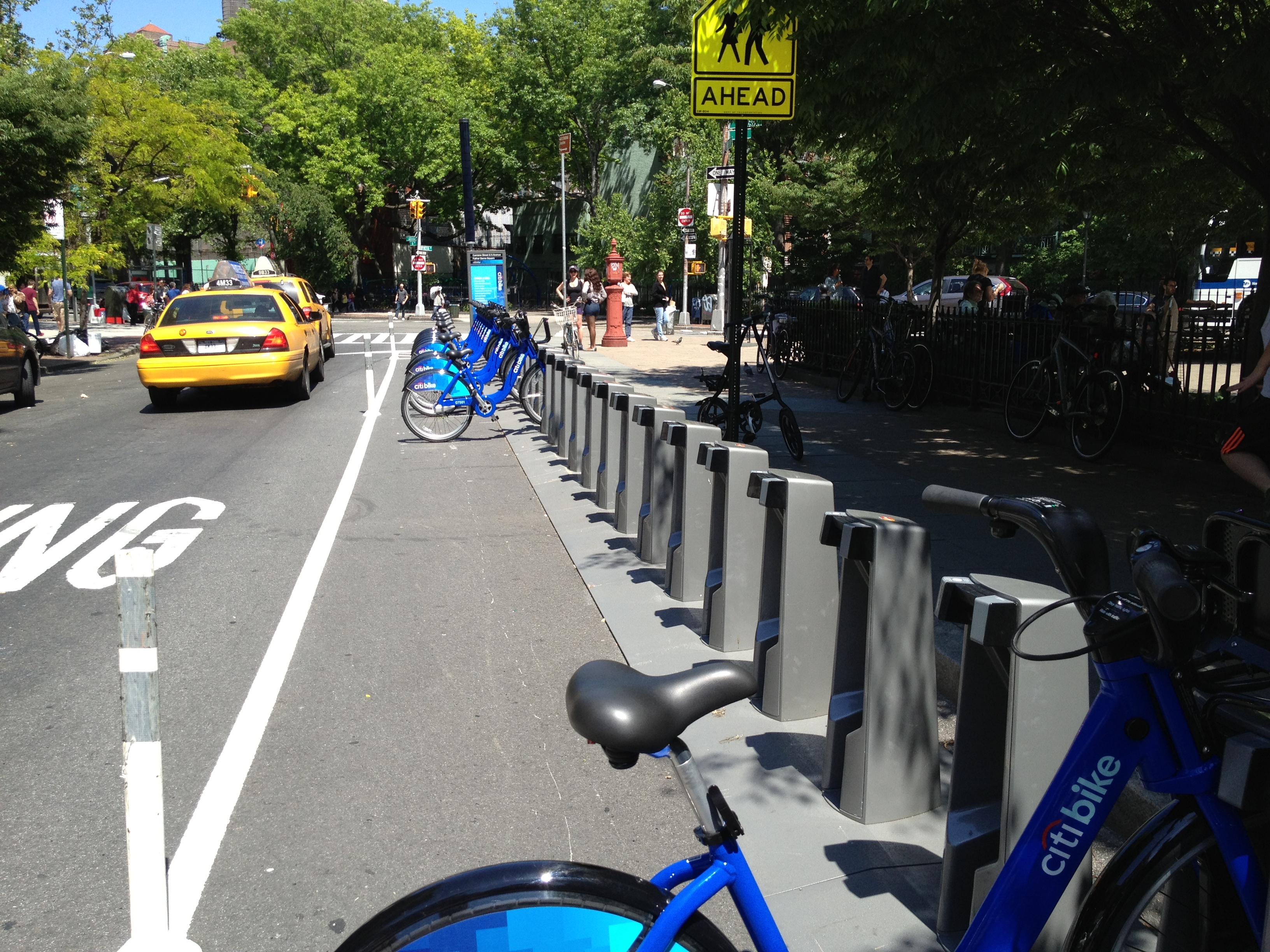
It was interesting to see how most of the bikes left in the Carmine Street station were located at the far end, away from the Bleecker Street bike lane.

Back at Dean and Fourth in Brooklyn, very few bikes remained in the late afternoon.
Welcome to the Future
Yesterday, my daughter got her first glimpse of the “blue bikes.” To her, scenes like this will be part of what it means to grow up in a city, and she wasn’t the only person I saw taking in this new addition to the streetscape with a sense of wonder, curiosity, and excitement. I actually saw someone park the bike lane on Dean Street, get out of his car, walk over to the kiosk, and say out loud, “Damn, that’s cool.” When we spoke briefly, he said he was going to go home and sign up online.
Congratulations to the Bloomberg Administration, the Department of Transportation, Alta, Citi Bike, and all of the tireless advocates who worked so hard to bring today to fruition.
Enjoy your first day in a bicycle-sharing city!
On the eve of Citi Bike’s launch, here’s a great explanation of bike sharing from someone who’s seen it all before, David Alpert of Greater Greater Washington:
…bike sharing is not the same as bicycling. This is why a lot of people get confused about bikeshare if they aren’t familiar with it. Some New Yorkers expressed shock that a 4-hour ride would rack up $77 in late fees on their Citibike system. As those of us who’ve used bikeshare know, people don’t ride a bikeshare bike for 4 hours, or if they do, they just return it every half hour and reset the clock.
Bike sharing is, in many ways, more like transit: it transports you from fixed stations to other fixed stations. However, it’s also different from transit. Transit has more capacity at peak times when there are more vehicles. It costs money to run a vehicle, so you run it when there’s demand. Therefore, bus lines in particular are far more useful at times when there are a lot of buses. At some times of day, they don’t run at all.
Bike sharing is the opposite. It has a fixed capacity that fills up quickly, but is always available. Bike sharing is most useful off-peak, when the stations aren’t filling up or emptying out so fast. It’s always available at night.
One of the important things to remember is that Citi Bike will not be perfect. That will be especially true as people get used to the system… and as the system gets used to the people. But it will also be true many years from now.
My wife, a bike share novice, recently asked me what happens if she tries to return a bike but finds that the station nearest her destination is full. After I explained how to request an extra 15 minutes from a kiosk in order to find another station with available docks, she responded by saying, “Yeah, but what if I really need to be somewhere?” She was needling me, of course, but I needled her right back. “If you really need to be somewhere on time, leave early!”
Subways get delayed, buses skip stops, and taxis get stuck in traffic. (Sometimes they crash.) While the problems some people will experience with Citi Bike may be unique to bicycle sharing–no one has to worry about finding an empty taxi dock, for example–they will not be unique to getting around. Real New Yorkers know how to roll with it when things don’t work out as planned. In fact, that’s one of bike sharing’s biggest benefits: when the bus is too slow, no taxi is available, and your subway line is suspended in both directions due to an “earlier incident,” the option of having all those blue bikes around will give you one more way to cope with life in the big city.
Enjoy your first week of riding, everyone! Welcome to the future.
“It doesn’t fit the neighborhood.”
Yesterday I posted a quote from Soraya Mackhrandilall, who led the effort to remove a Citi Bike station from in front of her building at 83-89 Barrow Street, on the the southeast corner of Barrow and Hudson.
Mackhrandilall, like many bike share opponents before her, based her complaints on historic accuracy and aesthetics, saying that the station wasn’t appropriate for the neighborhood. “This is a residential street, and it looked like Times Square,” Mackhrandilall complained to DNAinfo.
I happen to work a few blocks from this location and popped over there yesterday during lunch to check out this street for myself.
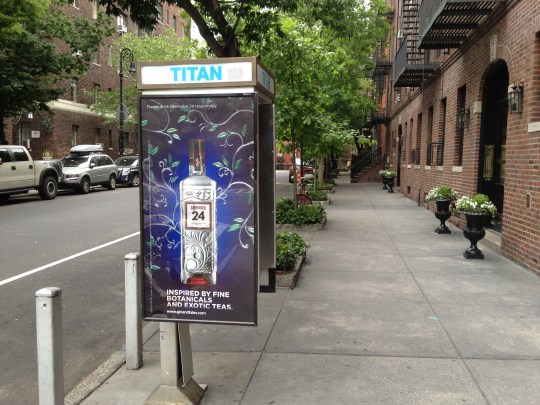
83-89 Barrow Street’s entrance is the first door on the right, in between the potted plants. The bike share station in question used to be in the parking lane just to the left of this phone booth. Curiously, the bright blue ad for a liquor company on the phone booth’s side hasn’t provoked comparisons to Times Square. And since payphones these days are rarely used for anything other than advertising, one has to wonder why local residents aren’t complaining to the Post about the wasted sidewalk space and visual pollution.
Then there’s the issue of the view.
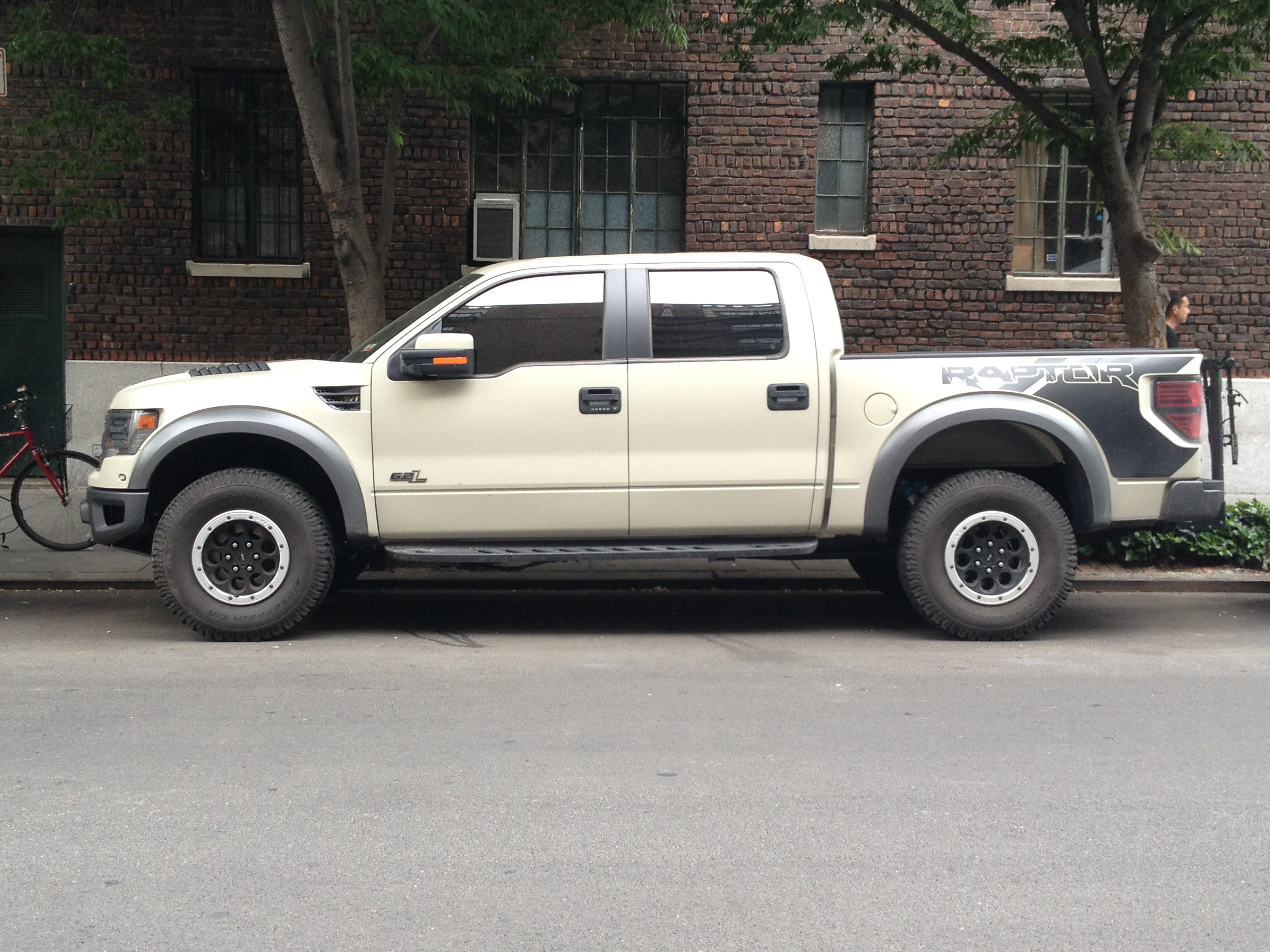
Now that the bike share station is gone, SUVs like this (above) await residents as they walk out of 83-89 Barrow’s front door. If car parking is restored to the southeast corner of Barrow, the view will soon look more like this:
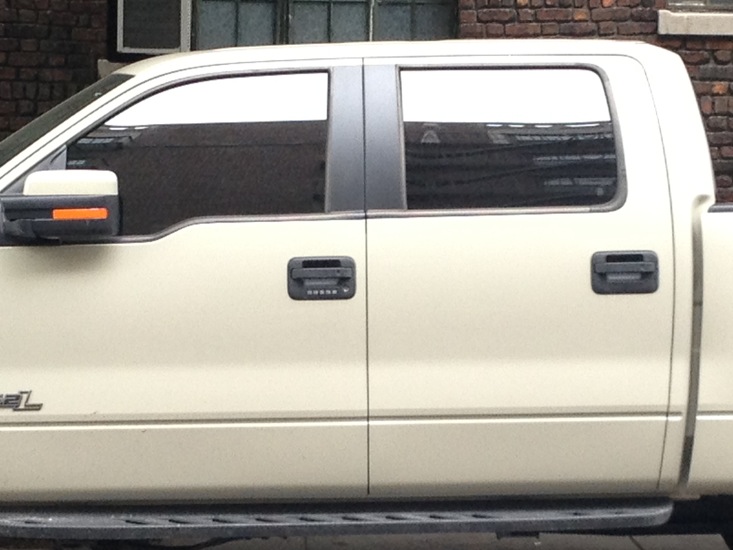
As I’ve pointed out before, almost every criticism about bike share can be leveled at automobiles as well. Yet you can be sure no one on Barrow Street is contacting CB2 about this 21st Century blight on their 19th Cenutry neighborhood.
Then there’s the question of where the station was relocated. It now sits on the northwest corner of Barrow and Hudson, in front of the garden of the Church of St. Luke in the Fields.
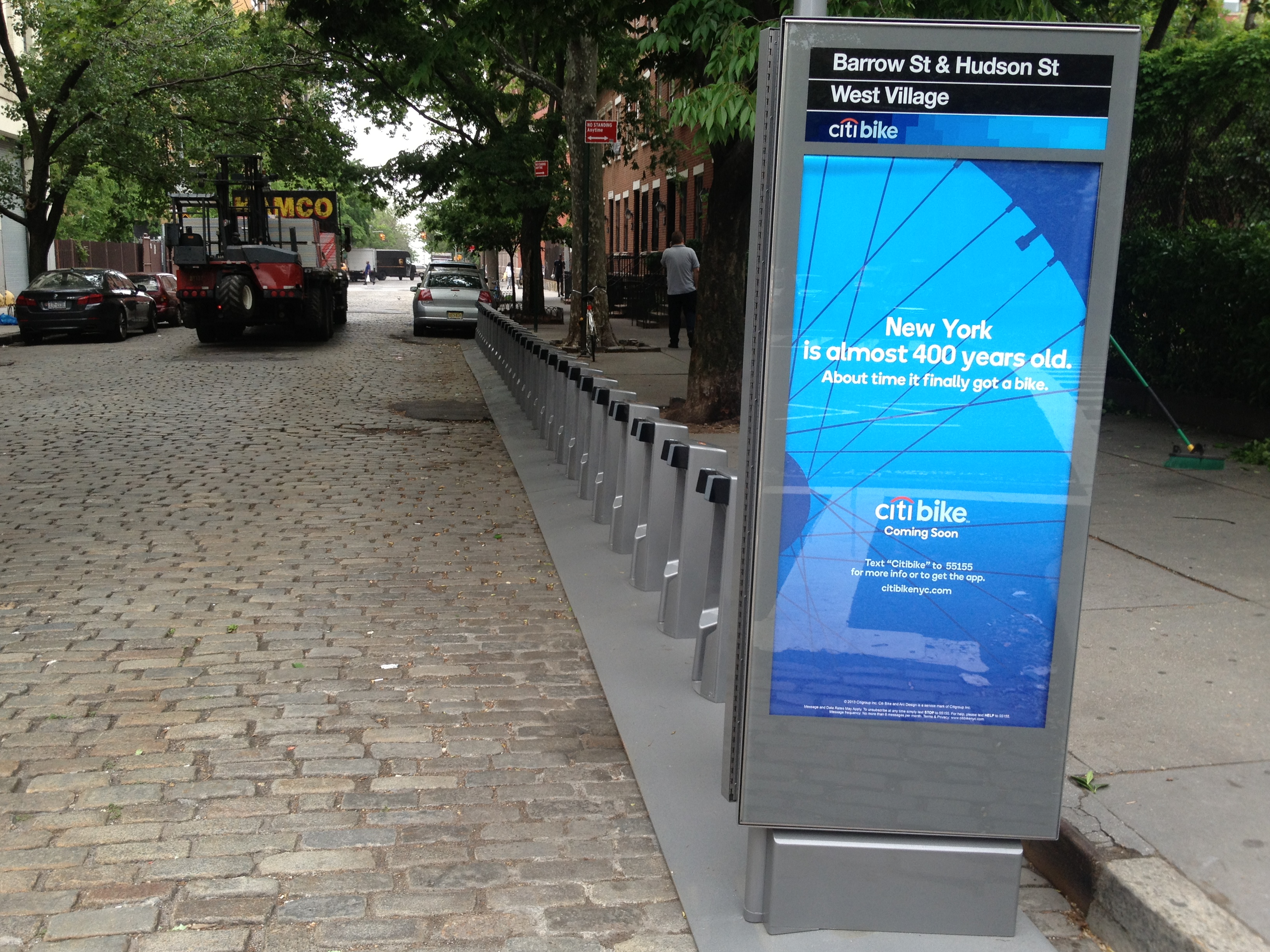
Although St. Luke’s in the Fields has undergone extensive renovations since the 1950s, much of the building and property dates to the Monroe administration, an era not exactly known for automobiles or even bicycle sharing.
In a reverse 99 Bank Street, the station was moved from blacktop to cobblestones, which opponents of all things bike are usually happy to tell you trump all other road surfaces in the historic accuracy department. Plus, all of the typical concerns over how cobblestones affect the safety of cyclists and pedestrians by forcing people on bikes onto the sidewalk don’t seem to exist now that the station isn’t in front of anyone’s apartment building. (Right before I took this photo, a cyclist did, in fact, turn off of Hudson and onto the sidewalk to go west navigating peacefully around two unfazed pedestrians, an incident you won’t read about in the Post.)
In the end, the positive message to take from the relocation of this particular station is that it proves that the Department of Transportation is listening and has the freedom to be flexible. I also think putting the station on this side of the street means that Citi Bike users can check out and return a bike within feet the Hudson Street bike lane. But it’s also a great example of how NIMBYs, for all of their concern over history and safety, rarely extend that concern farther than their own corner.
 Brooklyn Spoke