Bikes Mean Business

Friend of the blog Janet Liff snapped this picture in the 42nd Street Eastside passageway leading from Grand Central to Park Avenue and 45th Street. It’s great to see the full spectrum of cycling from recreation to transportation depicted in one advertisement. And for a bank, no less! Maybe some coming CitiBike envy is starting to pop up?
Every Lane is a Bike Lane

“Every Lane is a Bike Lane,” comes from L.A. Metro and is one of the best public service campaigns I’ve seen related to bikes in the U.S. In the absence of a true separated network for bicycles, it sends a clear and strong message that bikes belong.
New York tends to use sticks instead of carrots in its messaging so it’s nice to see that LA gets it. For bikes to be seen as equals on the road in the coming years we’ll need more of this kind of positive messaging.
Sponsored Post: The Moving 212

This is the final weekend to catch my Action Cam video of the Prospect Park West bike lane and Prospect Park at the Sony Store on Madison Avenue. And if you have the Sony Shopkick App, you can earn 250 kicks for viewing an Action Cam demo with a store associate. Hope you can check it out!
Quote of the Day

Will a potential de Blasio administration result in the removal of the Prospect Park West bike lane? Transportation Nation has the answer:
“No.” – Bill de Blasio spokesperson Dan Levitan.
So there you have it: the most concise campaign promise of the mayoral election so far.
Of course, the real danger isn’t so much that the world’s most popular bike lane will be removed but that the expansion of New York’s bike lane network will slow down in the years ahead, despite de Blasio’s claim that he wants to see bike lanes “expand around the city.” Stagnation, not contraction, is my greatest fear.
Vinegar Hill and the Brooklyn Waterfront Greenway
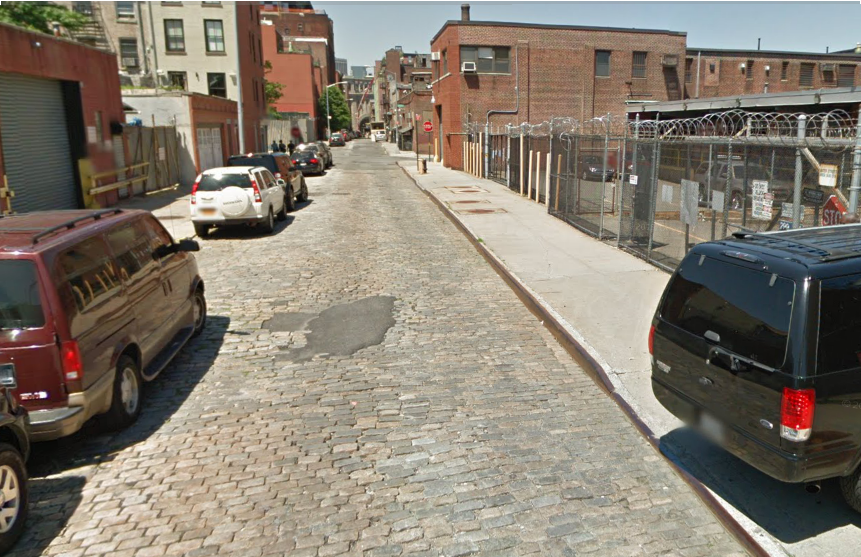
Regular readers of this blog will know that I have little patience for or sympathy with those who argue against bike and pedestrian infrastructure on purely aesthetic grounds. I’m still fascinated by the true motivations of people who make this argument, however. That’s one reason I’ve been following the minor controversy surrounding the stretch of the Brooklyn Waterfront Greenway that has been proposed for Vinegar Hill.
The Department of Transportation and the Brooklyn Greenway Initiative chose six blocks of the Belgian blocked Water Street in Vinegar Hill as part of the new bike lane.
In response The Vinegar Hill Neighbor Association released a petition, currently signed by Chadwick and over 80 others, stating “the use of Vinegar Hill by the Greenway would pose a danger to pedestrians, to motorists, to our Belgian block cobblestones, and to the historic character of our neighborhood.”
It’s hard to argue taste, but when one throws the vague spectre of dangers to pedestrians and motorists as the reason for objecting bicycle access to a particular street, the “historic character” part of your anti-bike-lane case becomes all the more suspect. Why? Because in at least two or three years of bikelash-related nonsense, none of the predictions made by bike lane opponents across the city have come to pass. If you believe bikes cause a unique threat to pedestrians and motorists, we’re at the point in the city’s relationship with bikes where it’s on you to prove it. (That’s how you know the bikes won: we’ve finally moved from “This Isn’t Amsterdam!” to “This isn’t Park Slope!”)
I had a look at the VHNA petition on Change.org to see what specific dangers the organization believes the Greenway will pose. It seems like the biggest risks are to the free-flowing movement and free storage of cars.
The narrowness of Hudson Avenue cannot accommodate two lanes of cyclists, two lanes of cars, and also parking.
Bikes don’t cause congestion. Period. They may cause drivers to slow down to speeds below the legal limit, but that’s probably something anyone who’s driven on Vinegar Hill’s cobblestone streets is used to anyway. And if a sense of historic preservation is at the heart of your objection to the Greenway, it seems hard to argue that the bikes can’t come in to your 19th Century neighborhood but the parked cars are free to stay as long as alternate side parking rules aren’t in effect. Here’s how Bike Snob put it when a similar group of local residents objected to proposed Citi Bike station locations in historic Fort Greene last summer:
…do you know what else they didn’t have in the twenty-five year period between 1855 and 1880 that is embodied by this neighborhood? Streets lined with cars! How are a bunch of Subarus and idling Fresh Direct trucks more in keeping with the landmark character of a neighborhood than a bike docking station? You don’t get to ditch the bike share but keep the free car parking. I’m willing to defer to their argument if and only if the people of this neighborhood are willing to preserve their neighborhood’s unique “sense of place” by eschewing alltrappings of life post-1880 while within the boundaries of their landmarked district. That means period-correct clothing only, and no cellphones, no computers, and no electricity.
The VHNA petition uses the scare tactic of a neighborhood overwhelmed by bicycles as further grounds for opposing the Greenway:
The Greenway and D.O.T.’s Implementation Plan would occupy with cyclists a full six city blocks of our small, ten-block neighborhood. This would introduce a volume of cycle traffic disproportionate to that absorbed more easily by larger neighborhoods. This is true especially considering that more than 1,000 cyclists per day are already using the Flushing Avenue segment of the Greenway.
Flushing Avenue does indeed have a high volume of bicycle traffic, but most of it is likely comprised of people going to and from work. For the petition’s claim to be true, one has to believe that a significant portion of weekday commuter cyclists who currently take this route to the Manhattan Bridge…

…would suddenly prefer a route that looks more like this:
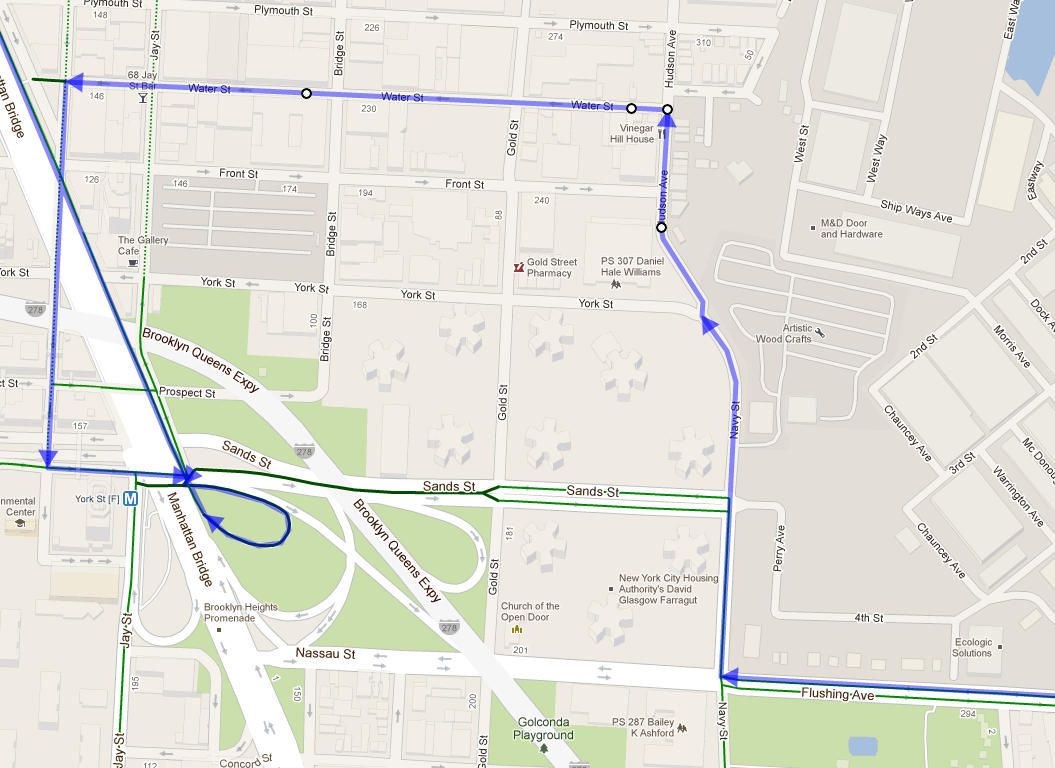
Seems unlikely, no? Weekends would be a different story, of course, since one goal of the Brooklyn Waterfront Greenway is to allow cyclists to explore the Brooklyn’s many waterfront neighborhoods, but I doubt it would be too much for Vinegar Hill to handle.
As for the aesthetic objections, it’s not as if DOT is planning to pave over the Belgian Blocks with black tar and slap down yellow and white paint. According to DNAinfo, “DOT plans to construct the bike lane using smooth machine-made cobblestones making it easier for bikers to use the streets.” This is about access to a neighborhood for non-motorized transportation. You’d think that would be something to celebrate in a neighborhood that was developed in the early 19th Century.
If you’re interested in the Brooklyn Waterfront Greenway route through Vinegar Hill, a third public workshop will be held this Wednesday, March 20 at 6 PM at NYU Poly Incubator, 20 Jay Street, 3rd floor.
The “A” Word
If you want to know why today’s announcement that the NYPD will no longer use the term “Accident” when referring to traffic collisions is so significant, look no further than this New York Times report by Jule Turkewitz of a crash that killed a 16-year-old boy today in Queens. (All emphasis mine.)
Witnesses said a dark red Dodge Caravan was westbound on Thomson Avenue when it apparently lost control around 10:30 a.m., striking a group of pedestrians as they waited to cross the intersection at 30th Street.
For something to lose control, it first has to have the ability to be in control. A van, of course, is in control of nothing. John Del Signore at Gothamist does a much better job describing what happened, putting the control of the van in the hands of a driver:
The driver of a Dodge minivan “apparently lost control and mounted the sidewalk” at 30th Street and Thompson Avenue in Long Island City this morning, running over at least five pedestrians, according to the NYPD press office.
Turkewitz continues:
“A group of students waited at the cross signal and this car came very fast,” said Mustafa Elmor, 25, who was standing across the street from the accident when it occurred.
How does anyone at the Times know this was an “accident”? Was the the driver speeding? Distracted? Drunk? If the answer to any of these questions is “yes,” then this was no accident. As Ray Kelly said, “accident” gives “the inaccurate impression or connotation that there is no fault or liability associated with a specific event.”
The driver of the van makes just one appearance in this story, and while some may take his apology as an admission of fault, it also could be interpreted as an absolution of responsibility:
A person emerged from the car screaming, “’I’m sorry, I’m sorry.'”
By appearing in the story so late and with such an apologetic tone, it appears as if the driver is as much a victim of an “out-of-control” van as the dead teenager. He’s just Mickey Mouse, unable to reign in a bunch of out-of-control broomsticks.
Six paragraphs into the story, a witness is given his turn:
The car was speeding, John said. “I saw this kid with green cargo pants literally flying.”
So, if the driver was in fact speeding, we’ve answered one of the questions I pose above.
Turkewitz does use the term “crash” elsewhere in the story, but as Eric McClure points out, it may be more for stylistic variety than journalistic integrity. Nevertheless, it’s not long before the dreaded “A” word is used again.
Around 12.30 p.m., hundreds of students blanketed the sidewalk across the street from the accident.
I never thought I’d write these words, but maybe the New York Times needs to start taking cues from the NYPD.
UPDATE: An earlier version of this post misidentified a witness. Mustafa Elmor was a bystander and witness to the crash, while the driver’s name has not been released. The post has been revised and I apologize for the error.
Sponsored Post: The Moving 212
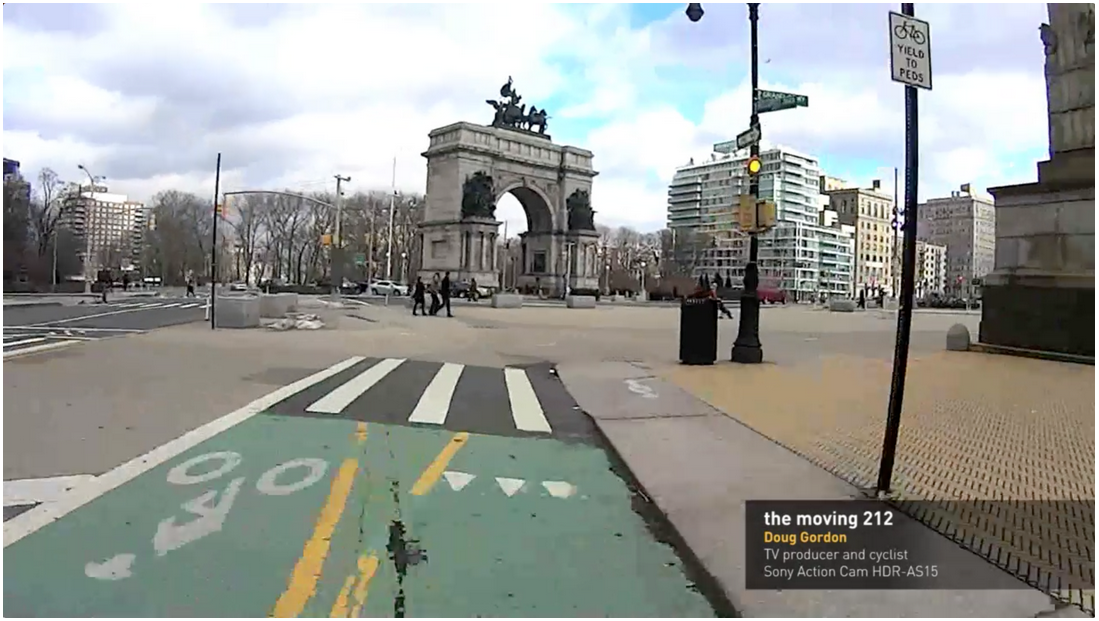
I was contacted by Sony a couple of months ago and asked to participate in “The Moving 212,” a promotion for the Sony Action Cam. In exchange for shooting some bike rides and posting images here, I was allowed to keep the camera. Starting on Saturday, March 9th you’ll be able to catch some of the footage I shot on in-store monitors at the Sony Store (550 Madison Avenue). I wanted to feature a nice green bike lane so naturally I headed to Prospect Park West where I got some great contra-flow action, as seen in the still above. The footage will be on display through March 22nd and hopefully will present a nice image of protected bike lanes to people who head into the Sony Store.
I plan to use the Action Cam for advocacy purposes soon. Jay Street, I’m looking at you.
Little Z

Please welcome the newest advocate for safe streets, Zebulon (Zeb) Gordon, born Sunday morning. As you’ll probably understand, I’m taking a brief hiatus from blogging until things settle down. I’m still active on Twitter, so look for me over there every now and then.
You’ll be happy to know that Z’s big sister has already asked me if the baby can ride to school with her.
The Perils of Running as “Not Bloomberg”
Missing from Matt Flegenheimer’s otherwise excellent piece on the mayoral candidates and their position on bike lanes is a satisfactory explanation of why, precisely, none of them seem willing to wholeheartedly embrace the proven and popular street changes that have been implemented during the Bloomberg administration. (Changes that I’ve noted are now being copied at a rapid pace by forward-thinking mayors of other cities, large and small.)
Thankfully, Dana Rubenstein of Capital New York provides some theories.
…the candidates have their reasons for criticizing the administration’s bike policy, beyond whatever sympathy they actually have for people who find it annoying.
For one thing, the city’s tabloids, ostensibly channeling the anger of car owners, have staked out deeply unfriendly positions toward bike lanes, and toward their proponents.
More importantly, all of the candidates, but particularly the ones interested in winning the Democratic primary, must say that they intend to do things differently and better than the incumbent has.
(I think things are perfectly fine and intend to allow things to go on precisely as they have for the past 11 years is a bad look, in any election.)
So as is the case with policing (where almost all the Democratic candidates support stop-and-frisk in some form) and education (where all the Democratic candidates support Bloomberg’s signature achievement of mayoral control), they express displeasure with the status quo and talk about making the decision-making process more democratic without actually promising to reverse course completely.
She’s right on both counts.
It’s a shame that the need for an endorsement from the Post or Daily News trumps a sound investment in safety and an investment in New York’s future economic health, but that’s to be expected when no Democratic candidate has the deep pockets of a Bloomberg. It’s an even bigger shame when the desire to be “not Bloomberg” means that a program that has the power to save lives get thrown under the bus. It’s like Mitt Romney trying to distance himself from his signature achievement, health care. Yes, it may placate an angry base and get you through the primary, but it makes for some seemingly untruthful statements and contradictory beliefs.
Quote of the Day
If the [bike share] program is successful, and the city has 10,000 residents and tourists biking around congested stretches of midtown and lower Manhattan, there are two options: More bike lanes and added safety, or inadvertent Critical Mass-style road closures and biker fatalities. The candidates for mayor can be the judge of which will be a more effective tool for winning reelection.
 Brooklyn Spoke