“In the end, those are just words.”
Via Sarah Goodyear at Atlantic Cities:
Drivers, cyclists, and pedestrians all compete for space and safety on the streets and roads of the world’s cities and suburbs. It’s a contentious and sometimes ugly coexistence, which is why so many government agencies and advocacy groups periodically mount public-awareness campaigns with messages like “share the road” or “don’t be a jerk” or “respect other road users.”
In the end, those are just words. The ultimate form of respect for any road user is properly designed infrastructure that allows that a person to travel with comfort and safety using their preferred mode. In the United States, it’s clear who gets real respect (and infrastructure spending) on a regular basis. That would be the people driving cars.
My Ben Yachid
Gothamist’s Christopher Robbins explains why irrational bike hate — which can even appear in a movie review — is so damaging to the overall goal of safer streets.
…bloodthirsty screeds like Leitch’s also contribute to the warped, anti-cycling mentality that the media willfully exploits, and echoes into a real world in which investigating the senseless death of a loved one is not a priority if they happened to be riding a bike.
Robbins continues:
You could forgive cyclists for believing that there is a spiteful cabal conspiring to promote falsehoods about bikes and the people who ride them, because there is. Emails obtained by Streetsblog show that former deputy mayor Norman Steisel and former DOT Commissioner Iris Weinshall (oh, did we mention she’s also Senator Chuck Schumer’s wife?) used their media connections to manipulate coverage of the dispute over the Prospect Park West bike lane. The coverage contained half-truths and altogether pitiful reporting to gin up outrage at “the cyclists,” (one of whom happens to be Chuck Schumer. Awkward!)
And if nearly every newspaper (or website) in town denounces cyclists as law-breaking assholes, why should the NYPD devote resources to investigate when they are injured or killed?
My wife often tells her congregants a story of a yeshiva with a stellar reputation for the kindness and compassion of its graduates. One day, the head of the yeshiva receives a visitor who’s curious about how the school has earned its reputation. The head of the yeshiva takes the visitor on a tour of the school and when then reach the first class room he points to a student and says, “Do you see that boy over there? That is my ben yachid, my only son.” The visitor exclaims, “How wonderful that your only son attends your school!”
The two continue to the next classroom and the head of the yeshiva once again says, “Do you see that boy over there? That is my ben yachid, my only son.” This confuses the visitor, but not wanting to offend his host, he just nods and follows the head of the yeshiva down the hall. They reach a third classroom and the head of the yeshiva points through the door and says, “Do you see that boy over there? That is my ben yachid, my only son.”
This continues as the two men visit a fourth, a fifth, and a sixth classroom. Finally, the visitor can’t contain his confusion any longer and says, “Sir, how is it possible that in every classroom you point to a different boy and say that he is your only son?”
“You came here wanting to know how our school sends such kind and compassionate graduates out in the world,” the head of the yeshiva responds. “Here is the answer: I tell my teachers that our students should all be treated as if each one of them is our ben yachid, our only son.”
This story speaks to a deep truth that I believe about how to make our city safer, and it has nothing to do with infrastructure. Instead of demonizing cyclists because they’ve “taken over” the city or labeling people as “smug” or “entitled” simply because they don’t want to get hit by trucks, we must understand that every person with whom we share the road — as well as every victim of traffic violence — is someone’s son or someone’s daughter. It may be pie-in-the-sky, Polyanna-esque thinking, but the quest for page views shouldn’t trump the basic rules of human decency.
Putting the “real” in Real Estate
At least one Daily News’ real estate writer understands what its editorial and news writers do not. Jason Sheftel makes the connection between bike lanes and Williamsburg’s “white hot” real estate market, as represented by a rental building at 65 N. 5th Street:
Two blocks from Bedford Ave., the building is a short walk or bike ride to anything a twenty- or thirty-something could want in their life. And if you think bike lanes don’t work, take a look at the bike racks on N. Seventh and Driggs Ave. They’re full enough to make anyone a believer.
Jason Sheftel may be the only member of the reality-based community at the Daily News.
Another DIY bike lane

Someone in Pittsburgh drew a bike lane on the street with what looks like chalk. It’s not completely obvious in the picture, but in addition to the green bicycle symbol there are chevrons drawn on the lane.
The Daily News Does Not Understand its Own Narrative
Please note the picture the Daily News uses to illustrate its latest story about “zooming,” “out-of-control,” “speeding menaces on two wheels” who continue to cause “dangerous near misses…and accidents” in Central Park.

Just look at these “speed demons,” won’t you? I mean, there’s absolutely no place for Central Park’s beleaguered pedestrians and joggers to hide from these scofflaws!

It never ceases to amaze me that the agents of the bikelash do not seem able to illustrate their stories correctly. Don’t these people understand their own narrative?
“It’s all used up.”
Writing for the Huffington Post, Dan Collins has an intellectually lazy defense of Bill de Blasio’s “incremental” approach to saving lives:
De Blasio’s call to slow things up certainly sounds reasonable. But remember the rule about space in New York City. It’s all used up. Some in the bike community believe, probably with good reason, that if the city goes slow, progress may stop altogether.
It’s not correct to say that space in New York city is “all used up.” It’s used, but often not for purposes that maximize its potential. Imagine if someone had looked at a young David Walentas and told him that it would be impossible to build condos in DUMBO because of all the old warehouses. “Remember the rule about space in New York City, David. It’s all used up.”
New York City’s story is the story of space that became a different kind of space. Part of the land that is now Prospect Park was purchased from Edward Clarke Litchfield in 1868. Apartments now stand where the Brooklyn Dodgers used to play baseball. West Side Story is set in neighborhoods that were razed to make way for Lincoln Center. Battery Park City is built on dirt excavated during the construction of the World Trade Center. Fresh Kills landfill is now Freshkills Park. And not that it’s a popular example, but there’s a giant spaceship that just landed on top of a rail yard not too far from where I live. New York changes in ways that can benefit the many (Prospect Park) or the few (the Barclays Center), and the merits of those changes will always be debated. But it takes a strange kind of anti-New York defeatism to say that nothing can be changed anymore or that, at most, it has to be done incrementally.
Contra Dan Collins, we actually have plenty of space for bike lanes on just about every street in this city. These lanes could be implemented quickly — radically, if you will — if only people prioritized the safe movement of people more than they do the free storage of private vehicles.
“It’s not an accident…”
WARNING: The above video may be unsettling for some viewers.
This brutal ad from Australia tells a difficult, but necessary truth: when a driver is speeding, it’s impossible to call any crash, injury, or fatality that results an “accident.”
As Aaron Naparstek writes in his recent essay for TA’s Reclaim:
Though it may sometimes seem otherwise, New York City drivers don’t wake up in the morning intending to harm pedestrians and cyclists. Most crashes are unintentional and “accident” is not an inaccurate word to describe them. But the fact remains: Driver negligence is the number one cause of crashes, and it’s no big surprise—or accident—when negligent driving hurts and kills people on crowded city streets. In fact, our legal system has a word for this type of unintentional killing: “Manslaughter.”
I always am amazed when drivers use the “I didn’t see him!” excuse after hitting a cyclist or pedestrian in New York City. You’re driving in one of the most densely populated urban environments in the world…what did you expect to see?
The Solo Cup Bike Lane
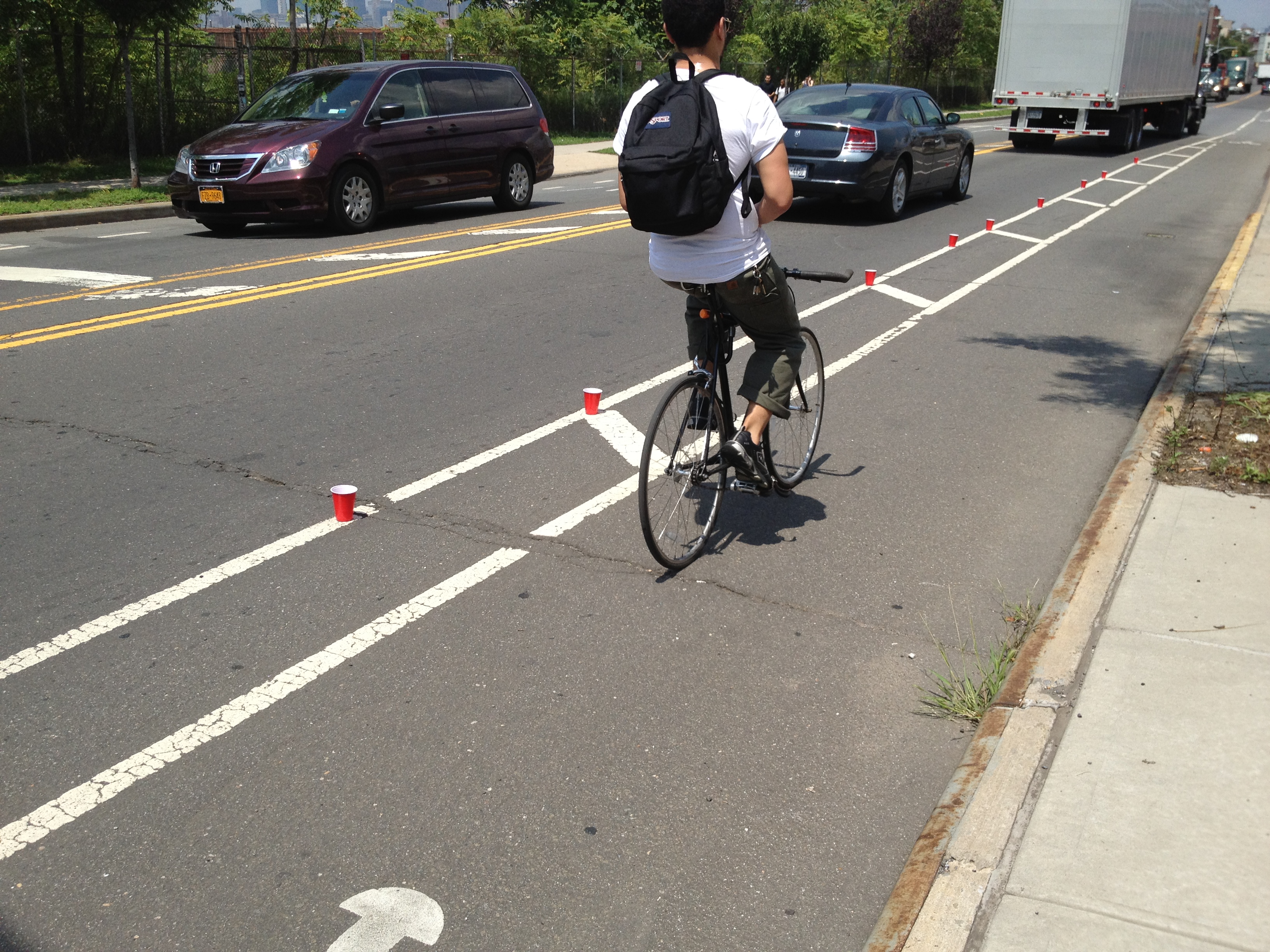
Inspired by Ian Dutton’s Guerilla Bike Lane, I started to think about other, more basic ways to separate drivers from cyclists in the city. Plastic delineators are nice, and a row of parked cars is even better, but sometimes all it takes is very simple approach. Some bike lanes can be separated from car lanes by little more than a raised curb and be quite effective. While such a design isn’t going to stop an out-of-control driver from crashing into cyclists or pedestrians, it can deter motorists from parking in the bike lane, with a few notable exceptions.
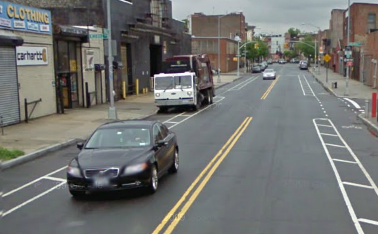
A few weeks ago I had plans to meet a friend in Greenpoint. Before I left I remembered that while the Kent Avenue bike lane is perhaps the gold standard of protected cycling infrastructure in the city, the physical separation switches to a mere painted buffer after North 13th Street. At North 14th Street, where Kent turns into Franklin Street, even the green paint disappears. I also remembered that Franklin Street is a favorite resting spot of livery car drivers and truckers who frequently park their vehicles in the bike lane and wide buffer. It’s not an exact match of the location where the bike lane switches from protected to buffered, but this screen grap from Google Maps shows a garbage truck parked in the Franklin Street bike lane:
The Guerilla Bike Lane on Bergen Street relied on some leftover plastic delineators, but since I wasn’t likely to happen upon such tools by chance–and definitely wasn’t about to haul a dozen of them on my rear rack–I decided to bring about as basic a “delineator” as I could find: plastic cups. In addition to their small size and low cost, they offered some other advantages:
- The red color would make them more visible against white thermoplastic and black pavement.
- They could be easily driven over by a fire truck or other emergency vehicle.
- If hit by a car, the only damage would be to the cups.
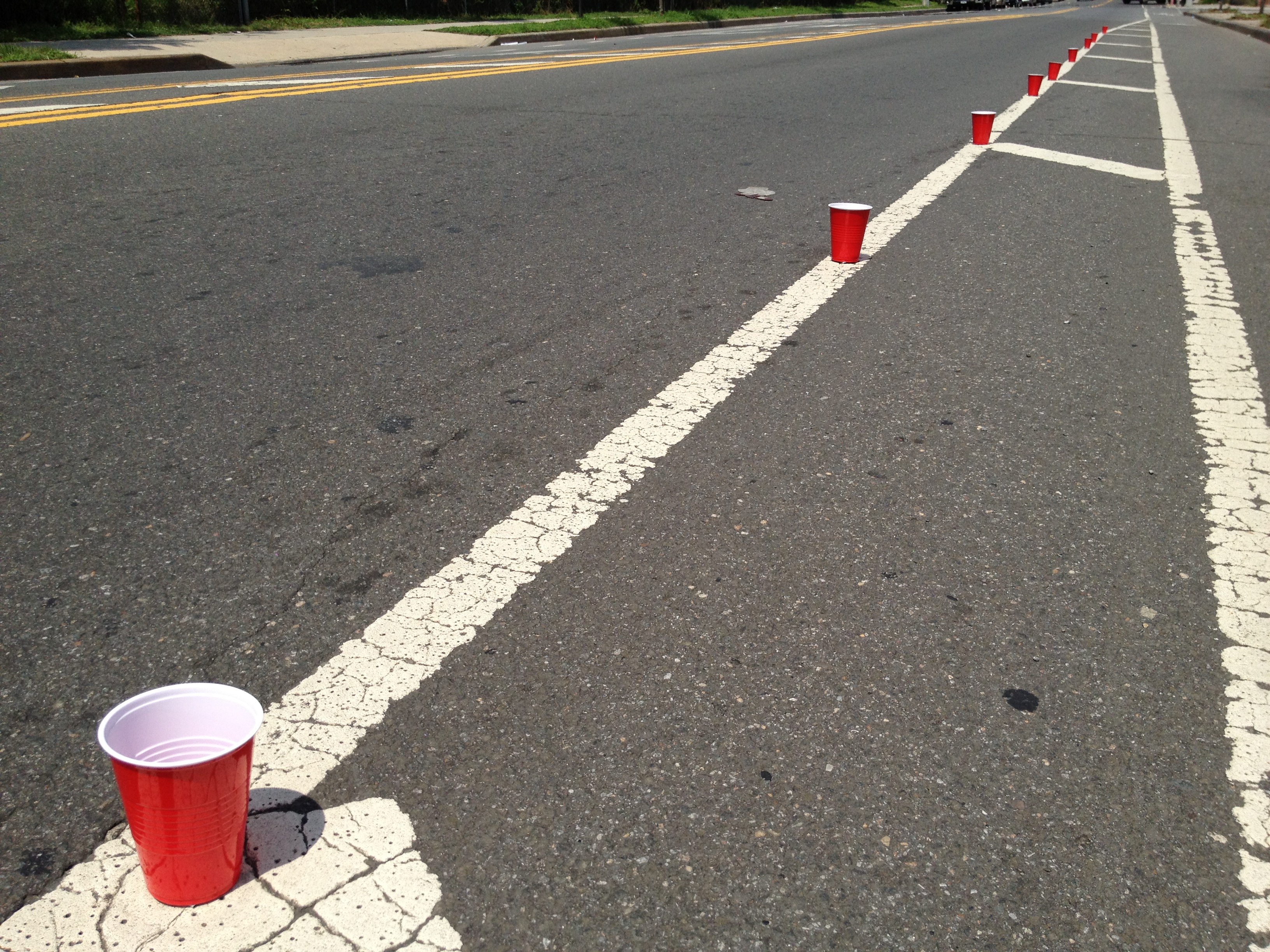
So, armed with a stack of cups and a roll of duct tape, I set out for Franklin Street and stopped shortly after North 14th Street. There, I set up this makeshift bike lane:
I stuck around to see how well it would stand up to traffic, which was light of both bicycles and motor vehicles. But what traffic there was tended to respect the bike lane, at least for awhile:
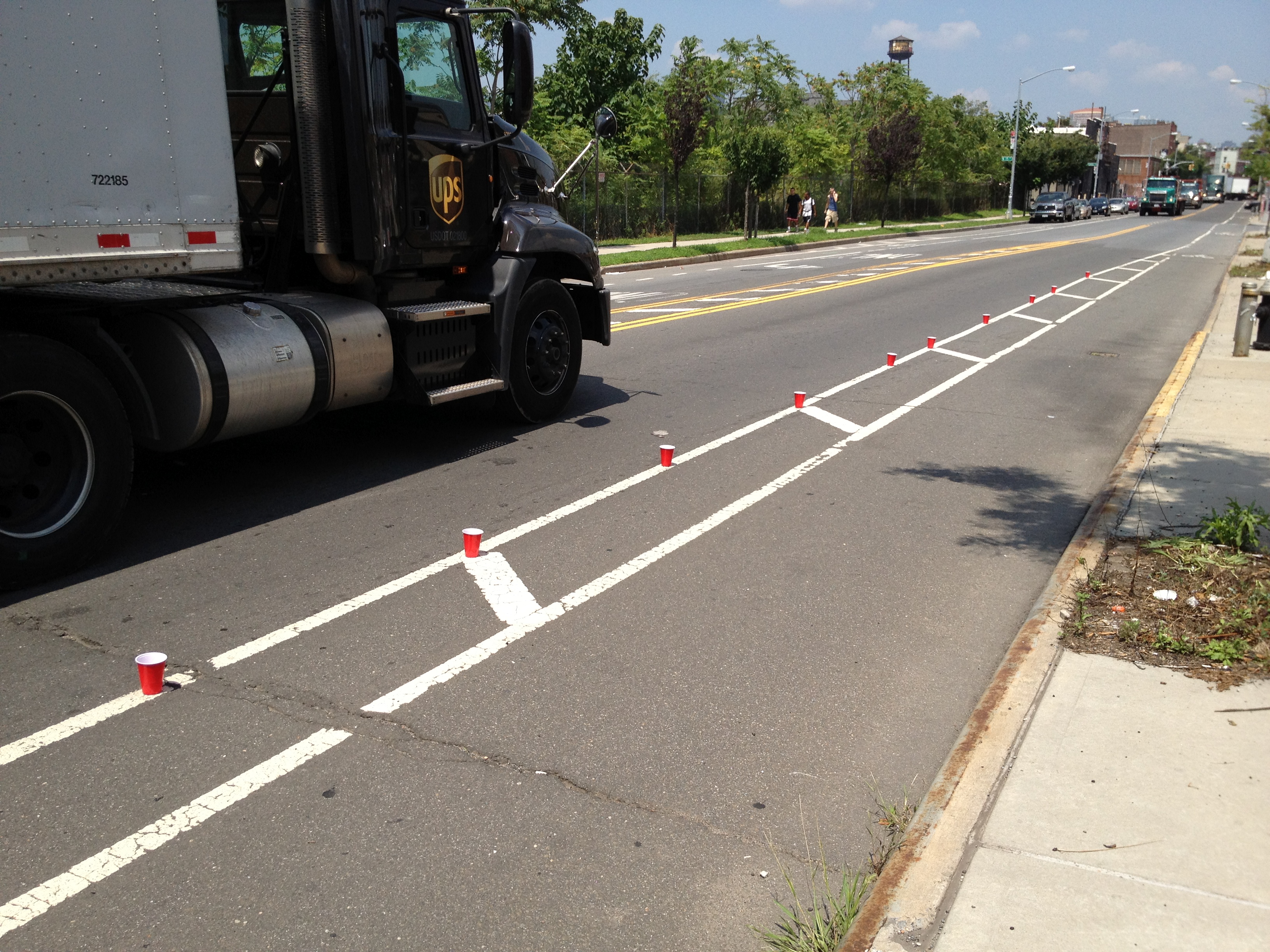
In fact, the cups seemed to be doing such a good job that one rider cruised by hands-free before tucking back down on his handlebars just at the end of the buffer.
James Schwartz of The Urban Country had similar results when he and Dave Meslin of the Toronto Cyclists Union created the “Trashy Bike Lane” to show how a simple new street design could improve safety at a location where a pregnant woman had been crushed by a truck while on her way to pick up her son at school.
After monitoring the bike lane for a little while and seeing no incursions by motor vehicles, I left to meet my friend. A more direct route to my daughter’s daycare meant that I didn’t take Franklin Street home, so I never got to check on the cups. I doubt they survived very long, since they eventually would have been crushed by a drifting driver, knocked over by a poorly executed bike slalomer, or swept up by a sanitation truck. But while using red Solo Cups may inspire a few jokes about Brooklyn hipsters and bike lane versions of beer pong, my little experiment did provide at least a modicum of evidence that very basic forms of separation can make big differences when it comes to defining road space for different users.
Open and Shut

Last week I biked my daughter into the city to enjoy Summer Streets, an event that has easily become one of favorite things about summer in New York City. Let’s hope it eventually expands into something called City Streets and happens every weekend all year long.
While riding downtown toward the Brooklyn Bridge, I noticed one of these signs. Note that it says, “Streets Open at 1 PM.” It instantly reminded of this 2011 Cap’n Transit post:
Several times I heard and read reference to the street being “closed,” and at 1:00 I heard repeated announcements that they were going to “open it up again.”
To someone like me, who rarely takes taxis and drives even less, when cars are allowed it doesn’t feel “open” to me. It’s open to me for three mornings a year, and pretty unavailable the rest of the time. Repeating over and over again that Park Avenue will be “opened up again” emphasizes that we don’t belong.
A few times I’ve stayed on one of the streets and been directly addressed by the staff, who don’t seem to be aware that bicycles are allowed on the streets even when Summer Streets is over. Last week a bunch of us were traveling the right direction in the Centre Street bike lane and got yelled at.
A more neutral framing would be to simply say, “Cars will be allowed on the street again. Be careful of the cars; they can kill you. Pedestrians move to the sidewalk, and bicycles move to the right.”
It’s hard to not feel how “open” the streets are when you’re having your picture taken in front of the statue of Cornelius Vanderbilt, a spot that is typically closed as far as pedestrians and cyclists are concerned. It’s the same way I feel about how people often refer to Times Square: the city didn’t close it to traffic but rather opened it to people. So if one of the points of Summer Streets is to serve as positive marketing for people-centric streets and the department’s ambitious agenda, let’s hope the next time a new batch of signs needs to be printed DOT changes the wording to say, “Streets re-open to motor vehicles at 1 PM,” or even the completely neutral “Summer Streets ends at 1 PM.”
Tomorrow’s Summer Streets is the final one of 2012. See you there!
Car & Driver
“Syncing Traffic Lights Isn’t the Fix Everyone Says it Is,” via The Atlantic Cities:
…if you make it easier and cheaper and faster for people to drive, more people drive. It’s Jevons paradox, applied to the city — if you make it more efficient to use a resource, more of that resource will get used.
There’s a fun fallacy at work here. Changing the conditions of traffic flow changes the entire environment of the city. And re-creating conditions across the scope of a city which make one car more productive fail to account for the fact that, in a city, you’re never just dealing with one car. You’re not even dealing with one car many times. You’re dealing with a whole environment of cars, and traffic-light-syncing, while it leads to many single cars having a faster trip, doesn’t account – as a policy – for changes to the whole environment.
I’d also add that you’re not dealing with cars — you’re dealing with drivers. And drivers have their own peculiar ways of thwarting even the best traffic models.
 Brooklyn Spoke