“Painted lines do not do enough to protect our children.”

This is how drivers "share" a bike lane.
I don’t normally quote comments from other sites, but this one from the Brooklyn Paper’s story on NBBL’s latest legal threat crystalized a lot of what I believe as an activist, a bike commuter, and, above all else, a father.
“Protected bike lanes are not just nice-to-have for us, as parents. They are critical safety measures. One of our kids has already suffered life-altering injuries when using a so-called ‘shared’ bike lane.
That’s my bias. Here’s my observation: many automobile drivers do not ‘share’ the road well. Local law enforcement–from my point of view–tends to side with the drivers. That’s why real physical barriers are necessary. Painted lines do not do enough to protect our children.”
“I was only speeding slightly.”
Via Copenhagenize and Bicycle Dutch.
In case after case where a cyclist or pedestrian is hit and killed by a motorist, the excuse told to police or the press is always the same: “He came out of nowhere.” But in a city one needs to expect people to always come “out of nowhere” and to drive in a manner that can deal with the unexpected. Translated to the Rumsfeldian, drivers must constantly be ready for the “known unknowns” of urban driving and slow the heck down.
The Dutch understand this in their bones and as such have produced this public service campaign artfully dismantling the reasons drivers have for speeding, even slightly. Needless to say, none of them are more important than another person’s life. Compare this campaign–essentially a form of public shaming–to DOT’s physics lessons for New York City drivers.
We all do it every now and then: speeding slightly. Sometimes fully aware, to catch up some lost time and sometimes unaware because we lost focus or we weren’t paying enough attention. Whatever the reason, (slightly) speeding is always very dangerous. Especially in the built up area where there are always unexpected traffic situations. And where you have to deal with vulnerable traffic users like children, elderly and cyclists. Not protected by airbags and seat belts they are the ones who have the largest risk to get seriously injured. Or worse…
And how do the Dutch define speeding slightly? As going over 30 kilometers per hour, which probably sounds absurdly slow to New York City drivers versed in the metric system.
Prospect Park West Improvements Coming This Month
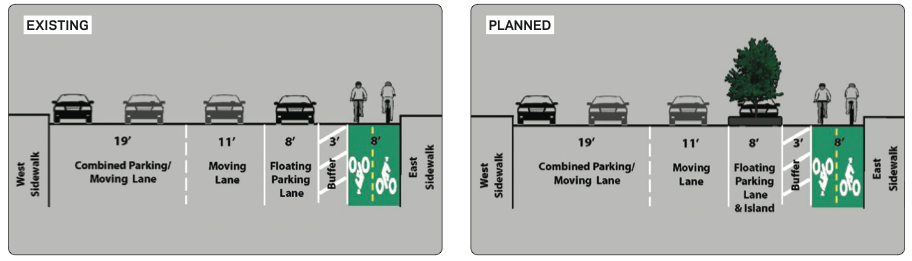
Click to enlarge.
DOT has announced that the long-awaited improvements to the Prospect Park West bike lane will begin to be implemented on April 23rd. The plan includes:
- 14 pedestrian islands with space for tree plantings
- Relocating pedestrian signals from the east sidewalk to the new pedestrian islands
Community Board 6 had earlier requested that DOT use historically appropriate materials to match the sidewalks along the park, which are not made of your standard New York City cement. (Waiting for the right materials was one reason for the delay in beginning this project.) By the time the improvements are finished the plastic delineator posts, pavement markings, and other current markings will be replaced with more aesthetically pleasing enhancements that will also improve visibility and prevent vehicles from parking in areas meant for pedestrians.
The Case for a Two-Way Protected Bike Lane on Plaza Street
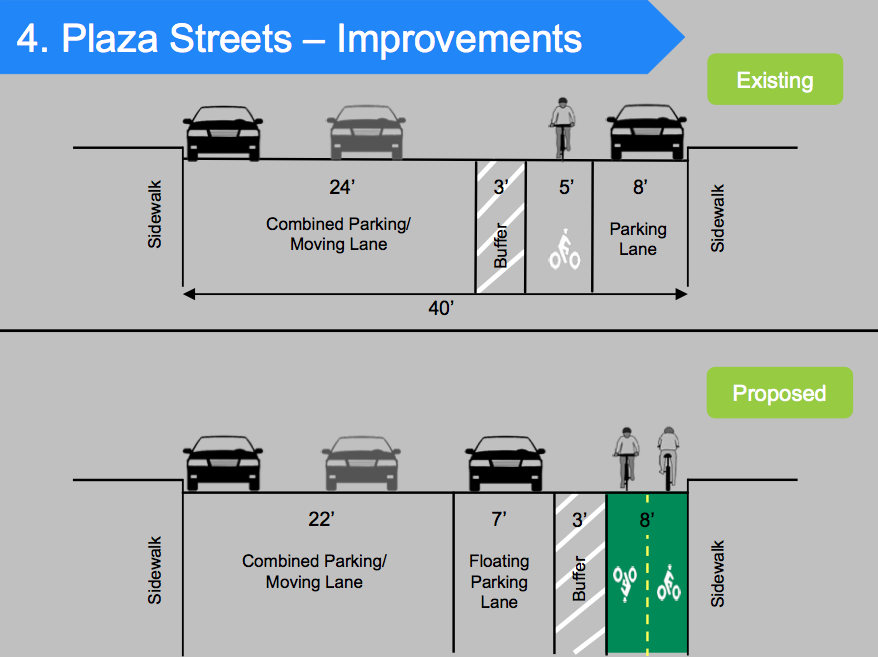
DOT's original April 2010 plan for a two-way protected bike lane on Plaza Street.
Mike Epstein is a dedicated livable streets advocate, a member of Brooklyn’s Community Board 2, and serves on the board of Transportation Alternatives. He submits the following to Brooklyn Spoke.
In April 2010, DOT proposed an overhaul of the chaotic and dangerous Grand Army Plaza to include two-way protected bike lanes on Plaza Street East and West. (Plaza Street is not the high-speed roadway around the arch and fountain, but rather the less trafficked outer roadways, which already have one-way buffered bike lanes. Plaza Street is fronted on one side by residential buildings and on the other side by planted berms.) DOT’s proposal [PDF} used the existing footprint of the bike lane and parking lane, as well as two more feet from the very wide moving lane, to flip the parking lane and bike lane, putting a two-way bike lane against the berm side of Plaza Street, protected by parked cars — a design nearly identical to that of the redesigned Prospect Park West.
DOT’s Grand Army Plaza overhaul was eventually constructed in 2011 minus the protected bike lanes, some say as a result of the political blowback from the Prospect Park West bike lane lawsuit. With the suit now dismissed and the safety and congestion fears of bike lane opponents completely discredited, DOT will re-introduce a proposal for two-way bike lanes around Plaza Street. However, the Brooklyn Paper and other sources indicate that the city might propose two alternatives: one protected by parked cars, as in the 2010 plan, and one unprotected (yet still two-way). This is odd, given the phenomenal success of the Prospect Park West redesign; a meeting next week may be the public’s only chance to speak out for a well-designed, safe, protected bike lane on Plaza Street.
An unprotected two-way lane would essentially take over the existing bike lane’s footprint, with a painted buffer between the bike lane and moving vehicles and bright green paint on the bike lane itself, but would not alter the position of parked cars on the street. This presents a bit of a conundrum: how can DOT protect contra-flow cyclists from moving vehicles, and where does DOT expect cyclists to ride while the bike lane is blocked by double-parked vehicles, motorists awaiting parking spaces, and drivers (quite legally) entering and leaving parking spaces?
It appears that the unprotected proposal is, at least in part, a response to a few local residents’ concerns that relocating parked cars would narrow the roadway on Plaza Street and cause traffic backups every time someone double parks. But this concern fails on two levels. First, even with a protected bike lane, much of Plaza Street would still remain wide enough to accommodate a double parked vehicle and room for motorists to pass — and emergency vehicles could legally drive in a protected bike lane at any time if they needed to. Second, and perhaps more importantly, since when do we design our streets primarily to facilitate illegal and anti-social acts of double parking, as opposed to protecting our most vulnerable street users?
A protected bike lane would use the footprint of the existing bike lane and swap it with parked cars, still leaving room for motorists to safely pass double-parked vehicles.
Moreover, support for retaining a street wide enough for moving vehicles to speed around illegally double-parked vehicles is a tacit admission that motorists see bike lanes as extra space for their vehicles. They might generously extend to cyclists the privilege to occasionally ride in the bike lane when no driver happens to find it convenient to park in it or drive in it, but cyclists are really an afterthought. Because, of course, if we are to design our streets to allow double parking, then we expect double parking to happen often, and we expect motorists not to hesitate to go around the double parkers.
Herein lies the true issue with an unprotected design: if motorists double-park in the moving lane and keep the bike lane clear, other drivers will have to choose between waiting behind an idling car or using the bike lane as a passing lane. The more likely scenario is that motorists will idle in the bike lane, but in either case cyclists will find their path frequently blocked by motorists.
In the case of a one-way bike lane, cyclists are used to merging with vehicular traffic to maneuver around obstacles, but there’s no precedent for what happens when legal contra-flow cyclists with the right of way approach double-parked cars and have to negotiate with impatient motorists heading in the other direction. In many cases, contra-flow cyclists will actually be forced out into oncoming traffic.
Without a protected bike lane, contra-flow cyclists will find themselves riding head-on into speeding traffic using the bike lane as a passing lane.
The situation would be even worse on Plaza Street than on most streets: the curve of Plaza Street reduces visibility substantially, and double-parked vehicles would further limit this visibility. This curve is another reason why a curbside, parking-protected two-way bike lane is absolutely essential on Plaza Street. No sane parent would allow their child to confront these conditions by riding contra-flow in an unprotected two-way bike lane.
To my knowledge, no other two-way bike lane in New York City requires automobile drivers to cross the bike lane to enter and exit parking spots. (Is this design in use anywhere in the world?) The few on-street two-way bike lanes in New York are either parking-protected (like Prospect Park West and Kent Avenue) or curbside (like the short connector path between Ocean Parkway and Park Circle and the proposed two-way bike lane on Central Park’s 72nd Street transverse). And there are a number of barrier-protected paths, like those on Flushing Avenue. All of those paths work well and keep cyclists safe precisely because they actively prevent the mixing of cyclists with moving vehicles.
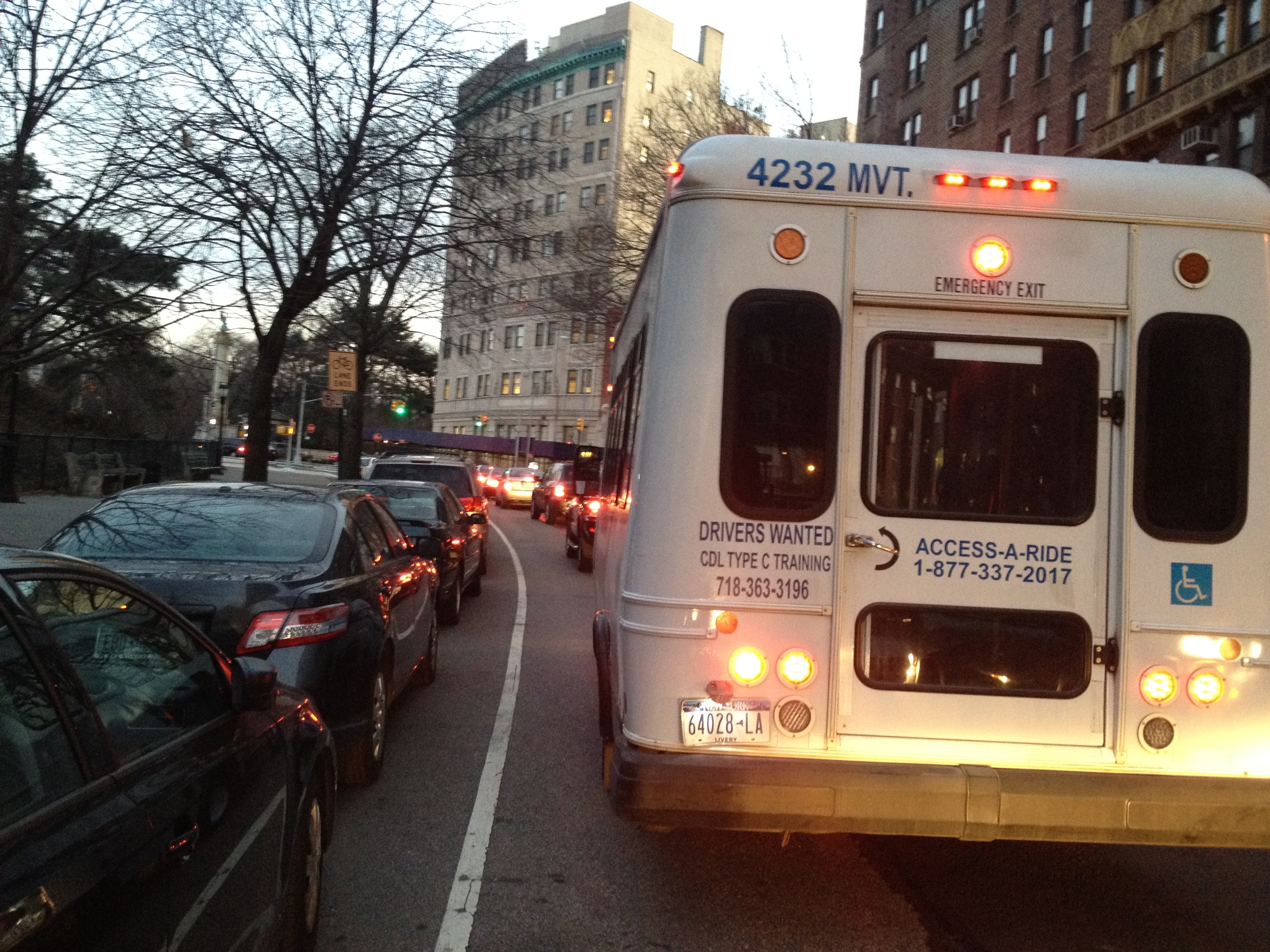
Will painting this lane green deter motorists from driving in it?
On Plaza Street cyclists would play chicken with drivers hundreds or even thousands of times a day: it would never be clear who had the right of way, the moving car or truck or the contra-flow cyclist forced into traffic by a blocked bike lane. Green paint alone does not, and cannot, resolve these conflicts. And impatient drivers already travel in the existing unprotected bike lane, creating an illegal extra vehicle lane at rush hour. This behavior, already dangerous, is not likely to change and could become tragic with contra-flow cyclists added to the mix.
We already know that a community-supported, two-way, parking-protected bike lane works phenomenally well on Prospect Park West, and in many ways Plaza Street is simply an extension of that bike lane and a vital connector to points north and west. We also know from experience all over the city that an unprotected path encourages conflicts with drivers seeking parking spaces, would inevitably be double-parked in, would likely be used by aggressively passing motorists, and in all of these ways would be unsafe for cyclists — and motorists.
Now we need to let the Community Boards and DOT know: no unprotected two-way bike lane for Plaza Street! Come stand up for a parking-protected design, similar to the wildly successful Prospect Park West bike lane, at the joint meeting of the Community Board 6 and 8 Transportation Committees:
Thursday, April 19, 6:30 pm
Turner Room, Prospect Park Residence
1 Prospect Park West (at Union Street)
You can also contact the offices of the two council members whose districts cover Grand Army Plaza to ask them to stand up for safe streets:
Stephen Levin (west half of Grand Army Plaza)
718-875-5200
slevin@council.nyc.gov
Letitia James (east half of Grand Army Plaza)
718-260-9191
ljames@council.nyc.gov
“City fathers have to choose. Cars or bicycles.”
Hat tip: Copenhagenize.
As the host of the UK’s Top Gear, Jeremy Clarkson doesn’t exactly scream livable streets advocate, but apparently he has a few things to say about bikes, cars, and what makes a city great.
I’ve decided that the world’s five best cities are, in order: San Francisco, London, Damascus, Rome and Copenhagen. It’s fan-bleeding-tastic. And best of all: there are no bloody cars cluttering the place up. Almost everyone goes almost everywhere on a bicycle.
“Now I know that sounds like the ninth circle of hell, but that’s because you live in Britain, where cars and bikes share the road space. This cannot and does not work. It’s like putting a dog and a cat in a cage and expecting them to get along. They won’t, and as a result London is currently hosting an undeclared war. I am constantly irritated by cyclists and I’m sure they’re constantly irritated by me.
“City fathers have to choose. Cars or bicycles. And in Copenhagen they’ve gone for the bike.
“In Britain cycling is a political statement. You have a camera on your helmet so that motorists who carve you up can be pilloried on YouTube. You have shorts. You have a beard and an attitude. You wear a uniform. Cycling has become the outdoorsy wing of the NUM and CND.
“In Copenhagen it’s just a pleasant way of getting about. Nobody wears a helmet. Nobody wears high-visibility clothing. You just wear what you need to be wearing at your destination. For girls that appears to be very short skirts. And nobody rides their bike as if they’re in the Tour de France. This would make them sweaty and unattractive, so they travel just fast enough to maintain their balance.
“The upshot is a city that works. It’s pleasing to look at. It’s astonishingly quiet. It’s safe. And no one wastes half their life looking for a parking space. I’d live there in a heartbeat.”
The New Prospect Park Loop Design
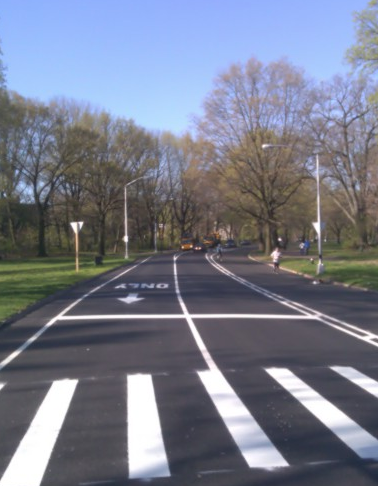
Via Noah Budnick. It looks like the new road design in Prospect Park will be ready sometime this week, although I’m assuming it depends on when they can paint bicycle and pedestrian symbols on the ground. As you can see from the picture in the background, cars are still driving in two lanes.
While I’m glad to see things moving in this direction, it’s important to ask how that white stripe of paint in the middle will protect cyclists, runners, and pedestrians from drivers using the park as a raceway.
Going with the Contra-Flow
Peter Furth, a professor of transportation engineering at Northeastern University, responds to complaints about a contra-flow bike lane in Brookline, Massachusetts. It’s a highly local issue, and I’m only paying attention because my dad lives in the area, but what struck me were his thoughts on the frequently heard idea that cyclists and motorists should always use streets in exactly the same way:
It rubs some people the wrong way that bikes should be allowed to do things cars aren’t allowed. Well, on every one-way street I know, pedestrians are still allowed to walk two-way; should we outlaw this exception, too? Streets are made one-way for reasons do to with motor vehicles — to keep traffic from cutting through a neighborhood, or because a street is too narrow for a pair of cars to pass. Those reasons don’t apply to pedestrians, and most of the time they don’t apply to bikes, either; so why not limit the restriction to where it’s needed? Based on the same logic, we sometimes apply restrictions to trucks that don’t apply to cars.
Good Friday on the Brooklyn Bridge
If you use the Brooklyn Bridge and ride mid-day, you might want to avoid it tomorrow. This hit my inbox just now:
A large religious processional is planned for Good Friday on the Brooklyn Bridge from Brooklyn into Manhattan from 10:45 a.m. to 12:45 p.m. There will be several thousand participants making it virtually impossible to ride through.
Cyclists heading from Brooklyn to Manhattan should be okay up to 10:45 a.m. if the procession has not arrived at the bridge yet. Cyclists heading from Manhattan to Brooklyn, however, should not enter the bike path unless they are sure they can be all the way across by 10:45.
The Manhattan Bridge is almost always a better alternative to the Brooklyn Bridge and that will be even more true tomorrow. Plan accordingly.
Plaza Street
Painting this bike lane green is not going to stop Access-A-Ride.
Brownstoner, the Brooklyn Paper, and Streetsblog are reporting that a two-way bike lane on Plaza Street is back on the table after being shelved last year. While DOT said it had to do with the scope of the changes of Grand Army Plaza, NBBL’s Louise Hainline had a different theory: ““If we had not done what we’ve been doing with the bike lanes, they probably would have moved ahead.”
I saw the proposed plan for the two-way, unprotected bike lane at a meeting last month, and while it is certainly a step up from the current Plaza Street design, it falls short of being a safe, robust bike lane worthy of connecting to the best bike lane in the city. It’s not something that I’d be completely comfortable riding with my daughter in her seat, nor is it something I’d want her riding on when she’s ready to pedal by herself. In fact, I’m willing to bet that for families seeking a safe way to get to and from the park, greenmarket, library, Botanic Garden, and other attractions around Grand Army Plaza, nothing less than a fully protected bike lane will do.
The only thing that’s changed between 2010, when DOT initially proposed the protected bike lane on Plaza Street and today, when they are prepared to present two options to the local community boards, is one frivolous lawsuit. That’s it. If the community boards were enthusiastic about the plans two years ago, they need to be reminded of that enthusiasm. (They also need to be remembered that every single one of NBBL’s doom-and-gloom predictions failed to come true.) Yes, everyone is weary from focusing on the green paint over on Prospect Park West, but no one should let that get in the way of a common-sense plan to make Plaza Street safer. Some times the only way to get over a controversy is to go directly through it and meet it head on.
Voicing your support for a protected lane is very important, especially if you live in the area. Here’s the contact info for both boards.
Community Board 8:
1291 St. Marks Avenue
Brooklyn, NY 11213
info@brooklyncb8.org
Community Board 6:
250 Baltic Street
Brooklyn , New York 11201-6401
Info@BrooklynCB6.org
Of course, being there in the flesh is better than a letter, so if you can swing it, please come to the joint meeting of CB6 and CB8. It will be held on April 19th and will take place at the Prospect Park Residence, 1 Prospect Park West, at 6:30 PM. See you there.
Chuck Schumer Photo Contest

A reader sends in this tip, via Senator Chuck Schumer’s Facebook page.
Facebook is transitioning to a new Timeline format, and Senator Schumer needs your help in picking a cover photo of New York. From the breathtaking Adirondacks and Niagara Falls, to the rolling vineyards of the Finger Lakes and the historic Catskills, and from the majestic Hudson Valley down through the Big Apple and Long Island to the sands of Montauk, New York State is full of natural (and man-made) beauty, and we want your help in capturing it.
Please send in your favorite high quality photos of New York, along with your name and where the photo was taken, to senatorschumerstaff@gmail.com.
Please remember that the photo must be taken by you, and, please, amateur photographers only – no professionals. We will post the photos as we get them and announce the winner this week.
You know what that means. Please send Chuck’s staff your pictures of people enjoying New York’s beautiful, breathtaking, majestic, man-made bike lanes. There’s nothing that captures New York’s essence quite like a complete street.
If you send in a picture, let me know how it goes.
 Brooklyn Spoke