What’s Wrong with This Picture?
 The commenters below Jane Brody’s otherwise excellent story about the “built-in safety features” of New York City’s new street designs are having a field day with the photo that accompanies the piece. Can you blame them?
Mind Your Manners
Miss Manners takes on a bicycle question:
DEAR MISS MANNERS: Where I live, it is both legal and necessary for cyclists to ride on the sidewalk. If I want to pass a pedestrian who is walking in the middle of the sidewalk, what is the best way to notify that person that I would like him or her to step to the side for a moment?
If I ring the bell on my bicycle, they almost always hear me, but I feel rude dinging at someone. On the other hand, if I say “Excuse me,” they almost never hear until I am practically shouting, which does not feel any less rude than ringing my bell.
This problem is exacerbated by the fact that about 75 percent of the people I pass on the sidewalk are walking while occupied with their phones and paying little attention to anything else.
GENTLE READER: This may be the only chance Miss Manners ever gets to correct someone for being too fastidious in worrying about what might be rude.
The purpose of the bicycle bell is not to chastise pedestrians who are on the telephone, or not in the habit of looking back to see what might be coming. Its purpose is to warn people of the danger of an approaching bicycle that may not be able to stop quickly. Use it.
Whatever city this is where it is “both legal and necessary” for cyclists to ride on the sidewalk, I suggest NBBL never schedule a retreat there.
SoHo Bike Share Planning Workshop
I work in SoHo, so it will likely be the place where I access New York’s bike share system the most. Even though I commute on my own bike, there are plenty of times when being able to hop on a bike share bike would be the best possible option: there’s no need to schlep my bike downstairs, carry a heavy lock, or worry about a safe place to park. It’s probably not too dissimilar from the reason a car commuter would take a taxi to get to a lunchtime meeting or doctor’s appointment.
On Monday at 6 pm, SoHo area residents, workers, and others can help shape the bike share system.
Join Manhattan’s Community Board 2, and local residents and business owners at a roundtable planning workshop to help decide how bike share should work and where stations should go in the West Village, Tribeca and and SoHo. In partnership with Community Board 2 and Councilmember Chin. The Workshop will take place at Our Lady of Pompeii, 25 Carmine Street in Manhattan.
I’d recommend that you find out which Community Board covers the neighborhood where you work and attend its bike share workshop if you can.
Manhattan Bridge Detour: “coming to a close this spring.”
According to a DOT newsletter emailed to subscribers yesterday, the Manhattan Bridge detour, which spits cyclists out onto the Bowery to mix with fast-moving truck traffic, will be in effect until the ambiguous date of “this spring.”
 The detour was originally scheduled to continue “until approximately January 2012,” [PDF] but that obviously didn’t happen. I have emails in to contacts at DOT and will post an update as soon as I receive one.
It’s a shame that the work won’t be finished earlier. I’ve found that the only thing that made the Bowery tolerable for most of the fall was the safety in numbers effect. Anytime I came off of the bridge and waited for the light at Canal with a group of five, ten, or fifteen cyclists, I knew the ride up the Bowery would be a little more relaxed, at least when the road wasn’t in terrible shape.
But bike traffic has decreased somewhat during cold winter days, and there have been a few trips where I was the only cyclist for blocks. The only saving grace has been our unseasonably warm temperatures, which has drawn fair-weather bike commuters back out onto the streets. But on those cold, lonely days I tend to avoid the Bowery when I can, and instead make a left on Canal and a quick right onto Elizabeth to head up to Prince Street. (Thanks, Steve, for the tip.) You can’t be too careful making that left onto Canal, but Elizabeth Street is a breeze.
The only thing I’ll miss when detour ends is the view.
The Great Divide
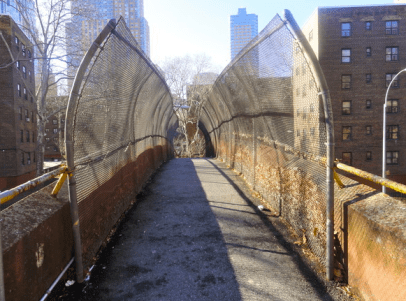
Photo: Fort Greene Patch
The DOT recently installed what some say is a very draconian fence on a pedestrian bridge linking the Ingersoll and Whitman housing projects in the wake of serious attacks against two cyclists and some tireless lobbying on the part of one of the victims, Stephen Arthur. (Additional fencing is yet to be installed.) Reaction to the new fence, according to the local media, has been intense. The Brooklyn Paper quoted residents who said it “feels like a punishment, like we’re in jail.” Just a few days ago the Times called the fence, “a fresh flash point in a swiftly changing neighborhood where luxury apartment towers have risen in the last few years.”
But nestled within the Times story is this almost throwaway line:
The new fence is curved but open at the top, hanging 18 inches over the walkway, similar to pedestrian passages on the Manhattan and Roosevelt Island Bridges.
The Brooklyn Paper similarly buries the idea that a fence on a pedestrian bridge is nothing new: “Two foot paths over the Prospect Expressway, connecting South Park Slope and Windsor Terrace with Greenwood Heights, are fully enclosed in fencing.” But by the time the reader gets to the final line of the story–if they get to it at all–the damage is done. There are irate neighbors, a “bigger divide,” and photos showing a white cyclist in a funny looking helmet or posing with his bike near the projects. Mix one part race with one part class, add a heaping spoonful of bike lanes and now you’ve got a story.
The real truth is that the fence on the Navy Street pedestrian bridge is similar to dozens upon dozens of pedestrian overpasses all over the city, and as such may not be as much of a cultural touchstone in Brooklyn’s ongoing struggles with gentrification as the media would like them to be.
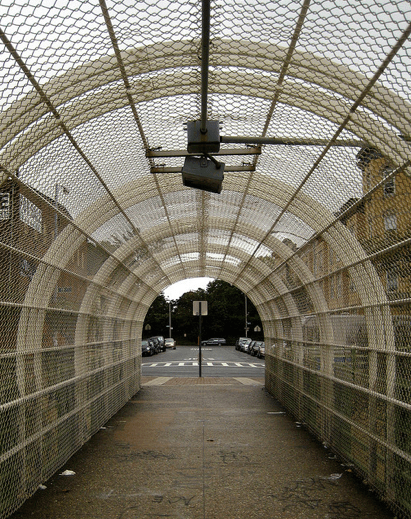
Photo: Jason Young/Flickr
The pedestrian bridge above crosses the Prospect Expressway at 8th Avenue. It’s even more severe than what was installed at Navy Street and looks like something out of The Shawshank Redemption.

Photo: NYCTAXIPHOTO
Above is a pedestrian bridge leading to East River Park, one of the many walkways over FDR Drive. While not completely enclosed like the one over the Prospect Expressway, it still doesn’t invite feelings of freedom or openness.
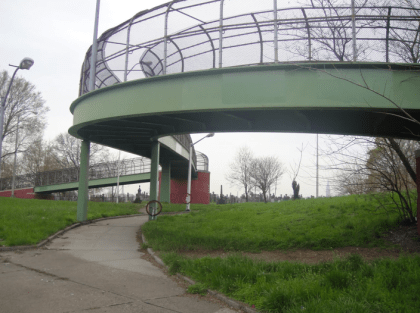
Photo: Unicycle Bridge Tour
The above image is a pedestrian overpass at the BQE on-ramp at Calvary Cemetery. As you can see, there aren’t even any railings on this bridge — it’s all fence. It’s a piece of infrastructure more appropriate for herding cattle to the slaughterhouse than for inviting pedestrians on a pleasant stroll.
That’s just a small sampling of the very severe-looking pedestrian bridges that dot the five boroughs. Even one of the newest and nicest looking pedestrian bridges in the city, the Intrepid Museum Pedestrian Bridge across the West Side Highway, includes high fencing that prevents people from throwing things into the traffic below.
Now, a pedestrian overpass that connects a neighborhood to, say, a park or tourist attraction by allowing residents to avoid an urban highway is very different from one that crosses a road like Navy Street, an arterial road that literally cuts the community in half. But it’s not the bridge that’s a “flash point in a swiftly changing neighborhood,” especially since the projects are likely to remain untouched by the hands of gentrification. It’s the road itself.
If I lived in those projects, I would probably detest Navy Street for cutting my home off from other parts of the city and bringing noise to my building, just so that outsiders could get through the area faster. If I were an alienated teenager who’d spent his whole life as the target of abuse and discrimination from white people who were mostly well protected behind glass and steel, I’d want to throw something at those cars. And if I saw a less-protected, slower-moving, well-fed-looking white guy going by, I might just throw something at him. It’s not right, but I understand where the impulse comes from. In some sense, you could say, they’re angry at Bob Moses for designing the projects and the road this way, and at all the people who supported him, and at all the people who maintain this degrading Corbusian environment. They can’t throw bricks at them, so they throw them at Stephen Arthur.
Just as high crime neighborhoods discourage walking and cycling, surely neighborhoods where walking and cycling are discouraged see an effect on crime. Few people would find a stroll near Navy Street pleasant, resulting in fewer eyes on the street to prevent kids from thinking they can get away with hurling bricks at people.
But back to my original point. Why are reporters essentially ignoring the huge number of enclosed pedestrian overpasses in this city, ones that routinely “fence in” pedestrians engaged in the simple act of getting from point A to point B?
My guess is that it’s because most of the existing fences, though not all, are designed to protect automobiles. Had a group of teenagers from the Ingersoll projects thrown bricks at a car’s windshield and injured a driver in the process, motorists would not have needed an advocate like Stephen Arthur to lobby the city for more protection. A fence would have been erected as soon as supplies could be ordered, extra foot patrols would have been deployed within twenty-four hours, and few reporters would have put pen to paper on the subject, at least not to claim that such a fence symbolized a “great divide.”
And that’s the effect throwing the idea of bike lanes into a story has on journalists: a cyclist on a $300 bike riding in a narrow bike lane through the projects is a symbol of the encroachment of elite white gentrifiers, but a motorist in a $30,000 automobile racing down a too-wide stretch of road that slices through the heart of a community is just a real New Yorker trying to get to work.
This story is undoubtedly important to the people who were injured, to the aggrieved residents of the Ingersoll houses, and to anyone who relies on Navy Street; I’m by no way implying that we should all just move on to other, more important issues. People have been attacked violently and such incidents can not be allowed to happen again. But the telling of this story reveals a lot about the media’s cynical manipulation of cultural “flash points” such as gentrification and bike lanes in order to avoid the larger and far more important story of poor housing conditions, isolating living environments, and safe streets for low-income New Yorkers.
How 20 mph Speed Limits Benefit Drivers
Most of the improvements our city’s streets have seen over the past few years have been hugely beneficial to pedestrians and cyclists. They’ve been beneficial to drivers, too, but that connection isn’t always clear. The DOT likes to trot out its statistic that streets such as 8th and 9th Avenue where separated bike lanes have been installed see a 40% reduction in injuries to all users, including drivers. And even though the traffic may flow better than before, all it takes is being stuck in one traffic jam while cyclists whiz by in a bike lane to make drivers remember the Halcyon days when New York City was free from any sort of gridlock. (Note: those days did not exist.)
As the deadline to apply for a Neighborhood Slow Zone approaches this Friday, much has been made about how 20 mph speed limits are beneficial to pedestrians and cyclists, who find streets much safer to cross or be on and how neighborhoods with slower car speeds feel more like a place, somewhere a person wants to be in rather than get through. But what hasn’t been articulated as much is how lower speed limits benefit drivers, too.
Based on some of the material provided by the 20’s Plenty for Us campaign in the UK on just that question, I thought I’d compile this short list:
- 20 mph speed limits result in fewer injuries to drivers and passengers. After 2 years of 20 mph speed limits, drivers in Portsmouth, UK had 23% fewer casualties. Passengers had 31% fewer. Elderly drivers saw 50% reduction in injuries while elderly passengers saw a 40% reduction.
- Less severe crashes save drivers money. It stands to reason that repairs to a car involved in a crash at 20 – 25 mph are likely to be less expensive than a car involved in a crash at 30 – 35 mph. That means lower insurance payouts and, over time, lower premiums. In fact, some insurance companies in the UK charge lower rates to drivers who live within a 20 mph zone, since they’re less likely to file a claim. The same holds true for medical bills and insurance: the less severe an injury is the less it’s going to cost to treat.
- The cheapest car repair is the one you don’t have to make. Driving at slower speeds increases reaction time and decreases stopping distances, meaning it’s much easier to avoid an accident in the first place.
- Less guilt. No driver wants to be responsible for another person’s death, but accidents happen. A slower speed decreases the likelihood of death in the event of a collision and gives drivers more time to avoid an errant child or distracted pedestrian.
- More free time for parents. A parent who is confident that the streets in his or her neighborhood are safe is a parent who doesn’t have to drive his or her children everywhere. And isn’t one of the benefits of choosing an urban life over a suburban one that you don’t have to be a chauffeur until your son or daughter gets a driver’s license?
Are there any inconveniences to drivers? Sure. Twenty mph speed limits increase the average car trip time by 40 seconds. Arterial roads and main commercial strips will be excluded from DOT’s Slow Zone program, so most drivers would therefore only have to spend a minimal amount of time in a slow zone before reaching Fourth Avenue, Flatbush Avenue, or any other commercial or arterial road where a higher speed limit is the norm.
Are slower speeds worth it to drivers? Definitely. And since most of them are pedestrians at one time or another, too, there’s an even greater list of benefits that needs no explanation here.
“Why some people get angry with cyclists”
Via The Invisible Visible Man:
Such anti-cyclist anger reminds me in many ways of the feelings about gypsies that I would hear expressed when in lived in central Europe. In Hungary, people would tell me they disliked gypsies because they were lazy and dishonest. In Romania, some gypsy groups were unpopular because they were more successful than most Romanians, and built large, vulgar houses to show it. The truth was that gypsies – like, I would suggest, cyclists – were unpopular principally for being different.
Humans seem to feel a rage against those who get away with things they long to do – with the gypsies for seeming carefree and unconcerned about bourgeois norms, with gay men for flouting their feminine side, with cyclists for skipping ahead of them to the front of the traffic queue. It would be wrong to claim that cyclists – mostly, in London, articulate, middle-class men – face anything like the problems that the perpetually victimised gypsies or blacks or gays face. But I think the instincts have a similar genesis.
None of this of course would matter much either if the sentiments expressed produced no real world consequences or if anything were being done to tackle the prejudices. Yet there are real-world consequences – and significant reluctance to tackle them.
20’s Plenty for Brooklyn
Crime and traffic are not “like water”, as sometimes claimed. If you make speeding and robbery difficult, people will do less of those things.
Whether it’s the result of poor street design or the NYPD’s laissez-faire attitude towards enforcement, the city has made speeding remarkably easy, allowing dangerous driving to spread so much that few parts of Brooklyn remain free from its cancerous effects. If drivers can exceed the speed limit on Fourth, Flatbush, Atlantic, Coney Island, and Ocean Avenues by 20 or 30 mph without consequence, why on earth would anyone expect them to obey it when they turn onto a side street? Traffic enforcement does not work on the honor system.
But while a driver racing at 55 mph on Fourth Avenue will easily turn into a driver doing 50 on 9th Street, it does not hold that a commuter doing 20 mph in Park Slope will turn into a NASCAR driver as soon as he escapes the neighborhood’s confines. Enforcing the law does not tamper down some innate tendency human to want to break it; I know of no place that has a high murder rate because the neighborhood next door is so darn effective at preventing murders.
But, for a moment, let’s say that the critics of 20 mph Slow Zones are correct. If one is willing to argue that drivers simply will not obey the posted speed limit if the road “allows” them to ignore it, or that they have no more self-control than wild animals and that slowing them down in one area will cause them to relent to an irresistible and irrepressible urge as soon as opportunity knocks, then that is precisely the reason why traffic calming measures must be put in place all over the city.
Lego #bikenyc

This is the first in a series of #bikenyc scenes depicted in Lego. Feel free to add your captions in the comments.
I, Robot Driver
Matthew Yglesias, writing in Slate, notes a few potential hurdles to self-driven cars becoming a reality beyond test courses. One stands out.
…new things are held to a double-standard and this is particularly true in the realm of the automobile. A lot of the issues around autonomous cars amount to basically “but under some conditions something could go wrong and cars could crash and people die.” Meanwhile, more than 90 Americans die each and every day thanks to automobile mishaps, and 1.2 million are seriously injured every year. There’s a social convention in the United States that we don’t talk about those 90 daily deaths as a serious problem, even though obviously if we had nine people getting killed by terrorists every month there’d be a perpetual state of freaking out. High-speed motorized transportation is a serious business, and conventional automobiles are not held to the same tough safety standards that we apply to most other products, so it’s extremely difficult for something new to compete.
I remember Randy Cohen, the Times‘ former Ethicist, remarking that if automobiles did not exist and were magically invented tomorrow, car companies would face a very tough sell. Here’s my account of him speaking at a Streetfilms fundraiser:
In 2009, 33,000 people were killed by cars nationwide. Cohen asked the crowd to think about that for a second. “Imagine you’re introducing a new transportation system,” Cohen said, “but there’s one catch: it will kill 33,000 people a year.” Cohen hardly needed to point out that few Americans would think it was okay to build something from the ground up with such a high casualty rate, yet that’s where we stand with cars right now.
It’s only the gradual creep of auto-dependency and the way in which its now woven into our way of life that has so innurred Americans to the senseless tragedies that befall tens of thousands of their fellow countrymen on an annual basis.
 Brooklyn Spoke