“A social problem more than a legal problem.”
Don’t ask me why, but I’m on a bit of anti-bike-licensing kick lately. The following take comes from Chris Rissel, a professor of public health at the University of Sydney. He writes about some of the technical and practical issues that would come with any bike licensing scheme, but it’s his take on the social component of shared streets that I like the most. Some highlights:
Riding too fast on a shared path with lots of pedestrians is a social problem more than a legal problem. It is bad manners, like someone running through a crowded mall. Collectively we need to remind each other that that sort of behaviour is inappropriate and re-establish norms around respect and basic etiquette.
If bicycle registration changed driver behaviour in a way that legitimised cycling then I’d be all for it. However, I can’t see a small metal plate with some numbers on it slowing impatient drivers down, or helping drivers “see” bicycles on the road, or affecting drivers in any meaningful way that made it safer for bicycles.
Rather than pursuing registration, politicians and cycling groups need to do more to promote existing cycling etiquette guides which emphasise respect for all road users. Bike shops should give these out whenever someone buys a bike, to reinforce good behaviour. Campaigns like “Do the right thing” can help support social norms about how all road users need to slow down and be respectful of each other.
Making more laws is rarely the answer to social problems like the interaction between different road users. This is not a question of legality: it’s a matter of manners, awareness, and of mutual respect.
Bike Share Geographies
 Click to enlarge.
Oliver O’Brien created this graphic representation of “Bike Share Georgraphies Around the World.”
It shows the “footprint” of the docking stations making up 49 bike share systems around the world. The colours represent the empty/full state of each docking station at the particular moment in time when the image was made. The numbers show the total number of docking points – each docking station being made up of one or more docking points, each of which may or may not have a bike currently parked in it.
The geographies and topographies of the cities themselves inform the shape of the systems – particularly coastal cities (e.g. Nice, Rio, Barcelona, Miami Beach) and ones with large mountains near their centres (e.g. Montreal).
If you take a look at Paris you can see the empty space marking the Seine River in the middle of a sea of dots.
New York Transit Museum: Special Day for Special Kids

This is really nice. The New York Transit Museum is hosting a “Special Day for Special Kids” [PDF] this Sunday. Admission is free from 10 – 11, discounted after that, and there are various activities planned all day.
Chuck Schumer: “There are few things I enjoy more than a bike ride.”
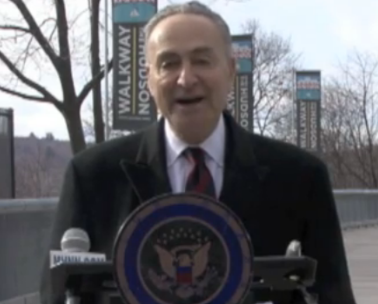
Chuck Schumer loves cycling. He also loves cycling infrastructure, so long as it’s in Poughkeepsie.
As many of you know, there are few things I enjoy more than a bike ride. I ride all over the state. I used to be…a basketball player and I used to play ball to recreate to get exercise but when I was about 50 my brain would say jump and my body would stay on the ground and I knew it was time for other exercise so I started riding a bicycle all over. I don’t like riding it inside, you know, stationary, but I love being outside everywhere, and there is nothing that’s going to be better for bike riding than the beautiful trail we have here on both sides of the Hudson in two of the most beautiful places in the whole east of the United States and that is Duchess County and Ulster County across the river and so it’s going to be a great opportunity.
What a shame that a man who completely understands the health benefits of cycling probably can’t risk being seen riding a bike in front of his own house.
Now last time someone brought a bike and I rode over the walkway. And it was amazing to me. You heard so many different languages on the walkway as people came and that showed you the international reach that this beautiful beautiful site has had in terms of bringing people to the Hudson Valley, creating jobs and economic development in the Hudson Valley, helping people understand other great things we have here in the Hudson Valley as well.
You know, sometimes you need a beacon. The Statue of Liberty or the Empire State Building brings people to New York City but then they see lots of things they never would gone and have visited otherwise. Same thing with the walkway. It is like our Statue of Liberty here.
The funny thing about the Prospect Park West bike lane is that it’s green…just like the Statue of Liberty.
Now There’s Something You Don’t Read Every Day
From The Local:
The city’s decision last year to kill the Lafayette Avenue bike lane was part of a backlash against cycle paths in some communities. In Park Slope, for example, the popular Prospect Park West bike path is currently the subject of a lawsuit.
Emphasis mine. Finally, Gersh Kuntzman admits what survey after survey and poll after p0ll has shown for over a year: there is no controversy on Prospect Park West.
Quote of the Day
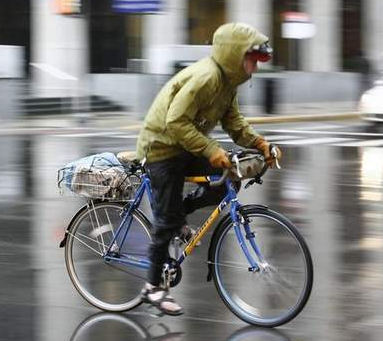
“Despite the popular refrain from naysayers in Indiana, some of the biggest cycling cities in the country get as much or more snow that we do every year. Cities such as Minneapolis; Boulder, Colo.; Denver; Madison, Wis.; and Chicago. It’s about infrastructure, and it’s about a few people setting an example of what’s possible.” – Erika D. Smith, The Indianapolis Star.
Is 20 Plenty for Park Slope?
This Saturday, January 21st, the Park Slope Civic Council is hosting a community meeting on “Neighborhood Slow Zones and Safer Local Streets.”
The city’s Department of Transportation is looking at locations in all five boroughs to install neighborhood slow zones, a program that reduces speed limits to 20 mph within a select area and adds safety measures in order to change driver behavior.
You can have a voice in where, how, and if these zones should be installed in and around Park Slope. Join us for this important and informative discussion.
Neighborhood slow zones are a community-based program that reduces the speed limit from 30 mph to 20 mph and adds safety measures within a select area. Signs and gateways announce the presence of a slow zone. The zone itself is a self-enforcing, reduced-speed area with traffic-calming treatments that may include speed bumps, curb extensions, and special markings.
The ultimate goal of the program is to lower the incidence and severity of crashes. Research has shown conclusively that lower vehicle speeds save lives. A pedestrian struck by a car at 20 mph has a 95% chance of surviving; the odds of surviving drop to 55% for someone hit at 30 mph. Slow Zones also enhance quality of life by reducing cut-through traffic and automobile noise in residential neighborhoods.
Slow Zones have been used to great effect in the UK as part of the “20’s Plenty for Us” campaign. Closer to home, Hoboken, NJ instituted a 20 mph public awareness campaign which has reduced serious injuries to pedestrians, cyclists, and drivers alike.
Find out more this Saturday, January 21st at 11:45 a.m at Congregation Beth Elohim. (274 Garfield Place at Eighth Avenue.) The meeting is co-sponsored by Councilmember Letitia James, Councilmember Brad Lander, Councilmember Stephen Levin, P.S. 10, Parents Association of Millennium Brooklyn High School, Park Slope Neighbors, Park Slope Parents, and Prospect Heights Neighborhood Development Council.
In my view, Slow Zones are a no-brainer: they reduce fatalities and injuries, help businesses, and make neighborhoods places to be in rather than merely places to get through. I’m looking forward to seeing what comes out of this important community meeting.
Tonight: Make Lafayette Avenue Safer
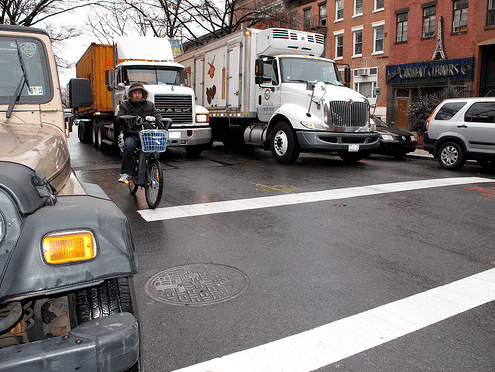
Photo via Gersh Kuntzman
Last year, DOT withdrew its plan to extend the existing cycle path on Lafayette Avenue from Fulton Street to Broadway after opposition from Community Board 2. Since then, more than 1,400 people have signed a petition asking the board to reconsider. Tonight, Community Board 2’s Transportation Committee will revisit the issue at 6 pm at St. Francis College. (180 Remsen Street between Court and Clinton Streets in Brooklyn Heights.)
“I’m hoping that the community board is going to listen to the community,” said Hilda Cohen, who collected the signatures with Alexandra Loxton as part of the “Make Lafayette Avenue Safer” campaign. “There may be personal opinions on the board, but it’s their role to listen.”
If I’ve learned anything, it’s that showing up is the key to making our streets safer. If you live, work, or commute in the area, please be there to lend your support.
Bike Licensing: “Limited benefits and significant challenges”

Image via pl8s.com
From a report commissioned by Ottawa lawmakers comes the latest evidence that licensing cyclists isn’t worth it:
…the system would cost about $100,000 a year and would recover, at best, $40,000 in fees from cyclists.
Worse, it would impose a barrier on would-be cyclists, who would have to go through an extra layer of bureaucracy before they could legally ride, just when the city actually wants people to take to their bikes because they don’t significantly contribute to traffic congestion and put less wear and tear on roads.
“Given the foregoing limited benefits and significant challenges, and primarily based on the fact that bicycle licensing would act as a significant barrier to cycling, it is recommended that bicycle licensing not be implemented in the City of Ottawa,” the report concludes…
As in Ottawa, bike licensing in New York City would pose more questions than could be answered with the limited tools of government. If the city required a license for all cyclists, would a person who commutes from New Jersey via the George Washington Bridge or a multi-modal commuter who uses a ferry need to have a license, too? How would you deal with bike share users, tourists at Bike and Roll, or visitors borrowing a friend’s bike? Do you license riders only or also require their bikes to be registered? If so, would a person with multiple bikes need a separate registration for each one? The list of questions would go on forever, as would the red tape.
A View from the Bridge

If this isn’t the finest view afforded any bike commuter east of San Francisco, I don’t know what is. Have a great holiday weekend.
 Brooklyn Spoke