America’s Most Bike Friendly City?
Via The Nation, a story on Long Beach, California’s effort to make itself into America’s Most Bike Friendly City:
“The math is pretty simple,” says April Economides, the principal of Green Octopus Consulting and the leader of the city’s outreach to local businesses. “You can park twelve bikes in the amount of space it takes to park one car. And someone who shifts from owning a car to a bicycle tends to have more discretionary income, because, for a commuter, the typical cost of a bicycle is $300 a year, compared to $7,000 a year for a car.”
The owner of a Long Beach coffee shop adds, “The bike racks outside our shop increase our visibility and bring us more customers. People on bikes stop at places they haven’t visited before because they don’t have to try to find parking.” (By the way, Economides is a great name for someone reaching out to businesses about the benefits of bike lanes!)
As I pointed out in relation to Hubway, Boston’s bike share system, some drivers tend to avoid certain neighborhoods because it’s too difficult to find a place to park. Add bike parking, however, and you’ll open up your neighborhood to a demographic that is willing to explore, able to go out of their way, and–thanks to the calories burned–hungry. That’s good for business.
The Baltic Street Parking Lot – UPDATE

Image if a restaurant slowly took over an entire city block with outdoor tables and chairs without first seeking a permit. Or consider a clothing boutique that decided to quadruple its floorspace by placing display cases and racks on the sidewalk. Surely the city would levy heft fines on both businesses and the police would be dispatched to shut them down very quickly.
The picture above is of Baltic Street between 3rd and 4th Avenues. On one side of the street is an autobody shop. On the other is a catering company. Both businesses use the sidewalk as parking lots for their employees and customers. The autobody shop, in fact, stores junked cars for weeks on end without having to pay a dime to the city, more or less commandeering parking spaces for their own private use. Any tickets they receive must be considered part of the cost of doing business, since even the cars parked on the street are rarely moved for alternate side parking.
Residents of my building have made numerous calls to 311 and the 78th precinct over the past months but nothing has been done. Perhaps we should tell them a restaurant is serving brunch on the sidewalk instead.
UPDATE 1/12/12: I checked my 311 service request status and, according to the website, “The Police Department responded to the complaint and determined that police action was not necessary.” A neighbor reports the same result. As of this morning, the cars were still parked on the sidewalk.
Help Improve Seventh Avenue
The Park Slope Chamber of Commerce is asking anyone with an interest in Seventh Avenue to fill out a brief survey about the “conditions and needs” of the strip. Property owners, business owners, residents and visitors are welcome to contribute their thoughts. It’s a great chance to suggest the kinds of things that are known to improve business, enliven a street, and contribute to a healthy and safe neighborhood.
Bike Share Exhibit at AIA
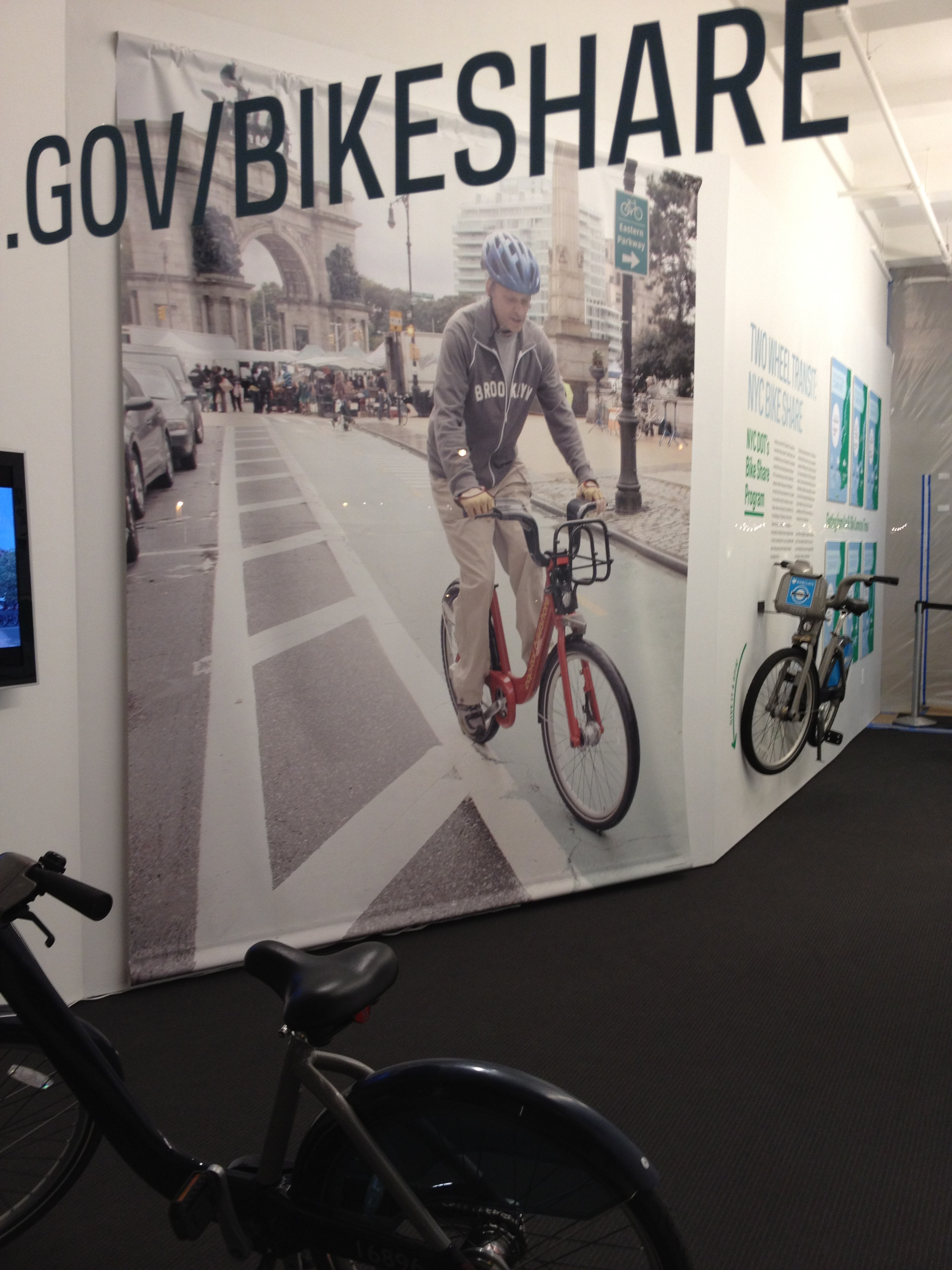
The Center for Architecture’s exhibit, “Two Wheel Transit: NYC Bike Share,” features a picture I took during a bike share demo last year of a man going for a test ride on Prospect Park West. If you find yourself on LaGuardia Place, check it out. There are a few bikes from systems around the world on display, as well as short films and information on how bike share will work when it comes to New York later this year.
The opening reception last night featured a talk by Janette Sadik-Khan and Alta Bike Share president Alison Cohen. The standing-room-only crowd was, according to AIA, the biggest for any opening event at the Center. It was also, in my opinion, a good barometer of just how ready and enthusiastic New Yorkers are for bike share. The energy in the room was truly electric, and as a father to a young girl I couldn’t help but think how cool it is that the biggest transportation revolution to hit New York City since the subway is being led by two women.

You can check out “Two Wheel Transit” at the AIA Center for Architecture through Feburary 4th.
“A virulent case of NIMBYism”

The Village Voice names Iris Weinshall one of its 100 Most Powerless New Yorkers.
93. Iris Weinshall, wife of Senator Chuck Schumer
Yes, Weinshall wields some power as a former Department of Transportation commissioner and current vice chancellor of CUNY (not to mention going to bed every night with Chuck). But despite all of these connections, when the sometimes-modest supporter of bike lanes was struck with a virulent case of NIMBYism as a bike lane was built on Prospect Park West, she wasn’t able to kill it. (And what good is being the wife of a senator and a former transportation politico if you don’t have the power to kill one lousy bike lane in your front yard after imposing miles of them on other people?)
Iris shares this honor with Black Hebrew Israelites, Park 51 opponent Pamela Geller, Mayan language speakers, and “Anyone who has to use the bathroom in New York City.”
Random Thought
Last year one of the greatest logical inconsistencies of reflexive bike lane hatred, often said within the same breath, was that a) bike lanes are unnecessary because no one rides in them and b) bike lanes are too dangerous for pedestrians to cross because they’re filled with riders. As has been pointed out by far smarter people than I, both things can not be true.
In this new year I’ve noticed a new and equally inconsistent piece of logic. It goes something like this:
On the one hand, bike lanes, being little more than thermoplastic stripes, do nothing to slow down speeding drivers and protect cyclists and are not an effective means of traffic calming. On the other hand, bike lanes, even ones that are little more than thermoplastic stripes, make accessing local businesses impossible and slow traffic to the point of intolerable congestion.
Both things can not be true.
Tel-O-Fun

I was in Israel at the end of 2011 and kicked off my visit there with a test ride of Tel Aviv’s bike share system, Tel-O-Fun. (The name is a mix of “Tel Aviv” and the Hebrew word for bicycle, “ofanaim.”) Annual subscriptions are available for 280 shekels, or about $72, but shorter options are available for visitors. I purchased a 24-hour subscription for just 14 shekels, or about $3.60, and like many bike share systems worldwide, the first 30 minutes of each ride are free.
I’ll write up a longer review later, but for now feel free to check out this Flickr set of my Tel-O-Fun experience. Tel Aviv is aiming to become the Amsterdam of the Middle East and its well on its way toward achieving that goal.
Next Week: Bike Share Exhibition
The Center for Architecture is hosting an exhibit, “Two Wheel Transit: NYC Bike Share,” that will set the ball rolling as the city gears up for what promises to be a very exciting summer. The exhibit kicks off with a conversation between Janette Sadik-Khan and Alta’s Alison Cohen on Wednesday, January 11 from 6 – 8 PM.
Starting in summer 2012, New York City will have a two wheel transit system! You will be able to pick up a public bike at any of hundreds of conveniently located self-service sharing stations, and drop it off at any dock when you’re done. The bike share program provides an easy way of making short, one-way trips; from your apartment to the subway, from your office to lunch, from dinner to a movie. Similar systems are thriving in London, Mexico City, Paris, Washington, DC, Montreal, Tel Aviv, Berlin, Taipei and dozens of other cities worldwide. For many people, cycling has become a logical extension of transit, connecting hard-to-get-to neighborhoods with existing services and changing how people move about the city.
This exhibition is designed to explain the bike share system, how it will work in New York City and how you can help shape the program by suggesting bike share locations. http://www.nyc.gov/bikeshare
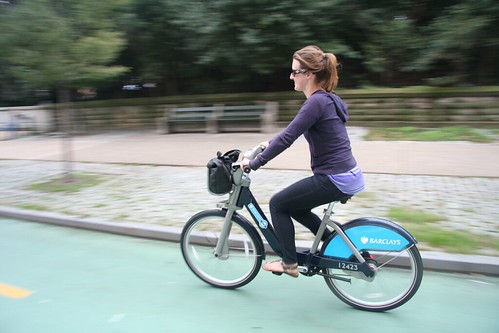
Rumor has it that the picture I took of a Barclays bike on the PPW bike lane will be included in the exhibition. See you there!
2012: The Year of Bike Share
Will Doig at Salon.com names bike share as one of seven bold and transformative projects that will change the urban landscape in 2012.
New York is making up for being late to the bike-share table by serving itself a portion bigger than any other U.S. city. How big? Ten thousand bicycles at 600 stations clustered throughout Manhattan and northern Brooklyn — and that’s just in the first phase. The system will launch this summer and be run by Alta Bicycle Share, the company that made Boston and Washington, D.C.’s systems a runaway hit. And New Yorkers have every reason to believe theirs will be just as successful: The number of bicyclists and bike lanes has exploded in the past few years. Plus, bike-share systems work best when combined with a great transit system (as a 10-minute walk to the train becomes a two-minute pedal) and New York’s is second to none. Transportation commissioner Janette Sadik-Kahn is already a heroine to New York’s cycling community — this should qualify her for sainthood.
The true measure of bike share’s success here in New York won’t necessarily be in the membership figures or trip numbers, which are likely to be huge, but when residents of neighborhood that isn’t included in the system’s first phase stand up and start staying, “Hey! We want bike share, too!”
Tithe to Transportation Alternatives

People engaged in the simple act of riding their bicycle from point A to point B have been labeled by the city’s most ardent bike haters as zealots, fundamentalists and, in one famous case, terrorists. I prefer to think of myself as a peace-loving evangelical, happy to proselytize to anyone willing to convert to bike commuting, so this holiday season I’m asking my cycling brethren to do what all good evangelicals do: tithe.
But fear not! I am not asking you to donate 10% of your annual salary to the Church of the Bike. What I am asking you to do is to consider how much safe cycling and the bike infrastructure is worth to you and to make a donation to the organization that makes it all possible, Transportation Alternatives. More on that later.
So how do you decide how much safe cycling is worth to you? I found an easy way to make my calculation.
Last April 15 I started a new job. I had always been curious about how much money I saved on subway and bus fare by biking to work, but up until that day I had never really kept track. After I got home from my first day I created a spreadsheet, labeling it Bikenomics in homage to the great Grist.org series by Elly Blue. Here’s a sample:
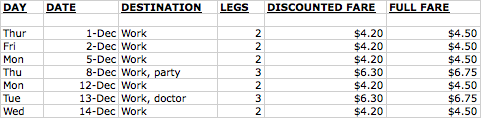
As you can see, I kept two running totals, one showing how much a day’s trips would have cost me if I used a weekly MetroCard at $2.10 per ride, a figure that I based on approximately 14 rides per week. The other was a comparison to the cost of a subway or bus ride at the full fare of $2.25. I was really strict about tracking my progress through the year. One might even say I was religious.
I only included trips, or legs, that would have otherwise been taken on a public transit had biking not been an option; trips to the grocery store didn’t count, even though I frequently shop by bike. I also didn’t include trips made possible because of biking, such as a visit with a friend in Greenpoint whom I never would have agreed to meet if it had involved a transfer to the L in Union Square.
So how did I do? Her are my results of Friday, December 16:
- Total legs: 244
- Total savings at discounted fare: $512.40
- Total savings at full fare: $549.00
Five hundred dollars might not seem like a lot to people who get pro bono legal representation, but it’s a significant savings for us “real” New Yorkers, especially considering the looming threat of fare hikes. Basically, I saved enough money since April that even if I stopped riding for the season today I’d have enough money to pay for about five months worth of MetroCards, more than enough to get me through the winter doldrums.
Yes, I had to get my bike tuned up a couple of times this year, which won’t be free until I become a better bike mechanic. I only had two flats this year and one emergency brake adjustment, which ate into my overall savings. I also probably eat a few more bananas than the average New Yorker. But since my commute became my exercise I cancelled my gym membership, resulting in $70 staying in my bank account each month. I don’t know if I can credit this to the riding, but I haven’t taken a sick day since last winter. As a freelancer who doesn’t get benefits through his job, that’s real money.
So, considering where my money would go if I returned to public transportation, I thought that I owed at least some portion of it to the organization that has made 2011 my favorite year for cycling since I moved here in 1998. I thought of all the great work Transportation Alternatives has done to make each of my rides as safe as it can be and the way in which so many of the dedicated staffers there have become not only great supporters of this blog, but friends. Donating to TA was a no-brainer.
My fellow evangelicals, fundamentalists, zealots, or simple bike riders, I encourage you to tithe to TA in the loosest sense of the word; donate ten percent, twenty-five percent, fifty percent, or even just five percent. Donate whatever you can afford.
Maybe it’s in the subway rides not taken, the old clothes that now fit, or the gallons of gasoline not burned, but biking brings with it tremendous benefits. Those benefits are only bound to increase as TA continues its hard work and advocacy to build the city we know New York can become. Donate today.
This is my last post of 2011. Many thanks to my readers, commenters, lurkers, and friends. I’m looking forward to a wonderful new year and can’t for 2012 — bikeshare! — to begin.
 Brooklyn Spoke