Baby on Board

Anyone else spot this DIY bike symbol at the intersection of Dean Street and 3rd Avenue? There’s been a lot of construction in the area as DOT builds bulb-outs and some of the street markings have been slow to reappear. Someone took matters into his own hands. Even though I regularly ride with my daughter in tow, I swear it wasn’t me.
Today’s Rally for Traffic Justice
Bike Haters of the Week: Jon and John
Here are two new additions to the my collection of “Some of my best friends are bike lanes” quotes, and both come from the Midwest. To be fair, these hew closer to Adam Sternbergh’s brilliant how-to piece, “I Was a Teenage Cyclist,” and his instruction that the “Invocation of personal cycling bona fides” is required in any anti-bike lane screed.
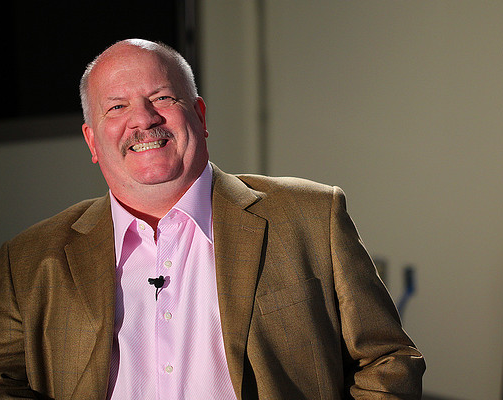
The first comes from the Twin Cities’ Jon Tevlin (above), writing in the Star Tribune:
It’s hard to argue against creating safer biking paths in the cities, or against the fact that biking is good for you and the environment. I bought a new bike last year and like to ride it around town. I like the new lanes when I’m riding my bike.
Tevlin likes bike lanes when he is riding his bike, but doesn’t like them when you’re riding yours.
Tevlin’s piece follows Alex Nazaryan’s standard measurement for bike lane success by using reader comments and anecdotal observation and not, say, data. He also follows many of the tired anti-biking tropes pioneered by Steve Cuozzo, John Cassidy and Andrea Peyser: comparing cyclists to “a Spandex-clad Lance Armstrong,” reducing delivery people to sub-human transportation bots unworthy of safe cycling infrastructure, and using one instance of gridlock as proof that bike lanes have messed up his formerly traffic-free city.
To top it off, paint and symbols confuse him in the way looking both ways before crossing the street seems to flummox certain Neighbors for Better Bike Lane members: “Like a lot of other drivers, I’ve also frequently been flummoxed on what to do when my car lane suddenly becomes a bike lane, or has a large painting of a bike in it.” Is this a problem? Car lanes suddenly turning into bike lanes? What does Tevlin do when he gets to a T intersection and a car lane suddenly turns into a sidewalk? “A large painting of a bike” is probably a sharrow, which means Minnesotan drivers are probably supposed to do the same thing New Yorkers do: park on them.
Speaking of NBBL, Tevlin introduces readers to that group’s Midwestern chapter:
Over in St. Paul, a group of residents, Local Taxpayers for a Livable Community (LTLC), has fought a bike lane through their neighborhood, arguing that changes made on Jefferson Avenue actually made traffic less safe, and diverted cars onto side streets where kids play. They raise some logical questions about how much of our roads, and money, we should devote to the 4 percent of people who commute by bike.
Clare Malloy Bluhm is one of the members of LTLC and says the group spans the political spectrum. “I think our voice isn’t being heard,” she said. “We keep hearing that St. Paul wants to be like Portland, and I always ask, ‘How long does the snow last in Portland?’
If this country’s bike lane battles were a Scooby Doo episode, the Mystery, Inc. gang would unmask Clare Malloy Bluhm and reveal her to be Louise “We are never going to be Portland” Hainline. LTLC: “…the group spans the political spectrum. NBBL: “The members of our organizations have been called affluent and politically well connected. A small number of our members are.” Malloy Bluhm: “I think our voice isn’t being heard.” Hainline: [PDF] “…there was no warning to any of the buildings on PPW about this.” To be fair, I don’t really know the particulars of Bluhm’s particular beef with the bike lane in her neighborhood and she may have some very legitimate concerns, but the similarities are still quite astounding. Is there a Midwestern version of Key Foods?
Not to be outdone by Tevlin, the Chicago Tribune’s John McCarron added this entry to the Bike Hater’s Almanac:
Mind you, I have nothing against biking or hiking. I can change inner tubes on my single-speed AMF Roadmaster; and the Ira J. Bach Walkway overlooking the river along Wacker Drive is, for me, a sacred path.
Drop a classic bike brand name, brag about your ability to change a flat and — ta-da! — you’re free to unleash a torrent of irrational criticism. McCarron, like Tevlin, goes even deeper in painting cyclists as spandex-clad freaks. He says that most people have neither the ego nor stamina to commute by bike and, in one artfully crafted sentence, is able to also imply that cycling is a pastime for the wealthy elite:
Besides, I’d look silly in cyclist couture. Imagine me in a Castelli Sorpasso bib tight cycling suit (available online for around $179.95 plus shipping). I’ve never paid that much for a real suit.
Yes, $179.95 for a “cycling suit” makes cycling too expensive to be a practical commuting choice, but a monthly car payment of at least that much, as well as gas, tolls, insurance, and maintanance, is sound economics for Joe Chicago. Not that I need one for commuting–I typically wear a “real suit–but for the price of owning and operating a car, I could by few new Castelli Sorpoassos and throw them out at the end of each week. (For a more precise take-down of McCarron, please visit the excellent Grid Chicago.)
By the way, as I’ve considered before, why is it that the worst bike haters know the most about high-end cycling equipment? The Daily News wrote of “Cannondale-mounted maniacs” in their open letter to Janette Sadik-Khan, but McCarron goes one deeper in naming not only a brand, but a specific model of bike racing clothing. The columnist doth protest too much, methinks.
On the one hand, it’s sad but somewhat inevitable that two metropolitan areas making such progressive strides are seeing some of the exact same bike hate that has plagued New York City. On the other had, it’s encouraging that these two areas are seeing some of the exact same bike hate. It means that the movement to create safe streets is spreading fast and wide while logical arguments against that movement are few and far between.
“Skeptics predicted disaster.”
Just as Hubway’s first season coming to an end, Boston has announced plans to expand the bike sharing system to Brookline, Cambridge and Somerville with about 30 stations and 300 bikes in the spring. (Unlike other bike share systems, including the one planned for New York, Boston’s shuts down for the winter.)
Hubway has been a phenomenal success. As the Globe reports, “in its first 2 1/2 months, Hubway recorded 100,000 station-to-station rides, significantly eclipsing the pace of similar systems in Minneapolis (where Nice Ride needed six months to reach that mark) and Denver (where B-cycle needed 7 1/2 months).” I strongly believe we’ll see similar levels of pent up enthusiasm breaching the banks of the bikelash when New York’s system makes its 2012 debut. Hyperbole-laden “news” stories like this one will be disproved quicker than you can unlock a bike from a docking station.
More lessons from Boston:
When [Mayor] Menino announced his goal of bringing to Boston something akin to Paris’s Velib, skeptics predicted disaster: tourists and inexperienced cyclists weaving down narrow and unpredictable streets amid inhospitable traffic – to say nothing about theft and vandalism.
But Hubway has experienced no serious crashes and only two reported accidents, neither of which required ambulances. Bikes and stations have proved resistant to theft and destruction, and graffiti is rare, Freedman said.
The crash rate for Hubway riders is well below the average for other cyclists, which may be a reflection of its safety features – sturdy bikes with automated lights – or the behavior of riders. However, less than half of Hubway users appear to wear helmets, compared with nearly three-quarters of those on other bikes, according to a recent census at 20 locations.
Hubway has been so successful, it even won over the Boston Globe’s Tom Keane who originally thought bike sharing “seemed one of those off-the-wall, goofy larks you’d find in cities like Portland, Ore., or San Francisco.” He now admits that it’s “one of Menino’s best ideas ever.”
Commuters coming into North and South Stations now routinely hop on bikes to get to their offices. Tourists use it as a way to better see the sights without the wear of walking. And I personally have found that it changes things: I now readily go places I didn’t. Cars are expensive to park; subways take too long. The bike is quick and easy.
Don’t expect a similar turnaround from Andrea Peyser or Tom Cuozzo, but many of the questions posed by New York’s most prominent bike critics are easily answerable, if only they’re willing to take a field trip to Boston.
Rally for Traffic Justice, Wednesday Morning
From TA:
On Wednesday, November 30th at 8:30 am, Transportation Alternatives, Public Advocate Bill de Blasio and the friends and families of victims of traffic violence will deliver thousands of letters to Police Commissioner Ray Kelly’s door. (If you haven’t yet, you can still take action now.)
The rally takes place at One Police Plaza and should be over before you have to be at your desk. See you there.
UPDATE:
If you want to ride in from Brooklyn with fellow attendees, a group will meet to at Grand Army Plaza for a 7:45 am departure.
SIFUAB

A reader sends in this picture of the Prospect Park loop on Saturday, where a major NYPD and PEP presence blocked off part of the drive in an effort to slow down cyclists. The particular location was the site of two serious cyclist/pedestrian collisions in recent months and prompted the installation of the “chute,” and the formation of the Road Sharing Task Force. I am told officers were distributing information as part of an education campaign about the rules of the road.
I don’t want to minimize the seriousness of the recent incidents in the park, but it is amazing to me that these historically rare events have spurred the NYPD to action. The same police force that says “accidents happen” when explaining away its decision to not investigate the death of a cyclist killed by a hit-and-run truck driver apparently doesn’t apply that philosophy to accidents involving bicycles. Not only that, it now has the resources to station officers and vehicles in the park for hours on end to educate cyclists and enforce slower, safer riding. (Yes, I realize that the 78th precinct and the Parks Enforcement Patrol are not responsible for how officers handled the Mathieu Lefevre case, but the general attitude at the NYPD seems to be “Two wheels bad, four wheels no problem.”)
The NYPD could have placed officers on just about any major roadway in Brooklyn for thirty minutes and done more for the general welfare of pedestrians than it accomplished inside the park for hours. Sadly, the bikelash has so taken control of this city’s discourse about road safety on every conceivable level that any rational allocation of limited resources to do the most good seems almost impossible.
And, as per usual, the Daily News isn’t helping:
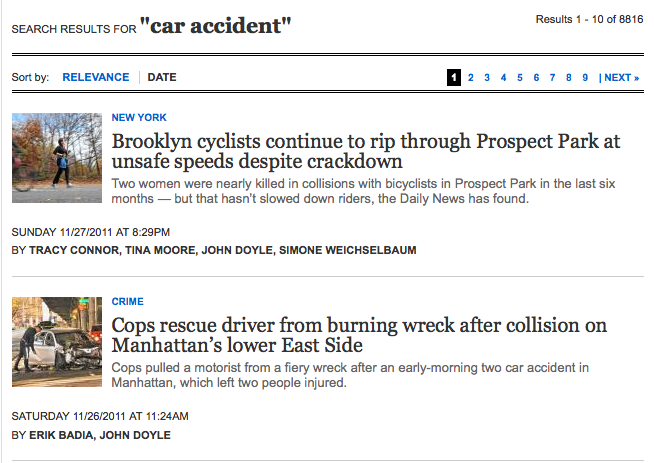
If you’re counting, it took four reporters to write one story about two bike/ped collisions in Prospect Park over the past six months but a high-speed drag race on FDR drive that sent two people to the hospital in one night took the work of just two reporters.
So what did one of those four reporters find in the park?
A reporter with a radar gun clocked bikers going as fast as 31 mph — even through a red light at a crosswalk — on the often-crowded driver that loops the Brooklyn Park.
The speed limit for cars and bikes in the park is 25 mph, although signs at the park entrances incorrectly state that it’s 15 mph.
No one should be zipping down a hill during prime park hours at high speeds, but I encourage the NYPD, PEP, and the Daily News to return to the park when it is open to cars; there’s no question they’ll find motorists exceeding the speed limit by far more than 6 miles per hour.
Emily Lloyd, Prospect Park, and the Road Sharing Task Force continue to ignore the elephant in the room, or as Copenhagenize likes to put it, the bull in the china shop. The NYPD and DOT response here, too, is telling. The FDR drive incident involved a drunk motorist traveling at speeds of up to 100 mph, yet you’ll find no chute anywhere along the East Side of Manhattan this week. You’ll also find zero NYPD officers educating motorists about the speed limit and safe driving practices.
Imagine a cyclist sneaking onto FDR drive and doing 25 mph. Then imagine the NYPD crackdown and tabloid response that would follow. Now imagine a car crashing into a playground and the relative silence it would elicit from law enforcement and the media. (Actually, you don’t have to imagine it.)
As you ponder how a city’s limited resources can be so disproportionately applied while people’s sense of moral outrage can simultaneously be so easily manipulated by a conflict-driven press and find yourself wanting to pull your hair out, you are not alone.
“Bicycle Cultures Are Man-Made”
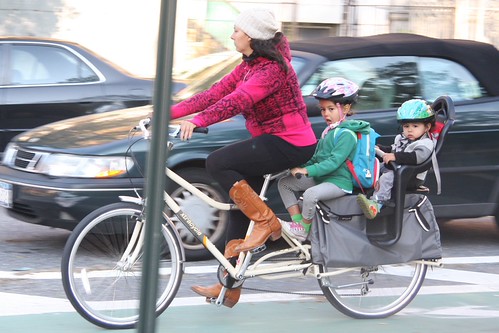
Marc over at Amsterdamized recognizes that no city in the world is Amsterdam, but not in the way that bike lane opponents might think:
Following the popular discourse: Amsterdam is unlike any other city. In the same way any other city is not Amsterdam, but unique in itself.
My point: each city has its own particular history regarding design, architecture and social contract, but in essence humans behave the same way the world over. When you facilitate a particular mode of transportation and make it safe and convenient, people will use it. This was the case for automobiles and this is certainly the case for bicycles.
The bottom line: there are more similarities than differences between the Netherlands and the rest of the world when it comes to everyday cycling. Thereʼs more than meets the eye, too, you just have to have an open mind.
Bicycle cultures are man-made. Itʼs a choice. Cycling should be for everyone, not just the brave and few.
Running Reds: Worth it?
On my morning commute the people I see running reds at Third Avenue and Bergen Street are often the very people I catch up to at Smith and Atlantic, where only the suicidal would cross on a red. The same holds true for most of the major intersections along Smith and Jay between Atlantic and Sands. Fulton, among other intersections on that route, is a major crossing for pedestrians, so blowing a light there is a good way to injure yourself, someone else, and the image of bike commuting in the process.
The Prospect Park Chute
I had a chance to check out the new orange barrels that Prospect Park and DOT installed on part of the park loop in the wake of a serious collision between a cyclist and a pedestrian earlier this month. I hesitate to call say that what the Park and DOT have done is install safety measures because the jury is out on whether this particular choice will, in fact, make things safer.

As you head down the hill on West Lake Drive you will see these orange barrels and the “Pedestrian Crossing” sign on the far right. The orange barrels gradually reduce the roadway from two traffic lanes to one:
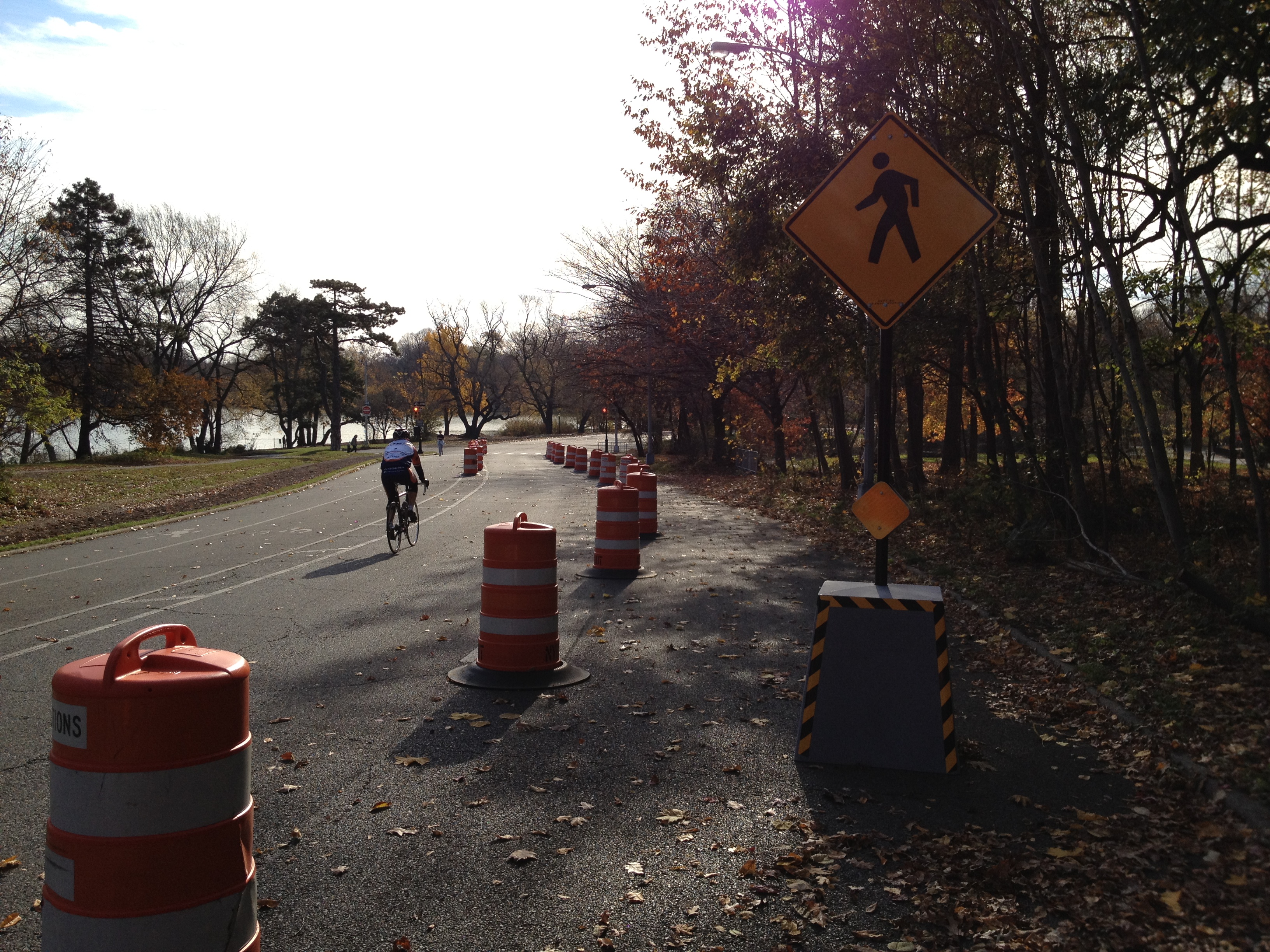
This new sign greets riders as they approach the crosswalk at the bottom of the hill. Another set of barrels form what many people at the Road Sharing Task Force’s public forum referred to as the “chute.”
I took this video on my phone on Saturday morning, hours after the larger groups of racers would normally be finished for the day:
Many of the people who spoke out last Wednesday noted that cyclists now have less room to maneuver if something goes wrong; if a pedestrian steps in front of a group of cyclists without looking, the cyclists would likely all crash into that person instead of spreading out like a flock of birds evading prey. Even if they did avoid a collision with a pedestrian, one cyclist clipping a barrel could send an entire peloton down.
Lest you be inclined to comment that fast cyclists deserve whatever injury they get, let me say that as someone who has had to suddenly avoid wayward pedestrians, soccer balls, water bottles, skateboards that have been liberated from their riders, cracked pavement, piles of horse manure, and sticks at low speeds on my commuter bike, I don’t think you have to be a high-speed racer to have the same concern. Three kids biking together could easily find themselves squeezed with no place to go but to the pavement.
Does this configuration slow cyclists down? It’s hard to say. I didn’t see too many hard-core racers while I was in the park on Saturday, but the few fast riders I did see were still riding quickly enough through this chute to cause serious injury to themselves or others in the event of a crash. Narrowing the lane further would exacerbate many of the problems and concerns I mentioned above. There’s also the little matter of cars in the park; you can only narrow the lane here so much if you still want cars to fit through.
A speaker on Wednesday also mentioned the barrels’ height as a concern, one he didn’t think Prospect Park or the DOT considered. The barrels are slightly taller than the average five- or six-year old and could possibly make it harder for cyclists and drivers to see a child about to dart across the road.
The Park also changed one important configuration for pedestrians, closing off a path that opened up onto the drive and instead directing them to use a crosswalk further down the hill.

It’s really hard to say what effect any of this will have. After all, it’s just one section of an over three-mile loop and two accidents, as horrible as they were, are statistical blips when it comes to determining overall park safety. During my casual ride around the park, I still saw plenty of pedestrians meandering in the middle of the road, parents with baby carriages crossing behind blind curves, cyclists riding in the wrong direction, and even two people tossing a football from one side of the drive to another.
The Park can’t very well put orange barrels around the entire loop, close off more pedestrian crossings with French barriers, and put signs on every available lamppost and tree. What kind of park do we want? One thing I do know is that most people, especially the people who took the effort to show up last week, want it to be car-free, no matter what the media reports may suggest.
I firmly believe that unless and until cars are banned from the park entirely, no discussion of park safety will have any serious or lasting effect. It’s completely ludicrous that the Task Force continues to debate the effects a 160-pound rider on a 25-pound bike can have on pedestrians while completely ignoring the effects of motorists of any size driving two-ton cars and trucks.
“There are people who have endless amounts of money.”
Christine Haughney has this report in the New York Times about “Cargo Vans on Steroids” that serve as mobile offices or “a children’s playroom on wheels” for the city’s 1%:
…during morning spin classes at Soul Cycle, the Upper East Side studio, the parking spaces cannot accommodate the Sprinter vans, Range Rovers and Lexus GX470s that are sometimes double-parked.
If anything tells you all you need to know about the state of transportation and our priorities in this city, this story may be it. Double-parking enforcement? Ha! Any mention of congestion charging and the false claims that it would hurt the working poor and middle class? Nope. The asthma rates these luxury tank users are increasing among their poorer neighbors? Let them suck on their inhalers!
The quote above reminds me of this quip from Representative Earl Blumenauer:
“Let’s have a moment of silence for all those Americans who are stuck in traffic on their way to the gym to ride the stationary bicycle.”
 Brooklyn Spoke