TransAlt Brooklyn Committee September Ride
The Transportation Alternatives Brooklyn Committee is resuming its monthly rides and the first one of the fall season is sure to be great. From the organizers:
Please join us for a ride examining changes to Brooklyn’s Safe Streets Infrastructure. Our ride will start on Sunday, September 25th at the entrance to Prospect Park at Grand Army Plaza at 11:00 AM and finish at the Putnam Triangle Block Party at 2:00 PM. We will stop at the following locations to check out the changes made over the summer:
A) Grand Army Plaza – North and South end redesign for bikes, cars and pedestrians
B) Fort Hamilton Parkway/47th Street (Boro Park) – removal of pedestrian islands by DOT after they were installed to provide safer streets
C) Wakeman Place Curb Cut/65th St @ 3rd Avenue (Bay Ridge) – DOT has installed a curb cut so that cyclists can continue riding the greenway route without getting off their bikes
Putnam Triangle Pedestrian Plaza (Clinton Hill) – DOT has created a 15,000 square foot pedestrian space that will stretch to the sidewalk on Putnam as well as the street itself between Fulton and Grand. The Fulton Area Business Alliance is holding an all-day block party on September 25th to commemorate the opening of this new plaza.
This is an unsupported ride, meaning you should bring your own snacks and water and have some basic competence with changing a flat. These rides are fairly leisurely and all are welcome. There’s a Facebook page for the event, so please RSVP.
Credit Where Credit is Due
Via The Brooklyn Politics Blog, here’s Marty Markowitz’ statement on the “Special Enhanced Commercial District” designation for Brooklyn’s Fourth Avenue:
I urge the City Planning Commission to adopt the proposal by the Department of City Planning as part of its contribution to the overall plan—with two changes that I have recommended. First, the Commission should modify the proposal by prohibiting trade schools, business schools, and medical and dental labs from being located within the mandatory commercial use portion of the ground floor level. I believe they don’t lend themselves to a lively and engaging environment and are not necessarily even pedestrian-friendly.
Second, we should take a page from the Special Downtown Brooklyn District, and require that the maximum sill height of transparent “show” windows be two-and-a-half feet above the curb, rather than four feet, the figure in the current proposal. This height would allow better views of merchandise for pedestrians walking down the Avenue.
For once, I agree with Marty. In order for Fourth Avenue to come alive as an active commercial and residential boulevard, it needs the types of businesses that promote foot traffic. A dental office that closes at 5 pm just doesn’t give the area the Jacobian “eyes on the street” it needs to feel like a community. Stores, restaurants, and businesses that provide a wide array of services do.
Traffic calming will also have to be a big part of Fourth Avenue’s improvements going forward; the speeding on Fourth Avenue is perhaps a bigger impediment to the street becoming more pedestrian friendly than any number of medical offices and dental labs could ever be. My biggest fear in life is crossing the street with my daughter to get to and from her daycare and with the growing number of big condo and rental buildings on both sides of the avenue I’m sure a number of families share the same concern. Still, it’s nice to see this kind of statement coming from the Borough President’s office.
Urbanized Trailer
I’m a big fan of Gary Hustwit’s “Objectified” and an even bigger fan of “Helvetica,” so I’m looking forward to his upcoming documentary, “Urbanized.” Looks like it has a lot to satisfy anyone who’s into livable cities and sustainable transportation.
The Heat is On

The DOT just released a heat map illustrating the number of bike share station suggestions and supports per square mile as of Monday. (It’s a relief to see the data broken out this way after the suggestion map was engulfed in a sea of blue squares.) While the deep red areas are striking, don’t ignore the vast swaths of yellow that cover the rest of Manhattan, much of northwest Brooklyn and large sections of Queens. Even the area around St. George in Staten Island is colored yellow, suggesting that people intuitively understand the utility of bike share for short trips and for making up the “last gaps” in the city’s transportation system.
As of today, DOT has received “5,566 individual station nominations and 32,887 support clicks,” or over 4,600 clicks per day since the official announcement last week. Support is surely bound to grow as DOT continues its outreach and demonstrations around the city and as they begin previewing the system next spring. The tabloids’ incessant and predictable nipping at the DOT’s heels is unlikely to curb that enthusiasm. The Venn diagram of New York Post readers and people who have suggested a bike share station is surely two separate circles.
What the Data Show
As Streetsblog has already noted, there is absolutely no link between the data in the Peter Tuckel/William Milczarski study on cyclist/pedestrian accidents and New York’s growing bike lane network. None. This seemed obvious to me after looking at the data about where the majority of accidents, at least those requiring medical treatment, occurred in Brooklyn since 2007. Here’s a chart showing the “Top Five Zip Codes…In Terms of Number of Patients Involved in Pedestrian-Cyclist Accidents: 2007-2010” and a short paragraph from the study:
In Brooklyn, the zip code with the highest frequency of patients is number 11206. This zip code is situated in the Bedford-Stuyvesant neighborhood. The second and third place zip codes in Brooklyn are numbers 11211 and 11220 which are situated in the Greenpoint and Sunset Park neighborhoods, respectively.

(The fourth and fifth place zip codes are Bushwick and Brownsville.)
Downtown Brooklyn, DUMBO, Brooklyn Heights, Cobble Hill, Carroll Gardens, Windsor Terrace, Park Slope, Prospect Heights, Fort Greene…not one of them registered in the Tuckel/Milczarski study. These are all neighborhoods with rather extensive bike lane networks and some of the highest cycling rates in the entire city. Bushwick and Greenpoint, which did make the top five, have some decent cycling facilities, but most merely connect with or lead to the more robust bike lanes that run through Williamsburg, such as the Kent Avenue bike lane.
Correlation does not imply causation, so there could be a number of reasons why areas with higher cycling rates and better bike lanes see fewer cyclist/pedestrian conflicts, and the study seeks no explanation or causes for its findings. Nor does it break down accidents by fault – perhaps pedestrians take more risks in Bed-Stuy than they do downtown or maybe the large number of cyclists in Park Slope are more law-abiding than those in Sunset Park.
However, many signs in this survey point to the “safety in numbers” theory of cycling and to the oft-cited DOT statistic that streets with protected bike lanes see a 40% reduction in accidents to all users. You’ve been living under a rock if you can’t recite the safety benefits of the PPW bike lane by now, but even less protected facilities have their advantages. There must be thousands of cyclists streaming through Jay Street, a clusterfuck of double-parked vehicles, jaywalking pedestrians, potholes, and — yes — red-light running cyclists, yet Downtown Brooklyn is not a major site of accidents that lead to injury, at least according to this study.
The most notable information, something that is getting buried in some of the more sensationalistic coverage, is that reported accidents between cyclists and pedestrians have gone down 15% since 2007. This while cycling in New York continues to grow every year. DOT screenline counts show a 14% rise in bike commuting since 2010, a 62% increase since 2008, and a 262% increase since 2000. (Side stat: reports of near-accidents have gone up by 942% in the New York Times comments sections and in letters to the editor of the Brooklyn Paper.)
While it may be a convenient — and predictable — media narrative to spin the findings as a sign that the city needs to do more to protect pedestrians from menacing cyclists, many of those who tend to spin the most probably don’t want to hear the solution that this very study unintentionally endorses: more bike lanes and more people biking.
UPDATE: 9:50 AM: The study lists 11211 as Greenpoint, but as a commenter points out, it covers Williamsburg, which is certainly an epicenter of Brooklyn cycling. I am not sure if the study broke the zip code data down more specifically, since some zips cover more than one neighborhood.
Park (Slope)

Here’s Park Slope Neighbors’ contribution to last Friday’s Park(ing) Day, located on Seventh Avenue and First Street. I’m sure Connecticut Muffin appreciated the extra seating for its customers!
Saturday: Check out Bike Share in Brooklyn!
Wondering what all this bike share talk is about? Want to see what the bikes will look like and how the system will work? Then head down to DUMBO on Saturday for a bike share demo.
Join us this Saturday, September 17! Come try out the bike share bikes in Manhattan Bridge Archway, one of Brooklyn’s newest iconic spaces. The archway, which was returned to the public in 2009 after being used for DOT storage for 17 years, has hosted the Brooklyn Flea, DUMBO Fight Night, and Royal Wedding viewing party. Ride the bikes around DUMBO or just stay within the car-free Archway.
Try out the bikes then swing by the Brooklyn Local, a urban-foodie fundraising event for City Harvest down the road at the Tobacco Warehouse!
The event will be cosponsored by DUMBO Business Improvement District and will take place from 12-4pm.
Nothing will help you understand and appreciate bike share like actually using the system. Since NYC’s won’t be up and running until next year, getting your hands on a bike and kicking the tires is the next best thing. Don’t miss this.
Fun with the Daily News
Here’s a fun game. Replace just one word in this Daily News editorial and you can expose the utter lunacy in their anti-bike hysteria!
It turns this funny passage:
Meantime, the overriding issue to be resolved is whether New York can absorb the attractive benefits of widespread cycling as a mode of making quick trips without paying too dearly in sidewalk blockages, traffic congestion and pedestrian discombobulation, if not dismemberment.
Into this quite serious one:
Meantime, the overriding issue to be resolved is whether New York can absorb the attractive benefits of widespread driving as a mode of making quick trips without paying too dearly in sidewalk blockages, traffic congestion and pedestrian discombobulation, if not dismemberment.
Neighbors for Better Bike Sharing
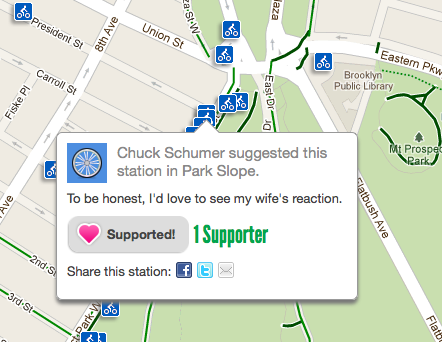
People are having a bit of fun with the New York City Bike Share station suggestion map. Zoom in on Park Slope and check out the growing number of suggested stations clustered around 9 Prospect Park West.
You know who else loves bike sharing? Our Borough President!

There’s a bike share station request for One Police Plaza and another in the middle of the Prospect Park Lake.
If you find any more fun ones, please post a link in the comments.
I Did it Hubway
I was in Boston last weekend and while I was there had the opportunity to use Boston’s bike share system, Hubway. To paraphrase some of the language from the announcement of New York’s bike share system, it was an affordable, easy, and fun way to get around the city. I spent five dollars for a “Casual 24-hour membership”, which was enough to get me from South Station to a friend’s apartment in Mission Hill and to countless points in between my arrival at on Saturday afternoon and my departure on Sunday. As a comparison, base fare on Boston’s T is two dollars.
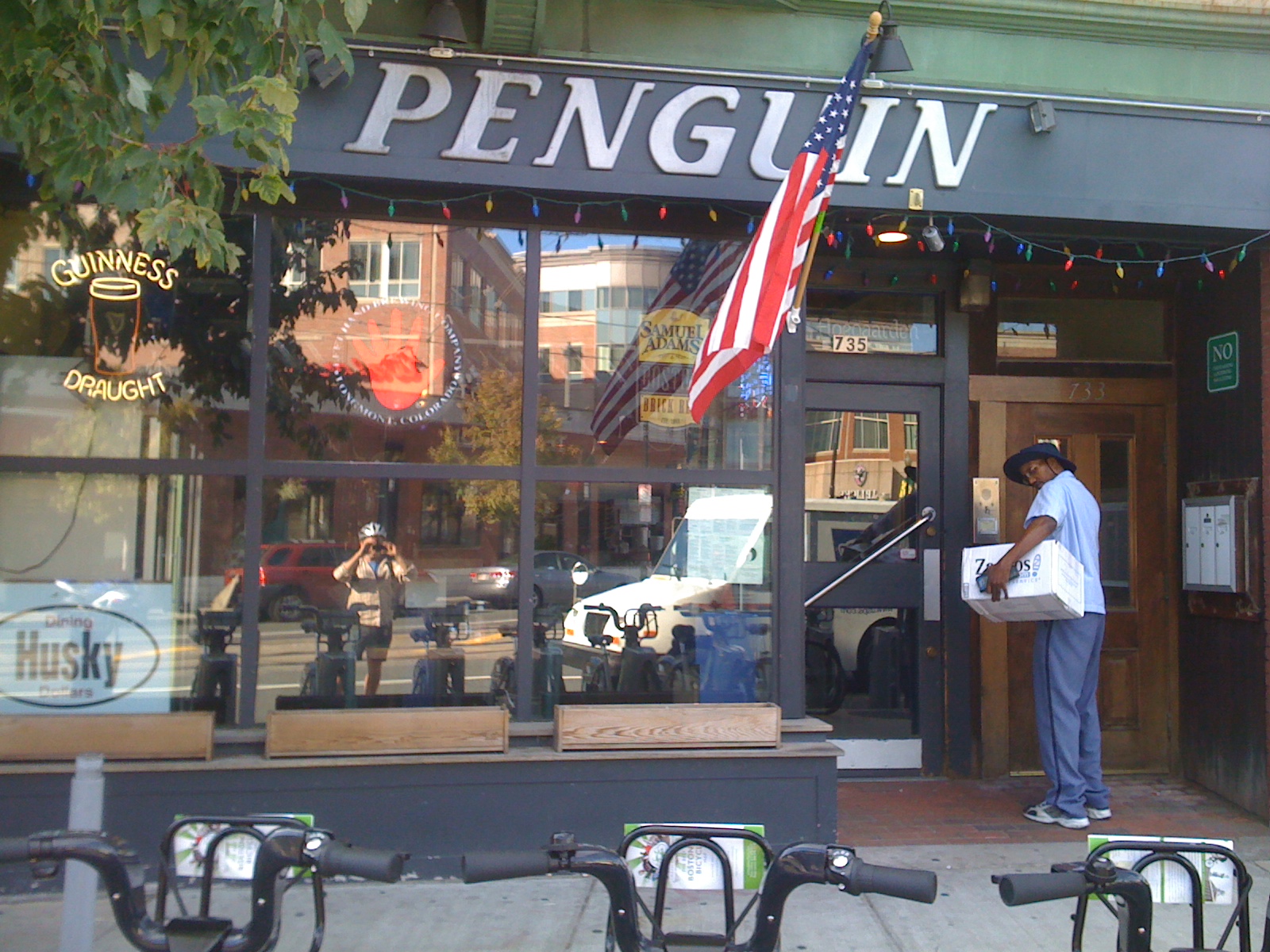 I met my friend at Mission Hill’s Penguin Pizza, which has a bike share station right outside. (By the way, you know who goes to Boston from New York and eats at a pizza place? This guy.) The station, which holds thirteen bikes, seemed to have taken the space it formerly took to park two cars. The jaded, bikelash-schooled activist in me immediately contemplated the reactions of the business owners on both sides of Huntington Avenue. I even imagined a Boston version of Steve Cuozzo penning an angry column on the subject, “Mission Hell.”
So, like the entitled, pushy Brooklynite that I am, when I sat down for drinks inside I stopped one of the bar’s owners, a blonde woman with a thick Irish brogue, as she walked by our table. “Let me ask you a question,” I said. “What do you think about the bikes outside?”
“We love them,” she replied. I was actually surprised by the level of her enthusiasm and asked how she felt about losing two parking spaces, the kind of street change that would cause apoplexy among the Sean Sweeneys of New York.
“Parking in this neighborhood is terrible,” she said. “People know that about Mission Hill and don’t come here, because they know they won’t be able to park.” She explained that two fewer parking spaces wasn’t going to be the deciding factor in someone’s choice between driving to eat at her restaurant or going elsewhere in Boston. Parking for over a dozen bikes, on the other hand, seemed to have made a difference in the short time since Hubway launched this summer. She told me that ever since the bike sharing station went in, people were riding in from all over, and the ease of using a Hubway bike may have had something to do with it. “There’s room for twenty bikes or two cars,” she told me. “You do the math.” It seemed her enthusiasm for the project had inflated her mind’s estimation of how many bikes were parked outside.
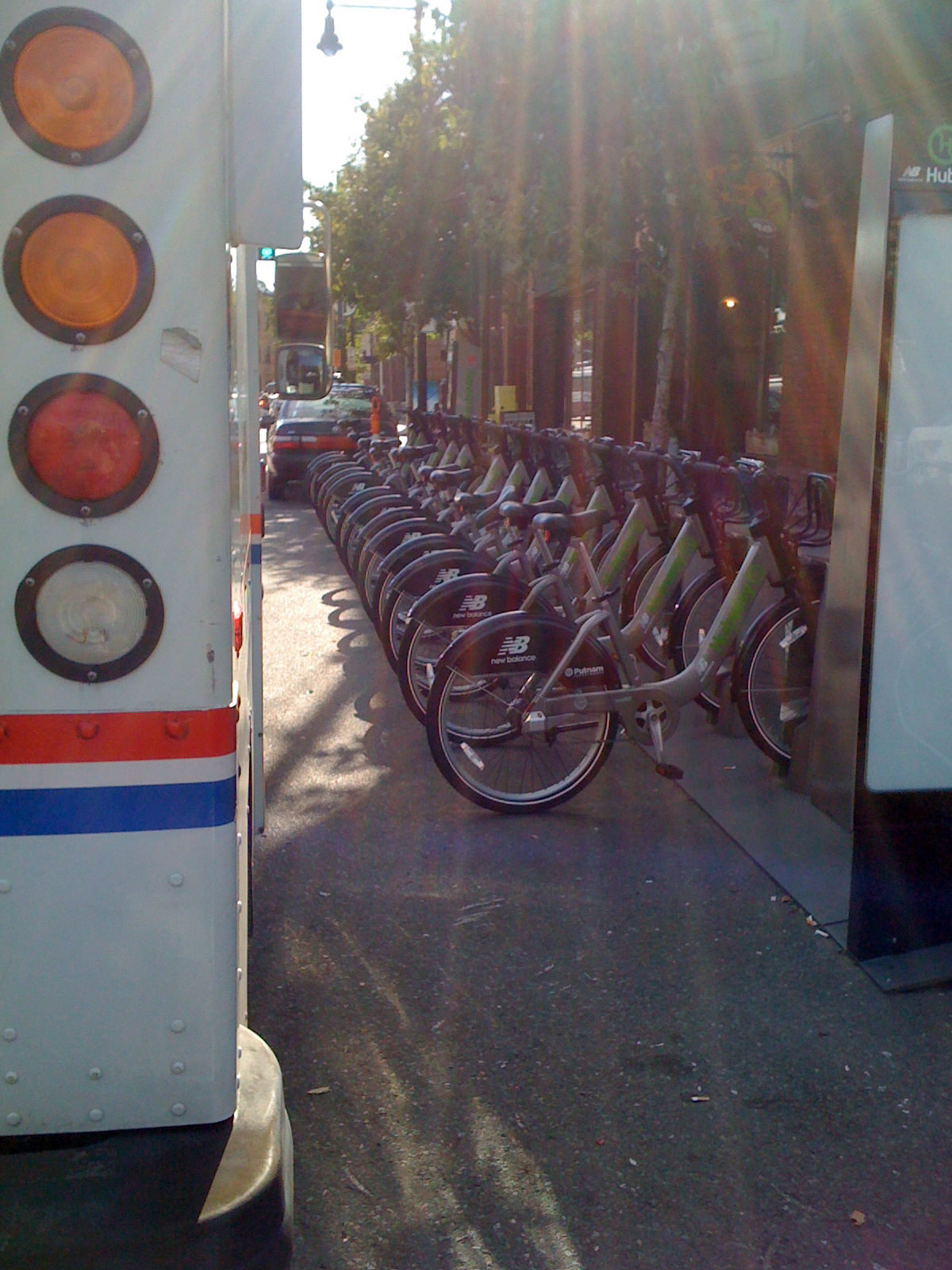 I asked her if she had noticed any change in her business and she seemed to exhibit the kind of understanding of basic economics one could only hope for in the New York business owners who claim that bike lanes killed their stores’ profits. She said that there was no real way for her to make a connection between the bike share station and her profits; Boston’s economy — especially the economy of bars and pizza joints — is very dependent on students, and most schools were only just finishing their second week of classes. Still she said there was absolutely no way the bike share station was hurting her business.
When it came to deliveries from vendors and suppliers, she was even more logical, noting no change. “It’s not as if anyone could pull right up to my store before – there were always two cars parked in front.”
Reading from my unofficial guide to the bike backlash, “Bike Lane Hate for Dummies,” (Markowitz, Weinshall, Steisel, et al., Gibson Dunn Press, 2010) I wondered if she was concerned that Boston’s unpredictable weather would render the bike share system impractical for many trips. “People use it all the time to come here,” she explained, leaning in as if telling me a secret, “even in the rain.” (Hubway stations will be packed up for the winter and put out again in the spring.)
Boston is by no means a logical location for a biking boom, but it’s booming nonetheless. With roads that were laid out not by a Commissioners’ Plan but by cows and sheep, its traffic can often be worse in some areas than in the five boroughs. The weather is less favorable than ours by a matter of degrees, and there’s an even deeper history, entrenched political interests, and neighborhood-based identity in Boston that can make change difficult or even impossible. As New York rolls out its bike share program in April 2012, it’s clear we have a lot to learn from our baseball rivals to the north. If bike share can make it there, it can make it anywhere.
 Brooklyn Spoke