Quote for the Day
You will have a hard time convincing people to ride a bike because it’s green – or economical, or chic, or fun or healthy, if they don’t find it convenient and safe. At the end of the day, most people will simply do what it’s easier for them to do. Nothing wrong with that, life’s hard enough as it is. – “My Bike is Not Green,” Marc van Woudenberg, aka Amsterdamized.
DOT to Bowery Cyclists: Drop Dead

Day three of the Manhattan Bridge detour and the Bowery was blocked from Canal Street to here, just below Rivington where the detour officially ends. This picture could have been taken anywhere, however, as there were multiple locations where not only was the curbside lane obstructed, but the middle travel lane was occupied by a double-parked truck or van.
If the NYPD is not going to do its job as an enforcement agency, the DOT should do its job as a design agency. It should offer cyclists something better than the death trap that awaits them as they pour off of the Manhattan Bridge and onto the Bowery.
A Simple Reminder

Just a reminder that after all the affidavits, FOIL requests, press releases, protests, press conferences, blog posts, TV news stories, radio segments, public hearings, tabloid articles and all the rest, this is what Jim Walden and Neighbors for Better Bike Lanes are in court today to remove.
How sad.
The Good, the Bad and the Deadly
Due to a cable rehabilitation on the Manhattan Bridge, bike commuters swapped sides with pedestrians on Monday and won’t switch back until January 2012. So, how did it go the first day out? Well, some parts were better than expected, some could have been better, and some were downright deadly. Below, the photographic evidence. (Click photos to enlarge.)
It was initially reported that cyclists would be required to dismount and use a set of stairs on the Brooklyn side of the bridge. That’s definitely an option:

The two sets of stairs have channels along side them so that cyclists can guide their bikes with ease.
 The good news is that there’s a small turn-around that allows commuters to stay on their bikes and keep riding:

It’s a tight squeeze and DOT had someone standing at this opening guiding people through since it’s impossible to see around the bend. I can’t imagine this guy will stand around twenty-four-hours a day for the next six months, so hopefully DOT will install a mirror to help cyclists avoid collisions. (It would be great if DOT could open the gate you see along the road, but that would put cyclists directly in the path of an off-ramp and would require additional signalization in order to make it safe.)
After that, it’s smooth sailing. DOT had staffers on hand to pass out maps in the pedestrian plaza, which is now the main throughput for cyclists as they go up to the bridge.
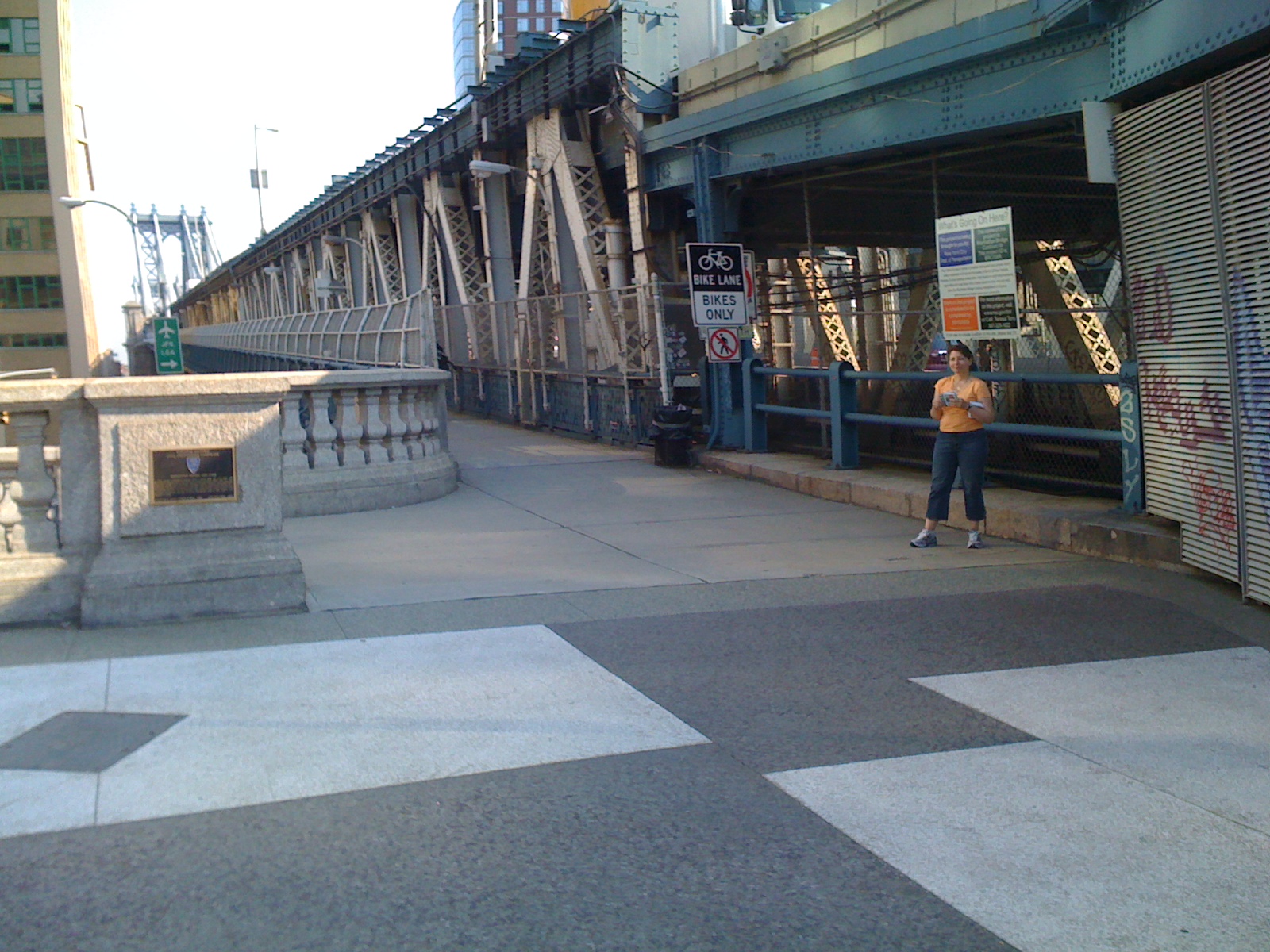
The pedestrian side is less steep than the normal bike approach, making for an easy climb, and since it’s on the southern side of the bridge it now offers commuters perhaps the most beautiful view east of San Francisco:
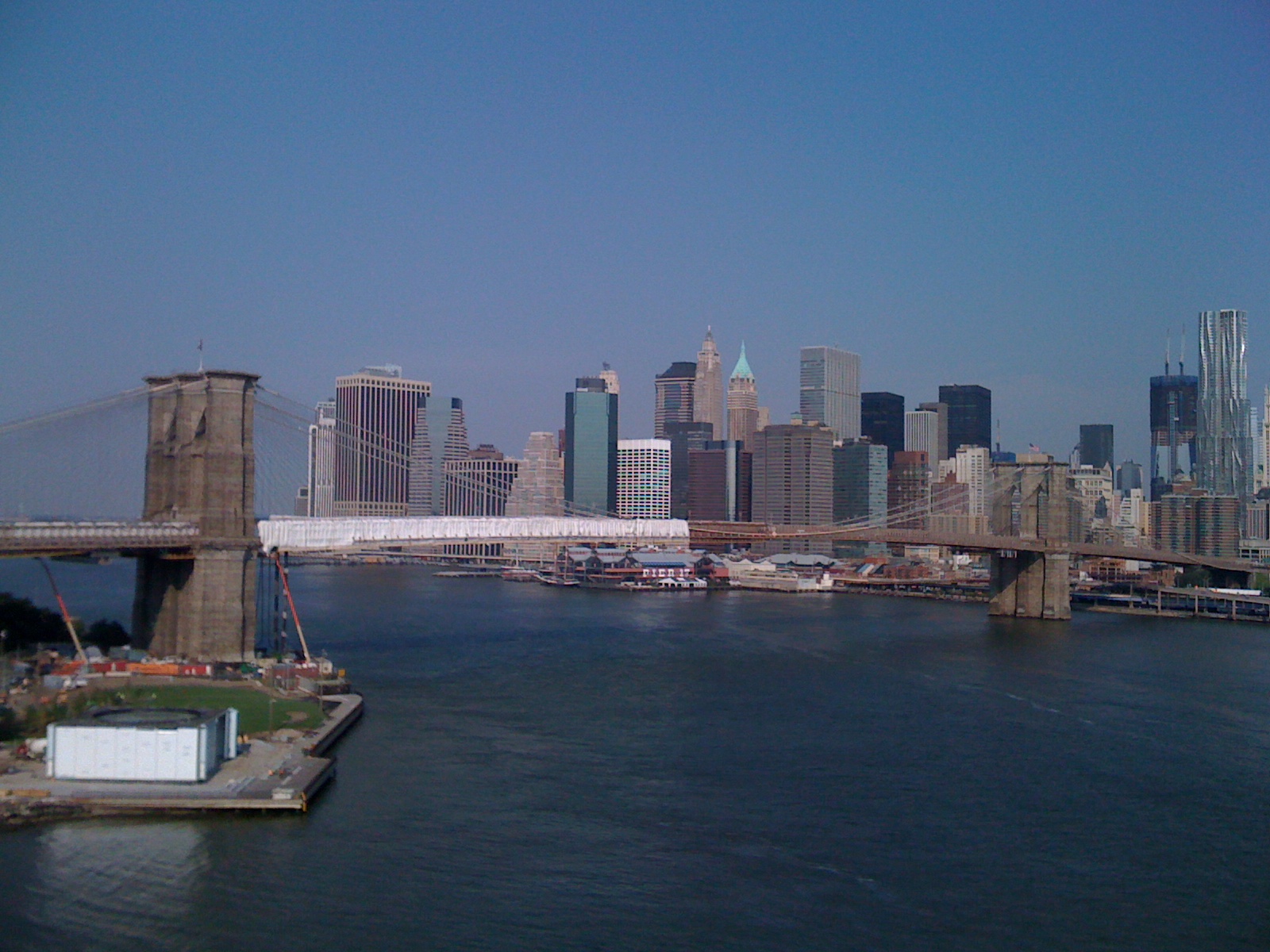
As I rode this morning, I was pleasantly surprised. The new Brooklyn-side approach offers only the most minor of inconveniences, and as long as cyclists take things slowly on that tight switchback it shouldn’t be much of a problem.
But then I got to the Manhattan side. I believe DOT has turned what used to be one of the safest, most pleasant commutes in the city into one of the most dangerous. Cyclists are dumped onto the Bowery, just under Canal, with little separating them from traffic. There is a bike lane for only the first few meters; the rest is dotted lines and sharrows. (You’ll never appreciate how much drivers actually do, in fact, respect painted, buffered bike lanes until you rely on sharrows to guide your commute.)
The first hazard to cross is a wide lane of turning cars trying to get onto the Manhattan Bridge:

There’s a bike lane over there, but first you have to watch for this:

Not surprisingly, most of the trucks I saw turning onto the bridge approach did not yield for cyclists. And what greeted cyclists after they got onto the freshly painted Bowery bike lane? An NYPD van, of course! If ever there was evidence of the chasm between DOT and the NYPD, this picture is it:

To be fair, I wanted to chant ma nishtana as I saw this, but an NYPD van at this location on this day seemed like salt in the wound on this first day out.
Once bike commuters cross Canal Street they have to ride up Bowery. And that’s when things go from merely inconvenient to downright deadly. I simply can not believe that DOT will allow cyclists to continue to ride this way, although one DOT staffer I spoke to on my way home admitted that they are hoping cyclists will find other safer routes. (“I probably shouldn’t be saying this,” she said.) I don’t see how it’s possible to avoid the Bowery, at least for a block or two, and if you want to go uptown there’s no way around crossing Canal.
Below, you can see a cyclist across the street trying to avoid a truck pulling away from the curb:

The Bowery may as well have not been marked at all, given the frequency with which the bike symbols, dotted lines, and sharrows were ignored. And without enforcement or barriers to standing, the problem is only going to get worse as this new configuration becomes routine within a few weeks.
This Fung Wah bus was parked, its driver loading luggage, when the woman on the bike rode out into traffic to try to get around:

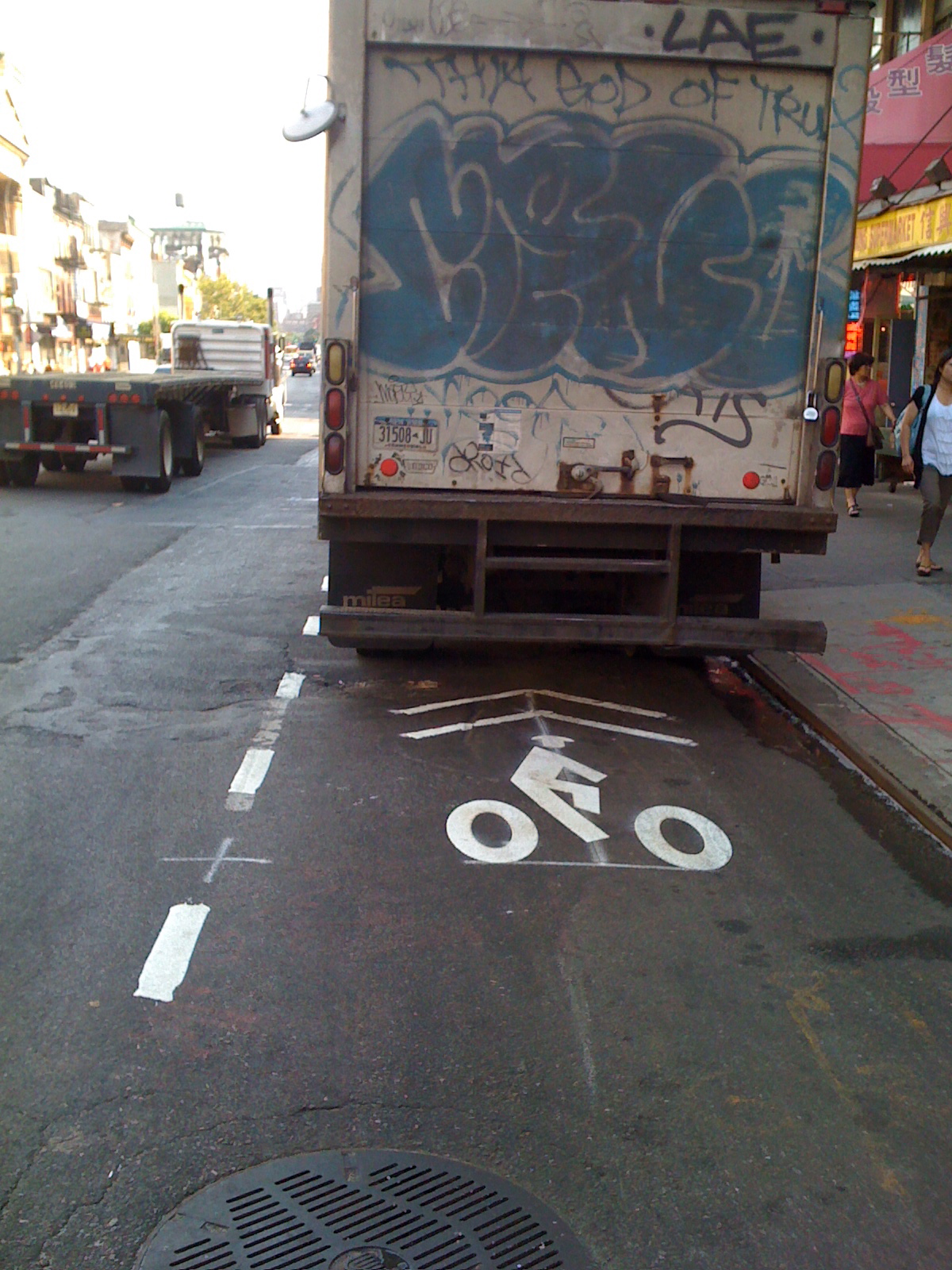
As in a Road Runner cartoon, it’s almost as if the sharrows in the picture below are directing cyclists into the back of the van. You can also make out a row of parked cars in front of it, as well as the SUVs and trucks that sped by in the left-hand lanes:
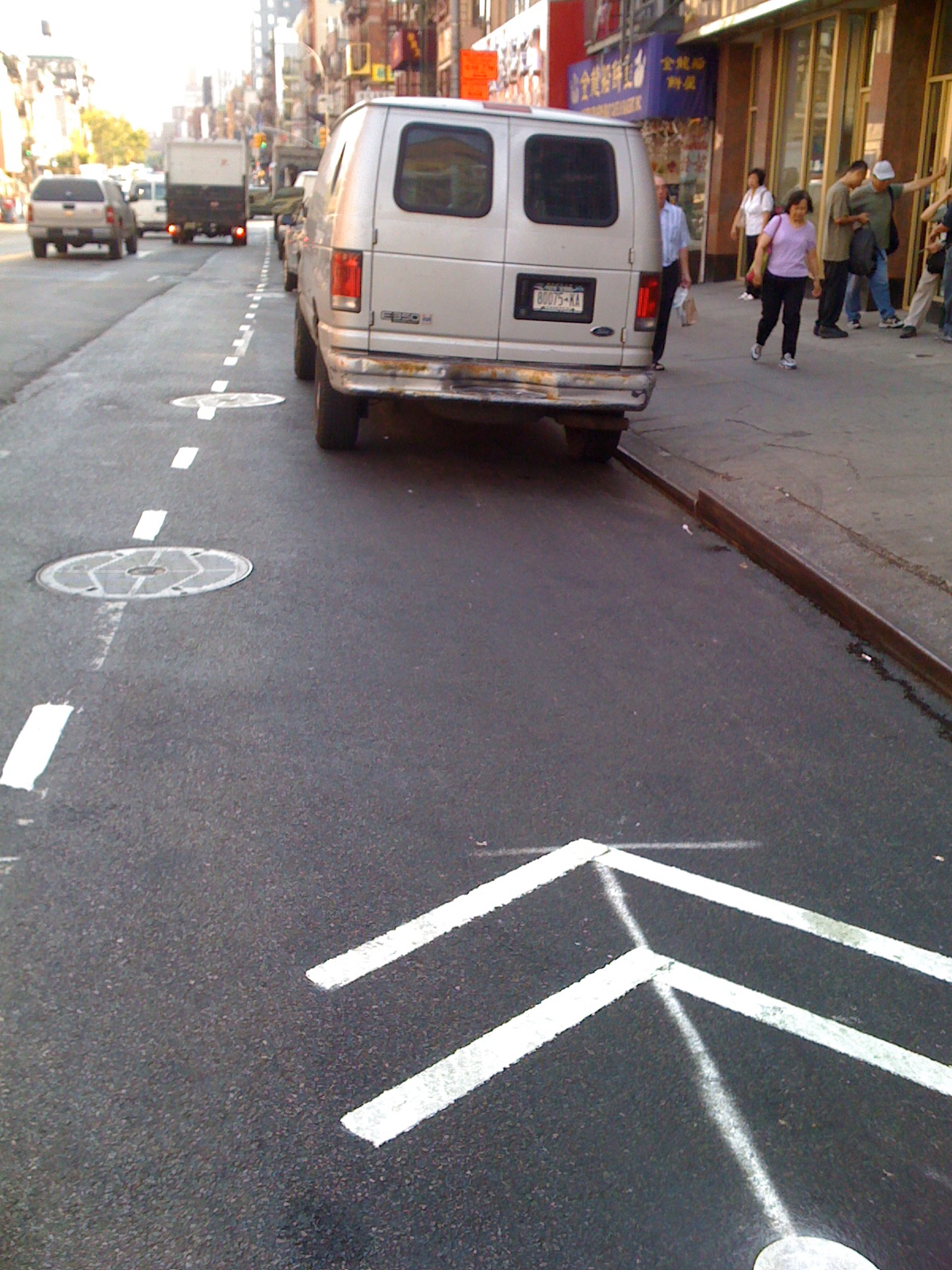
Here’s a similar, but different van, just a block ahead. You can see a line of cyclists having to ride between the parked vans and moving traffic — which, curiously was also made of a lot of vans. It’s a dooring accident waiting to happen.
Eventually I started to think that these weren’t bike symbols, but chalk outlines of the cyclists who are bound to get killed riding this speedway:
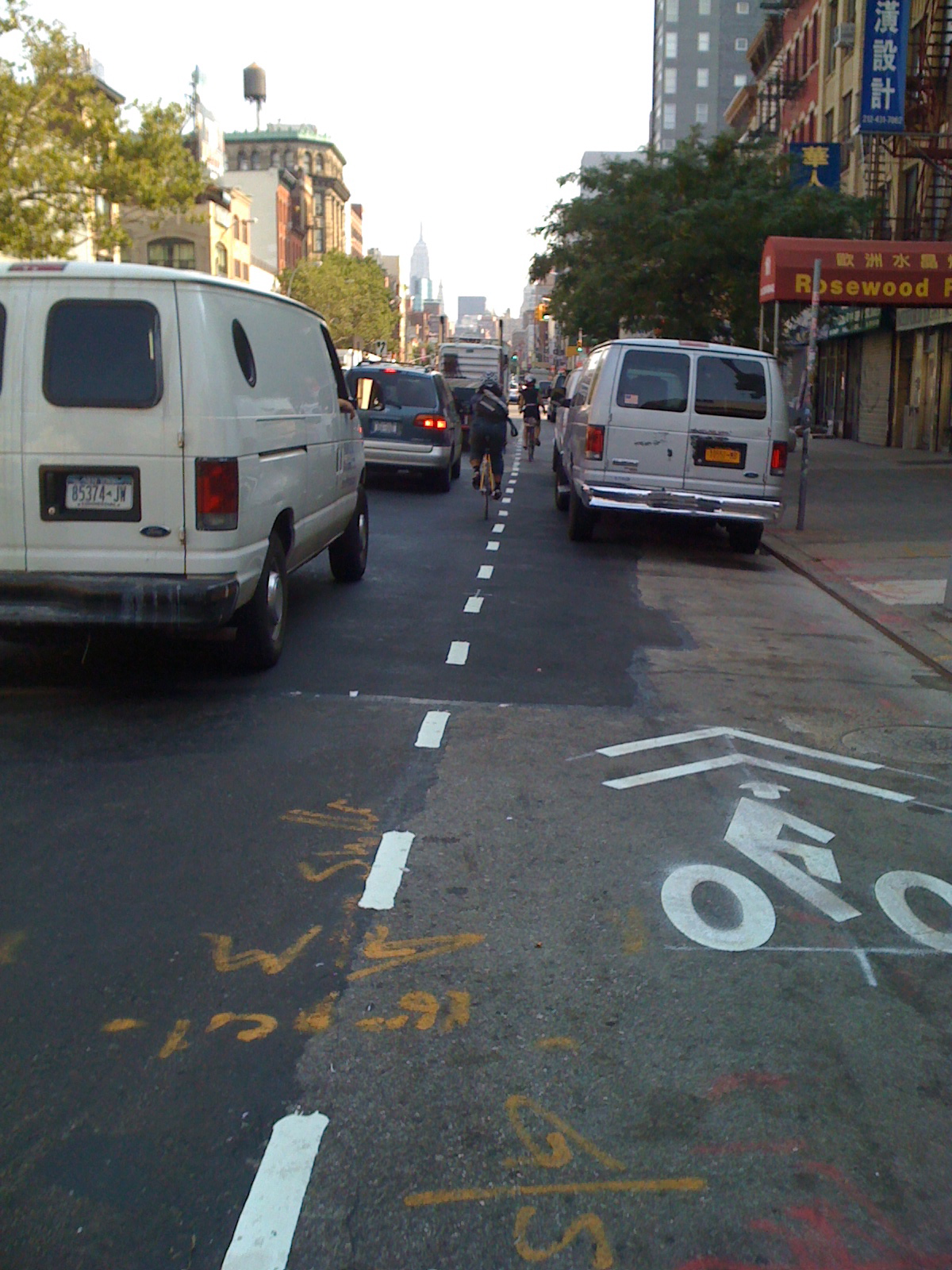
If this truck had had its back open, someone could have pulled a Casey Neistat:
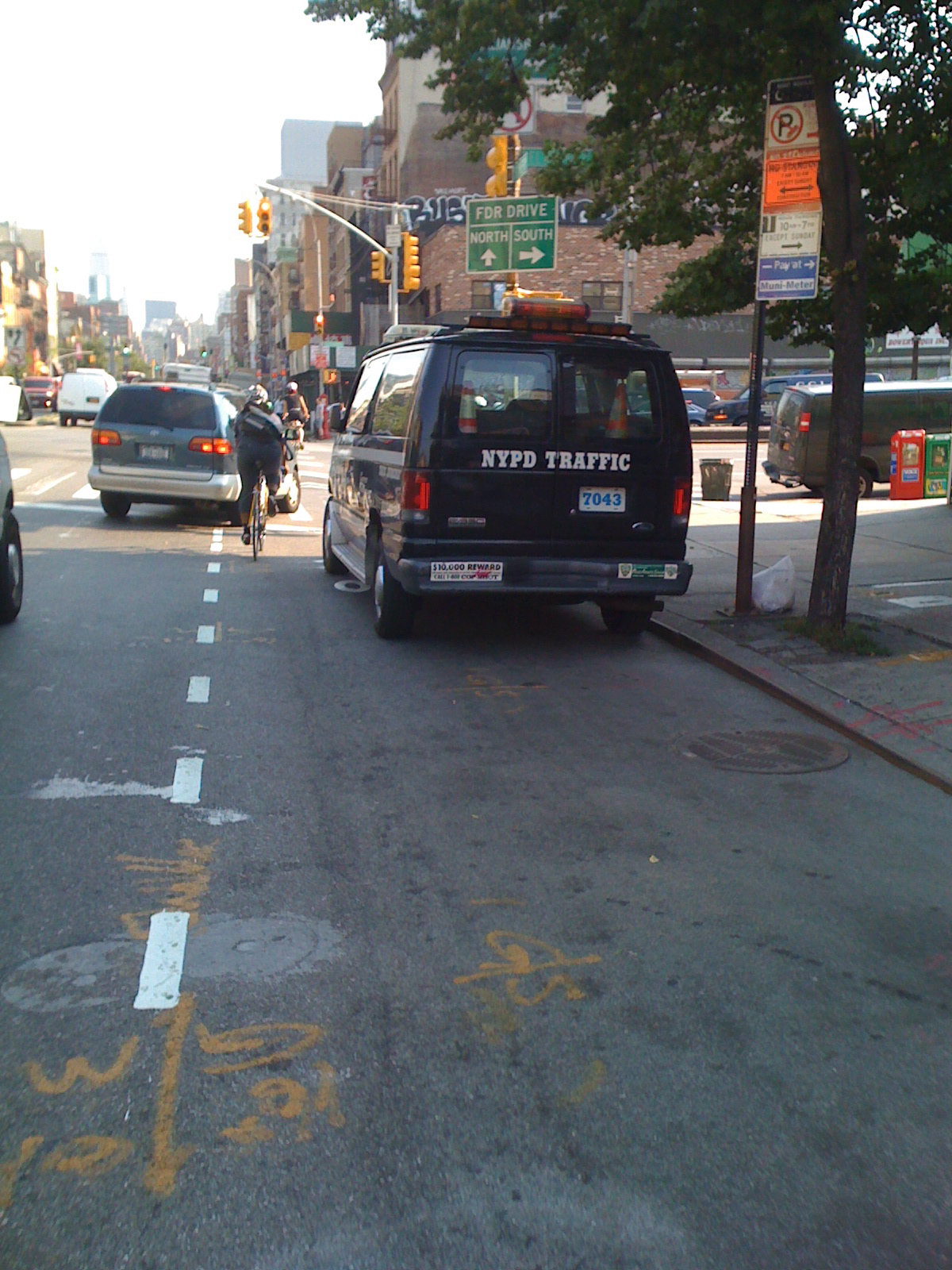
What greeted cyclists at Delancy and Bowery? Another NYPD van, of course:
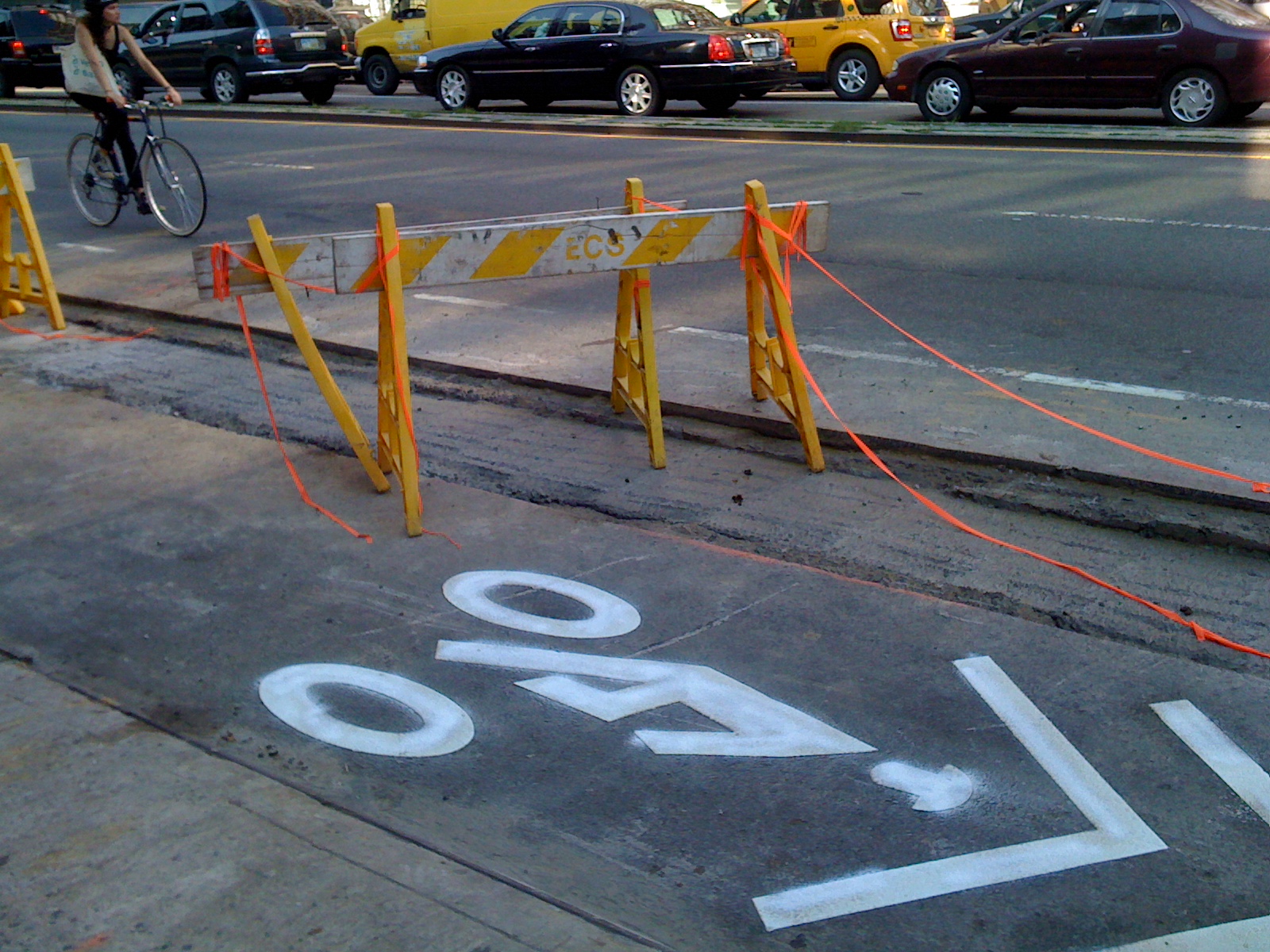
Not long before I got to the left onto Prince Street, I saw this piece of street construction which may or may not be related to the new bike route. Either way, I’m not sure how this set-up helped anyone on their ride. You can see that the construction forced cyclists into one of the two available car lanes. With northbound traffic moving at a rapid clip, this woman would need more than a tote bag to protect her if she were hit by a truck:
I believe the planning for this new route represents a major failure of DOT’s primary responsibility, which is to keep people safe as they move around the city. An inconvenient route borne of the necessity of a bridge repair is one thing, but a dangerous one is something completely different. I understand that the department was tasked with finding an uptown route for cyclists that connects to various crosstown bike lanes, but the cycling infrastructure provided — if you can call what DOT provided infrastructure — is woefully insufficient. Tiny orange signs affixed below traffic signs tell drivers “No standing,” but signs aren’t enough to keep New York City drivers out of no standing zones.
What is needed along the Bowery is a mix of bollards, jersey barriers, and other features that will keep cars and bikes separate from each other. I am sympathetic to the reality that many of the businesses along the Bowery need the curb space to make deliveries, so perhaps DOT could place designated loading areas every block or two. If business owners complain, DOT can tell them what they’re telling cyclists: it’s only temporary.
Sadly, I am almost certain that a major injury or death will occur on this route. I can’t imagine that a new cyclist — someone who may have only started commuting by bike this summer — will be all that encouraged to keep riding if this is what greets him in Manhattan every workday. Whatever gains the city has made in ridership over the Manhattan Bridge in recent months are likely to be erased until next spring.
And that’s just the ride in. Later, I’ll post about the ride back to Brooklyn, which was fraught with its own host of dangers, including more discount buses.
“Don’t get me wrong…”
Elisabeth Rosenthal, in a piece cross posted on Yale 360 and the Guardian Environment Network, wonders why American cities are “bicycle deserts” in comparison with their European counterparts. She begins her piece describing a visit to Prospect Park West, “where a new bike path along the edge of Brooklyn’s largest park had angry residents worked up into a lather.” (The lane’s controversy is always greater on the pages of newspapers and blogs than it is on the street; the hundreds of cyclists of all ages I saw on PPW this weekend seemed perfectly pleased with the lane.)
I expected to find a diversity of opinion about the bike path, which was created last year by Mayor Michael Bloomberg. I did not. Almost everyone I interviewed began with the following introduction: “Don’t get me wrong I love bikes, I ride all the time…” and then segued into a barrage of objections: The path was a hazard for old people and mothers with baby strollers crossing to enter the park. Riders pedaled too fast. They should just ride inside the park. The loss of a lane made parking worse and traffic slower. It made it harder to stop to drop kids at school. It was unsightly.
Who did Rosenthal speak to? Norm Steisel and Marty Markowitz? Saying that it was “created” by Bloomberg — and not, say, by a years-long, bottom-up, community process — is a stretch, although I hear Jim Walden might now use this article as evidence at Wednesday’s hearing. (Note to Jim Walden: I’m joking.)
It’s an otherwise good piece on the challenges of growing cycling in the United States that unfortunately tries to use the PPW nontroversy as a framing device.
Picture of the Day

My Public D3 and the Prospect Park Audubon Center just seem to go together.
Louise Hainline: “I learned about this project late…”

In this email to Brooklyn Borough President Marty Markowitz obtained by Streetsblog, Brooklyn College dean Louise Hainline admits she was told by none other than Iris Weinshall herself that the PPW bike lane was not at all “temporary,” betraying the notion upon which NBBL’s entire case against DOT rests. In addition, Hainline gives the impression that not only is she against the bike lane on her block, but that entire boroughs may be inappropriate locations for bike lanes; she describes the axing of the B69 bus as “ironic,” considering the installation of the bike lane, when “coincidental” would be the more appropriate word; she says that Prospect Park was “made for biking” even though it opened in 1867, over twenty years before cycling truly took off in the United States; she questions DOT data months before DOT releases any figures, offering a preview of the confirmation bias she and other NBBL members will exhibit later; and she suggests that cyclists and pedestrians can share the “luxurious width” of PPW’s “lovely sidewalks,” which would ironically — I think the word fits in this context — put Hainline’s friends in Seniors for Safety in danger.
To top it all off she admits that she “learned about this project late.” It makes her March 2011 admonition to hundreds of PPW fans to “take a deep breath” all the more disdainful, considering how many of them had been involved in the project for years by that point; when everyone else has been in the pool for hours, it’s the person who dives in last who should probably take the deepest breath.
I thought about writing a longer take-down of this email, but it’s hardly necessary. Luke DePalma, Marty Markowitz’ transportation advisor, already wrote one. [PDF]
“I don’t mind. Everybody’s got to slow down a bit.”
Via the Toronto Cyclists Union comes this video from Jarvis Street, the Canadian counterpart to many of the so-called “controversial” bike lanes in New York. (Toronto is about to spend $400,000 to remove this heavily used lane.) As you can see, when the story is taken out of the tabloids and down to the street most drivers are actually perfectly happy sharing the road. Considering that polls show a majority of New Yorkers approve of bike lanes, my guess is that a similar video shot on Prospect Park West, Kent Avenue, 8th Avenue, or 2nd Avenue would yield similar results and fewer Canadian accents.
Fairfield Inn Adds Bike Racks to Third Avenue
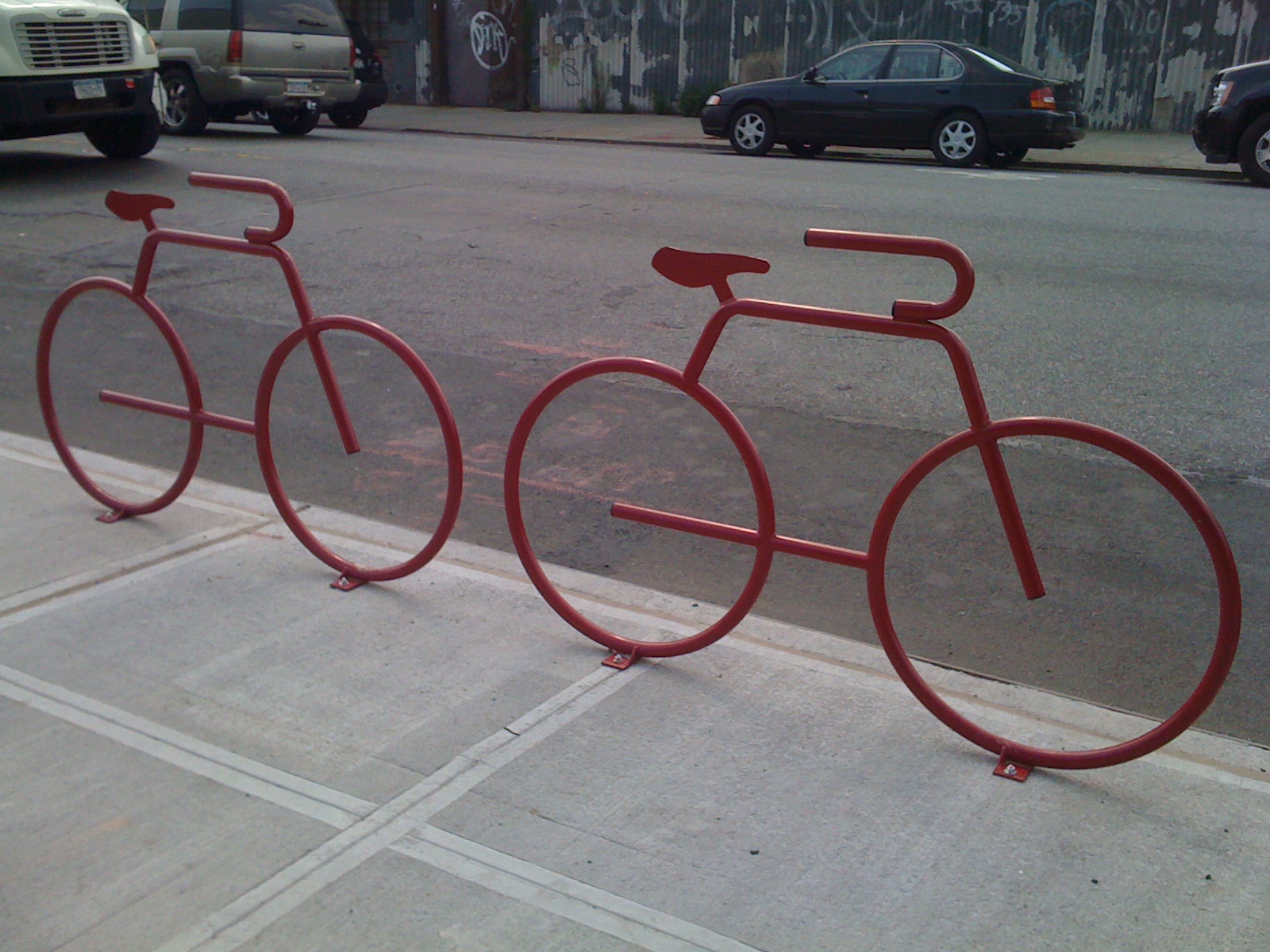
I walked past the new Fairfield Inn & Suites on 3rd Avenue and Butler Street and was pleasantly surprised to see that two new bike racks have been installed on the sidewalk right outside the entrance.

These aren’t the typical U-style bike racks seen elsewhere in the city, and that’s a good thing. It’s nice to see an representation of bicycles given such a prominent spot on a busy avenue, especially since so many cyclists use 3rd Avenue to travel to and from the Dean and Bergen Street bike lanes.
Third Avenue isn’t exactly scenic, which is one reason the hotel might want to offer its guests bikes to borrow or rent. The hotel’s location is within easy riding distance of everything from Brooklyn Bridge Park to Prospect Park. Public Bikes, which I’m partial to, partners with many hotels so that guests can borrow a bike during their stays.
The new hotel has an abundance of car parking on both sides of the building, which is a shame since on-street parking is generally abundant on and around 3rd Avenue. But given the traffic near Flatbush and Atlantic, anyone who drives from out of town to see relatives in Park Slope or Boerum Hill may have no choice but to leave the car in the lot and grab a bike if they want to get around during their visit.
So what do you say, Marriott? Want to be one of the first hotels in Brooklyn to offer free bikes?
See? Iris and I love bike lanes!
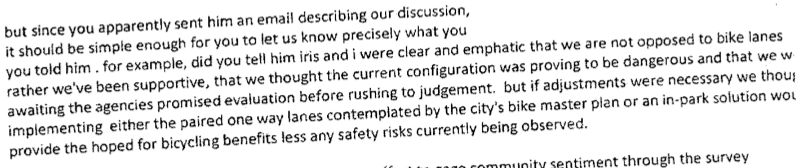
Here’s yet another addition to the growing list of Some of My Best Friends are Bike Lanes quotes. It comes from Neighbors for Better Bike Lanes member and former deputy mayor Norman Steisel in an email sent to Brad Lander. Via a Streetsblog FOIL request. [PDF]
The full email is a good read. In it, Steisel claims “600 plus verified neighbors in the ppw corridor” who are presumably NBBL members or at least sympathetic to his cause. If that number seems big given NBBL’s pathetic showing at the March 2011 CB6 hearing, don’t forget that using the standard multiplier effect of 50:1 for constituent support, Steisel is sticking up for over 30,000 unhappy Prospect Park West residents.
 Brooklyn Spoke