The Butterfly Effect
There’s a pretty sad article in the New York Times today regarding the city’s school lunch program, which is on track to be $8 million in arrears by the end of the school year. The Education Department collects money from public schools, money that those schools are supposed to get by charging $1.50 per student per meal. Of course, many poor students get meals at a reduced price of twenty-five cents or for free, but the story notes that “even some of the students charged the reduced price have fallen behind.” As a dad to a kid whose biggest problem with food is that she’s getting pickier about what kind of foods she’ll eat, these kind of stories always hit me hard.
This sentence caught my attention:
Of the city’s 1,600 schools, 1,043 owe a collective $2.5 million to the department for meals served in the first three months of this school year.
I quickly remembered why that number — $2.5 million — stuck out. Back in January, City Council Transportation Committee James Vacca fought off a proposed twenty-five cents parking meter increase for outer borough residents.
Meter rates would have gone up from 75 cents per hour to one dollar per hour. Now those rates won’t go up until July 1 at the earliest, pending another round of budget negotiations before the next fiscal year. Deferring the parking rate increase means the city has about $2.5 million less to spend in the current budget.
Of course, there’s no single source of or fix to our city’s fiscal woes. The $2.5 million could just as easily come from different or higher taxes, slashing another part of the budget, raising fees on city services, or other revenue generation. And even if the $2.5 million could be erased, there’s still a lot of lunches left to serve until the school year ends.
I’m not at all asking drivers to shoulder the entire burden of paying for city services, but the symmetry of the numbers is striking. While not all car owners are wealthy, I can’t imagine that a large number of people who can’t even afford twenty-five cents for their kids to eat lunch are also car owners who can’t afford twenty-five cents more to park.
But that’s where we seem to be in our current state of affairs right now, where politicians do what’s best for small constituencies and where a lack of any sense of mutual responsibility seems to be the new normal. In a city with so much, is an extra twenty-five cents per hour when you park your car too much to sacrifice so that poor school kids can eat lunch?
Ask Again Later
It tells you something about the state of bike lane hysteria and journalism in New York that the most sensible take on Neighbors for Better Bike Lanes comes from a Magic Eight Ball, via F*cked in Park Slope.
Do you think that one of the leaders of NBBL taking hours of video footage of traffic patterns on PPW is voyeuristic and creepy?
M8B says: Signs point to yes.
Cyclists Matter
Via the Lo Fidelity Bicycling Club.
If you want to make yourself feel better about the negative media and cycling backlash in New York these days, watch this video and imagine the story takes place here and not in the Netherlands. To totally oversimplify what this video is about, can you imagine a bruised knee getting so much attention in a New York newspaper?
This is required viewing for all who imagine a better, more balanced future.
Quotes for the Day
The bike people drive her crazy, but they know they have an ally in me,” – Senator Chuck Schumer, January 10, 2005
“But this journey is not one that can be undertaken in a car – you’d miss the details, the human scale, and the pace of life as you fly by. Even walking won’t do – you won’t be able to cover nearly enough ground. To really get to know New York, you’ve got to ride a bicycle.” – Senator Chuck Schumer, June 22, 2009.
“He’s asked legislators what they’re going to do about [this and other] bike lanes,” – Anonymous source, New York Post, February 6, 2011.
A Letter From Marty Markowitz

Despite his near-silence on traffic injuries and deaths, Marty’s theatrical entrance-by-bike at his 2011 State of the Borough speech was, in one way, less offensive than something else that happened during his oratorical tour of Brooklyn.
When I read that Marty featured a pole dancing exercise instructor on stage at Sunset Park High School during his speech, I thought it was in bad taste. Bike commuters may make up a small percentage of his constituency, but women still make up about half of the people who live here and as a relatively new dad I’m sensitive to the kind of world in which my daughter will grow up. I’m also a huge fan of Chris Rock’s advice to fathers:
Okay, so the pole dancer at Marty’s speech wasn’t exactly a stripper. She was an exercise instructor at Exotic Curves in Bay Ridge and all the more power to her for owning or being part of a business that must be doing well enough right now to catch to the BP’s attention. Marty has long told Brooklyn to lighten up, so I guess I can make the connection between his clear commitment to personal health and his boosterism of local entrepreneurs.
But still. Did Marty need to feature her in his speech? It’s not exactly a hanging offense, but it also isn’t something I think an elected official should put on full display at one of the biggest events of the BP’s year. (Not that it would happen in a million years, but Bloomberg would generate a national outrage if he told so much as a blond joke at a press conference.) That’s the risk of mixing your political persona with comedy: sometimes the jokes fall flat.
So, I did what any other sanctimonious Park Slope liberal breeder nutjob would do. I wrote him an email.
To: askmarty@brooklynbp.nyc.gov
Sent: Friday, February 04, 2011 7:49 PM
Dear Mr. Markowitz,
As a father of a young daughter, I watched your State of the Borough
speech with mild disgust. Even though you were promoting a local
business, to feature a woman pole dancing on stage during your
presentation — at a public high school, no less — was crude and in
poor taste. Is that really the message you want young girls in your
borough to see and hear? There were high school students and children
present at your speech. Is that how we should promote our great
borough? By putting a young woman in revealing clothing front and
center during your speech? Our borough’s young women deserve better.Brooklyn has so much to be proud of and so much to offer people who live
and visit here, that I’m disappointed you couldn’t find something
different to fill the time in your hour and a half of stage time.I think you owe women and girls, who make up half of your constituency,
an apology.
Not too bad, right? All I mentioned was “mild disgust,” disapointment, and a thought that perhaps, in the fourth largest city in America, Markowitz could have chosen any of a few thousand other local personalities or colorful businesspeople to entertain his audience.
I never really expected a reply, but I got one on Monday either from the man himself or from a punctuation loving staffer using Marty’s email address and a computer with an intermittently functioning shift button.
From: Markowitz, Marty
Mon, Feb 7, 2011 at 2:26 PM
Are you serious?????? First, there were no young girls present and
secondly, this guest did nothing lewd…she runs a business that is all
about exercise for men and woman…..this was not about sex
dancing….every year in my annual Borough speech I present bonafide
Brooklyn characters…and unique Brooklynites doing unique
things……that’s all there is to it…..marty
Good to know that this was not about “sex dancing” but his response left me curious: how many men take pole dancing classes? I’m happy to hear from anyone who knows.
Let me be clear: I love this email response. Someone else might have given me the classic non-apology: “I’m sorry if you were offended.” But that’s Marty for you. His response was vintage old-school Brooklyn: “I’m sorry if you were offended, wussy.” To give him or his office credit, I can see the benefit of this response: it’s a straight-shooting, say-what-you-mean email, not some form letter to “Dear Brooklyn Resident.” Sometimes you just have to laugh.
I have only one minor point of contention. According to Marty, “there were no young girls present.” Then I guess the dance troupe that also performed during his speech is made up of some impressively young looking adults:

The Bike Lane Made Them Do It
Andrea Bernstein at Transportation Nation has a very astute analysis of the “Bike Lane Battles.” She lists some common complaints–congestion, historic character, pedestrian confusion–and brings up the fact that the sheer pace of change may seem to be too fast for some people’s taste. (I know more than a few people who’d say it’s not fast enough.)
She makes this important observation:
But I also wonder if there isn’t an element of the following: it can be disorienting to have our immediate physical environment disrupted.
That’s the whole issue right there: change is hard.
If you’re a wealthy Prospect Park West resident or home owner and you’ve never paid attention to or attended Community Board meetings, if you don’t belong to a neighborhood civic association, or if you don’t follow transportation issues, it may seem as if the PPW redesign was implemented overnight. One NBBL member even testified at the City Council hearing on bicycles that she and her husband returned from vacation to find, with some shock, that the street had been changed, it seemed, overnight. Well, if that was the first she learned of the change, then of course it would be a shock to the system, like coming home to find that they key to get into your apartment now has to be turned to the left after years of turning it to the right.
As a giant aside, that’s not to say that there aren’t NBBL members who aren’t involved in their local community. Lois Carswell is a former chairperson of the Brooklyn Botanic Garden board and an active volunteer there, from what I understand. Others have undoubtedly donated time and money to the Prospect Park Alliance, Brooklyn Museum, and other institutions. Many more lived in Park Slope long before the waves of gentrification began, fixing up brownstones and working to make the neighborhood safe. I met Lois Carswell shortly before last October’s rally and, during a pleasant conversation, thanked her for her part in making Park Slope the neighborhood I know and love today.
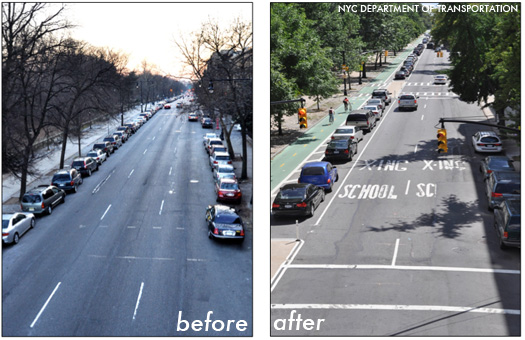
But now, after decades of incremental change, something is different. The neighborhood, or more specifically the street, many people have known for perhaps thirty years or more has changed. On top of that visual change, privileges they were used to for decades–driving speeds, parking–have also changed.
Andrea’s analysis stuck with me as I read the December letter Jim Walder, NBBL’s lawyer at Gibson Dunn, sent to the DOT. This line jumped out:
…the accident reports we have received indicate that accidents are occurring at a far greater rate after the installation of the bike lane than before. These reports strongly suggest that the bike lane is the direct and proximate cause of these accidents.
Given all of this change, it’s not surprising that it seems as if the “accidents are occurring at a far greater rate after the installation of the bike lane.” These “accident reports” are anecdotal and self-reported accounts collected from many who are sympathetic to the “no bike lane” cause, and not, as far as I know, verifiable before and after reports from the NYPD, other city agency, or disinterested party. And that’s where the shock of the new or different comes into play.
It’s human nature to start noticing something more following a big change. After my daughter was born, my ears would pick up whenever I heard a story about children on the radio. Was NPR suddenly running more stories about kids at the end of 2009? Was my daughter’s birth the “direct and proximate cause” of their new focus? Of course not. All that happened was what happened to me: there was a big change in my life that caused me to pay attention to those kinds of stories more. It’s just one example of a phenomenon we experience all the time. When I leased a blue Volkswagen Jetta shortly after moving to Atlanta in 1996, I suddenly noticed all the Volkswagen Jettas on the road, especially the blue ones. Some things make us pay more attention to something that previously wouldn’t have caused us to even blink.
The accident reports to which Walden refers don’t suggest that the bike lane is the “direct and proximate” cause of anything more than people noticing accidents more than they used to, whether or not those accidents are greater than, lower than, or exactly the same as they were before the street changed. (For the record, they’re lower.) Factor in an aversion to change, and even an aversion to bikes, and there’s all the more reason to start paying attention to accidents more, even if they might not rise to the level of anything to report to the police.
I doubt too many NBBL members were out collecting accident reports before the bike lane was put in, and that, right there, should be enough to tell us what’s really going on here. Why are people on Prospect Park West now paying more attention to traffic? The bike lane made them do it.
Chuck Schumer, Street Safety Opponent

Chuck Schumer cares about your vote, but not your safety. So the next time you see the senator around the neighborhood, as I did at a 7th Avenue street fair last summer when this picture was taken, ask him why he’s devoting his time, energy, and influence towards removing a traffic safety project that nearly 90% of his Brooklyn neighbors love. Oh, and it’s not just the bike lane in his own backyard that’s drawing his attention:
“He’s asked legislators what they’re going to do about [this and other] bike lanes,” said one source.
Don’t worry about health care, unemployment, or the economy, Brooklyn voters. Chuck Schumer is calling your elected representatives to make sure their priorities are in order. Do something about those pesky bike lanes!
From the look on her face, my daughter knew something was up a long time ago. Either she had a dirty diaper or she wanted to ask Chuck, “Why are you making it more dangerous for my dad to push me across the street in my stroller when we go to the park?” She’s just that smart. (And, yes, I am a stroller-pushing, Ray-Ban-wearing Brooklyn stereotype.)
Look, I’ve got enough perspective to know that the PPW bike lane is a tiny little issue that barely registers anywhere. It’s not as if making a few phone calls is going to hurt Schumer politically, since the man’s campaign coffers could probably pay for ten thousand bike lanes. He’ll be New York’s senior senator for as long as he wants. (And, not being a single issue voter, I’ll probably keep pulling the lever for him.) But his involvement further belies the notion that Neighbors for Better Bike Lanes represents anyone other than a wealthy, elite few.
Iris Weinshall wants her parking. The majority of the community wants safety. Chuck Schumer may put on a happy public face, but we know which side our senator is really on.
It’s the Bike Lane? Stupid.
Here’s another brilliant example of bad reporting from deep within the news room at CBS in New York: Lack of Parking Destroying Columbus Avenue Businesses.
When the Department of Transportation installed a bike lane on Columbus Avenue in November, it changed the whole street design and took away parking spaces. That lack of parking spaces is now wreaking havoc on local businesses.
So how many local business owners does CBS’s Peter Haskell interview for his story? Just one.
Ivan Pharmacy owner Ivan Jordan said his business has declined by 25 percent and the major cause is the parking trouble.
Is parking really the problem? Maybe it has something to do with the record amounts of snow we’ve had since the Christmas weekend blizzard and the fact that it’s been impossible for people on foot, on bike, on car, or whatever to get anywhere. The piles of snow covering street corners and other parking spaces hasn’t factored into it? I’m assuming many of Jordan’s customers are elderly people. I wonder if the icy, narrow sidewalks are keeping a lot of them at home?
A simple search for pharmacy near 691 Columbus Avenue, New York yields nine other pharmacies within walking distance of Ivan Jordan’s business. There’s a Duane Reade just across the corner at 700 Columbus Avenue. Maybe the encroachment of chain stores into Jordan’s neighborhood has something to do with it. There’s also the Internet; I’ve seen those Soap.com ads everywhere.
Of course, there’s this darn recession. Fewer people with jobs, fewer people with health insurance, fewer people filling prescriptions…that could be the reason, right? Nope. It’s the four parking spaces that Jordan’s block has lost.
“The decline in business was the most immediate because people got frustrated looking for a parking spot that they just went elsewhere,” Jordan said.
This is absurd on its face. I doubt too many people drive to one location in New York and, when they can’t find parking, drive a few blocks away to a land where parking is free and abundant and the businesses are all exploding with profits. Parking sucks in Manhattan no matter where you go.
This is all my own theory, done with not a whole lot more than a few seconds of thought and an Internet connection. I can’t say what the real cause of Jordan’s loss of business is, but then again, neither can Jordan. And more importantly neither can Haskell. But that doesn’t stop him from airing it on CBS radio. It probably took Haskell as much time to produce his radio piece as it took me to write this blog post. But that’s the state of old fashioned media these days. It’s sad.
I’ll add that CBS is not alone in this regard. Here’s the headline from AMNY, the free daily: Study: Street redesign hurting Upper West Side businesses. Well, not exactly. Area businesses aren’t very happy with the bike lane and are blaming it for a decline in business, but correlation is not causation. A study by members of CB7 and local politicians even says that the study “did not ask merchants to quanitify the impact of the street redesign to their business.” The bike lane may not be perfect, but without verification it’s a stretch to say it’s the sole or even leading cause of lower profits.
For a better, researched take on the Columbus Avenue bike lane and potential tweaks in its design, please read this piece filed by Kate Hinds at TransportationNation.org. There are statistics, facts, figures, quotes from local officials, and multiple points of view are presented. It’s journalism.
Shame on Marty Markowitz
Two days after Marty Markowitz made a mockery of bike lanes in his over-the-top State of the Borough speech, a hit-and-run incident has left a Brooklyn woman fighting for her life:
And Through A Day writes that victim Serena was struck while biking at South 4th Street and Wythe Avenue in Brooklyn around 2:30 p.m. yesterday. The driver sped off, and Serena is suffering from “a punctured lung, broken pelvis, among several other severe injuries and is in the ICU at Bellevue Hospital. She is currently unconscious under heavy sedation.” They’re currently looking for any witnesses.
Please visit this website if you can help in any way.
We’re just 36 days into 2011 and the evidence that Marty Markowitz is completely out of touch with the real problems on the streets of the borough he purports to represent continues to mount. I’ve lost track of how many cyclists and pedestrians have been injured or killed by car drivers on Brooklyn streets and sidewalks so far this year, but I’m certain that the number of car drivers injured or killed by pedestrians and cyclists remains at zero.
The Long Game
Here’s a comment over at Streetsblog on the subject of last night’s State of the Borough speech that caught my eye.
…you’ve gotta hand it to this big, dopey buffoon. Riding in to the State of the Borough Speech on a bike was genius. See, Marty loves bikes! He just doesn’t like this one particular bike lane. From a public relations-perspective Marty is simply cleaning y’all’s clock.
To use a term I may be too old to type, Marty is totally pwning livable streets advocates, the Mayor, the DOT, Brad Lander, CB6, and thousands of Brooklyn residents on this issue. With all the subtlety of a carnival barker, he’s playing right into the hands of a simplistic, lazy media that probably gets more page views on bike lane articles than it does on stories about Egypt or health care. So allow me to give credit where credit is due: His entire speech could have been him saying “applesauce” over and over again, but riding in on a tricycle filled with cheesecake got his picture splashed all over the place. Nicely done.
A lot of people think Marty is a buffoon, myself included, but that doesn’t mean he’s stupid, even if his logic stretches the bounds of the possible. He’s playing the long game on this one, knowing that if so much as an old lady’s poodle is hit by a bike on Prospect Park West anytime in the next two years, then the irrational bike lane debate will hit a new level of crazy. And if it’s a person who’s injured? An elderly person? Try getting the Post to write about the nuances of statistical blips or to do an honest comparison of year-to-year crash data so as to better understand the context of such an unfortunate event. It won’t matter if there’s a six-car pile-up down the street. Marty will be on the bike lane the next day with a hardhat and a jackhammer, CBS2 television cameras capturing every moment.
It’s a cynical, dastardly strategy and may come at the cost of someone’s life–in many ways it already has, considering his silence on other traffic injuries and deaths–but after seeing this play out in a few media sources this morning, it’s time to stop underestimating Markowitz and simply hope that he drives off to Boca when his term is up. The guy may be crazy, but he ain’t dumb.
 Brooklyn Spoke