Biking and Perception
If I could add any line to Woody Allen’s observation that the only cultural advantage to Los Angeles is that “you can make a right turn on a red light,” I’d say that the reason I don’t ever want to leave New York is that I don’t ever want to live anywhere where you can’t get the Sunday New York Times on Saturday. It’s like news from the future!
That Saturday paper delivery marks the start of a weekend ritual for me and my wife. We open the Sunday magazine to The Ethicist, reading the questions and debating our answers before checking to see if we agree with Randy Cohen, the column’s author.
Last night, I got the chance to hear Randy Cohen speak at a fundraiser for Streetfilms. While many in the crowd of livable streets advocates offered sustained applause to NYC DOT commissioner Janette Sadik-Khan, I was very excited for Cohen’s presentation. He’s a city cyclist and has a lot to say on shared spaces in New York. The theme of his short talk was perception and how, in the complicated world of city cycling and transportation, it often trumps reality.
Cohen opened his talk by asking what he admitted was a somewhat depressing question for the otherwise enthusiastic and cheerful crowd. “Why is there so much hatred directed at cyclists these days?” Despite–or perhaps because of–trends towards higher ridership, more bike lanes, and a greater consciousness of the ill effects of cars, there is a bit of a backlash brewing against cyclists, he said. People all over New York, if not the country, are living under a false impression that they are imperiled by a growing and menacing tide of bicyclists. They are suffering, Cohen said, from “false consciousness.”
Cohen brought up four points that illustrate false consciousness and the problem of perception in the battle for livable streets.
- Some people are “conservative by temperament” and fear change.
Cohen used the example of Hungarian doctor Ignaz Semmelweis, who introduced the idea of hand washing into surgery. The idea that a doctor would not wash his hands before operating on patient seems completely ignorant today, but when Semmelweis introduced the concept in 1847 he was met with abject ridicule by the medical establishment. (In fact, Semmelweis was dismissed as insane by his colleagues, institutionalized, and died, ironically, of sepsis.)
There’s a funny thing about change, Cohen noted: once it’s put into place things become knowable. Just as we can measure infection rates in surgery before and after the institution of hand washing protocols, the DOT can measure things such as automobile speed and accident rates. And guess what? Traffic calming and bike lanes make people measurably safer. This is basic science and proves, Cohen said, that not everyone’s opinions are equally valid. The rantings of an opinion journalist or the taxi driver quoted in an eleven o’clock news segment about closing Times Square to automobile traffic should not be given equal weight with the work and research of people whose job it is to study and measure these things.
- By changing streets, the city is inconveniencing the driving majority for the sake of a biking minority.
Another false perception, said Cohen. Car owners in Manhattan, Brooklyn, Queens, and the Bronx are a tiny minority of the overall population. (It’s a slightly different story on Staten Island.) In the congestion pricing debate, most of the loudest opponents in the city council or state assembly represented districts where car ownership or daily use is in the single digits. So, in fact, the city currently inconveniences the walking, transit-using, bike-riding majority for the auto-dependent minority. Despite the appearance that cars are everywhere, we ought to do a better job of asking who is driving, where they are from, and who is truly entitled to use the city’s rarest of resources, public space. We need to challenge the perception that the automobile represents some majority of the population. It simply does not.
- The NYC DOT caters to an Upper West Side bourgeois elite.
There’s a perception in the media that it’s crunchy, treehugging, limousine liberals who are setting the policy and making things tough for Joe Commuter. Once again, the congestion pricing debate illustrated this, with newspaper columnists and politicians claiming that tolling bridges would make commutes too expensive for poor people while having no effect on rich white people. But this, too, is false. The non-wealthy and non-white drive in very small numbers and improvements to transit benefits the poor and middle class much more than it does the rich. The populist position, then, is to get people out of their cars.
- Bikes are a menace to senior citizens and the population in general.
In 2009, 33,000 people were killed by cars nationwide. Cohen asked the crowd to think about that for a second. “Imagine you’re introducing a new transportation system,” Cohen said, “but there’s one catch: it will kill 33,000 people a year.” Cohen hardly needed to point out that few Americans would think it was okay to build something from the ground up with such a high casualty rate, yet that’s where we stand with cars right now.
Cohen asked the room full of cyclists how many people knew someone who had been hospitalized as a result of being hit by a bike or who had been hospitalized themselves for the same reason. Only two or three hands went up. But when Cohen asked the same question, this time involving cars, almost every hand in the room went up. Bikes may be seen as a menace, but even the most hostile, anti-bike crowd, if pressed, would have a difficult time moving that fear from perception to fact. Anecdotes are powerful, of course, but are not statistics. And the statistics do not back up the terrorizing fear that cyclists are said to impose on the city’s helpless elderly.
Last year, 65 155 pedestrians were killed by cars in New York City. How many were killed by bikes? Zero. How many pedestrians were killed by bikes nationwide? No one keeps track, Cohen noted, suggesting that the rate is “so trivial as to be noncontroversial.” Cohen joked that one can find statistics for the number of Americans killed by falling out of bed, collapsing coffee tables or angry wasps, yet we don’t see movements to encourage people to sleep on the floor or keep their remote controls on the couch and we so far have not found a way to ban bees. “Biking is safe,” Cohen said. “We are less than a threat than bees or coffee tables.”
Being right and having the truth on one’s side is not always a surefire ticket to victory, Cohen said, but it doesn’t hurt. The importance of Streetfilms, Cohen noted, is that Streetfilms presents the actual facts. The Streetfilms crew goes out, camera in hand, and counters false perceptions by showing the positive effects things such as bike lanes, pedestrian plazas, and bus rapid transit has on the city.
I support Streetfilms wholeheartedly and encourage anyone who rides in New York to support them, too. If you can, please make a donation to the organization so they can continue documenting the positive changes all over New York and the world.
End of Discussion?
Is there anything more predictable in the biking world than the response to yet another study proving the efficacy of helmets to prevent serious injury? Read any message board or blog post on the subject, and inevitably someone will make the following claim:
If you’re hit by a truck, a helmet isn’t going to help you at all.
Well, there’s really nothing to argue with here, right? If a cyclist falls under a steamroller, no piece of plastic and styrofoam will save him. Got it. But why is that presented as if it’s the end of the discussion? Saying that catastrophic accidents are an argument against helmet use is like saying that the existence of hurricanes in the world means you shouldn’t close your house’s windows when it rains. Life is full of uncertainties, many of which may kill you, but that doesn’t mean you don’t take reasonable precautions when appropriate.
The best analogy to helmets, one that’s commonly used in their defense, is seat belt use. Most people comply with seat belt laws, even though no one reasonably believes they’re a good defense against being hit by a freight train or driving off of a bridge. Although it’s the spectacular car crashes that make the news, it’s the more mundane fender benders that make up the majority of automobile accidents where seat belts can mean the difference between a bruise across the chest or a head that slams into a windshield.
Many of the inconveniences of wearing seat belts–they’re uncomfortable, they can wrinkle your clothes–apply to helmets–they’re uncomfortable, they mess up your hair–yet most drivers wear them religiously. A wrinkled business suit is a tiny price to pay for some extra safety. And don’t be fooled into thinking that seat belt laws come from the kind, good heart of a government that cares about the health of its citizens. The insurance industry has a lot of sway here: if you and I are in a car accident that’s my fault, my insurance company does not want to pay out millions of dollars for your care when a cheap canvas strap could have lessened the severity of your injuries. You better believe that Geico and AllState really want to keep seat belt laws on the books.
Another common dismissal of bike helmets meant to shut down any discussion is that we don’t require or even encourage their use among drivers, even though they might prevent far more injuries. But what does that have to do with anything? What people wear while they drive has no bearing on my safety as a cyclist. All road conditions being equal, how would helmet-wearing motorists in Jell-O filled cars protect me when I bike?
Yes, I know there is a lot of fear mongering on the pro-helmet side, which may alone be the cause for the reflexive anti-helmet hysteria one can find online. In sex ed, anyone who claims that condom use is a 100% guarantee against unwanted pregnancies and STDs just isn’t being truthful, but the right-winger who argues against contraception entirely because condoms fail 2.3% of the time is living in a dangerous fantasy world.
As I’ve mentioned in a previous post, the choices we make as riders should depend on where we ride, not on what bloggers or government agencies tell us to do. Taking a leisurely ride through Copenhagen? Who cares if you wear a helmet. Commuting to work from Williamsburg to downtown Manhattan? I say wear one. Where and how you cycle should dictate what gear you use when you cycle. I’ll repeat my mantra: work towards the type of city you want to ride in, but ride in the city you live in today.
Streetfilms Fundraiser Tonight
I’ll be at this fundraiser for the always excellent Streetfilms tonight. There are still a few tickets left, so book yours and don’t miss your chance to support the amazing production team behind Streetfilms.
The Five B’s
How can you tell if your city is moving in a direction that’s safe for regular bike commuting? Bike lanes? Check. Secure bike parking? Yep. But it’s not only about infrastructure, since cycling is truly a matter of form following function. Take a look at the people on bikes riding to work on any weekday. Who is riding? What are they wearing? What are they riding?
Here’s a list of things that encourage me about the direction of city cycling. Tiny barometers that I’ll call the Five B’s of Better City Biking.
- Boots on bikes. And not just boots. Dress shoes, high heels, casual sneakers…the more people can wear the same shoes to ride in that they wear to work or to walk around the block the more biking becomes just another way of getting around. No one wears special driving shoes or subway shoes, so why should biking be any different?
- Bells on bikes. Bells are required by law in New York, but that doesn’t mean they’re used all that frequently or even effective in getting a car driver’s attention. However, safer streets mean that the only warnings you may have to give are to other riders you pass or pedestrians who cross against a light. In New York, sometimes there’s no avoiding yelling at a pedestrian, even nicely; it’s the only way to get someone’s attention over the din of traffic and honking. But the more yelling gives way to a gentle bell, the more that means that streets are safer and quieter. If Amsterdam can be said to have an official city sound, it’s the bicycle bell. Bells also mean people feel secure leaving some gear on their bikes when they are parked.
- Bags and baskets on bikes. I see more panniers, Basil Bags, and baskets on bikes every day. Road warriors keep their gear in messenger bags or Army-grade backpacks. Commuters put their stuff in baskets and racks.
- Babes on bikes. Sorry for the sexism in the service of alliteration, but more women on bikes is a fantastic sign that we’re moving from macho street warriors to people who like easy, efficient ways of moving around. Plus, science backs this theory up. Yes, science!
- Babies on bikes. There is no shortage of babies and toddlers in Park Slope, where I live, but up until recently, spotting one on a child seat was about as rare as finding someone chowing on a Big Mac at the Food Coop. Recently, however, I’ve spotted more people riding bikes with their kids on the back, dropping them off at nursery school or running errands with them. When people feel comfortable loading their bikes with truly their most precious cargo, that’s one of the best signs of safe biking one can hope for.
I’m sure there are other clear signs of a changing bike culture and any one of the above clearly has exceptions. None is hard and fast and none has any meaning by itself. But taken as a whole, the list points to a city moving in the right direction. What are your barometers? And, no, yours don’t have to start with the letter B.
A Biking Post First
This article on the New York Times’ City Room blog may be the first time someone has posted about biking and not had a comment that mentions scofflaw cyclists running red lights. Granted, it’s about recumbent bikes and their owners, not exactly a crowd that behaves like the messenger set, but a guy’s gotta look for glimmers of hope where he can, right?
Do As I Say, Not As I Do
I attended yesterday’s rally at City Hall to call on the Bloomberg administration and the DOT to extend the East Side bicycle lanes northward to Harlem. It was a beautiful day for a rally and a great excuse to get out and on my bike. I rode from my apartment in Brooklyn over the Brooklyn Bridge, which was filled with the typical number of tourists, a fair share of them proudly displaying their marathon finishers medals around their necks. (Marathon Sunday is my favorite day of the year, and I love to see the way the visitors it brings to New York get diluted throughout the city as the week wears on.)
Despite the brilliant sun and warm weather bringing so many tourists to the bridge, I encountered few creeping into the bike lane. My entirely unscientific hypothesis is that because so many of them appeared to be from Europe, where people are more used to sharing city spaces with bicycles, they were more aware of the occasional bike than an American would be. American tourists typically visit from places where even walking is rare; looking out for bikes doesn’t even register for most Midwesterners.
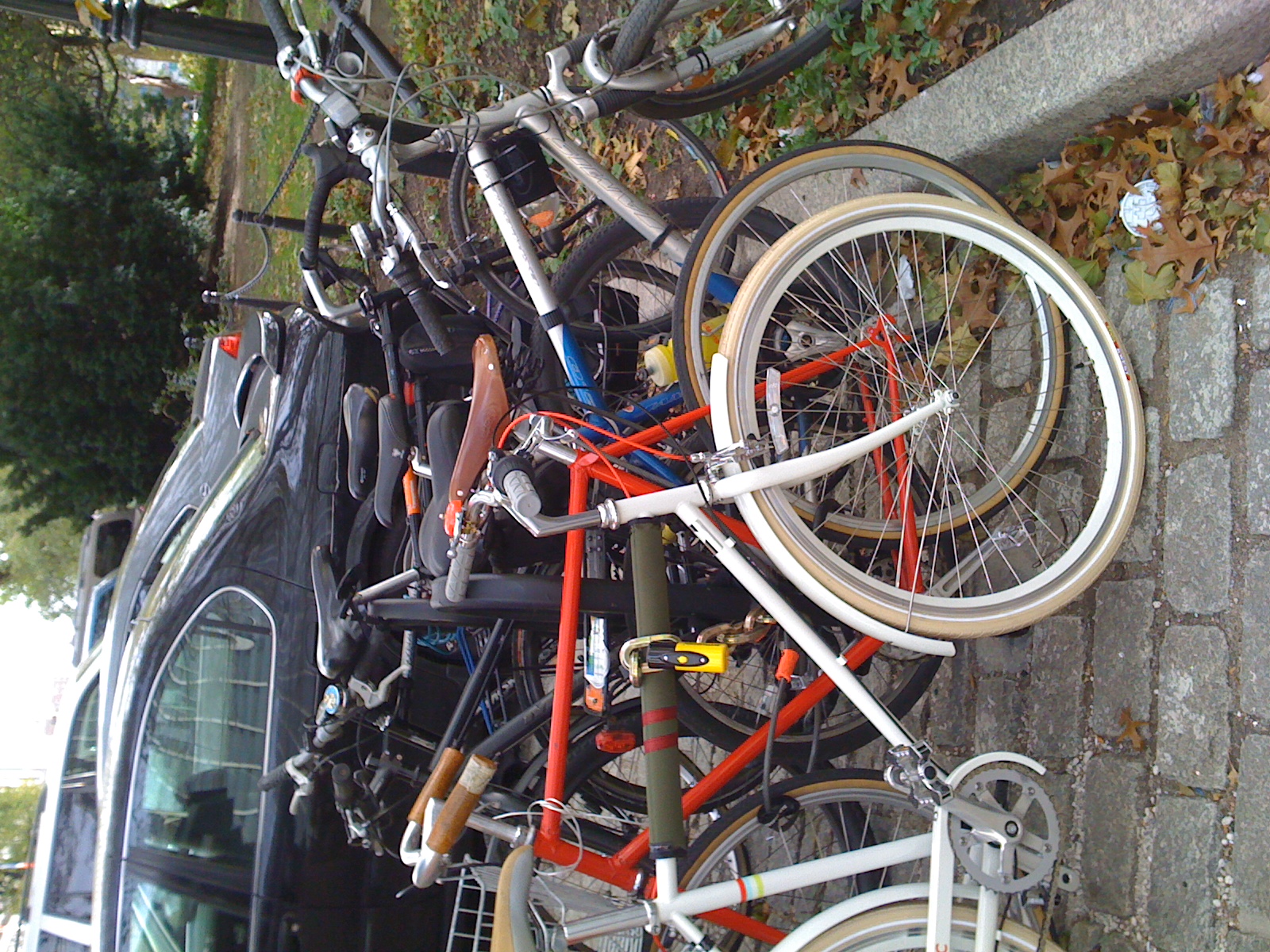
Bike parking at City Hall
When I arrived at City Hall, I looked for a place to safely park my bike, since bicycles aren’t allowed inside the plaza. There are no racks on the west side of City Hall, which in and of itself seems strange, since so many bikes pour off of the Brooklyn Bridge on nice days that you think there’d be a demand for it.
After asking a fellow cyclist who was there for the rally if he knew where to park, he said he’d try the other side. He rode off, on the sidewalk no less, and I walked my bike to the other side. (Not that I don’t break the rules from time to time, but I figure that when you’re at a place to lobby for better treatment of cyclists, it helps to give pedestrians better treatment.)
On that side I approached a security kiosk, manned by a police officer. A few other cyclists were there, asking to park their bikes on the rack just inside the gate, pictured left. The rack was full, but we managed to get a few more bikes on there. I threaded my chain through the red bike and around the rack, reasoning that if the red bike’s owner needed to unlock his bike, it would be pretty easy to find all the other people who had biked down to the rally. Besides, I figured this inconvenience was better than taking my chances on the street, as other cyclists were forced to do once the officer refused to allow in any more bikes.
I walked in to the rally with a few other cyclists and we all chuckled at the irony. Fifty people show up on their bikes to rally for safer streets for bikers and find no safe place to park. (If there was a bigger area in which to park bikes, none of us saw it.) Compare the paltry bike parking offered by City Hall with the space allotted for cars, pictured below right. There are so many cars in City Hall Plaza that they even park a row of cars in, blocking other cars. And that’s just one side. Just to the left of where this picture cuts off is another row of parked cars, maybe another ten or eleven.
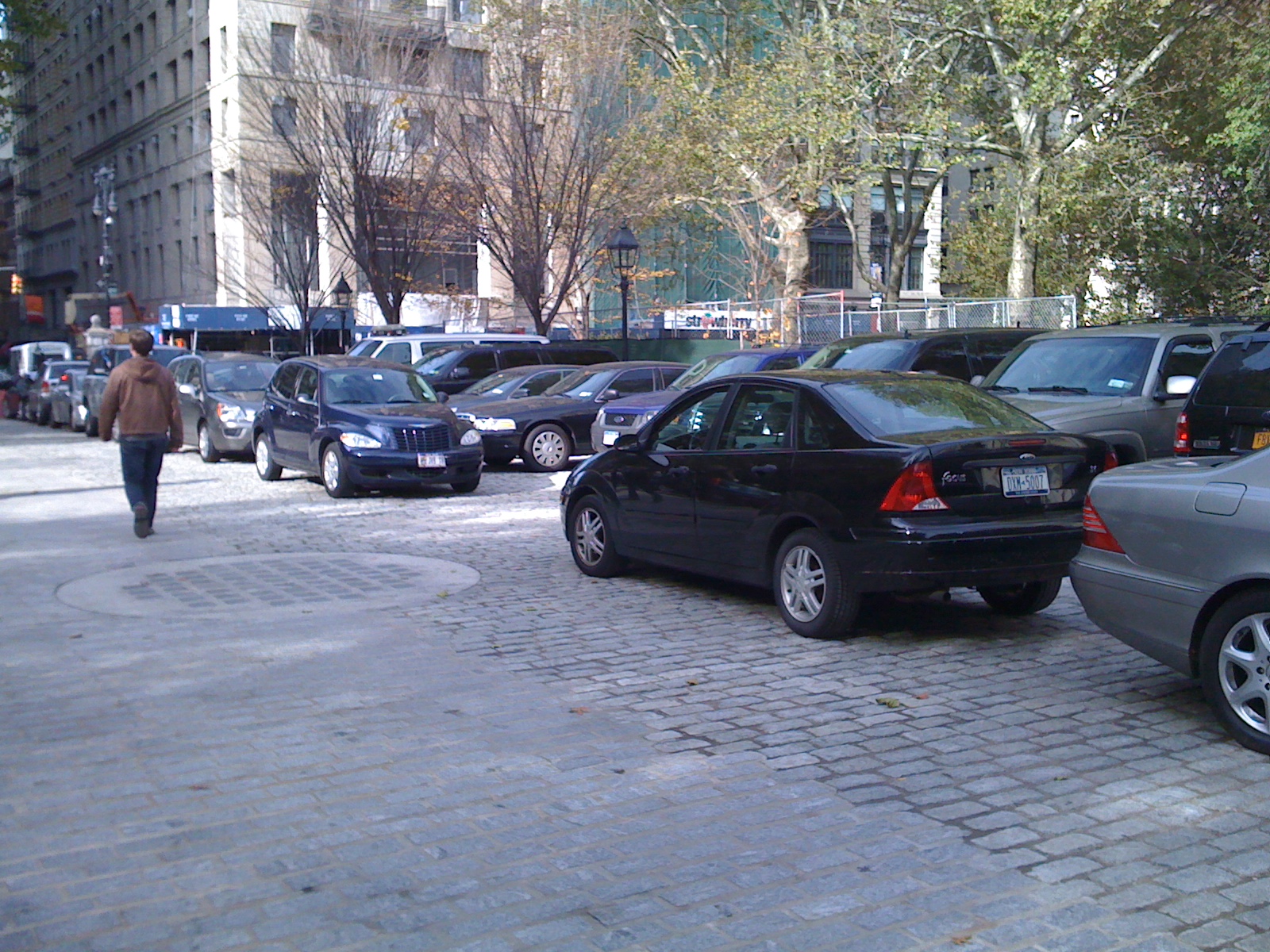
Ample car parking at City Hall
The current mayor heads the most bike-friendly administration this city has ever seen. Bloomberg himself makes a point of commuting to work on the subway, a no-brainer since City Hall is surrounded by a huge number of train lines. Yet on one of the city’s most beautiful and historic open plazas–not open in the public sense, but open in the spatial sense–you’ll find as many as twenty or thirty cars.
Look, I’m not an anti-car zealot. I understand that there may be very legitimate security reasons for the presence of some of the automobiles at City Hall. But surely the city could eliminate, say, five of the spaces it gives to cars and turn it over to bike parking. It would send a powerful message, one of practicing what the city preaches. The city is remaking streets and neighborhoods at a fast pace, much to the chagrin of local business owners whose principal complaint is that there’s no where for their customers, employees or delivery vehicles to park. Another (false) complaint is that bike lanes are rammed down neighborhood’s throats, so not having bike parking or allowing a lot of cars at City Hall is a do-as-I-say-not-as-I-do example that bike lane foes can use to undermine the administration’s noble efforts.
Plus, DOT head Janette Sadik-Khan has been a fierce advocate of cycling as a means of transportation. But if even City Hall employees have a hard time finding a secure place to park near their place of work, what does that say to building managers and business owners across the city?
Imagine if Bloomberg routinely smoked cigarettes at his favorite restaurant or was photographed washing down a trans-fat-soaked batch of french fries with a Coke. What if Sadik-Khan, despite riding a bike herself, was filmed in being chauffeured to work in a black SUV. Despite the laudable improvements the city has made to its biking network, I believe that turning just one parking space at City Hall into bike parking would have a bigger PR benefit to the cause of safe streets than any single bike lane.
Errands by Bike
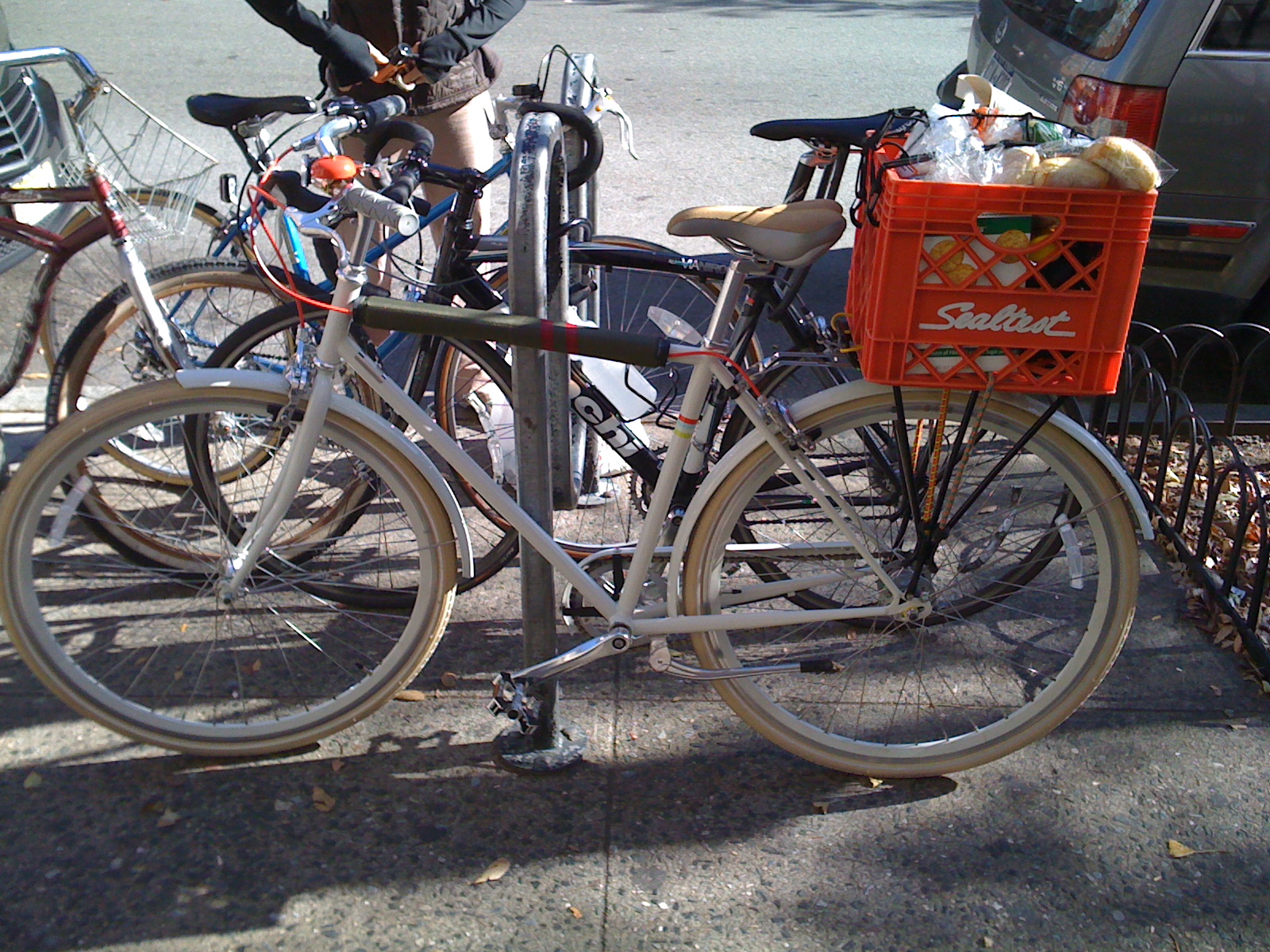 Car or bike? My suburban friends tend to think it’s simply easier to own a car, and in places where the car is sole means of transportation, they’re not wrong. But even my most lawn-loving friends tend to admit that there’s something about the city that has the suburbs beat. As Woody Allen said about the country, “There’s no place to walk after dinner.”
Despite this romantic idealization of city life, there’s one thing that most car-dependent people simply can not understand. How do you shop for groceries? Putting aside Fresh Direct or any grocery store that delivers, how do you lug home enough food to stock your fridge for a week? How can you possibly carry so much? Isn’t it easier to drive?
The short answer, in my opinion, is no. I live less than ten minutes by bike from the Brooklyn Trader Joe’s. Before I started running errands by bike, I’d use a number of means to do my shopping. I’d walk, carrying a bag or two home. I’d take the bus, but that didn’t increase the amount I could carry. Occasionally, I’d rent a Zipcar, but that brought with it a whole host of inconveniences.
I did a grocery run on my bike yesterday, and loaded up a backpack and the red milk crate, pictured, with groceries, some heavier than anything I ever would have been able to carry had I walked. Sure, I can’t take home in one trip as much as I could in a car, but there’s an advantage to that.
Here’s why I think biking, not driving, is the way to run basic errands such as grocery shopping.
1. Driving a car adds to my grocery bill. Zipcar? That’s forty bucks, minimum, so I have to run other errands make it worth it and worry about returning the car on time. Car service? Twelve bucks. Even taking the bus adds $4.50 to the total. If I lived in the ‘burbs where those things aren’t a factor, I’d still have the monthly costs of car ownership. Riding is free, and has the added benefit of helping my bike pay for itself.
2. Even if I can’t get everything I need in one trip, I could make two or three runs and still spend less time on my bike than I would looking for parking if I drove. I’ve shopped at grocery stores in the ‘burbs and finding parking, even in a giant parking lot, can still involve a fair amount of cruising around.
3. I only buy what I can carry. A disadvantage to anyone with a windshield perspective, no doubt, but since I don’t have room for that impulse buy–the pint of ice cream, for example–I tend to only get what I absolutely need. This saves me money and calories.
4. However, if I do have some spare room and I decide to add a treat to my shopping cart, I know that I just need to ride a few extra blocks out of my way to start working off the calories.
5. I rarely have to think about what time it is. If I drove or took the bus, I’d have to worry about traffic. On a bike, I only have to think about how long the check out might be, a not insignificant factor at Trader Joe’s.
Rally for Safe Streets
I’ll be at this rally tomorrow (Wednesday, November 10) at noon at City Hall in Manhattan to add my support to the completion of East Side traffic safety improvements. I’m planning to bike over the Brooklyn Bridge, which spits you out right by City Hall, and the weather is supposed to be perfect, so there’s no reason not to go.
The redesign of city streets is coming under an increasing amount of attack, and a disproportionate amount of that ire is being directed at bike lanes. Whether that’s due to slashed budgets or the simple fear of change, it’s more important than ever to counter this trend. Somehow there’s always money for more roads, so the budget concerns don’t seem to hold water. And things such as pedestrian islands, neck extensions, bike lanes, and new street designs make us all safer, whether we walk, bike, take transit, or drive. Change needs to be based on facts, not the perception of fear.
Look for me. I’ll be on the white bike and will be wearing a green jacket.
On the Other Hand…
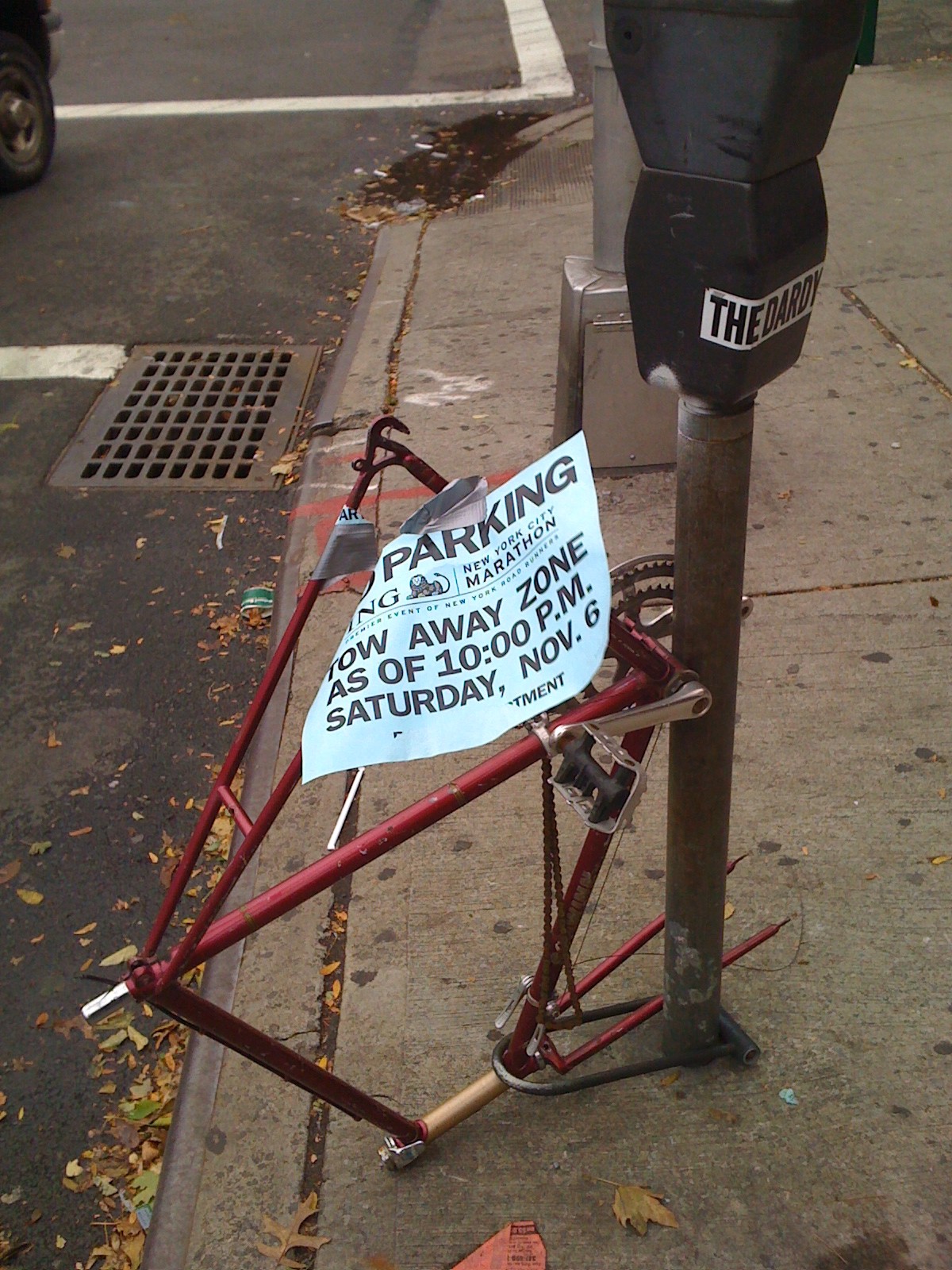 Contra this earlier post, this may be the saddest bike I’ve seen, if you can still call a frame stripped of everything except the chain and a pedal a bike. Interestingly, this bike is locked up with an old-style Kryptonite, the kind that was can be unlocked with a ballpoint pen. So perhaps this thief wanted to challenge himself. Or maybe he’s never seen the Internet. At least no marathon runners were inconvenienced.
This was on 4th Avenue near Bergen Street. More on 4th Avenue coming soon.
What’s the saddest bike you’ve ever seen? Post links, descriptions, and locations to the comments below.
Park It and Forget It
After dropping my daughter off at daycare in the morning, I walk down Park Slope’s 5th Avenue to my favorite coffee spot, Gorilla Coffee, my favorite spot for getting a little writing done each morning. There may be stronger coffee in the world, but you’d have to fly to Colombia and suck on fresh-picked coffee beans to find it.
Daycare drop-off is at 8 AM, during a transitional time in the neighborhood. Street cleaning vehicles run the length of 5th Avenue. Most of the businesses are closed, except for the delis, dry cleaners, and other coffee shops in the neighborhood. School kids roam the sidewalks, looking for places to kill time before classes start. Delivery trucks line up in front of the grocery stores, where drivers unload milk crates and other supplies.
My walk from daycare to Gorilla takes roughly ten minutes, and lately I’ve taken to doing a mini survey of the bikes I see parked outside as I make my way down 5th.
There are a few bike commuters on the road, but the big wave of biking starts later, as the nine o’clock hour approaches. Lots of the bikes you see, then, are locked up around the neighborhood. And most of these are the rusty clunkers that belong to the delivery guys from area restaurants and delis.

I have lots of barometers for measuring the health of a neighborhood’s cycling culture, and the number and types of bikes locked up outside overnight is one of them. Delivery bicycles alone would not be something the average New Yorker would notice very much. These are the invisible cyclists that have ridden the streets for decades, hardly something that registers on anyone’s radar, at least not when measuring the state of city cycling. So forgive me if I don’t include these road warrior bikes in my assessment.
Lately I’ve noticed a larger number of commuter bikes chained to racks, iron fences, and parking meters. There are lots of vintage Schwinns and one lovingly restored Peugeot that I see near Sackett Street every day. Not surprisingly there are more than a few beater bikes, the kind that basically scream out, “Go ahead, steal me. My owner doesn’t care. But every so often I’ll see a more expensive bike chained up outside, left to the chance of New York city vandals, thieves, and Mother Nature. This one has been parked at 2nd Street for at least a few months, sometimes with a blue Basil Bag attached. It’s a Batavus Fryslan and costs about $950.
To me, this bike is a leading indicator that when it comes to biking as transportation in Brooklyn we’re getting there. Now, one could argue that perhaps the owner of this bike is simply so cavalier with her money that getting a new one if it gets stolen would be no big deal. (It’s a step-through, leading me to believe the bike belongs to a woman, but you can never be sure. It could belong to a suit-wearing man for all I know.)
A better, and more hopeful bet, is that this person is so confident in her lock and the relative safety of her block that she can leave this all-weather bike out overnight, never doubting that it will be there when she needs to ride out in the morning. Not only that, the bike has so far not fallen victim to the simple, aggressive vandalism–bent rim, stolen seat, slashed tires–that New Yorkers may have expected in years past.
I don’t necessarily advise leaving a $4,000 titanium road bike outside, and I am certainly happy that my building offers indoor bike parking, but give credit to the owner of this bike for leading the way. There’s a (proven) theory that more bike riders on the road leads to an exponential uptick in the number of people who ride bikes The same could probably be said of parked bikes. The more people see nice bikes like this left outside, the safer they’ll feel leaving their nice bikes outside. I have a lot of predictions for what will happen with biking in New York in 2011, but one of them is that you’ll see more bikes like this parked in more neighborhoods throughout the city. And that will be a very good sign.
 Brooklyn Spoke