The New Second City?
Here’s Chicago Mayor Rahm Emanuel talking about his reasons for supporting a robust bicycle lane network, including a new protected lane right through the middle of the Loop:
“Two facts in the last year,” he said. “Coincidence? I think not. One, the city of Chicago moved from tenth to fifth of most bike-friendly cities in the country in one year… In the same year the city of Chicago moved from fifteenth to tenth worldwide in startup economy… You cannot be for a startup, high-tech economy and not be pro-bike.”
“Now I think it’s self-evident that I am a competitive, let alone an impatient person,” Emanuel quipped. “So when my staff gave me this headline from Portland, it did bring a smile. The editorial from a magazine in Portland read, ‘Talk in Portland, Action in Chicago,’ as it reflected on Dearborn Street. The Seattle Bike Blog wrote, ‘Seattle can’t wait longer. We’re suddenly in a place where we’re envious of Chicago bike lanes.’ So I want them to be envious because I expect not only to take all of their bikers but I also want all the jobs that come with this.”
And here’s Los Angeles Mayor Antonio Villaraigosa explaining why he supports bike lanes, bike share, and events such as CicLAvia. It wasn’t just about the broken elbow he suffered in a bike accident.
“There was actually a lot more to it,” says Villaraigosa. “There was Copenhagen and Mexico City. And there were a lot of players involved.”
The mayor was in Denmark in 2009 to speak at the Copenhagen Climate Change Summit.
“Everywhere I look in Copenhagen, everybody’s on bikes,” he said. “They were even riding in the rain in 10 degrees! That assessment of the L.A. County Bike Coalition was right: We didn’t have biking on our list. That changed after Copenhagen.”
Even the potential future leaders of L.A. aren’t afraid to mention their support for a more bike-friendly City of Angels.
It’s not just the leaders of the nation’s largest cities that are getting on board with bike lanes. Here’s Mayor A C Wharton, Jr. of Memphis:
“I am living proof that there is life after putting down bike lanes in a hostile environment,” he said.
Still, the mayor added, the effort has been worth it because it sends the message that Memphis is a city open to change.
“It’s one of the greatest things we’ve done,” Wharton said.
Mayor Tom Barrett of Milwaukee also wants in on the biking action. His city recently received a grant to help with the planning and installation of a bike share system.
“For the city of Milwaukee to continue to grow and be a destination for families, events and employers, we need programs like BikeShare that allow more people to enjoy our amazing city on bikes.”
These mayors get it. Bike lanes, bike share programs, and safe streets are what the cities of the 21st Century need if they’re to remain competitive and attract well paying jobs, families, tourists, and business travelers as well as the tax revenues that come with them.
Compare these forward-thinking mayors with Bill de Blasio or Christine Quinn. They’ve made no secret of their distaste for bike lanes, polling be damned. Bill de Blasio, in a craven ploy for tabloid love, even went so far as to call Janette Sadik-Khan a radical, essentially declaring his opposition to innovation.
So here are the questions I have for de Blasio, Quinn, and any other mayoral candidate who thinks getting behind safe streets is a losing political issue: How many jobs are you willing to lose to Chicago and Los Angeles? How many families are you willing to see settle in Milwaukee? How many tourist dollars are you willing to send to Memphis? And it’s not just those cities. Portland is snatching up tech jobs as fast as it can. Austin is exploring a bike share system and becoming more family friendly by the day. Atlanta is starting to get serious about bikes. And, of course, there’s San Francisco.
I simply can’t imagine another area in which New York leads the world — fashion, finance, sports, or the arts — where our mayor would cede the Big Apple’s status at the top of the heap. Are Quinn and de Blasio okay with New York becoming the new Second City?
“You Hate My Bike”
Comedian Will Hines, who admits to owning and riding a bike, dissects society’s irrational hatred of bicycles:
A few years ago, New York City added lots of bike lanes in an effort to make the roads more environmentally supportive. Since then I have never ridden in a taxi without the cab driver pointing out that the bike lanes are taking up so much of the road that the world has become completely ruined. Traffic can’t function, the economy will soon collapse, and children no longer know right and wrong. I have been told that bike lanes are the worst thing to happen to this city while being driven by Ground Zero.
And this passage will resonate with anyone who’s ever attended a Community Board meeting or delved into the comments section of the Daily News:
Look, I know, you know of a time that you saw a bike behave recklessly, even dangerously. And you know of a place where bikes are really just too much in the way. My point is that you will get more angry at this situation than is necessary.
Grand Central Lights
On Friday night, I was one of 135 people who participated in this wonderful Improv Everywhere event staged in honor of Grand Central Terminal’s 100th birthday.
Via IE founder Charlie Todd:
It was almost exactly six years ago when we staged our Frozen Grand Central mission. 32 Million views later, it’s our most popular of all time. So I was thrilled when Arts for Transit approached me and asked if I would be interested in staging something in the Grand Central Terminal on its 100th birthday. While scouting the terminal with them, I noticed someone walking on the catwalks. I had never even realized the catwalks were there. They aren’t open to the public and are only used by employees to get from one side of the building to the other without having to use the elevators. The sight of one person walking by was striking. I figured a large group of people would be even better.
Multi-colored flashlights and pocket cameras created the spectacle. One of our instructions before the top-secret event was to bring a high-powered flashlight from home. I brought a headlight from my bike, of course.
Getting to walk along the catwalks was a unique thrill in this New Yorker’s life. I don’t know which was better: being that high above the main floor or being that close to the ceiling!
Squint and you can make me out in the picture below. I’m second from the left on the top row. That’s my camera’s flash sensor glowing orange before it fired. (Sorry, Charlie!)
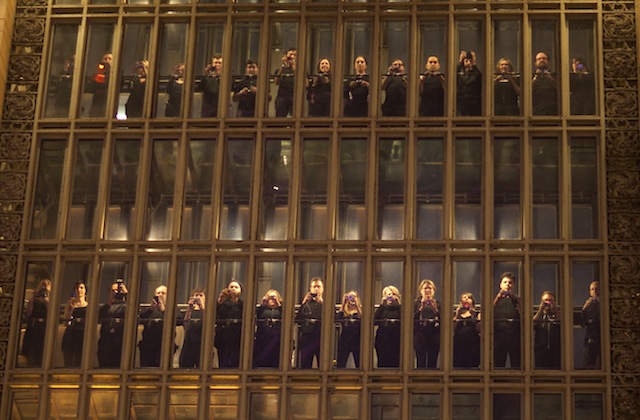
Photo: Improv Everywhere
Brooklyn Eustace
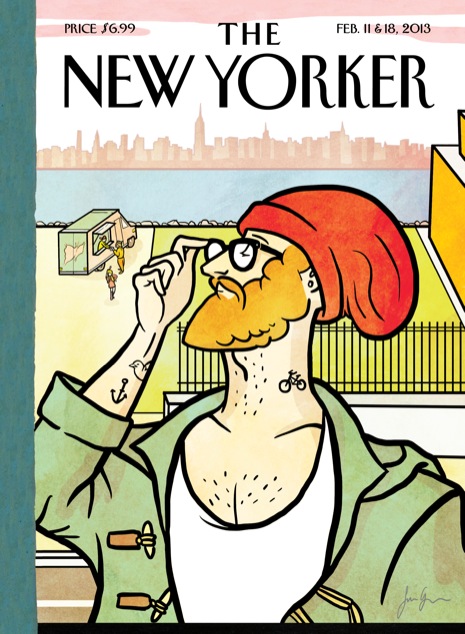
Image via The New Yorker
The New Yorker’s iconic Eustace Tilley gets the modern-day Brooklyn treatment, filtered through the borough stereotypes of Williamsburg hipsters, Kent Avenue, food trucks, and bicycles. This version is by 31-year-old Australian Simon Grenier:
Greiner, who moved to the city a year-and-a-half ago following his girlfriend (now wife), subscribed to The New Yorker while still in Sydney. Reading about all that was happening in New York inspired him to move here. He now lives in Brooklyn—indeed, in Park Slope. “This is not me,” he says of his cover, “I certainly move in a world where those people exist—they’re all around me—but they’re not my people. I’ve been identified as a Brooklyn hipster, but I’m sure I’m sort of at the edge of that Venn diagram.” Greiner, who used to have a studio in Williamsburg, has been known to ride his bike around Brooklyn. He has a beard, but adds, “I’ve had a beard for as long as I remember.“ He has no tattoos.
Greiner’s take on his place on Brooklyn’s hipster class sounds a lot like mine. I have a beard, a bicycle, and live in Park Slope, but I’m also on the edge of that Venn diagram. I have no tattoos.
“Hamill’s cranky nonsense”
The Village Voice joins the Denis Hamill ridicule party with its own entry into what has become, in just a few short days, almost its own literary genre:
Perhaps tellingly, several years after the bike-lane battles reached their peak, the Daily News‘s own readers were almost universally disgusted by Hamill’s bullshit, expressing, pity, disappointment, disbelief, and the conviction that “Hamill, you are a disgrace to the New York Irish.”
At the end of his piece, Hamill tried to make a pivot toward city politics, calling for a mayoral candidate ready to “hit the brakes on bike lanes.”
If the popular response to his column is any indication, mayoral candidates will recognize that as a sucker’s move.
And speaking of those Daily News readers:
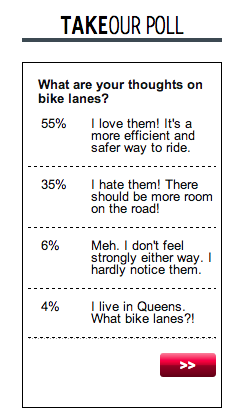
Bikelash Mad Libs, Denis Hamill Edition
I don’t have much to say about Denis Hamill’s anti-bike-lane screed in the Daily News that Adam Sternbergh didn’t already describe in his brilliant “‘I Was a Teenage Cyclist,’ or How Anti-Bike-Lane Arguments Echo the Tea Party,” written in the ancient dark ages of the bikelash of 2011.
In bold are the “boilerplate” pieces Sternbergh says are part of any argument against safe streets followed by examples from Hamill’s column. As you can see, Hamill nails the Sternberghian rules of irrational bike lane hate to a T.
Invocation of personal cycling bona fides:
When I was a kid, I built my first bike from assorted discarded parts mined from the wood bins of our tenement in Brooklyn.
It looked like Bozo the Clown’s bike. But I taught myself to ride in Prospect Park, taking several hard falls long before bike helmets were even made, never mind made mandatory.
A few scraped knees later, I was zooming along Prospect Park West from Grand Army Plaza to Bartel-Pritchard Square.
Soon I was hired as a butcher’s delivery boy, and I pushed an industrial bike with a basket sometimes filled with more than 100 pounds of meat to homes from Flatbush Ave. to Green-Wood Cemetery.
I fought for my place in my city in the clanking, horn-blaring urban traffic. We didn’t need no stinking bicycle lanes. We blazed our own trails.
The yuppie-ki-yay bike lane, where kids dressed like hockey goalies pedal in a danger-free fantasy lane…
Sheltered, helmeted kids getting zeroes in street-smarts pedal past with a clear path through life.News flash: Life ain’t a smooth sail, kiddos! There’s a big crash just waiting at the end of every bike lane.
Invocation of meddling government apparatchiks:
For me, more than any other of Big Brother Bloomberg’s paternal edicts, these bike lanes are infuriating because they have disfigured the city in a logistical and aesthetic way.
Invocation of obviously repellent stereotype:
No, the curb is reserved as a barrier reef for the Hipster Highway for Richie Rich on his $1,500 Lance Armstrong Doperacer.
…quick return to actual motivation:
If you hit the lottery and see 10 feet of free space in the parking lane, you can no longer use the curb to guide your parallel parking.
I find it oddly comforting that in the six years since Janette Sadik-Khan and Michael Bloomberg embarked upon their campaign to make the city safer for pedestrians and cyclists, writers along the intellectual spectrum that runs from John Cassidy to Steve Cuozzo have completely failed in their efforts to develop a single new or original argument against bike lanes. Meanwhile, the proof of these street improvements continues to grow, the fact of their efficacy in taming traffic and saving lives literally becoming cemented into the ground.
Hamill is just the latest example of a self-appointed guardian of the “real” New York gone mad.
Extreme Communting Costs
Continuing yesterday’s thread about the Times’ extreme bike commuters, I was curious about how much it would cost to purchase all of the gear mentioned in the story:
Having sheathed his legs in NASA-worthy Capo bib shorts — woven from high-tech fibers that compress leg muscles to minimize fatigue — he pulled on a pair of winter cycling tights lined with fleece from the waist to the thighs. Next came over-the-calf Smartwool ski socks under Sidi Genius 5.5 shoes strategically packed with chemical toe warmers. To shield his torso, he wore a wool base layer under an Italian long-sleeve racing jersey, and a windproof vest reinforced in front to block freezing gusts and meshed in the back to vent excess heat. On his head, an Assos Fuguhelm racing cap with vents on top to minimize sweating, and a pair of Oakley Jawbones sunglasses. The final touch: a pair of $19 insulated work gloves, coated with beeswax to make them water resistant.
So what would you have to shell out if you used this commuter as an example for your ride to work? A heckuva lot. I pulled prices from a variety of sources — Amazon, big-name cycling stores, and general outdoor retailers such as L.L. Bean and Campmor — and came up with a total.
- Capo bib shorts: $169.95
- Winter cycling tights: $49.99
- Smartwool ski socks: $25.95
- Sidi Genius 5.5 shoes: $149.95
- Chemical toe warmers, pack of 40: $35.75
- Wool base layer: $54.95
- Italian long-sleeve racing jersey: $90.96
- Windproof vest: $64.96.
- Assos Fuguhelm racing cap: $149.95
- Oakley Jawbones sunglasses. $200.00
- Insulated work gloves: $19
- Beeswax: $4.99
The damage? $1,016.40. And almost all of that total goes to cycling-specific gear that can’t be re-purposed as office wear. Spending that much is certainly any individual commuter’s prerogative — I have certain expensive wardrobe items that I believe are worth the cost — but the laundry list of luxury items has to be off-putting to the average would-be bike commuter.
As the title of Sarah Goodyear’s piece on the subject states, “You Don’t Have to Be Superhuman to ride to Commute by Bicycle.” You also don’t have to be rich.
Quote of the Day
Via Sarah Goodyear at The Atlantic Cities.
…the image of the road warrior in space-age gear, pedaling a custom-built bike worth thousands of dollars over icy predawn roads, is off-putting to most ordinary folks. And it’s ordinary folks who make up the 98 percent of New Yorkers who use bicycles for transportation in New York City.
This is the time of year when you see features such as the one in the Times to which Goodyear refers. It’s also the time of year when cycling magazines publish lists of the top gear for winter riding and advice for how to stay warm during a chilly commute. But like Goodyear and Dmitry Gudkov, I also find that such features have the potential to do more harm than good. One of the beauties of bike commuting is the virtually non-existent barrier to entry, so the minute someone thinks they need to buy specific gear or make a lot of special preparations in order to ride to work is the minute you’ve lost them to the subway.
As long as your commute is relatively short there’s no mystery to winter riding. Think of it like a brisk, extended walk on a chilly day: all you need is an extra layer or two, a comfortable pair of shoes, warm gloves, and the common sense to take it slowly over icy patches. And most New Yorkers already know that comfortable shoes and common sense are indispensable, no matter the temperature.
Forth on Fourth Planning Meeting Wednesday
In advance of an important Fourth Avenue Safety Visioning Workshop hosted by the Department of Transportation and the Borough President’s Office, Forth on Fourth is holding a planning session tomorrow (Wednesday) at 6:30 PM.
Via Park Slope Patch:
If you want to help identify and support problem areas, suggestions, and strategies on the thoroughfare — notorious for speeding and danger to pedestrians — come to the Forth on Fourth Avenue Committee’s planning session this Wed., Jan. 23 at 6:30 p.m.
The meeting, which will generate ideas for February’s meeting with the Department of Transportation, Brooklyn Borough President Marty Markowitz and the Fourth Avenue Task Force, will take place at the Fifth Avenue Committee office at 621 Degraw Street (between Third and Fourth Avenues).
The FOFA meeting will help spark, expand, and share community ideas that can be presented at the DOT meeting, which be a public workshop to explore Fourth Avenue’s future.
Maps and other resources will be available to help identify and support problem areas, suggestions, and strategies.
This is a real opportunity to make sure that Fourth becomes not just a high-speed thoroughfare for automobiles, but a safe and vibrant neighborhood. More information is available at the Park Slope Civic Council’s website.
Support the Bike Corral on Franklin Avenue
Via: Patch
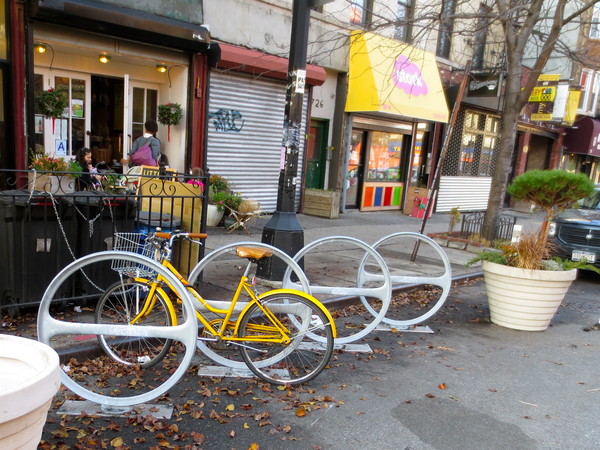
The owners of Little Zelda have launched a petition to counter the opposition to the bike corral on Franklin Avenue. You can sign by clicking here.
The corral helps support the merchant community up and down Franklin by providing 8 times the parking and beautifies the avenue with two big planters with seasonal plants maintained by the volunteer maintenance partner, Little Zelda (a coffee shop located at 728 Franklin Avenue). The corral also means that bikes no longer have to clutter the sidewalk, chained to street trees and parking signs, as frequently.
In the face of some emerging opposition from car drivers who demand the single parking space back, please show your support for a cleaner, greener Franklin Avenue with options for people who drive bikes as well as those who drive cars.
The installation happened after discussion & affirmative vote at CB8’s transportation committee meeting, followed by a vote of confidence for the bike corral by the full Community Board 8.
You can also send an email with your words of support to littlezeldabk@gmail.com.
 Brooklyn Spoke