Valuable
Residents of an apartment building in Bay Ridge are unhappy with the city’s plan to remove eight on-street parking spaces and create a left-hand turn lane on Fourth Avenue and 65th Street. Even though the building has its own parking lot many residents park on the street when the lot is full. Via The Brooklyn Paper:
“They are quite valuable to the building,” said Bay Ridge Towers board president Thomas Clark, claiming that not every apartment has a parking space, and some tenants have as many as three cars — news that elicited angry responses from parking spot-strapped CB10 members attending last week’s Traffic and Transportation Committee meeting.
“If you’re going to have three cars, move elsewhere,” board member Joseph Sokoloski told Clark.
Two minor thoughts:
- It’s funny how much the word “valuable” is thrown around to describe a resource the city gives away for free.
- Drivers don’t really hate cyclists and pedestrians — they hate other drivers.
That is all.
A happy New Year!
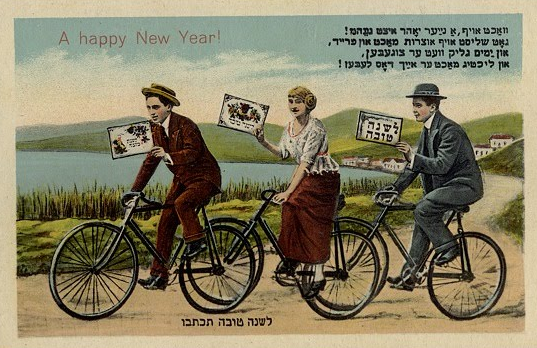
Above image via The Blog About the Postcards:
The greeting cards above were published somewhere around 1900-1920 by the Williamsburg Art Company. Each has the Hebrew inscription “L’Shana Tova Tikatavu” which roughly translates into “May you be inscribed in the Book of Life for a good year.”
The rest of the writing on the postcard is in Yiddish. Anyone know what it says?
Placard Abuse on Hoyt Street
Without fail, this Honda is parked on the Hoyt Street bike lane every weekday during my evening commute, making a sometimes dicey right turn from Schermerhorn into the bike lane on the left side of the street even dicier. These three images were recently taken on three separate days:
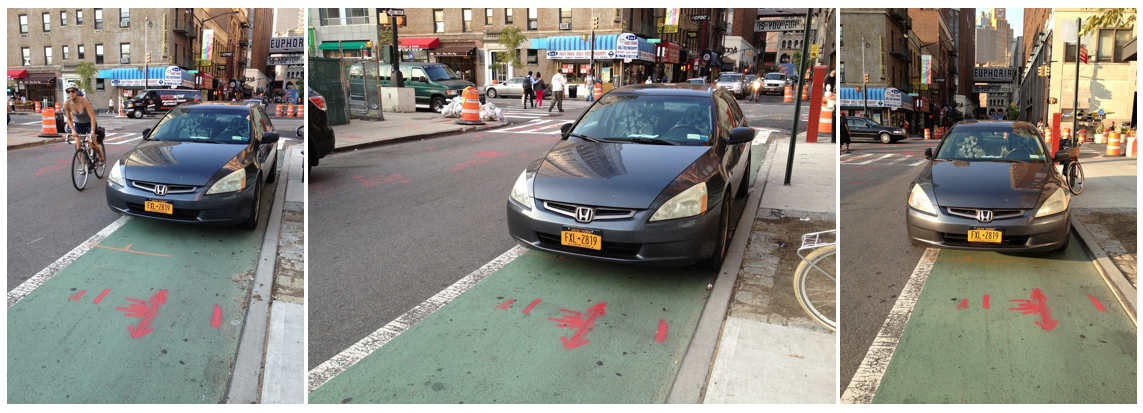
Despite this post’s title it’s hard to call what’s happening on the Hoyt Street bike lane placard abuse, since this is the “placard” used by the car’s owner:

Those are cards from the Patrolmen’s Benevolent Association. In addition, this faded piece of paper is also on the dash:
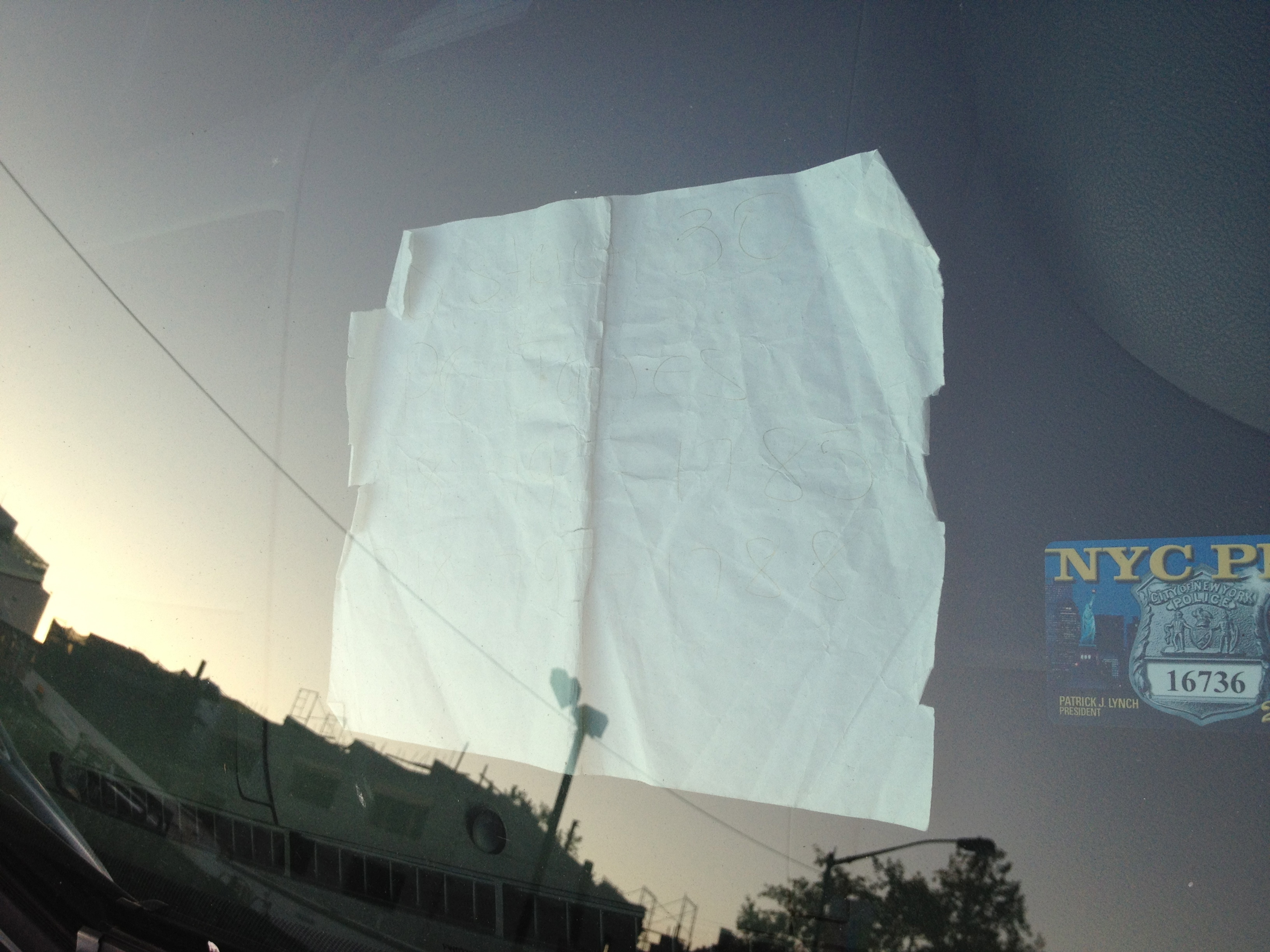
I couldn’t make out what it says, but the fact that it’s so faded is good evidence that this bike lane abuse has been going on forever. What’s really galling about this is that there’s almost always an open space directly across the street:

If police officers can park with impunity in the bike lane, why can’t they park in a metered spot? Surely those “placards” are enough to tell any Traffic Enforcement Agent not to write a ticket. Of course, why bother walking across the street when you can stick a PBA card or two in your dash and block the bike lane? And if that doesn’t work, why not try a reflective vest?
The Honda most likely belongs to an officer with the NYPD’s Transit Bureau, which has a district office right around the corner. If you ride this route and notice this car parked in your path, feel free to call the Deputy Inspector John DeRose of Transit District 30 at 718-797-1720.
What about the Germans?
A great take on bike licensing, via Jim Meyer at Grist:
If you own several bikes — say a road bike, a mountain bike, a fancy two-wheeled-unicycle, and one for your pet chimp — that’s a lot of licenses and a lot of cash. And what about kids? Can your 9-year-old pass the rider’s test? If not, should he be tazed by the authorities? And tourists? Lots of people head to Oregon on vacation (mostly Germans) to bicycle (because Germans don’t know what fun is). What about them? What about the Germans?
Bike-Ferry-Bike
Via the New York Times:
Titania Inglis, a 33-year-old fashion designer who wears her own flouncy avant-garde creations, likes to take the East River Ferry from Greenpoint, Brooklyn, where she keeps her work samples, to the East 34th Street slip in Manhattan and then bicycle to the garment center. Indeed, Ms. Inglis, who lives in Williamsburg, Brooklyn, can wax rhapsodic about the pleasures of sailing on a swift tidal river glistening with sunlight.
“It’s about having a fun commute,” she said, as she wheeled her bicycle off the ferry arriving at 4:10 p.m. at the India Street pier in Greenpoint. “The wind in your hair, watching the skyline come toward you as you approach Midtown and getting to see New York from this vantage point.”
But she was one of only three people to get off that ferry. And the same number got on.
I don’t think bicycles are a panacea here, but surely one way to increase ridership on the East River Ferry would be to make cycling to and from it safer and more convenient on both sides of the river. Riding from almost anywhere in Williamsburg and Greenpoint to one of the ERF stops along the waterfront is safe and pleasant due to relatively lower auto traffic volumes and the more complete bike lane network, including the unparalleled Kent Avenue bike lane. However, it’s on the East Side of Manhattan that things break down, turning an integrated bike-ferry-bike trip into something only the intrepid would dare attempt.
Christine Quinn, who has been a great supporter of the East River Ferry, needs to understand that it takes a holistic approach to New York’s transportation network to guarantee the success of any one part.
Vicious Cycle
If you force yourself to read the Daily News editorial pages, you’ll notice that the majority of letters it publishes on the subject of bike lanes are from readers who don’t like them. It then points to those letters as proof that “ordinary” New Yorkers “don’t really seem to want bike lanes,” as Alex Nazaryan said in defiant ignorance of the latest Q polls. So the only real vicious cycle going on is within the Daily News itself: it publishes an anti-bike-lane screed which in turn encourages the haters to put pen to paper to “sound off” on bike lanes. Those letters, in turn, encourage the editors to run more anti-bike-lane screeds, which in turn enable more haters to put pen to paper…
And the head eats the tail.
Something is rotten in the state of Denmark
Even the bicycle-friendly city of Copenhagen has its issues with the police and their narrow view of urban mobility. Via Copenhagenize:
The Police also have a firm understanding of car traffic – well, all traffic modes – as a fixed entity. They do not consider that people could make active choices and change transport modes. If a road has 50,000 cars it’s a law of nature in the Police mind. They must be catered to, period. Traffic evaporation and induced traffic are not concepts that the Police’s mental model of traffic can handle.
New Yorkers are more reasonable than the New York media
Erica Pitzi of PIX11 jumps on the Daily News bandwagon to report about the problem of speeding cyclists in Central Park. There are just two small issues: she can’t get anyone to admit it’s much of a problem, and, in the grand tradition of Marcia Kramer and other local journalists, the images that float across the teevee screen do not match the story she is trying to tell. To wit:
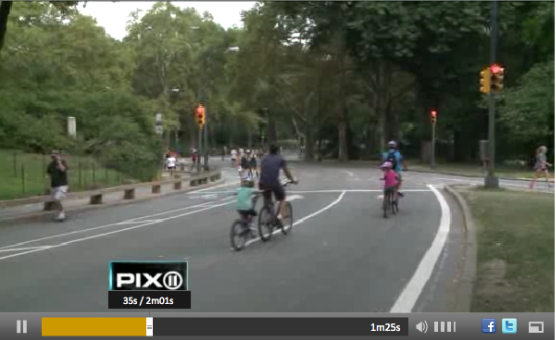
Yes, the lights are red, but here’s the commentary from the reporter that runs over the above image of two parents towing their kids on trail-a-bikes:
“Not only do some cyclists not stop for the red lights, some say they are speeding well past the speed limit.”
One thing to note about this intersection just inside the park from East 72nd Street is that there is no crosswalk here. That’s because the merge and the signals that go with it are designed for cars, not people. So even if the city is trying to create a culture of courtesy where cyclists stop or yield for pedestrians in Central Park, I’m not sure you can expect that culture to be created if the park does not provide safe, pedestrian- and cyclist-centric infrastructure. If you want cyclists and pedestrians to understand what to do at intersections like this, get the cars out, remove the traffic signals, stripe a crosswalk, put up some in-roadway yield signs, and then start ticketing cyclists who don’t stop for people trying to cross. (Especially those dads with trail-a-bikes — they’re speed demons!)
In her quest to stir up controversy about the menace of cyclists, Pitzi is unable to find anyone who can admit that it’s much of a problem. First, there’s Harriet Feldman, who Pitzi presents as the stereotypical senior who’s “getting sick of cyclists on Central Park.” Instead, Feldman — whom I coincidentally happen to know through my wife’s synagogue — comes across as the most reasonable person in New York:
“Well, they have a right to ride. I have a right to walk across the street safely.”
Who can argue with that?
Then there’s Billy Palmier, who’s identified only as being from “New York.” Perhaps he’s meant to represent one of those “real” New Yorkers who inform so much of the Daily News editorial board’s point of view. Once again, Pitzi’s set-up doesn’t match her interviewee’s follow-through. Pitzi asks, “Do you feel like you’re dodging cyclists when you come to the park?” Palmier responds:
“No, I think you have to keep your eyes open and look both ways, but I don’t feel like I’m dodging them but I do think that some of them go pretty quickly.”
Maybe that’s how you can tell Palmier is a “real” New Yorker: he’s too smart to take Pitzi’s bait and also comes across as entirely reasonable.
Pitzi continues her piece by mentioning that “the NYPD is reportedly stopping cyclists at certain traffic signals and handing out bicycle safety brochures that emphasize the speed limit is 25 miles per hour all in hopes this informational campaign will slow them down.” She returns to Feldman who merely says “I think it’s a good idea,” although we don’t know if that’s in response to a question about the NYPD’s brochures or to a proposal to go for ice cream with the camera crew.
Then she interviews a tourist, Joe Rohde, who offers some real straight talk:
It’s a little ridiculous to have these guys, cyclists literally stop at red lights and I’ve noticed that today they’re literally stopped there because they’re afraid of getting a ticket.
Even Havinder Bedi of the New York Cycle Club, whom I suppose was chosen to represent the spandex-clad Lance wannabe set, can’t be goaded into giving Pitzi an incendiary quote:
“When there’s a pedestrian, we stop…”
So there you have it. Average New Yorkers can not be convinced to meet tabloid journalists on the imaginary frontlines of the bikelash. It’s as if the next thing we can expect to see on the local news is a befuddled Clint Eastwood yelling at a riderless bike.
Revolution

NBC is organizing New York City’s first ever bike-in screening featuring an exclusive premiere of J.J. Abrams’ new show Revolution, with 100 bicyclists powering the screening completely free of traditional power. TA is providing a bike valet and there will be free snacks and beverages, I’m told. The event is this Tuesday, September 4th and is bound to bring a lot of cyclists out for a nice evening along the water.
I have a couple of VIP tickets to give away, and will randomly select a commenter to get ’em. Be as snarky/witty/intelligent/funny as you wish.
“I’m a liberal, but…”

I thought this last week’s New Yorker cover was okay, although I suspected that illustrator and avid motorist Bruce McCall meant it as a mild jab at the mayor’s push for a cleaner, calmer, and safer city. Then I read McCall’s explanation and realized there was nothing mild about it:
“When I heard about Bloomberg blocking off part of Broadway for pedestrian malls a while back, I felt that it was wrong. It could cause gridlock with cars idling, spewing out exhaust, so it’d be just as bad,” says Bruce McCall about the inspiration for this week’s cover, “A Greater, Greener New York.” He continues: “The whole forcing people to become more ecologically ‘aware’ health-wise seems to me to be Big Brother imposing on people, really the personal philosophy of the mayor and his ‘do-gooder’ group. I’m a liberal, but I find it offensive that we can’t be allowed to make our own decision about anything, and that there’s a better, ‘higher’ form of knowledge and expertise that we have to obey.”
“I’m a liberal, but…” is the “I like bike lanes, but…” of all irrational objection to common-sense solutions to every problem that plagues humanity.
McCall also calls worrying about one’s carbon footprint and doing what one can to save the environment a “liberal form of smugness,” which I’m sure his great-grandchildren will appreciate as they flip though old archives of his cover illustrations in the main branch of the public library in the floating city of New Chicago.
 Brooklyn Spoke