Damn Deer Lanes
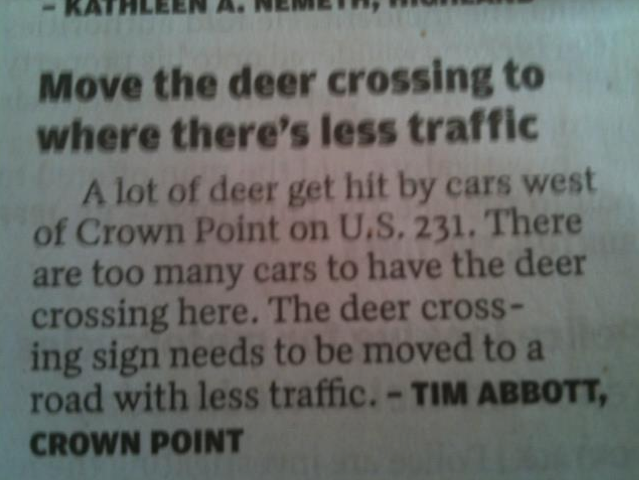
If a better example of “blaming the victim” exists, I can not imagine it.
Brooklyn Bridge, 1899
Take a ride across the Brooklyn Bridge in 1899, just sixteen years after it opened, in this vintage film from the Edison Manufacturing Company. The trip starts in Brooklyn and ends in Manhattan.
Fourth Avenue Car Crash
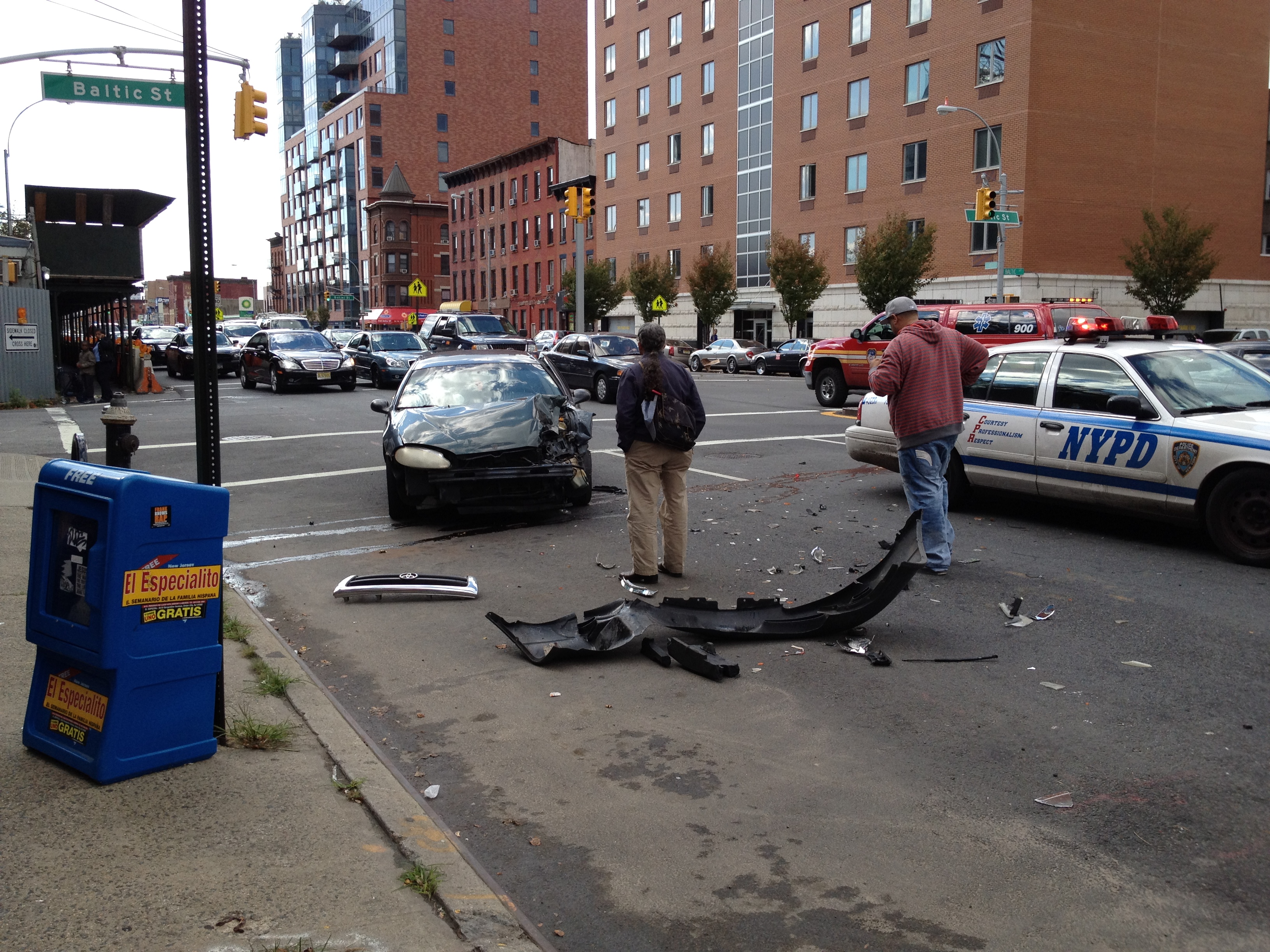
Here was the scene on Saturday at 4th Avenue and Baltic Street across from my apartment building. According to a person I spoke with who witnessed the incident, one of the cars ran the red light and hit the other. Some might call this an accident, but when a driver runs a red light the consequences of that action are hardly the result of chance.
I saw one person on a stretcher being loaded into an ambulance; no word on whether it was one of the cars’ occupants or a pedestrian.

The debris was cleaned up later, but the bumper was still on the sidewalk on 4th Avenue as of Monday morning.
The other car:
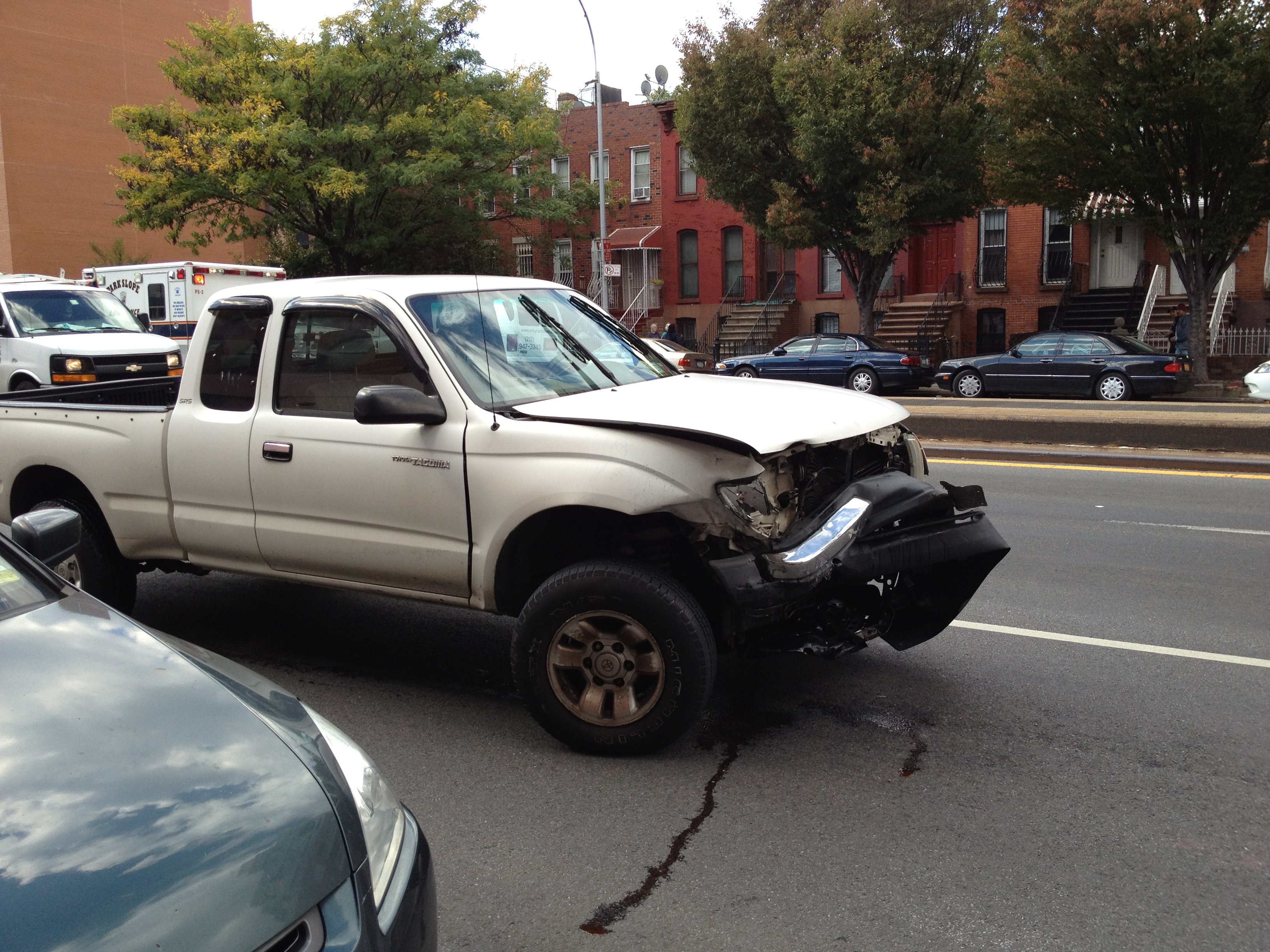
When Fourth Avenue is not choked with morning rush hour traffic it’s a speedway, and for cars to sustain damage like this it’s likely that at least one of the motorists was driving faster than 30 mph. According to CrashStat, there was a pedestrian fatality one block away near Warren Street in 2004 and too many other cyclist and pedestrian injuries in the past seven years to tally right now. As a parent who pushes his daughter in her stroller across Fourth Avenue every day, traffic calming and pedestrian safety enhancements can not come fast enough.
B is for Barclays
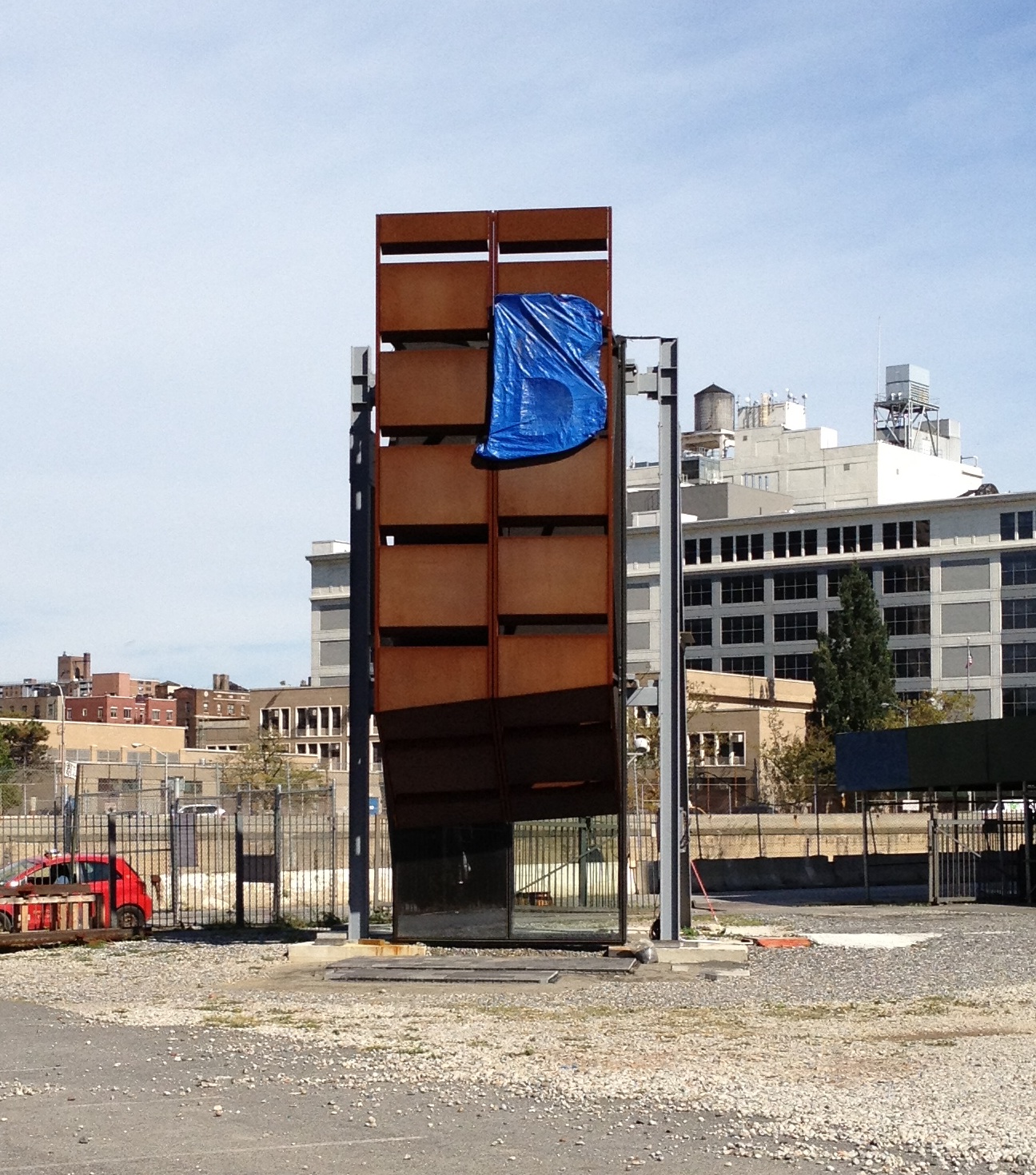
I spotted this during a ride up to Prospect Heights on Sunday. It’s the B for the Barclays Center façade at a staging area on the corner of Dean Street and Carlton Avenue.
This isn’t Amsterdam
There’s something uniquely American about defining the United States not by what it is or could become, but by what it is not and could never be. A political leader who dares suggest that we have anything to learn from looking abroad will find himself on the receiving end of a school-yard taunt, one that’s ready-made for a cable news sound bite: “If my opponent loves [country] so much, I suggest he move there.”
This isolationist sentiment is a disease that infects our political discourse and prevents the United States from tackling real problems. We can’t have national health care because we’re not Switzerland. We can’t offer more generous unemployment benefits because we’re not France. We can’t do something as basic as switch to dollar coins or get rid of the penny because we’re not Canada. And we can’t have bike lanes because we’re not Amsterdam.
What San Francisco is to the Republican party, Amsterdam is to bike lane opponents: a convenient bogeyman for reductive arguments from people with little apparent interest in constructive, high-minded, forward-thinking discussions about solutions to New York’s congestion and safety problems. No one uses this strategy better than the Brooklyn Borough President:
“What is our objective in this city? To stigmatize the use of cars? To make it difficult to park? Do we want Brooklyn to replicate Amsterdam? These are legitimate policy issues.” – Marty Markowitz
Marty may be Brooklyn’s unofficial anti-bike-lane poet laureate, but someone who actually makes his living as a writer can give the phrase a more poetic flourish:
“New Amsterdam Is Not Amsterdam.” – Daniel Meltzer, playwright
Meltzer’s use of the cliche is all the more ironic because he uses another in the same piece: “Houston, we have a problem.” I’d argue that the problem we have right now is that too many people want New York to be less like Amsterdam and more like Houston.
Others are not interested in poetry and simply use the phrase to get to get grossly inaccurate statements about the cost of bike lanes inserted into news coverage:
“This is not Amsterdam. $65 million is going towards building bike lanes that serve so few people. Bloomberg is wasting our money.” – Barbara Ulrich
According to the DOT, the entire cost to New York City for building or painting over 250 miles of bike lanes since 2006 is $1.6 million. Not that it matters to critics; no cost is too low to be too expensive to turn New York into the Netherlands.
Like most NIMBY arguments, overuse can lead to a breakdown in basic cognitive functioning:
“This isn’t Amsterdam. We have many narrow streets and a great number of cars and trucks.” – Hank Sheinkopf, political consultant
You know, because Amsterdam’s streets are so wide and car-free that they can run canals right through the middle of them.
Eventually, using Amsterdam as a stand-in for all things that New York can not be is far too limiting so it’s helpful to take the argument somewhere just as bike-friendly. Unfortunately, as any traveler knows, something can get lost in the translation from one country to the next that even an intelligent Times columnist can get confused:
“NYC is not Copenhagen. If it were, we wouldn’t be busting everyone for weed.” – Charles M. Blow
Blow’s mistake illustrates why it’s better to rely on a simple list of cities and nativism:
“This is not Copenhagen or Amsterdam. People in this neighborhood are not taking bicycles to the grocery store.” – Assemblyman Alan Maisel (D-Canarsie)
Sometimes it helps to distill this tabloid-driven narrative into its most basic elements and be as emphatic as possible:
“And they said they wanted the city to look like Copenhagen. And this is Manhattan. It’s Manhattan. It’s not Copenhagen.” – Ernest Rossi, shop owner
Still other people who are against “Better Bike Lanes” like to tie their arguments back to America:
“We will never be Amsterdam, never be Copenhagen. We are never going to be Portland.” – Louise Hainline, NBBL president
If Portlandia-style liberalism and European-style socialism isn’t enough to scare New Yorkers away from bike lanes, then the specter of actual Chinese Communism should do the trick:
The lawsuit concerns just one stretch of road. If successful, however, it could open the way to a broader challenge to City Hall, which sometimes seems intent on turning New York into Amsterdam, or perhaps Beijing. – John Cassidy, The New Yorker
Amazingly, you can complete the six degrees of anti-bike-lane hysteria separation between a respected economics writer and a buffoonish Brooklyn Borough President in just one move:
“Beijing is looking more like New York City and New York City is moving towards Beijing of the 1960s and 50s.” – Marty Markowitz
Unfortunately for the forces that want to keep New York mired in the Eisenhower era, using Amsterdam, Copenhagen, Beijing and other cities to make an argument against bike lanes and traffic calming is fraught with dangers, especially when a new street design’s worth is so obvious and beneficial that a NIMBY has to cross over to the darkside and become a YIMBY:
“Grand Army Plaza, as you know, is known as Brooklyn’s Arc de Triomphe, our Piccadilly Square, our Piazza Navona, but over the years as you know it’s become increasingly difficult and dangerous for Brooklynites and visitors to reach and enjoy, and that is why we’re so thrilled with these plans to create landscaped pedestrian islands, a dedicated bike lanes, additional crosswalks, and pedestrian signalss, which will help return this hub to the European-style plaza it was designed to be.” – Marty Markowitz
If you find other “This isn’t [city]” quotes, please share them in the comments.
UPDATE: 3/15/2016
Marty Markowitz, whose “This isn’t Amsterdam” protestations first caused me to start keeping track of everyone else’s, is back with more thanks to the never-ending saga of the Prospect Park West bike lane lawsuit:
Outside the courtroom, Markowitz told us that there’s no inconsistency between the work his office does using bike infrastructure as a selling pointfor tourists and his opposition to an amenity his old neighborhood has largely embraced.
“I don’t oppose all bike lanes, just this particular one,” he explained, describing his position on the bike lanes on Kent Avenue and the West Side Highway: “Love love love it.”
Still, he said, “New York City is not Amsterdam, it never will be Amsterdam, and that’s all there is to it.”
Longtime readers will also note that the first part of Marty’s quote falls solidly into another favorite bikelash category: “Some of My Best Friends are Bike Lanes.”
UPDATE: 4/29/2016
Here’s one from a story in the Chattanooga, TN Times Free Press, about a plan to add bike lanes to Frazier Avenue, a major downtown corridor. It’s one of the rare “This isn’t Amsterdam” quotes that also includes a couple of other American cities. Progress, I suppose:
“The whole concept from the beginning doesn’t make any sense,” said Suzanne Bishop, owner of Frankie and Julian’s, a women’s clothing store. “You don’t compare Chattanooga to a city like Amsterdam. Then a lot of people like to envision this like a Portland or a Seattle, but it’s not like that at all in any way, shape or form.
Bike Share Demonstrations This Weekend

Don’t miss this bike share demonstration in Brooklyn today:
Come ride the bikes with the coolest students in Brooklyn! Take advantage of the Bedford Avenue bike lane to test ride the bikes. Afterward you can swing by the Brooklyn Botanic Garden or Prospect Park, both only a couple blocks away. Bikes will be located at the main entrance to the College at 1650 Bedford Avenue, at the corner of Crown Street, from 11 am – 3 pm.
In cooperation with Medgar Evers College and Councilmember Letitia James.
A big tip of the bike helmet to Tish James, who’s been a prominent supporter of bike share since it was announced.
There’s also a demonstration Saturday in Brooklyn Bridge Park at Pier 1 from 11 am – 3 pm. I may swing by to take a few more pictures.
Quote of the Day

“I pointed out that we could not afford to loose more parking spots…” – Former DOT Commissioner Iris Weinshall, focusing on the important stuff in the fight against traffic calming.
Stop driving…Start Pedaling

The best thing to come out of the unfolding GM anti-bike debacle? Simply reverse the slogan in the above ad and you have a catchy new phrase for your pro-biking activism: “Stop driving…start pedaling.”
GM didn’t just manage to tick off cyclists but also gave a big finger to pedestrians. It’s all the more ironic since the campaigns targets college students, a class of people who generally live on some of the most idyllic, car-free spaces on the planet. This image is still on the GM website as of this posting:
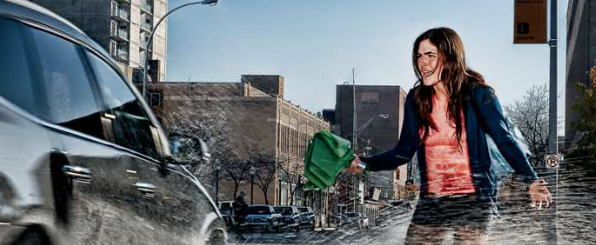
I guess livable streets activists can thank GM for this one as well: no one before had successfully made a sartorial argument for 20 mph speed limits in urban environments.
Community? Bored.
Whether it’s because of concerns about safety, health, the economy, or sustainable transportation and environment, there are many reasons to support livable streets. NIMBY-style opposition, on the other hand, comes in few flavors, most of which can be tied back to a fear of change and lost privileges.
One of the strategies for preserving the status quo is to level the accusation that a new street designs are “jammed down” a community’s throat by ivory-tower bureaucrats. This tactic is rearing its head in a brewing brouhaha in Santa Rosa, California, where the city will install bicycle lanes on three streets in an effort to “ease road congestion and promote environmentally friendly modes of transportation.” The plan will reduce the car traffic lanes from four to two and eliminate 35 parking spaces in the area. It’s been in the works since 2007.
Even though the Santa Rosa City Council makes its meeting schedules and minutes available to the public, some people are claiming they weren’t included in the democratic process.
Karen Hall was among about 250 Fifth Street West residents who signed a petition asking the City Council to reconsider its 4-1 vote on Jan. 19 to install bike lanes on the three thoroughfares. Several residents complained at a subsequent public hearing that they did not feel city leaders did enough to inform them in advance of that vote.
The similarities to gripes in Park Slope that “the community has been strangely left out” are striking. The public process surrounding a certain local street also began in 2007, yet here’s Neighbors for Better Bike Lanes president Louise Hainline in a May 2010 email to Marty Markowitz: [PDF]
I don’t know who the City Council speaks with, but there was no warning to any of the buildings on PPW about this, and as president of the coop at 9 PPW, I probably should have received something. Actually, my major source of new [sic] about Community Board actions is the newspapers I pick up at Key Food, but I hadn’t seen this had popped up again after what we thought was a quashing of the plan last year, thanks to you. It’s clear that they did not want to heavily engage the people most affected by this.
I’m encouraged when I find news stories about a small group banding together to form their own version of Neighbors for Better Bike Lanes. It means that NIMBY philosophy is, for the most part, simple and predictable, even if it does occasionally come with the influence and support of a U.S. Senator, his wife and his daughter. Innovative ideas about change, however, need to be expansive and inclusive and are likely to become more so as the challenges facing cities require more of them.
Of course, it wouldn’t be me if I didn’t include this quote from the Santa Rosa story, which also shows you how few arguments are available to those who oppose change:
She also worries about increased traffic congestion on the street, particularly when parents are dropping off and picking up their children outside Sassarini Elementary School.
“I like bike lanes, but I don’t see this as the best use of our time or money,” Hall said.
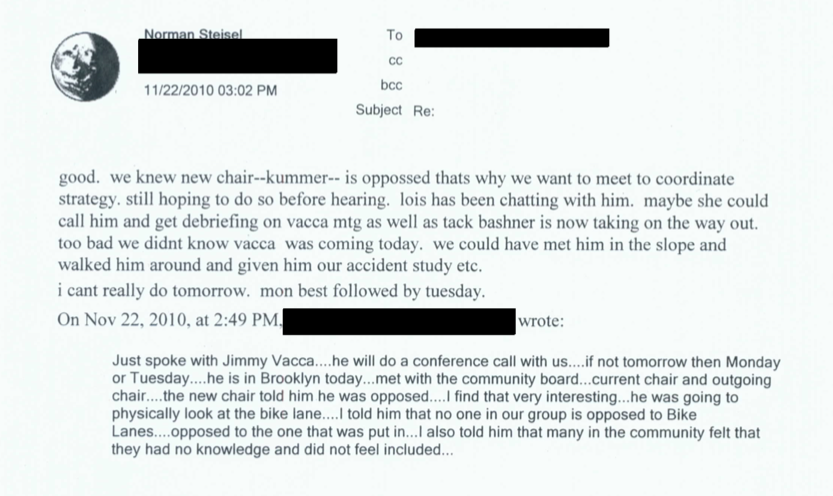
UPDATE: Inside Streetsblog’s excellent series, “The NBBL Files,” is this email from Norman Steisel to a fellow NBBL member, whose identity has been redacted:
 From Brooklyn to Santa Rosa and back again, NIMBY language is remarkably narrow:
…no one in our group is opposed to Bike Lanes…opposed to the one that was put in…I also told him that many in the community felt that they had no knowledge and did not feel included…
There’s also a stunning amount of willful ignorance on display here: by the fall of 2010 a person involved in the fight against the PPW traffic calming project simply had to know that the public process began in 2007, especially if he or she was exchanging emails with Norman Steisel or other members of NBBL. But because some sort of invitation to be involved wasn’t personally delivered to the email’s writer, he or she felt slighted. Too bad.
Democracy requires participation.
Columbia Street Bike Lane: Open for Business
We took a ride down to DUMBO on Sunday via the Columbia Street Greenway and I was happy to see the new jersey-barrier-protected bike lane, now fully painted and available to use. I ride this route all the time, so seeing the finished product was a real-life manifestation of Jan Gehl’s famous quote: “It’s really wonderful to live in a city where every day when you wake up in the morning you realize that the city is a little bit better than yesterday.”
Here’s the view looking up Atlantic Avenue, around the bend to Columbia Street:

Further around the bend onto Columbia Street:
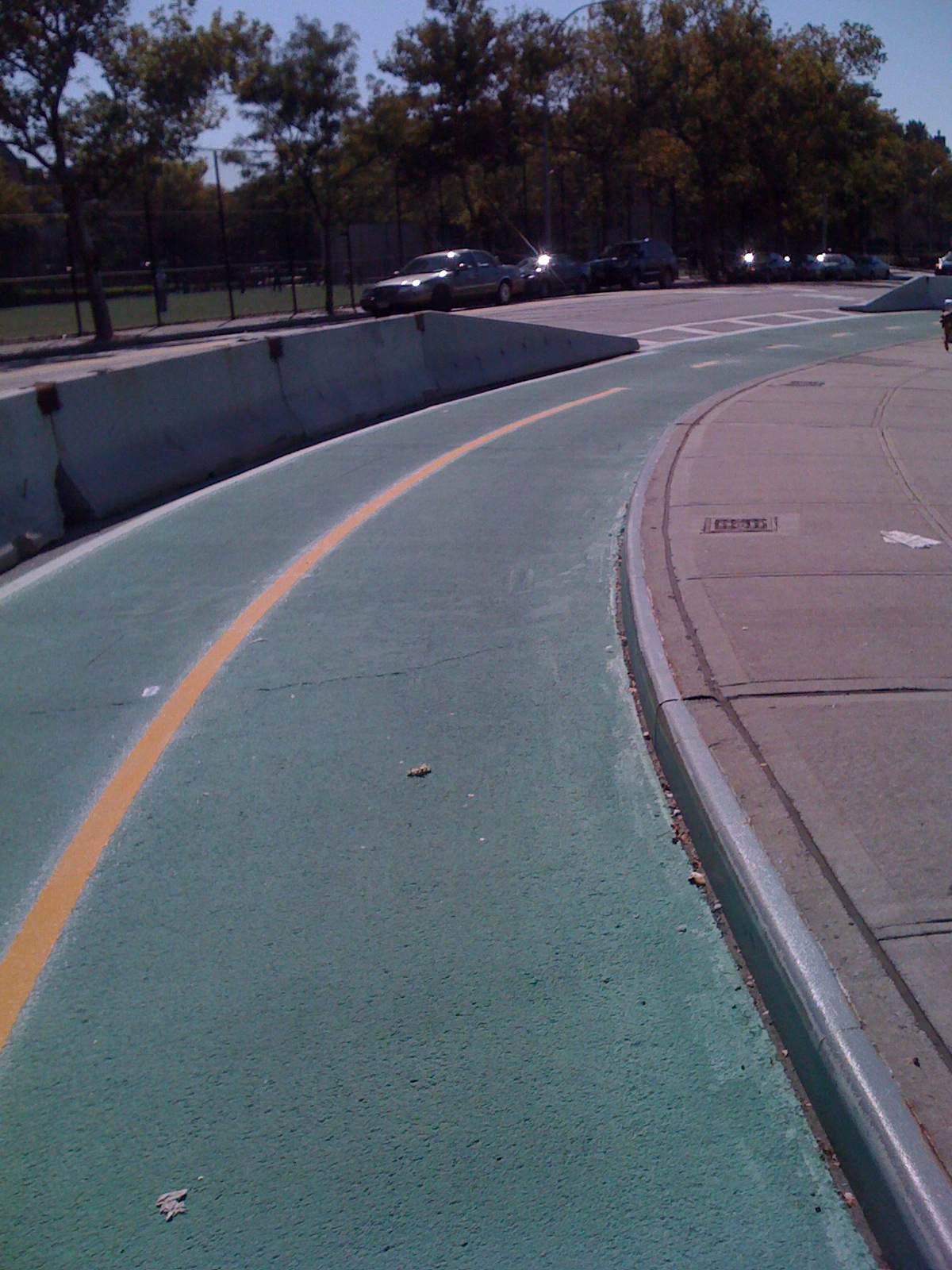
Looking down Columbia Street, the lane runs to Congress Street:

 Brooklyn Spoke