Vigilante Gardener
This is located at the corner of 5th Street and 8th Avenue in Park Slope, around the corner from my old apartment. Todd’s also an amazing filmmaker and a great guy. It’s nice to see someone using his superpowers for good.
Full Lander/Bashner Press Release
Press Release: Councilmember Brad Lander and Former CB 6 Chair Richard Bashner File Amicus Brief in Support of Prospect Park West Bike Path
Legal Brief Details an Inclusive, Democratic Process with Community Support
Brooklyn, NY – City Councilmember Brad Lander and former Brooklyn Community Board 6 Chairman Richard Bashner today filed an amicus curiae brief in support of the Prospect Park West two-way bike path and traffic reconfiguration. Lander and Bashner’s brief shows that the process that led to the path’s installation was inclusive and democratic, initiated by the community board to enhance safety, involved multiple community meetings that attracted hundreds of people, and is supported by the community board, civic institutions, and a majority community residents.
Opponents of the bike path sued the City of New York in an Article 78 proceeding, claiming that the NYC Department of Transportation’s decision to install the bike path was “arbitrary and capricious.” Lander and Bashner’s amicus brief shows that DOT acted at the request of the community, in full public view, in support of neighborhood goals for safety.
Bashner, a resident of Prospect Park West, served as chairperson of Community Board 6 from January 2007 to December 2010, during the time the path was requested, debated, approved by CB6, and installed (and has been a member of CB6 since 1999). He has filed this brief in an individual capacity; no other CB6 board members or staff were involved in the preparation of the brief. Lander is the City Councilmember for the 39th District in Brooklyn, which includes much of Park Slope; he was also a member of CB6 from 2007 to 2009, prior to his election to the City Council. DLA Piper LLP (US) provided pro bono representation to Bashner and Lander in preparing this brief.
By filing this “friend of the court” brief, Councilmember Lander and Richard Bashner are helping inform the court of the facts regarding the long history of public participation in the creation of the Prospect Park West bike path. The Lander/Bashner brief recounts the democratic, inclusive, well-noticed, collaborative decision-making process around the Prospect Park West path, including many of the following:
- March, 2007: At a Park Slope community meeting attended by hundreds, concerns about speeding and safety on Prospect Park West are raised, noting that cars exceed 60 MPH, and that many cars substantially exceed the speed limit.
- June, 2007: CB6 sends a letter to DOT, requesting study of a protected, two-way bike path on Prospect Park West as a way to reduce speeding and improve safety.
- April, 2009: DOT presents initial plan for parking-separated path to CB6 Transportation Committee, which unanimously voted to approve the plan.
- May, 2009: The full CB6 board votes to approve the plan, 18 – 9, with suggested modifications.
- April, 2010: CB6, Lander, DOT sponsor an open house, attended by hundreds, showing design plan for additional public comment.
- April, 2010: DOT presents the modified design (addressing many issues raised by CB6 and community residents) to CB6.
- June, 2010: Prospect Park West parking-protected, two-way bike path is installed.
- Summer, 2010: Lander meets with bike path opponents and supporters.
- July, 2010: Lander requests that DOT commit to provide data to community, after the path has been in operation for several months, on how the path is working.
- August, 2010: DOT commits to provide data, and report back to the community in early 2011.
- October, 2010: Lander, Councilmember Steve Levin, and CB6 conduct a detailed survey on the path, completed by over 3,000 Brooklynites, which reveals significant support for the path, and suggests some additional modifications.
- October, 2010: DOT releases first round of data, showing dramatic reductions in speeding and sidewalk cycling, and significant increases in cycling.
- January, 2011: DOT presents data to CB6 (at a meeting attended by hundreds) on the first six months of the path’s operation, showing speeding, accidents, and injuries are down, travel time remains constant, sidewalk riding is down, cycling is up. DOT also proposes additional design modifications in response to community requests, including raised pedestrian islands and bike rumble-strips to improve bike/pedestrian interactions.
- March, 2011: CB6 holds public hearing (attended by hundreds), at which the significant majority of community residents present favor the bike path.
- April, 2011: CB6 votes unanimously to approve the raised pedestrian islands, bike rumble strips, and other design modifications proposed by DOT (requesting that the design of the islands be contextual with Prospect Park West).
“The process surrounding the installation of the Prospect Park West bike path has been inclusive, transparent, collaborative, and democratic,” said Councilmember Brad Lander. “The vast majority of Park Slope residents support the path, believe it makes the community safer, and want it to remain.”
“I am proud of the extensive democratic process that took place here,” said Richard Bashner. “Community Board 6, heeding the calls of the community, requested traffic calming on Prospect Park West to eliminate dangerous speeding. At our specific request, DOT studied the question of whether a two-way protected bicycle path could be installed on Prospect Park West, and developed a plan for implementation. We approved the concept, provided extensive opportunities for residents to make their opinions heard at many public meetings, suggested changes to the design, and worked with DOT on modifications before and after its implementation. DOT should be lauded for its collaborative community process, rather than being accused of making an ‘arbitrary and capricious’ decision. Thanks to this process, Prospect Park West – the street where I live – is much safer today. Traffic is now much closer to the 30 mph legal speed limit, bicycles and cars are separated, and pedestrians have an easier time crossing the street because they now have to cross only two lanes of car traffic instead of three.”
Brad Lander and Former CB6 Head File Amicus Brief in Support of Prospect Park West Bike Lane
Former Community Board 6 Chairman Richard Bashner and Councilmember Brad Lander filed an amicus brief today in support of the Prospect Park West bike lane. It includes a detailed timeline of the four-year, community-board-initiated process that led to today’s new street design, and strongly counters Neighbors for Better Bike Lanes’ claim that the DOT acted in an “arbitrary and capricious” manner.
“The process surrounding the installation of the Prospect Park West bike path has been inclusive, transparent, collaborative, and democratic,” said Councilmember Brad Lander. “The vast majority of Park Slope residents support the path, believe it makes the community safer, and want it to remain.”
“I am proud of the extensive democratic process that took place here,” said Richard Bashner. “Community Board 6, heeding the calls of the community, requested traffic calming on Prospect Park West to eliminate dangerous speeding. At our specific request, DOT studied the question of whether a two-way protected bicycle path could be installed on Prospect Park West, and developed a plan for implementation. We approved the concept, provided extensive opportunities for residents to make their opinions heard at many public meetings, suggested changes to the design, and worked with DOT on modifications before and after its implementation. DOT should be lauded for its collaborative community process, rather than being accused of making an ‘arbitrary and capricious’ decision.”
I was actually wondering when or if someone would do something like this and I’m not at all surprised that Lander rose to the occasion. He’s has demonstrated commendable leadership on the subject of safe streets, and I’m glad that he and Bashner have made this effort to squelch the false claim that this project was jammed down the community’s throat.
More info to come.
Bike Lane Hater of the Week – Runner Up
Charles M. Blow may be ignorant when it comes to bike lanes, but at least he can’t write policy. Too bad the same can’t be said for New York City Council Member Eric Ulrich.

Here’s a CrashStat map of the immediate area around Ulrich’s district office. (Click to enlarge.)

CrashStat doesn’t have the latest statistics, but on Ulrich’s block, 101st Ave between 93rd St and 94th St, there were at least 10 pedestrian and cyclist injuries between 1995 and 2005. Two blocks away at the intersection of 101st Avenue and Woodhaven Boulevard, there were 19 pedestrian injuries and one fatality in the same time period. But you don’t have to go that far back to find examples of just how dangerous the streets are in Ulrich’s district. On January 8, 2011, an 81-year-old woman crossing with a walk signal was hit by a tow truck when its driver turned left onto Woodhaven Boulevard.
Isn’t Eric Ulrich hilarious?
“I feel happy of myself”
If this video doesn’t bring a smile to your face and warm your heart, then you have lost the ability to smile and probably have a lump of coal in the spot where your heart should be.
Missed (Photo) Opportunities
Every time Marcia Kramer does a story about street safety improvements causing terrible traffic congestion and problems for drivers, she never manages to find a backdrop that tells the story she’s pushing. Here’s Kramer filing a story about the “chaos” caused by pedestrian islands in Borough Park, although it may just as well be about the Rapture given how many people and cars are behind her:
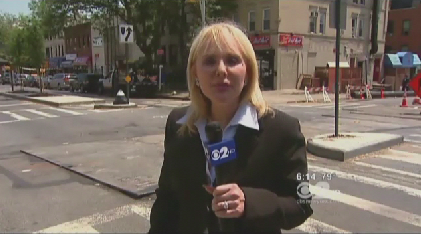
Kramer did the same thing in February while reporting on the traffic caused by the Prospect Park West bike lane. (Image via Bike Snob.)

How sad that CBS still calls her a “political reporter.” She’s more of an operative in the war on safe streets.
The Mute Button
The very funny people at Improv Everywhere staged this mission at the Grand Army Plaza entrance to Prospect Park West. I’ve participated in some IE events in the past and always enjoy watching them pull off stuff like this.
Bike Lane Hater of the Week: Charles Blow
On Sunday, someone I follow on Twitter retweeted a true gem from Charles M. Blow, the Op-Art columnist for the Times. Like a social media version of John Cassidy, Blow quickly unleashed a torrent of irrational arguments against bike lanes in the tweets that followed. It was almost as if he sent out the first one, realized his mistake, but then couldn’t stop himself from trying to have it all make sense.
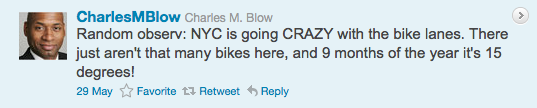
Random observ: NYC is going CRAZY with the air conditioners. 9 months of the year it’s 15 degrees! Seriously, do you know how much roof space, infrastructure, and money is devoted to equipment that’s only in use for three months? I mean, why have beaches, public pools, parks, or, on the flip side, even schools? They’re not in use 100% of the time and therefore must be unnecessary. Did you know that most roads are totally empty for at least eighteen hours a day?
Never mind that the more bike lanes you build and the better you maintain them, the more likely are you are to see year-round ridership. Copenhagen is not exactly Los Angeles when it comes to weather, yet 80% of its residents continue cycling through the winter.
Speaking of Copenhagen:

Marijuana is illegal in Denmark. Amsterdam, Copenhagen…whatever.

Blow should realize that he can’t out Cuozz the Cuozz:
The DOT’s bike lanes are usually devoid of bikes except for food-delivery personnel. The lanes are the superhighway for General Tso’s chicken, but lonesome highways for everyone else.
Remember: delivery men and messengers are not humans deserving of the security and protection afforded them by bike lanes.

Shorter tweet: we should wait until New York City is under water to install more bike lanes.
Blow must have read Adam Sternbergh’s how-to for writing an anti-bike-lane argument, because the requisite “pre-emptive self exoneration” is right there. From the Times‘ “Let’s be clear. We like bicycles,” to Dominic Recchia’s “I’m not against bike lanes,” establishing some sort of environmental or cycling bona fides is essential when making this kind of irrational argument.

Zero. Then again, as everyone knows, there was no traffic in New York City until 2007, when Janette Sadik-Khan was chosen to head the DOT.
One of Blow’s followers stepped into the fray, presumably tweeting, “Portland, Amsterdam, Copenhagen, Berlin and DC have robust bike lane networks. Why not NYC?” Here’s Blow’s response:

I’ve never understood this line of reasoning. Why would NYC be too “big and complicated” for bike lanes, but not for all of the other things one finds in cities? Is London less complicated than New York? Over 21 million people live in the Mexico City metropolitan area, and yet it supports a thriving bike share program. Private cars, not bikes, become increasingly inefficient as cities get bigger and more complicated.
If by “size” Blow means geographic area and not population, his reasoning also falls flat. The more one divides New York into a collection of small, walkable neighborhoods, the less relevant its overall geographic size becomes. While few people undertake a daily 22-mile bike ride from the Rockaways to Times Square, bicycles are ideal for short commutes or for trips around the neighborhood. Plus, a funny thing happens if you build enough bike lanes for the majority of people who take those short trips through small neighborhoods: eventually you have a connected network that benefits the people who take long ones.
Another follower challenged Blow along those lines, telling him that bike lanes were a classic case of “If you build it, they will come.” Blow’s response:

When it comes to traffic safety, this city has been a failed experiment for nearly a century. Sadik-Khan’s “experiments” have resulted in the lowest number of traffic fatalities in decades. If Blow is interested, the statistics would make a great chart.

I found this line of reasoning to be Blow’s strangest. Yes, New York is unique in that kids often get placed into schools a long distance from their homes, but that doesn’t mean every school is located on the outer fringes of the city, ten miles from nowhere. Park Slope, where both I and Blow live, has some of the best neighborhood schools in the city, which is part of the reason apartments zoned for PS 321 command such high prices. Offering further explanation, Blow later tweeted, “Kids (or parents & kids) have to schlep all over the place, with book bags, and sports equipment and cupcakes. It’s a real pain.”
This is textbook bike-lane-hating narcissism: “Because I can not use a bike as transportation, the city should not do anything to promote bikes as transportation.” Give Blow credit, however. Before going the full Markowitz, he pulled back a little bit:

I don’t think advocates are well served when they try to convince someone like Blow that he can, in fact, bike to work or schlep his kids and their cupcakes to school on a cargo bike. If he can’t or doesn’t want to, that’s up to him. But it would be nice if people who were so reflexively anti-bike lane could better understand their prejudices or at least admit, “Eh, it’s not for me.”
Watching Blow dig his hole was entertaining enough, but one tweet he sent moments after the last was the most telling:

I pictured Blow pedaling away furiously on a stationary bike, getting out a week’s worth of personal frustration, when suddenly a “random observ” pops into his head. He whips out his Blackberry, types it in, hits “send” and begins his rapid descent into irrationality, enshrining himself as another strange character in New York’s bike lane backlash.
Maybe he would have been happier if he had been outside enjoying the beautiful weekend weather pedaling down a bike lane instead.
Well, They Both Have “Transportation” in their Names
The New York Post‘s distaste for cycling is so ingrained into the fabric of its editorial voice, that when confronted with a story about biking its reporters can’t bother to do something that’s straight out of Journalism 101: research.
A transportation advocacy group is encouraging bicyclists to keep track of the recent police crackdown on bike-riding violations with an online map that tracks where summonses are issued and for what infractions.
And although Transportation Nation’s program has been up and running for only five days, the data already show which neighborhoods cyclists should steer clear of.
Friday: Streetfilms at the Brooklyn Museum
Come to the Brooklyn Museum Friday night at 7 PM for a great event featuring your pals at Streetfilms:
Streetfilms is proud to present a selection of some of their latest and greatest transportation films. From the roadways of China and Copenhagen to those of Oakland and Brooklyn, these films highlight recent urban development projects that make our streets safer for everyone. Many of the films screened will be world premieres, and many are geared specifically toward Brooklyn cyclists. Come see what’s going on in your neighborhood!
I’ll be there and hope you can make it, too. Buy tickets in advance at Museumtix.
 Brooklyn Spoke
